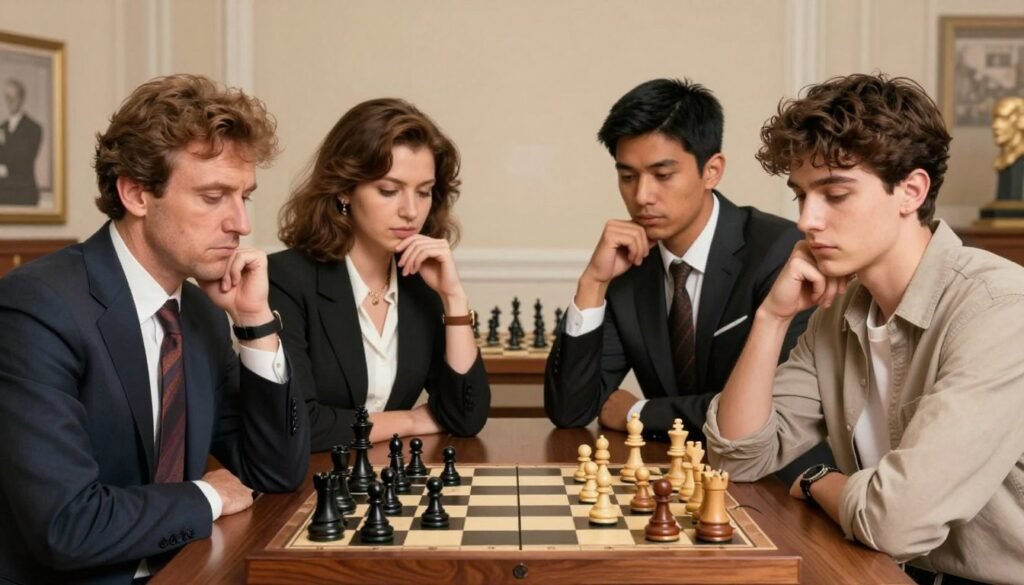
Chess is not just about who won the most games. It is also about who changed the way people played. From the 1970s to the 2020s, each era had a player who made the whole chess world look up and say, “This is the one to beat.” Bobby Fischer lit a fire in the 1970s. Anatoly Karpov squeezed rivals with calm control. Garry Kasparov brought power, prep, and fear. Viswanathan Anand made speed and class look easy. Magnus Carlsen turned small edges into wins for more than a decade. Today, Gukesh D is the World Champion, while Carlsen still sits at number one on the FIDE rating list as of May 2026.
Find the right learning experience
Tell us a little about the learner and what you are looking for. Our team will review your answers and help you identify the most suitable next step.
- Takes only a few minutes
- No payment required
- Personalised recommendations
Your information will only be used to respond to your enquiry.
The 1970s Were Ruled First By Fischer’s Fire And Then By Karpov’s Calm Grip
The 1970s gave chess one of its biggest story swings ever. The decade started with Bobby Fischer breaking the long Soviet hold on the world title, and it ended with Anatoly Karpov proving that he was not just a champion by name, but a real ruler of top chess.
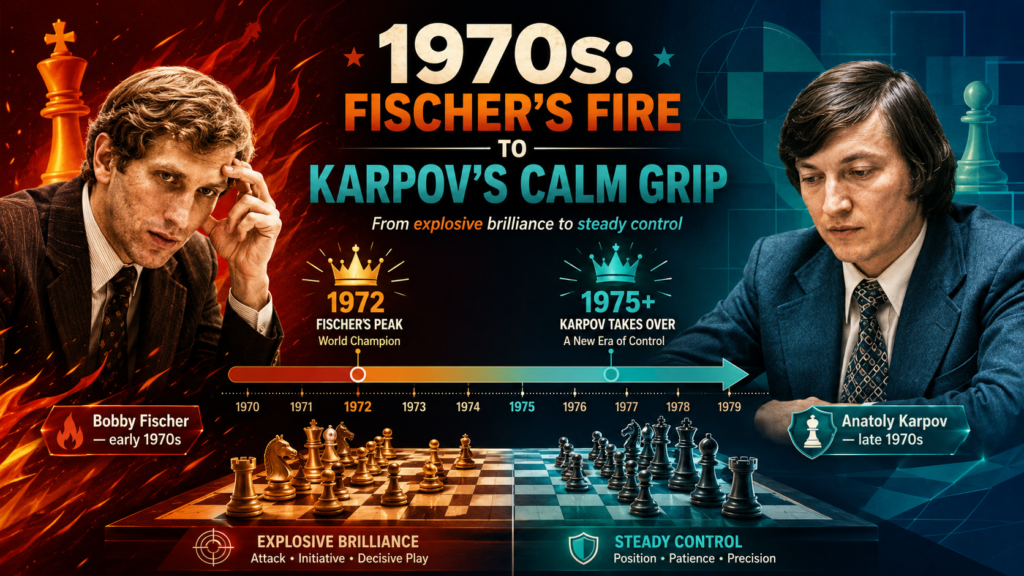
Fischer brought heat, drama, and clean logic. Karpov brought control, patience, and a slow kind of pressure that made strong players feel trapped. Together, they gave the decade two very different faces.
Fischer showed how one player could shake the whole chess world, while Karpov showed how long-term class can build a steady empire. Fischer beat Boris Spassky in Reykjavik in 1972 by a score of 12½–8½ and became the 11th World Champion, while Karpov became champion in 1975 after Fischer did not defend the title.
The first half of the decade belonged to Bobby Fischer because he made chess feel bigger than chess
Fischer’s run before the 1972 title match was not just strong. It was almost scary. He beat Mark Taimanov 6–0, Bent Larsen 6–0, and Tigran Petrosian 6½–2½ on his way to the match with Spassky.
Those scores matter because Taimanov, Larsen, and Petrosian were not weak players. Petrosian was a former world champion. Larsen was one of the best non-Soviet players in the world. Fischer did not just win; he made elite players look out of answers.
Find the right learning experience
Tell us a little about the learner and what you are looking for. Our team will review your answers and help you identify the most suitable next step.
- Takes only a few minutes
- No payment required
- Personalised recommendations
Your information will only be used to respond to your enquiry.
For parents and young students, Fischer’s rise teaches one clear lesson. Great chess growth starts with serious work on the basics. Fischer was famous for loving clear moves, strong openings, active pieces, and endgames that made sense.
He did not try to win by magic. He won by making better moves again and again. That is a huge lesson for children. You do not need tricks first. You need good thinking habits first.
The Fischer lesson for kids is to make every move have a job
A young player can copy Fischer in a simple way. Before moving, the child can ask, “What does this move do?” Does it attack something? Does it defend something? Does it help a piece? Does it make the king safer? This one small question can stop many careless moves.
At Debsie, coaches use this same kind of thinking in class. Kids learn that chess is not about moving fast just to move.
It is about choosing with care. That skill helps far beyond chess. A child who learns to pause before moving a queen may also learn to pause before answering too fast in school, giving up too soon in homework, or reacting too quickly when upset.
The second half of the decade belonged to Anatoly Karpov because he turned control into a weapon
Karpov became World Champion in 1975 without playing Fischer, but he did not hide behind that. He played major events, won often, and showed the chess world that his title had weight. Britannica says Karpov dominated world competition from the mid-1970s to the mid-1980s.
That matters because a champion’s job is not only to win one match. A champion must keep proving it against hungry rivals. Karpov did that with a style that was quiet but very hard to fight.
Karpov’s style was not loud. He did not always chase big sacrifices. He would improve one piece, take one square, stop one plan, and make the other player feel smaller move by move.
Many of his wins looked calm from the outside, but inside the position, the opponent had no air. This is why Karpov is such a good model for children who think chess is only about attacks. He shows that patience can be just as powerful as speed.
The Karpov lesson for kids is to win space before winning material
Many beginners want to grab pawns as soon as they can. Karpov’s games teach a better idea. First, make your pieces better. First, keep your king safe. First, stop your opponent’s best plan. Then, when their pieces are stuck, the pawns and tactics often come by themselves.
This is one reason chess is so helpful for kids. It teaches delayed reward. Children learn that the best move may not give them something right away. Sometimes the best move simply makes the next move easier.
That is a life skill. Focus, patience, planning, and calm choices are exactly the habits Debsie tries to build in every student, not only for tournaments, but for school and daily life too.
Fischer or Karpov, who truly dominated the 1970s?
The honest answer is that Fischer owned the shock of the decade, while Karpov owned the staying power. Fischer’s 1972 win changed the mood of chess around the world. He ended the Soviet world title streak for a short time and became a global name.
But Fischer then stepped away from official chess for many years, while Karpov kept playing and kept winning. Fischer gave the 1970s its biggest moment. Karpov gave the 1970s its strongest long rule.
For a young chess player, that comparison is useful. One big win is exciting, but long-term growth comes from showing up again and again. A child may have one great tournament, then a bad one the next week. That is normal.
The Karpov path teaches children to keep building. The Fischer path teaches children to aim high and study deeply. The best student learns from both.
The action step from the 1970s is to study both clean attacks and quiet pressure
A smart training plan for this era is simple. Study Fischer when you want to learn clear development, active pieces, and brave play. Study Karpov when you want to learn small improvements, strong squares, and how to stop counterplay.
A child does not need to understand every deep idea at once. Even one game a week, explained by a good coach, can slowly change how a student thinks.
That is where guided learning matters. Random online videos can help, but they can also confuse kids because they jump from one idea to another. In a Debsie class, the coach can slow the game down, ask the child questions, and turn a grandmaster game into a simple lesson.
That makes chess feel less scary and more fun.
The 1980s Became The Karpov And Kasparov Decade, With One Rivalry Taking Over The Chess World
The 1980s were not just about one champion. They were about one great fight. Anatoly Karpov started the decade as the king, and Garry Kasparov ended it as the new force. Their rivalry became the main story of world chess. It had age, style, pressure, politics, stamina, and deep preparation.
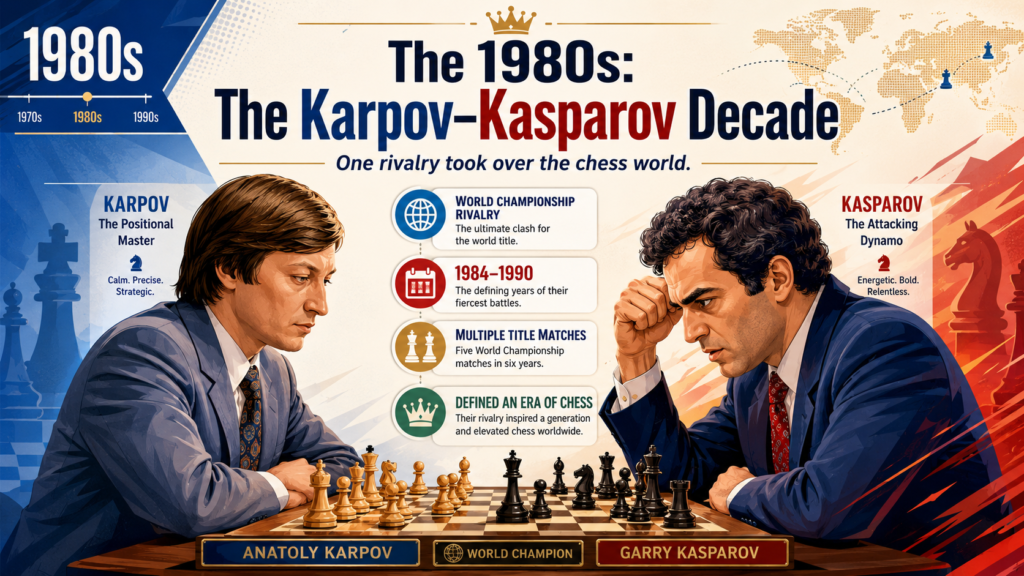
Karpov was the smooth champion who rarely gave anything away. Kasparov was the rising storm who brought energy, opening work, and fierce will. Their matches shaped how serious players studied chess for years.
Karpov beat Viktor Korchnoi again in 1981, defended his title in the long 1984–85 match, and then lost the crown to Kasparov in their 1985 rematch.
Karpov started the 1980s as the player everyone had to solve
At the start of the decade, Karpov was still the standard. His 1981 title defense against Korchnoi was much clearer than their tense 1978 match.
By then, Karpov had become a complete champion. He could play quiet positions, defend worse ones, and convert small edges with great care. He did not need to scare opponents before the game. The board did that for him.
Karpov’s strength was his ability to make normal moves feel painful for the other side. If you gave him one weak pawn, he would tie you to it. If you gave him one open file, he would use it. If you allowed one bad bishop, he would make you suffer with it for the rest of the game.
This is why his style is gold for students. He shows that “boring” moves are not always boring. Sometimes they are the moves that win.
The Karpov training habit is to ask what the opponent wants next
Most kids look only at their own plan. Karpov looked at both plans. That is a big step in chess growth.
Before making a move, a student should ask, “What is my opponent trying to do?” This question can save pieces, stop checkmates, and turn panic into clear thinking.
This habit is also great for life. Children learn to see the other side. They learn not to act with only half the picture. In school, sports, and friendships, this kind of thinking helps kids become calmer and smarter problem solvers.
Kasparov changed the decade because he played with energy and prepared like a machine
Kasparov became World Champion in 1985 at age 22 after beating Karpov in a 24-game match. Britannica notes that he became the youngest official champion in the history of the game at that time. His win did more than change the name of the champion.
It changed the feeling of top chess. Kasparov brought a new level of opening work, direct pressure, and fighting spirit. He wanted the initiative. He wanted active pieces. He wanted positions where his energy could grow.
Kasparov’s rise is a powerful lesson for children because he did not beat Karpov by being calm alone. He had to survive first. In the 1984–85 match, Karpov built a big early lead, but Kasparov adjusted and fought back.
FIDE later halted that match after 48 games, and the rematch came in 1985. That story teaches kids something important: losing early does not mean the story is over.
The Kasparov lesson for kids is to keep fighting after a bad start
Many children lose focus after one mistake. They hang a piece and think the game is finished. They lose one round and feel the whole tournament is ruined. Kasparov’s road against Karpov teaches the opposite.
A bad start is not the end. You breathe, you look for chances, and you keep making the best move you can find.
At Debsie, this lesson is a big part of coaching. Kids are not just taught openings and checkmates.
Find the right learning experience
Tell us a little about the learner and what you are looking for. Our team will review your answers and help you identify the most suitable next step.
- Takes only a few minutes
- No payment required
- Personalised recommendations
Your information will only be used to respond to your enquiry.
They are taught how to handle mistakes. That matters because confidence is not built by winning every game. It is built by learning that you can think clearly even when things go wrong.
Karpov and Kasparov together made the 1980s one of the deepest learning eras in chess
The 1980s are so useful for students because the two main players were so different. Karpov was control. Kasparov was force. Karpov slowly reduced your options. Kasparov made you solve hard problems right away.
When they played each other, both had to grow. Karpov had to handle sharper pressure. Kasparov had to learn patience and defense. That is why their games are not only history. They are training tools.
A child who studies only attack may become careless. A child who studies only defense may become too passive. The Karpov-Kasparov era teaches balance. You need to know when to build slowly and when to strike.
You need to know when to stop your opponent and when to push your own plan. This is the kind of balanced thinking that turns a casual player into a real competitor.
The action step from the 1980s is to train both patience and courage in the same game
A good exercise for young players is to review one position and find two plans. First, find the calm plan that improves the worst piece. Then, find the active plan that creates a threat. After that, compare them. Which plan is safer? Which plan gives more chances? Which plan fits the position?
This kind of training makes kids think instead of guess. It also makes chess more fun because they start to see choices.
They are no longer just asking, “What move can I play?” They are asking, “What kind of game do I want to create?” That is a big step in chess maturity, and it is one of the reasons parents choose structured coaching instead of leaving kids to learn alone.
The 1990s Were Still Kasparov’s Decade, Even When Chess Became Messy
The 1990s were not clean and simple in chess history. The world title split in 1993 after Garry Kasparov and Nigel Short played outside FIDE, which meant chess had two title paths for many years. That made the crown harder for fans to follow.
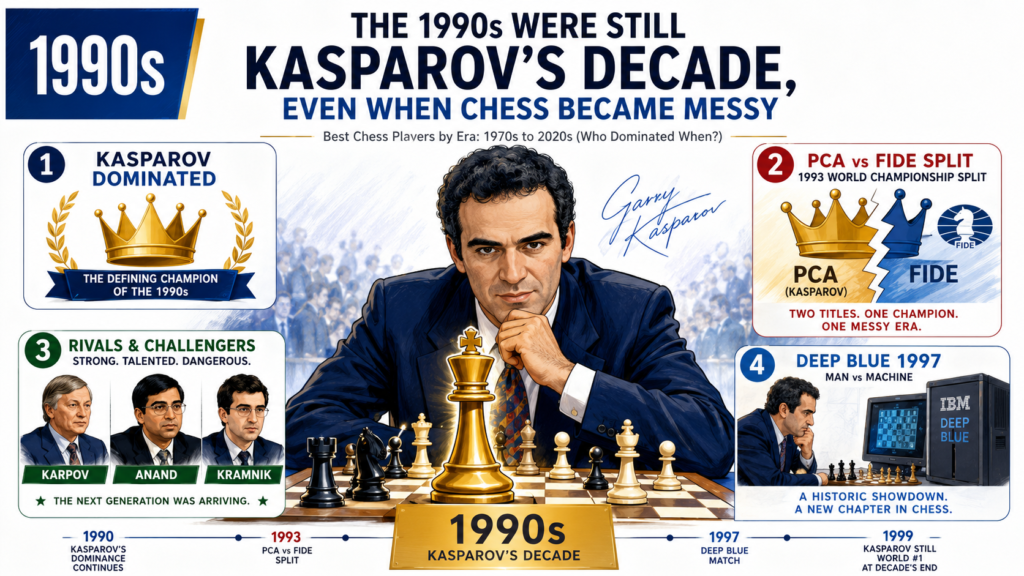
But if we ask who dominated the board, the answer is still Kasparov. He stayed at the top of the rating list, defended his title, beat elite rivals, and became the player every other great player had to measure himself against.
Chess.com notes that from 1993 to 2006, the world title was split, while Kasparov remained the classical champion until 2000.
Kasparov stayed number one because he made preparation a weapon before the game even started
Kasparov was not only a great attacker. He was also one of the best-prepared players ever. He brought sharp opening ideas to the board and forced opponents to solve hard problems early. That made him feel different from older champions. Against Kasparov, you could not just know chess. You had to know his chess.
He also showed that hard work away from the board can win games before the first move is played. That is a huge lesson for students. Many kids think chess improvement only happens while playing games.
But real growth also happens when you review mistakes, study model games, solve puzzles, and learn opening ideas with a coach who explains the reason behind each move.
The Kasparov lesson for young players is to prepare with purpose, not panic
A child does not need to memorize twenty moves of an opening. That can become boring and confusing. A better goal is to learn the first few moves, understand the plan, and know where the pieces belong.
Kasparov’s example should not make kids scared of preparation. It should make them see that study gives confidence.
At Debsie, this is why coaches focus on “why” more than just “what.” When a child understands why a knight goes to a strong square or why the king must castle early, the moves start to feel natural. That turns chess from memory into clear thinking.
Anand rose in the 1990s because speed, calm, and clean tactics became more important
The 1990s were also the decade when Viswanathan Anand became a true world title contender.
Britannica notes that Anand fought with Kasparov and Vladimir Kramnik for the top spots in the rating list during this period, and he played Kasparov for the PCA title in 1995. Anand lost that match, but his rise mattered because he showed a new kind of elite chess. He was fast, natural, and very hard to trick.
Anand’s style is wonderful for kids to study because he made good moves look simple. He did not always need a huge attack. Many times, he found the clean tactical shot, the right trade, or the smooth path into a better endgame.
For students, this is comforting. Great chess does not always look like a storm. Sometimes it looks like making the neat move at the right time.
The Anand lesson for kids is to trust simple moves when they are strong
Many young players search for fancy moves because they want to feel smart. Anand teaches the opposite. If a simple move wins a piece, play it. If a safe move keeps your advantage, play it. If trading queens makes the ending easy, do not be afraid of it.
This is also a strong life lesson. Children do not always need to make things hard. Smart thinking often means finding the clean path. In Debsie classes, students learn to slow down, spot threats, and choose moves that match the position. That kind of calm choice builds confidence.
Deep Blue changed the 1990s because chess entered the age of machines
In 1997, Kasparov lost a famous match to IBM’s Deep Blue, and that moment changed how people saw chess and computers. It did not mean humans were “done.” It meant chess training was about to change. Over time, engines became helpers.
They showed hidden tactics, checked opening lines, and helped players review mistakes faster.
For students today, this is important. A chess engine can show the best move, but it cannot always teach a child how to think. That is why coaching still matters. A coach turns engine answers into human lessons.
The engine may say a move is bad. A coach can ask, “What did you miss? What was your opponent threatening? What should you check next time?”
The action step from the 1990s is to review every loss like a detective
The best habit from this era is simple. After a game, do not just say, “I lost.” Find the moment where the game changed. Was it a missed tactic? A weak king? A bad trade? A rushed move? When kids learn to review this way, losses stop feeling painful and start becoming useful.
This is one of the biggest reasons structured chess learning works so well. A child with the right coach does not just play more games. The child learns how to learn from each game.
The 2000s Were A Bridge Era, With Kramnik’s Defense And Anand’s Speed Changing The Game
The 2000s were a bridge between the old chess world and the modern one. Kasparov’s long rule ended, Vladimir Kramnik became the classical champion, and Anand finally became the clear world champion after years of being close.
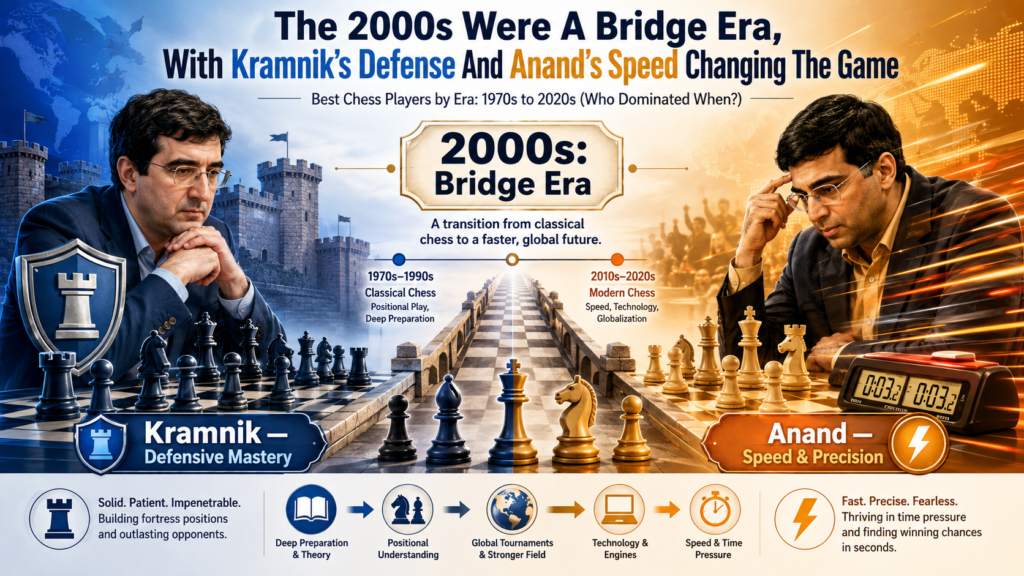
This decade is not always as loud as the Fischer years or the Kasparov years, but it is one of the most useful decades for young players to study. It teaches defense, match strategy, fast calculation, and the power of staying ready for your chance.
Kramnik took the crown because he found a way to stop Kasparov’s biggest strength
In 2000, Kramnik shocked the chess world by beating Kasparov in London. ChessBase describes how Kramnik used the Berlin Defence to slow down Kasparov’s attacking power and win the match without losing a single game.
This was not a lucky win. It was a deep plan. Kramnik understood that he did not need to out-attack Kasparov. He needed to take away the type of game Kasparov loved most.
That is a powerful idea for students. You do not always beat a strong player by copying their style. Sometimes you beat them by choosing positions where you feel safe and they feel less comfortable. Kramnik made defense look active.
He showed that saying “no” to your opponent’s plan can be just as strong as launching your own attack.
The Kramnik lesson for kids is to build a safe position before looking for glory
Young players often want checkmate too fast. They push pawns near the enemy king before their own king is safe. They attack with one piece and hope something happens. Kramnik teaches a better path. First, make your position hard to break. Then look for chances.
This does not mean playing scared. It means playing with care. A safe king, solid pieces, and good pawn structure can give a child the confidence to play longer games without falling apart.
At Debsie, coaches help students see that defense is not boring. Defense is strength with patience.
Anand became the face of the late 2000s because he could adapt to any format
Anand’s long wait paid off in the 2000s. Britannica records his world championship wins in 2000, 2007, 2008, 2010, and 2012, and notes that he became known for quick tactical calculation and many speed chess titles.
His 2007 win made him the generally accepted world champion after the title split years, and his 2008 match win over Kramnik showed that he could defend the crown in match play too.
What makes Anand special is not only that he was fast. It is that he was flexible. He could play sharp attacks, quiet endings, rapid games, classical games, tournament formats, and match formats.
That is rare. Some players are great when the game suits them. Anand was great because he could change with the game.
The Anand lesson for kids is to become flexible instead of only having one favorite style
Some children love attacking. Some love trading pieces. Some love traps. But real growth starts when a child can play many kinds of positions. Anand’s career teaches kids to be open. Learn tactics, but also learn endgames. Enjoy attacks, but also learn defense. Study openings, but do not forget simple checkmates.
This is exactly why a full chess program is better than random practice. A child may avoid weak areas when learning alone. A good coach gently brings those weak areas into the light and makes them easier. That is how young players become well-rounded, not just tricky.
Kramnik or Anand, who truly dominated the 2000s?
The answer depends on which part of the decade we mean. Kramnik owned the early 2000s because he took down Kasparov and held the classical crown.
Anand owned the late 2000s because he became the clear world champion and defended his place. Chess.com lists Kramnik as classical champion from 2000 to 2007 and Anand from 2007 to 2013, which shows the handoff clearly.
For children, this decade gives a beautiful message. There is more than one way to be great. Kramnik won through deep defense, match planning, and calm control. Anand won through speed, balance, and the ability to adjust. Both paths are useful. Both paths can help a child grow.
The action step from the 2000s is to train one quiet skill and one sharp skill every week
A smart young player should not train only puzzles or only openings. Each week, the child can practice one quiet skill, like king safety, endgames, or defense. Then the child can practice one sharp skill, like tactics, attacks, or calculation. This keeps training balanced and fun.
At Debsie, this balance is built into the learning path. Students get live coaching, personal attention, and clear guidance so they do not feel lost.
If your child enjoys chess or is just starting to show interest, a free trial class can help you see how the right coach can turn that interest into focus, patience, and smart thinking.
The 2010s Became The Magnus Carlsen Era Because He Made Small Edges Feel Huge
The 2010s had many brilliant players, but one name stood above the rest: Magnus Carlsen. He became World Champion in 2013 by beating Viswanathan Anand in Chennai with a 6.5–3.5 score, and that win started a long reign at the top of classical chess.
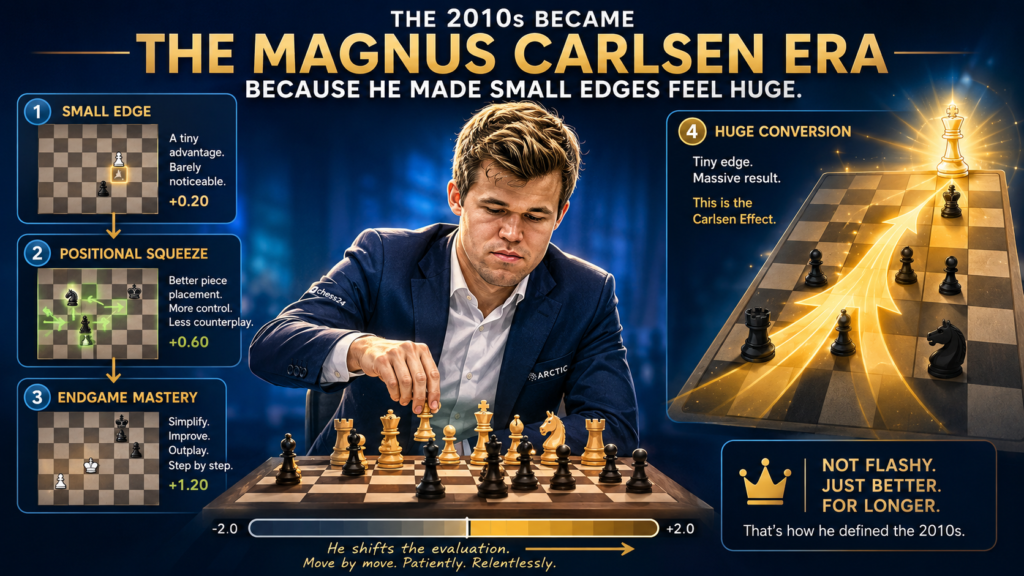
What made Carlsen different was not only his rating or his title. It was the way he won. He could take a tiny edge, keep it alive for hours, and slowly turn it into a full point. FIDE’s archive describes the 2013 match as the start of his ten-year reign as world champion.
Carlsen changed chess because he made “simple” positions dangerous again
Before Carlsen, many fans loved sharp opening fights and deep computer prep. Kasparov had made opening preparation feel like a battlefield. Kramnik had shown the power of deep match strategy.
Anand had shown speed and balance. Carlsen added something different. He often chose positions that looked normal, even quiet. Then he kept asking questions until the other player cracked.
This is why Carlsen is such a great model for young players. Kids often think they need a trap to win. Carlsen showed that you can win by keeping pieces active, making better pawn choices, and staying focused longer than your opponent.
His games teach children that chess is not always about one big move. Many times, it is about making ten good small moves in a row.
The Carlsen lesson for kids is to stop rushing and start squeezing
A good Carlsen-style habit is to ask, “Can I make my worst piece better?” This is simple, but it is powerful. If a knight is stuck, move it to a better square. If a rook is doing nothing, bring it to an open file. If the king is unsafe, fix that first. These small choices add up.
At Debsie, this is one of the main skills coaches build in students. Children learn that a chess game does not need to be won in five moves. They learn to stay calm, improve slowly, and trust the process. That helps in chess, but it also helps in school.
A child who learns to stay patient in a long endgame may also learn to stay patient with math, reading, or any hard task.
Carlsen’s title defenses showed that he could win even when rivals came prepared
Carlsen did not just win the crown once. He defended it against Anand in 2014, Sergey Karjakin in 2016, Fabiano Caruana in 2018, and Ian Nepomniachtchi in 2021. The 2018 match with Caruana was especially telling because all classical games were drawn, and Carlsen won in rapid tiebreaks.
That showed another side of his strength. He was not only a classical giant. He was also deadly when the clock was faster.
His 2021 match against Nepomniachtchi was one of his clearest wins. Carlsen won 7.5–3.5, and Game 6 became famous because it lasted 136 moves, the longest game in world championship history. After that marathon win, the match changed completely.
Carlsen’s pressure broke through, and Nepomniachtchi could not recover.
The training lesson from Carlsen’s match play is to build stamina, not just skill
Many kids can play well for twenty minutes. The next step is learning to think well for a whole game. That means not giving away pieces when tired. It means checking for threats even after a long think. It means staying brave after a draw, a loss, or a missed chance.
This is where live coaching helps a lot. A coach can see when a child is rushing. A coach can teach the child how to breathe, slow down, and use a clear thought process. That is why Debsie’s chess classes focus on much more than moves. They help kids build focus, patience, and calm thinking under pressure.
Was anyone close to Carlsen in the 2010s?
Yes, but no one truly passed him. Anand was still elite early in the decade. Caruana came very close in 2018. Karjakin defended with great strength in 2016. Nepomniachtchi rose near the end of the decade.
Players like Levon Aronian, Hikaru Nakamura, Wesley So, Alexander Grischuk, and Maxime Vachier-Lagrave also had brilliant years. But Carlsen stayed the main man because he kept winning across formats and kept holding the number one image in chess.
For students, the lesson is not that everyone must play like Carlsen. The lesson is that strong chess habits beat tricks over time. If a child learns to improve pieces, save weak squares, trade at the right time, and stay focused, that child will grow.
The action step from the 2010s is to practice winning equal-looking positions
A smart exercise is to take a quiet position and ask, “How can I make progress?” This helps kids stop hunting only for checkmates. They learn to improve pieces, use open files, create weak pawns, and play endings with care.
This is one of the best reasons to study Carlsen with a coach. His games can look simple, but the ideas are deep. A good coach can turn those ideas into small steps a child can use right away.
The 2020s Are Still Being Written, With Carlsen’s Shadow, Ding’s Moment, And Gukesh’s New Crown
The 2020s are different from every earlier era because the chess world is faster, younger, and more open. Online chess is huge. Engines are stronger than ever. Teenagers can train with tools that past champions never had.
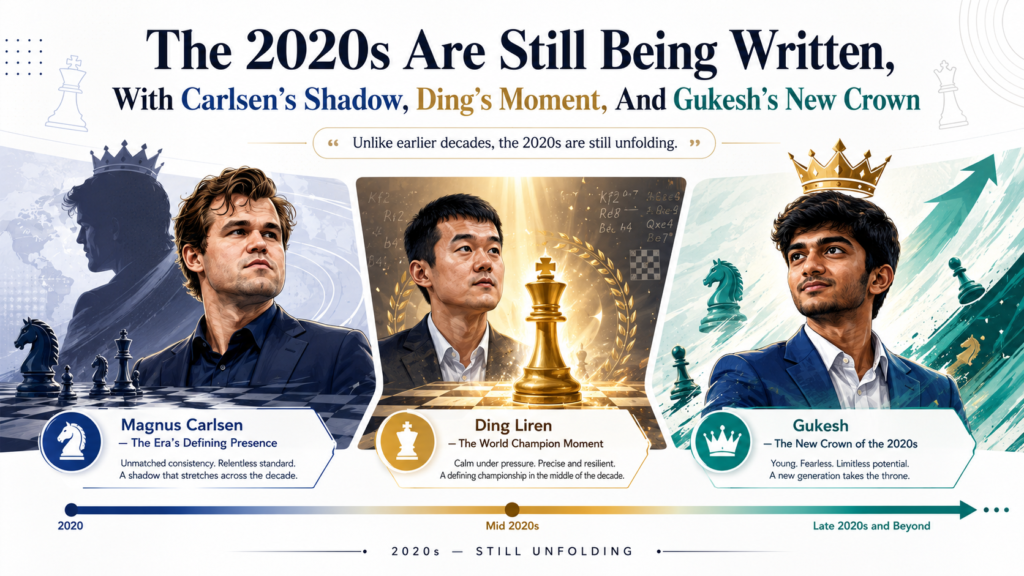
Magnus Carlsen is no longer the classical world champion, but he still matters in a massive way. Ding Liren became World Champion in 2023 after beating Ian Nepomniachtchi in rapid tiebreaks, and Gukesh D became the new World Champion in 2024 by defeating Ding 7.5–6.5 in Singapore.
Carlsen still shapes the 2020s because number one is not the same as world champion anymore
Carlsen chose not to defend his classical world title in 2023, which opened the door for Ding and Nepomniachtchi to play for the crown. That made the 2020s feel strange. For many fans, Carlsen was still the strongest player, but he was not the world champion.
This split between “best player” and “title holder” became one of the biggest stories of the decade.
As of May 2026, FIDE lists Carlsen as world number one among active players with a 2840 standard rating. That matters because ratings are not perfect, but they do show long-term strength. Carlsen’s hold on the top rating spot means he still casts a huge shadow over the era, even without the classical crown.
The Carlsen lesson for the 2020s is to keep growing even after reaching the top
Carlsen could have stayed only inside the old world title path, but he kept chasing new challenges. For young players, that is a strong message. Growth does not stop after one trophy. A child who wins a school event still has more to learn. A child who loses a game still has more chances to improve.
At Debsie, this growth mindset is a big part of the journey. Kids are taught to enjoy progress, not just prizes. That keeps chess fun and helps children become more confident learners.
Ding Liren’s title win showed that courage can come from quiet strength
Ding’s 2023 win was emotional because the match with Nepomniachtchi was full of swings. Ding fell behind more than once, but he kept coming back. The match was tied 7–7 after classical games, and Ding won in the rapid tiebreaks. FIDE called him the World Champion after that dramatic finish in Astana.
Ding’s story is useful for children because he did not look unbeatable every moment. He had hard days. He made mistakes. But he stayed in the fight. That is real chess. That is also real life. Kids need to know that strong players are not strong because they never struggle.
They are strong because they keep thinking even while struggling.
The Ding lesson for kids is to stay in the game when emotions are high
Some children play too fast after a mistake because they feel upset. Others freeze and stop trusting themselves. Ding’s path teaches a better response. Take a breath. Look at the board again. Find the next best move. The past move is over. The next move still matters.
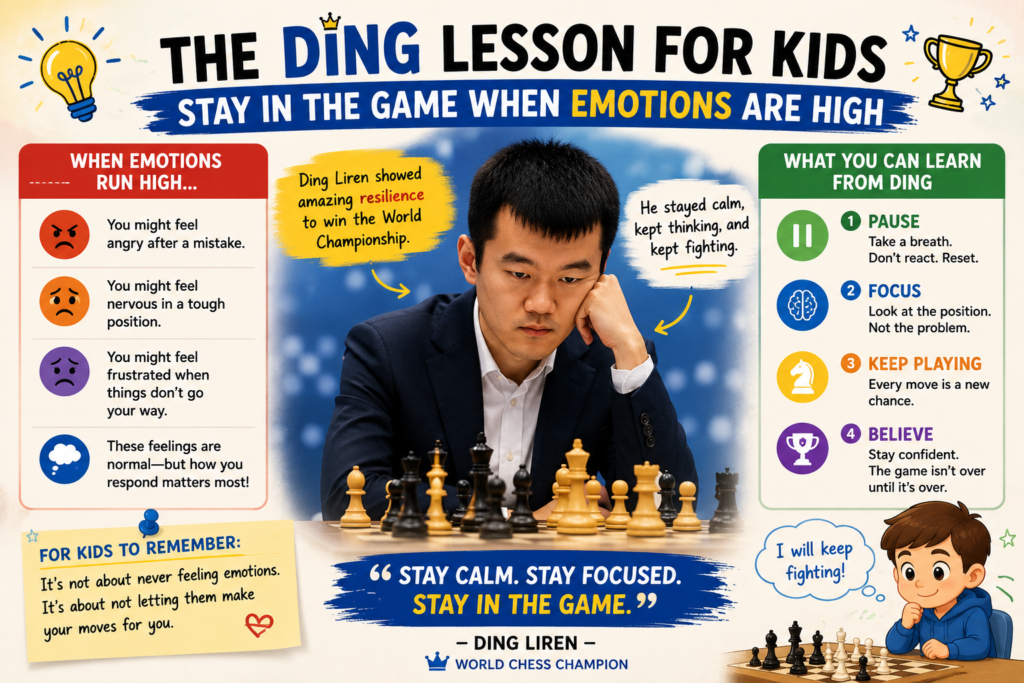
This is one reason chess is such a good tool for child development. It teaches kids to handle pressure in a safe space. They learn how to lose, recover, and try again. With the right coach, that lesson can stay with them for years.
Gukesh’s rise may be the start of a new youth-led era
Gukesh D became the youngest world champion in history when he defeated Ding in the 2024 World Championship match.
FIDE reported the final score as 7.5–6.5 and called him the 18th World Champion. He was only 18, which made the moment feel bigger than one match. It showed that the next generation is not waiting politely. It is already here.
Gukesh’s rise also matters because it gives young students a champion who feels closer to them in age. Of course, most children will not become world champion at 18. That is not the point. The point is that steady training, strong support, and brave effort can lead to big growth.
The action step from the 2020s is to mix human coaching with smart tools
Today’s young players have more resources than ever, but that can also be confusing. Engines, apps, videos, and online games are helpful, but they can overwhelm kids. The best path is balance. Use tools to practice, but use a coach to understand.
That is where Debsie can help. A live coach can spot a child’s habits, explain mistakes in simple words, and build a clear plan. If your child is curious about chess, a free Debsie trial class is a simple next step. It can help you see how chess can build focus, patience, problem-solving, and confidence.
The Fairest Way To Judge Each Era Is To Look At More Than The Crown
It is tempting to say the best player of any era is simply the World Champion. That is often true, but not always. Chess history is a little more complex than that. Some players held the crown while another player had the highest rating.
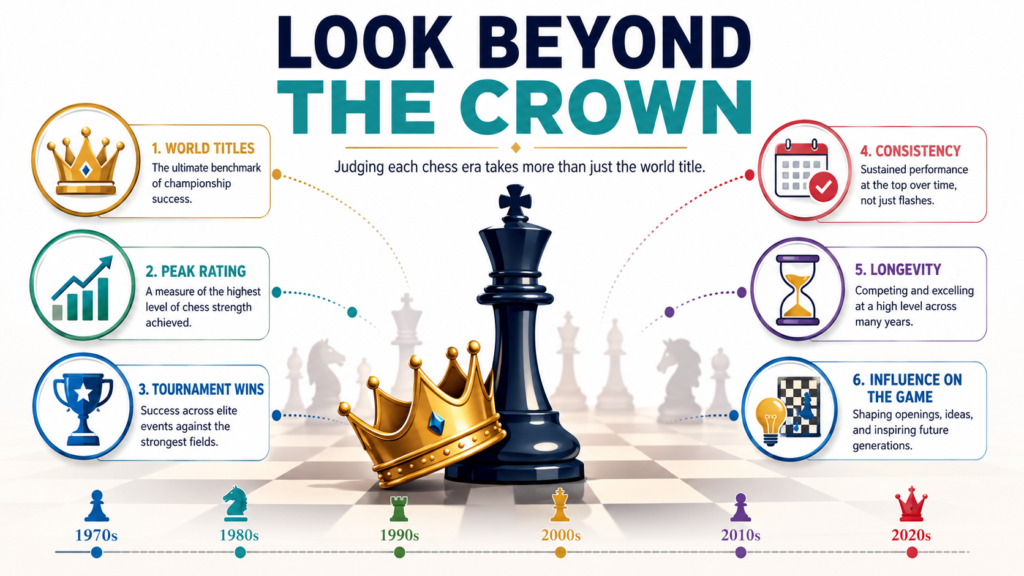
Some players won the title but did not rule events for long. Some players did not become champion during a certain decade but still shaped how the best players trained and played. This is why a fair answer needs more than one measure.
A strong era leader should pass three tests. First, the player should have major results against the best rivals of that time. Second, the player should have clear influence, meaning other players had to adjust because of him.
Third, the player should have staying power. One great year matters, but true domination means the whole chess world keeps looking at that player as the main target.
The world title matters because it shows who handled the biggest pressure
The World Championship is special because it is not just another event. It brings huge pressure. Every move is studied. Every mistake is talked about. Every opening choice becomes a message. This is why world champions often define eras.
Fischer, Karpov, Kasparov, Kramnik, Anand, Carlsen, Ding, and Gukesh all became part of chess history because they won the highest title in the game. Chess.com’s updated champion list shows the title path from Fischer through Gukesh, including the split-title years when chess had more than one championship track.
But the title alone does not tell the full story. The 1990s are a good example. The world title split after Kasparov and Short broke away from FIDE, so fans had to follow more than one title line.
Still, most serious chess fans saw Kasparov as the main player of that decade because his strength, rating, and influence were so clear. This is why we need to judge both title and total dominance.
The lesson for kids is that trophies are important, but habits are what keep you strong
Children love trophies, and they should enjoy them. Winning feels great. But chess growth cannot depend only on medals. A child may win one event because of good form, easy pairings, or a lucky save. Long-term strength comes from habits.
Do they check threats before moving? Do they review losses? Do they stay calm when behind? Do they listen to the coach and try again?
At Debsie, this is why the focus is not only on winning the next game. The bigger goal is to build strong thinkers. A child who learns good habits in chess can use the same habits in school, exams, and daily choices. That is the real win parents should look for.
Ratings matter because they show long-term strength across many games
Ratings are not perfect, but they are useful. A high rating shows that a player has performed well across many games against strong rivals. A world title match can be affected by form, nerves, or one big mistake.
A rating is built over time. That is why Magnus Carlsen still matters so much in the 2020s. Even though Gukesh is the World Champion, FIDE’s May 2026 Top 100 list still has Carlsen at number one with a 2840 classical rating.
This is an important difference for readers to understand. The champion is the player who won the title match. The number one player is the one with the highest rating at that point in time. Sometimes they are the same person. Sometimes they are not. The 2020s are a great example of this split.
The lesson for kids is that steady performance matters more than one perfect day
A rating grows when a player keeps doing good work over time. That is a healthy way for children to think about improvement. One bad game does not make them bad. One great game does not mean they are finished learning. Growth is a pattern.
This is why structured learning helps. A Debsie coach can help a child see progress in small steps. Maybe the child blunders less. Maybe the child uses the clock better. Maybe the child spots checkmate faster. These signs matter because they show the child is becoming a stronger thinker, not just chasing quick wins.
Influence matters because the greatest players change how everyone else plays
The most powerful champions do more than win. They change the game. Fischer made opening study and clean calculation feel urgent. Karpov showed how quiet pressure could crush great players. Kasparov turned preparation into a weapon.
Kramnik showed that deep defense could stop even the strongest attacker. Anand proved that speed, balance, and calm tactics could rule modern chess. Carlsen made endgames and tiny edges exciting again.
Gukesh may now lead a new youth wave, where young players grow up with engines, online games, and global coaching from the start.
That is the hidden mark of domination. If other players copy you, fear you, or prepare mainly for you, you are shaping the era. You are not just winning games. You are setting the test.
The action step is to let your child study champions by skill, not just by name
A child does not need to study every famous game at once. That can feel too big. A better plan is to study one champion for one skill. Fischer for clear development. Karpov for patience. Kasparov for active play. Kramnik for defense.
Anand for simple tactics. Carlsen for endgames. Gukesh for fearless modern fighting.
This makes chess history practical. It turns old games into lessons a child can use today. That is also why a guided class can be so helpful. The coach can choose the right champion game for the child’s level and explain it in simple words.
The Decade By Decade Answer Is Clear, But The Real Story Has More Heart
Now we can answer the big question more clearly. Who dominated when? The 1970s were split between Fischer’s peak and Karpov’s rise. The 1980s became the Karpov-Kasparov battle, with Kasparov taking over by the end. The 1990s were Kasparov’s decade, even with title confusion.
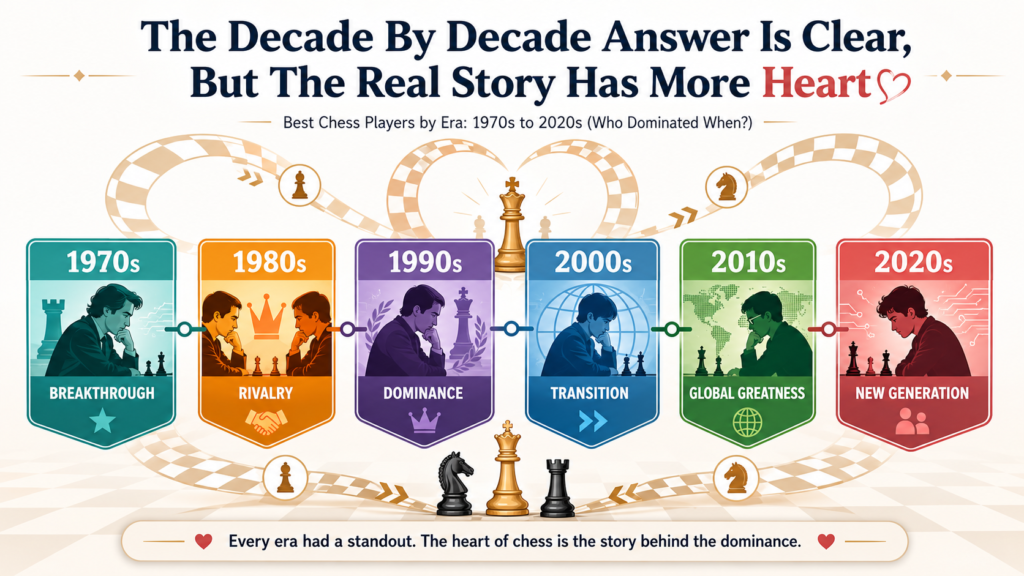
The 2000s were shared by Kramnik early and Anand late. The 2010s belonged to Carlsen. The 2020s are still open, with Carlsen still rated number one, Ding having his brave world title moment, and Gukesh now holding the classical crown.
That is the clean answer. But chess is not only clean answers. Each decade tells a different story about how greatness works. Some players win through fire. Some win through control. Some win through preparation.
Some win through stamina. Some win through calm courage.
Fischer and Karpov made the 1970s a decade of shock first and control later
Fischer’s 1972 rise gave chess one of its most famous moments. He did not just become champion; he made chess feel global and dramatic. Then Karpov stepped in and gave the second half of the decade a very different mood. Karpov was not about noise. He was about pressure. He made small edges feel heavy.
For kids, this is a perfect contrast. Fischer teaches bold study and clear play. Karpov teaches patience and control. A child who learns both becomes much harder to beat because they can attack when needed and slow down when needed.
The 1970s action step is to ask whether the position needs energy or patience
Before moving, a young player can ask a simple question: “Is this a moment to attack, or is this a moment to improve?” That one question can stop many bad moves. Some positions need courage. Others need quiet care. Great players know the difference.
This is a skill Debsie coaches help students build through guided questions. Instead of just telling a child the answer, a good coach helps the child see the reason. That makes the learning stick.
Kasparov made the 1980s and 1990s feel like one long test for everyone else
Kasparov’s rise in the 1980s and rule in the 1990s changed elite chess. He brought energy, deep prep, and a fighting spirit that made him hard to face. Even after the title split in 1993, he stayed the player everyone had to prepare for. That kind of long pressure is rare. It is why Kasparov is often placed near the top in any serious “greatest player” debate.
His era is useful for kids because it shows how much work happens before the game. Kasparov did not rely only on talent. He studied deeply, came ready, and pushed opponents into hard choices.
The Kasparov action step is to prepare one idea before every serious game
Young players do not need to memorize huge opening files. They can start smaller. Before a game, they can know one safe opening setup, one common trap to avoid, and one simple middle-game plan. That is enough to feel more ready.
This kind of preparation builds confidence. A child who knows what they are trying to do will not panic as easily. That is one reason Debsie’s structured classes can help so much. They give children a clear path instead of a pile of random ideas.
Kramnik and Anand made the 2000s a decade of smart adjustment
The 2000s were about changing with the game. Kramnik adjusted first by finding a match plan that stopped Kasparov. Anand adjusted again by winning in different formats and finally becoming the clear world champion.
This decade is not as easy to label with one name, but that is what makes it so useful. It shows that greatness is not always loud. Sometimes greatness is the ability to change when the game changes.
Anand’s career is especially inspiring for young players because he stayed elite for so long and played with great grace. He showed that fast thinking can still be calm thinking. He also gave Indian chess a hero whose impact is still seen today in the rise of Gukesh, Praggnanandhaa, Arjun Erigaisi, and many other strong Indian players.
The 2000s action step is to train weak areas before they cost you games
Every child has a chess comfort zone. Some love attacks but hate endings. Some know openings but miss tactics. Some play fast but do not check threats. The 2000s teach that improvement comes from adjustment. You find what is missing and work on it.
A coach can make this process much easier. Parents may see that their child enjoys chess, but a trained coach can see exactly what the child needs next. That is where a Debsie free trial class can be a smart first step.
Carlsen, Ding, and Gukesh make the modern era feel younger, faster, and more open
Carlsen owned the 2010s and still sits at the top of the May 2026 FIDE rating list. Ding’s 2023 win showed courage under pressure after a tied classical match and rapid tiebreak finish. Gukesh’s 2024 win over Ding made him the youngest World Champion in history, with FIDE reporting the final score as 7.5–6.5.
The 2020s are exciting because the story is not finished. Carlsen still has the strength. Gukesh has the crown. Many young stars are chasing both. For children learning chess today, this is the best time to start. The game is more open, more global, and easier to learn with the right support.
The modern action step is to start early, stay steady, and learn with guidance
Today’s kids have online boards, puzzles, videos, engines, and live coaching. But more tools do not always mean better learning. Children need direction. They need someone to explain what matters, what to ignore, and how to turn mistakes into progress.
That is exactly what Debsie is built to do. A free trial class can help your child see chess as more than a game. It can become a fun way to build focus, patience, smart thinking, and real confidence.
What Your Child Can Learn From Each Champion, Without Copying Their Whole Style
The best way to study chess history is not to worship famous names. It is to borrow useful habits from them. A child does not need to become Fischer, Karpov, Kasparov, Anand, Carlsen, Ding, or Gukesh. That is not the goal.
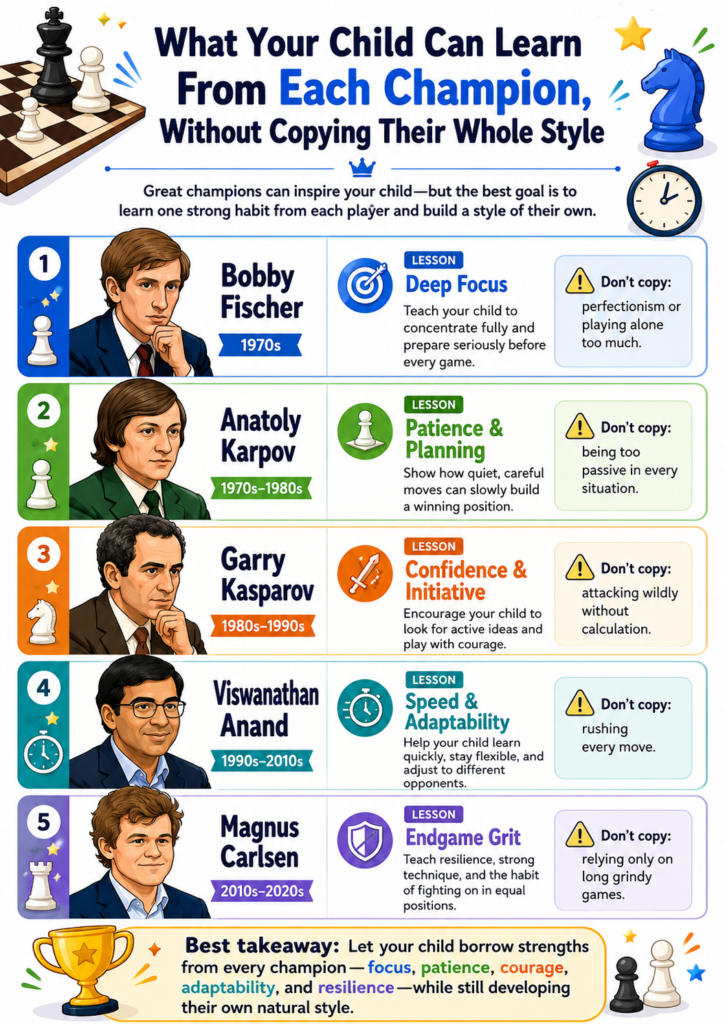
The goal is much simpler and much healthier. A child can take one strong lesson from each champion and use it in real games.
This matters because kids can feel overwhelmed when they hear about grandmasters. They may think, “I can never play like that.” But when the lesson is broken into one small habit, the game feels possible again. That is how great coaching works. It turns big ideas into small steps a child can use today.
Fischer and Karpov show that great chess starts with clear moves and calm control
Fischer’s games are full of clear purpose. His pieces often moved to active squares, his king became safe early, and his attacks grew from strong basics. Karpov’s games show another kind of strength. He did not always rush. He improved his pieces, took space, and slowly made the other side uncomfortable.
For a child, this is a perfect pair of lessons. Fischer teaches energy. Karpov teaches patience. When both habits come together, a young player becomes much harder to beat. They stop moving pieces without a plan, and they stop rushing into attacks that are not ready.
The home practice is to make one move with a reason every time
A simple question can change a child’s chess very fast: “What is the reason for this move?” The answer does not have to be deep. It can be, “I am saving my queen,” “I am attacking a pawn,” “I am helping my knight,” or “I am making my king safer.”
This small habit cuts down many blunders. It also helps children build stronger focus. Instead of guessing, they begin to explain. When a child can explain a move, the child is not only playing chess. The child is learning how to think.
Kasparov, Kramnik, and Anand show that every child needs more than one chess tool
Kasparov teaches children to come ready. He showed how powerful preparation can be when it is used with courage. Kramnik teaches children that defense is not weakness. A strong defense can stop even a dangerous attack.
Anand teaches children to stay flexible. He could play fast, sharp, quiet, and practical chess, which made him strong across many formats.
These lessons are very useful for young students because most kids have one favorite way to play. Some want to attack all the time. Some trade too much. Some play too fast. Some are afraid of losing pieces, so they never take action. The champions show that strong players need many tools, not just one.
The coaching practice is to fix one weak habit at a time
Parents often want children to improve everything at once. That sounds good, but it can make learning messy. A better way is to pick one habit for a short time. Maybe the child works on not hanging pieces. Maybe the child works on castling early. Maybe the child works on using the clock better.
At Debsie, this kind of focused learning is a big part of the coaching path. A coach can see what the child needs next and give the right kind of practice. This keeps the child from feeling lost and helps progress feel real.
Carlsen, Ding, and Gukesh show that modern chess rewards calm minds and brave hearts
Carlsen’s long success shows the power of steady pressure. He became World Champion in 2013 by defeating Viswanathan Anand 6.5–3.5 in Chennai, and FIDE describes that match as the start of his ten-year reign.
Ding’s 2023 world title win showed courage in a match that went to tiebreaks after the classical games. Gukesh’s 2024 win over Ding made him the 18th World Champion and the youngest ever, with FIDE giving the final score as 7.5–6.5.
For children, the modern era is inspiring because it feels close. Young stars are rising faster than ever, and chess is now easier to access from home. But access alone is not enough. A child still needs guidance, care, and a clear path.
The modern practice is to mix online play with real review
Online games are fun, but playing game after game without review can create bad habits. The better plan is to play, pause, and learn. After each game, the child should find one good move and one mistake. That keeps learning simple and useful.
A Debsie coach can make this even better by showing the child why the mistake happened. Was it a missed threat? Was it rushing? Was it poor piece placement? Once the reason is clear, the child can fix it faster.
How Parents Can Use Chess Eras To Help Children Improve Faster
Parents do not need to know every opening or every famous game to help a child grow in chess. They only need to understand what each era teaches. The 1970s teach basics and patience. The 1980s and 1990s teach preparation and fighting spirit.
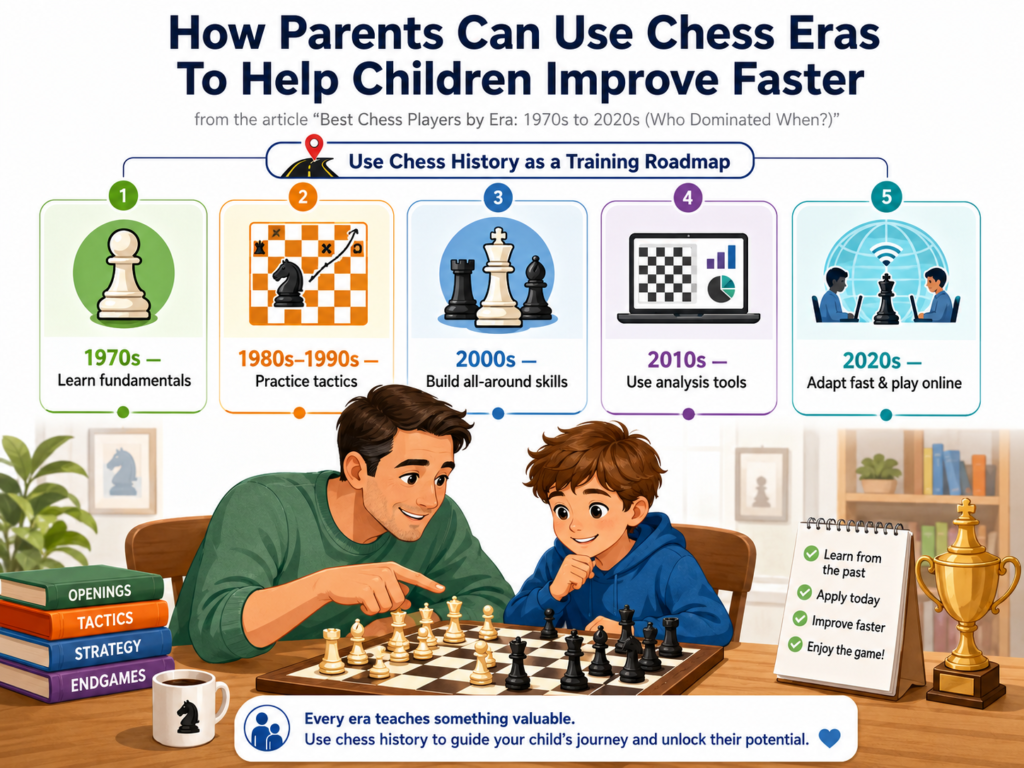
The 2000s teach adjustment. The 2010s teach focus and stamina. The 2020s teach courage, youth, and smart use of tools.
This makes chess history more than a story. It becomes a learning map. Instead of saying, “Study grandmasters,” a parent can say, “This week, let us learn how Carlsen improves pieces,” or “This week, let us learn how Anand finds simple tactics.” That feels much easier for a child.
The first parent job is to praise thinking, not only winning
When a child wins, it is natural to celebrate. But parents should also praise good thinking in games the child loses. Maybe the child remembered to castle. Maybe the child spotted a tactic. Maybe the child stayed calm after losing a pawn. These moments matter.
This is important because children connect praise with identity. If they are praised only for winning, losing may feel shameful. But if they are praised for thinking, trying, and learning, losing becomes part of growth. That is how confident chess students are built.
The better question after a game is what did you learn from it
After a game, try not to start with “Did you win?” A better question is, “What did you learn?” This gives the child room to think. It also makes the result feel less scary.
In Debsie classes, coaches help children talk about their games in a calm way. The goal is not to blame. The goal is to notice patterns. When kids learn to review without fear, they improve faster and enjoy chess more.
The second parent job is to keep training steady and not too heavy
Chess improvement works best when it is steady. A child does not need five hours of study every day. In fact, too much pressure can hurt the joy. What most children need is regular practice, good feedback, and a coach who knows how to keep lessons clear.
This is where live classes can be much better than random videos. Videos can teach ideas, but they cannot always see the child’s mistake. A coach can. A coach can ask questions, slow the lesson down, and adjust to the child’s level.
The best training plan is simple enough to repeat
A strong weekly rhythm can be very simple. The child plays a few games, solves a few puzzles, studies one short lesson, and reviews one mistake. That is enough when done well.
Parents should not chase too many resources at once. Too many apps, books, and videos can confuse a young learner. A clear path is better than a crowded path. Debsie’s structured chess program gives children that path through live coaching, personal attention, and regular practice.
The third parent job is to see chess as life training
Chess helps with more than rating points. It teaches children to pause before acting. It teaches them to plan. It teaches them to handle mistakes. It teaches patience when things are not easy. These are the same skills children need in school and daily life.
This is why chess is such a powerful activity for kids. A child learns that one careless move can change a game, but also that one mistake does not end the game. That balance is beautiful. It teaches responsibility without fear.
The best next step is to let your child try a real class
If your child already likes chess, a guided class can help that interest grow. If your child is new, a trial class can show whether chess feels fun and exciting. Debsie offers a free chess trial class where your child can meet a coach, learn in a friendly space, and see how chess can build focus, patience, and smart thinking.
The goal is not to force every child to become a champion. The goal is to help every child become a better thinker. Chess is simply one of the most joyful ways to do that.
The Great Challengers Matter Because Dominance Is Stronger When The Rival Is Strong
A champion looks greater when the rivals are great too. That is why it is not enough to only name the main player of each era. We also need to look at the players who pushed them, tested them, and sometimes nearly took their place.
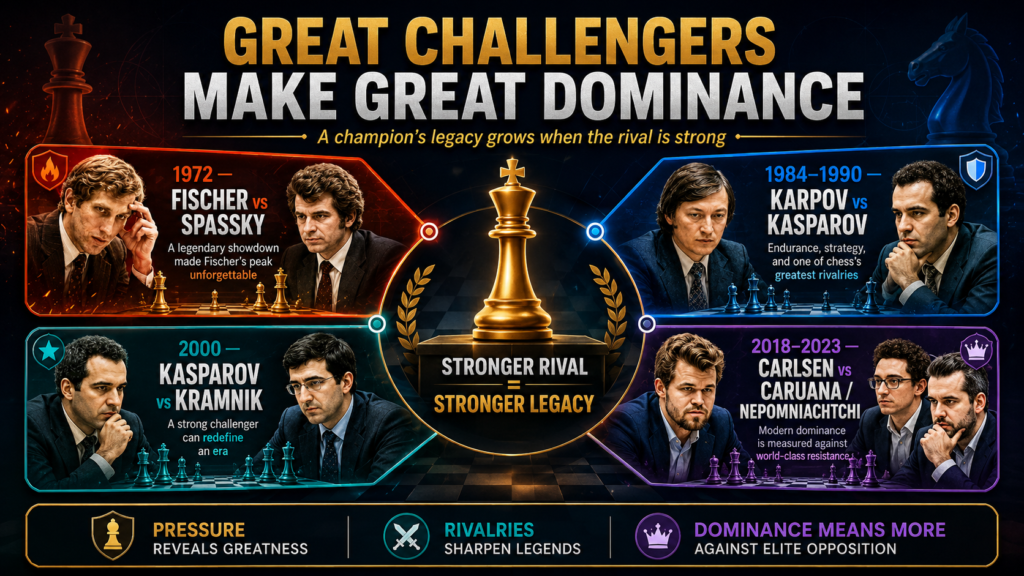
Chess history is not a solo story. It is a line of battles. The champion stands in front, but the challengers shape the road.
This matters for young players because it teaches a healthy lesson. A strong rival is not a problem. A strong rival is a gift. The rival shows your weak spots. The rival makes you prepare better. The rival forces you to grow. Many children feel upset when they lose to a stronger player, but that stronger player may be the best teacher they meet that day.
Viktor Korchnoi, Boris Spassky, and Bent Larsen made the 1970s more than a two-player story
The 1970s are often remembered for Fischer and Karpov, but the decade had many giants around them.
Boris Spassky was the champion Fischer had to beat. Bent Larsen was one of the most creative players in the world. Viktor Korchnoi became Karpov’s fiercest match rival, and his fighting spirit made him one of the hardest players to break.
These players mattered because they brought different tests. Spassky was flexible and calm. Larsen was bold and full of ideas. Korchnoi was stubborn, sharp, and fearless. If Fischer and Karpov had ruled against weak fields, their dominance would feel smaller.
But they ruled in a world full of strong minds.
The student lesson is to stop fearing stronger players and start learning from them
When a child loses to a better player, the first feeling may be sadness. That is normal. But after that feeling passes, the game becomes a gift. It can show what the child needs next. Maybe the opening was weak. Maybe the child missed a fork.
Maybe the child traded too soon. Maybe the child attacked before finishing development.
This is why Debsie coaches help students review games with care. The goal is not to make the child feel bad. The goal is to find one clear lesson and turn it into the next step. A strong opponent can show the map. A good coach can help the child read it.
Karpov, Korchnoi, and later Kasparov made the 1980s one of the toughest chess decades ever
The 1980s had deep tension because the top players were so hard to beat. Karpov did not just disappear when Kasparov arrived. He stayed strong, fought match after match, and made Kasparov prove himself again and again. Their rivalry was not a quick handoff. It was a long struggle.
This is one reason Kasparov’s rise feels so powerful. He did not take the crown from a tired or weak champion. He had to pass Karpov, one of the best positional players ever. And even after winning the title, Kasparov had to keep facing him. That made both players sharper.
The student lesson is that growth often comes from repeated tests
Many kids want quick results. They want one lesson to fix everything. But chess does not work that way. A child may need to face the same kind of problem many times before the lesson becomes natural. That is not failure. That is training.
At Debsie, this is why students get steady practice instead of random tips. A coach can notice patterns across games. If a child keeps missing back-rank threats, the coach can return to that idea until it becomes a habit. Repeated tests build strong thinking.
Kramnik, Anand, Topalov, and Leko made the 2000s a battle of styles
The 2000s were rich because the top players did not all play the same way. Kramnik was solid and deep. Anand was fast and smooth. Veselin Topalov brought energy and sharp attacks. Peter Leko was precise and hard to beat.
This mix made the decade feel like a chess lab. Different styles were tested at the highest level.
For students, that is very useful. It shows that there is no single “right” personality in chess. A quiet child can become a strong player. A bold child can become a strong player. A fast thinker can grow. A careful thinker can grow.
The key is not to force every child into the same style. The key is to build strong basics and then shape the style around the child.
The student lesson is to know your style but not become trapped by it
A child may say, “I am an attacking player,” and that can be true. But if the child only attacks, they may lose many games where patience was needed. Another child may say, “I like safe positions,” but if they never take chances, they may miss winning moves.
A good chess teacher helps children stretch. Not too much at once. Just enough to grow. Debsie’s live classes are helpful here because a coach can see the child’s natural style and guide it with care.
The Best Player Of An Era Is Often The One Who Solves The Main Problem Of That Time
Every chess era has a main problem. The player who solves that problem usually becomes the face of the era. In the 1970s, the question was whether one player could break the old order and bring a new level of individual preparation.
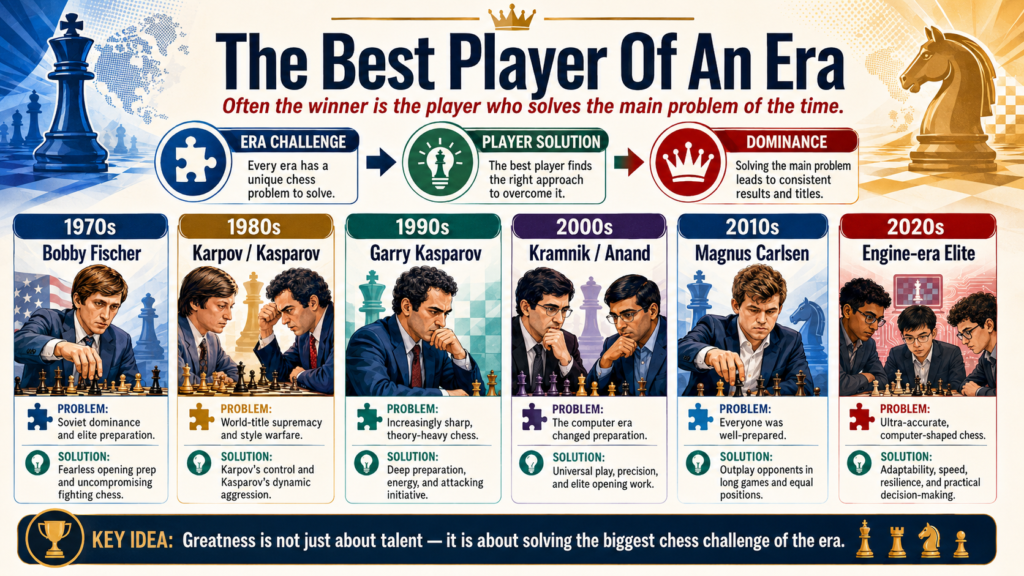
Fischer answered that. Then Karpov answered the next question: who could rule after Fischer left? In the 1980s and 1990s, the problem became how to mix deep preparation with fighting chess. Kasparov solved it better than anyone.
By the 2000s, computers and match strategy were changing the game. Kramnik and Anand adapted in different ways. In the 2010s, opening prep had become so deep that players needed to win from small edges and quiet positions.
Carlsen solved that. In the 2020s, young players are growing up with engines, online chess, and global training. Gukesh’s rise shows what this new world may look like.
Fischer solved the problem of fear by proving one person could challenge a system
Fischer’s rise was not only about moves. It was about belief. Before him, Soviet chess had a huge system behind it. Strong players, strong coaches, strong study groups, and deep tradition made the Soviet school feel almost impossible to beat. Fischer stood alone in many ways, and that made his rise feel even larger.
For young players, this part of the story is exciting, but it should be used in the right way. Fischer’s lesson is not that a child should work alone. His lesson is that deep focus can change what seems possible.
With the right support, a child can grow far beyond what they first believe.
The student lesson is that belief grows when work becomes clear
Children do not become confident just because adults say, “Be confident.” They become confident when they know what to do. If a child learns how to open a game, how to spot a fork, how to protect the king, and how to finish a checkmate, confidence starts to feel real.
That is why Debsie focuses on clear lessons. Kids need steps they can follow. They need wins they can understand. They need mistakes explained in kind words. Then belief grows naturally.
Karpov solved the problem of control by making small edges feel final
Karpov showed that a player did not need to attack wildly to dominate. He solved the problem of control. He could take a small space edge, a weak square, or a better piece and keep building until the opponent had no good choices.
This is one of the hardest skills in chess because it takes patience.
Many children struggle with this. They see a small advantage and want to win right away. But chess often rewards the player who keeps the advantage safe first. Karpov’s games show children that winning can be slow and still be beautiful.
The student lesson is to protect the advantage before trying to grow it
When a child is ahead by a piece, the goal is not to find a fancy move. The goal is to avoid giving the piece back. When a child has a safer king, the goal is to keep it safe while improving the pieces. When a child has a passed pawn, the goal is to support it.
This is a simple but powerful lesson. Many winning positions are lost because the player gets excited. A coach can help a child learn how to stay calm when ahead. That is a life skill too. Success needs calm hands.
Kasparov solved the problem of pressure by making every move feel urgent
Kasparov’s opponents often felt pressure from the opening. He prepared deeply, played actively, and forced hard choices. He did not wait for opponents to make easy mistakes. He created positions where mistakes became more likely. That is what great pressure does.
For students, this teaches the value of active play. Active does not mean reckless. It means your pieces have jobs.
Your rooks find files. Your bishops look at strong diagonals. Your knights jump to useful squares. Your queen supports real threats instead of moving around for no reason.
The student lesson is to make your pieces work together before launching an attack
A common beginner mistake is attacking with one piece. A queen comes out early. A bishop gives one check. A knight jumps forward without support. These attacks may work against beginners, but they fail against stronger players.
Kasparov’s games teach that a real attack is a team effort. Before attacking, children should ask whether enough pieces are ready. This habit can make their attacks stronger and their games cleaner.
The Modern Champion Must Be A Complete Player, Not Just A Specialist
In the past, a player could sometimes become famous for one special strength. Some were known for attacks. Some were known for endings. Some were known for defense.
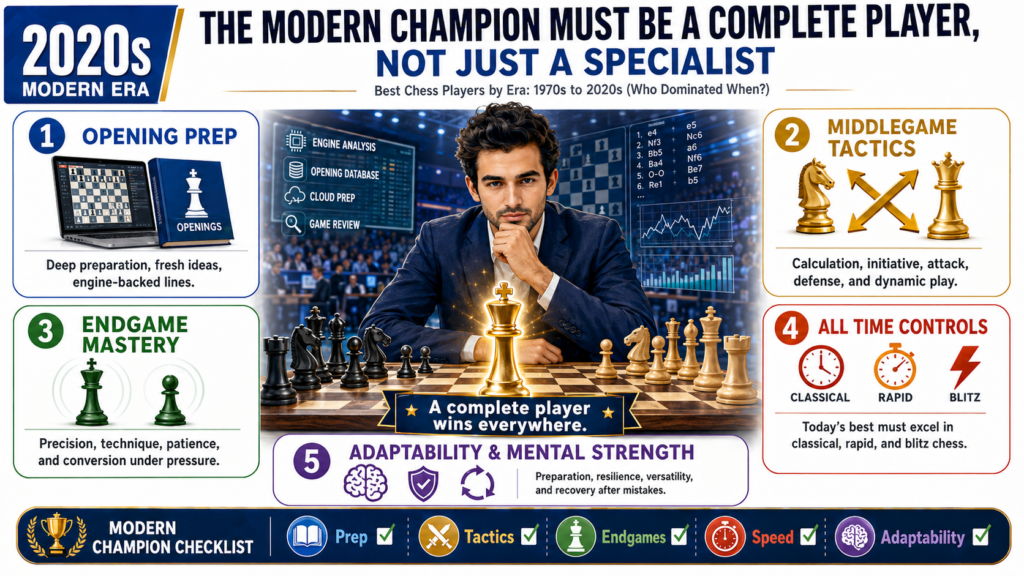
Today, the very best players must do almost everything well. They need openings, tactics, strategy, endgames, speed, stamina, online skill, classical patience, and emotional control. This is why modern chess is so demanding.
But for children, this should not feel scary. It should feel exciting. A child does not need to master everything at once. The modern game simply shows that chess has many doors. A child can enter through puzzles, stories, tournaments, online games, or live classes.
The important thing is to keep learning in a clear and balanced way.
Carlsen became the model complete player because he could win without needing the perfect opening
Carlsen’s strength was not that he always got a huge edge from the opening. Many times, he reached a normal position and simply played better from there. That made him hard to prepare against. If the opponent survived the opening, the real fight was still coming.
This is a very healthy lesson for kids. Some young players worry too much about openings. They think a game is lost if they do not remember a line. Carlsen teaches that understanding matters more than memory. If your pieces are active, your king is safe, and you understand the plan, you can still play a good game.
The student lesson is to learn opening ideas instead of only opening moves
A child should know why they are moving a pawn, why a knight belongs in the center, why castling matters, and why the same piece should not move too many times early. These ideas help even when the opponent plays something unexpected.
This is how Debsie coaches make openings less scary. They do not just ask children to memorize. They help them understand. Once a child understands, the board feels friendlier.
Ding showed that emotional strength is part of modern chess strength
Ding’s world title win mattered because it showed emotional fight. Modern chess is not only about finding engine-like moves. It is also about handling pressure, public attention, missed chances, and long games. Ding had difficult moments, but he kept coming back.
Children need this lesson badly. Many kids are smart enough to improve, but they become upset after mistakes. They may rush, cry, quit, or stop caring. That does not mean they are weak. It means they are still learning how to handle pressure.
The student lesson is to name the feeling and still find the next move
A child can learn to say, “I am upset because I lost my rook,” and then still ask, “What is my best move now?” That is a huge step. Chess gives kids a safe place to practice this. They can feel pressure, recover, and try again.
A patient coach can make this process gentle. At Debsie, students are guided to see mistakes as part of learning, not as proof that they are bad at chess. This helps children stay open and brave.
Rating Peaks Help Us See Dominance, But They Do Not Tell The Whole Story
Ratings are useful because they give us a number. That number helps compare players across events, rivals, and years. But a rating is not the whole truth. Chess is still played by humans. Pressure, match format, nerves, age, health, and motivation all matter.
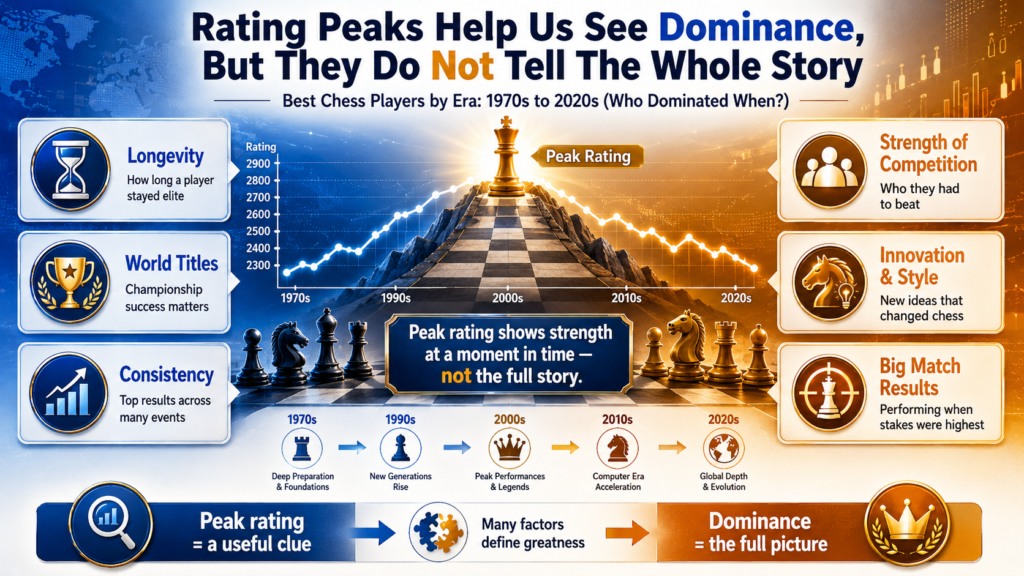
That is why we should use ratings as one strong clue, not as the only answer.
Magnus Carlsen is a good modern example. FIDE lists him at 2840 standard, 2832 rapid, and 2869 blitz in May 2026, and his FIDE profile also places him at world rank number one among active players and all players.
That supports the idea that he still has a strong claim as the best overall player of this time, even though Gukesh holds the classical world title.
A high rating shows steady strength because it is built across many games
A world championship match can turn on one mistake. A rating takes longer to build. It is shaped by many games against many strong players. This is why ratings are helpful when we ask who dominated an era. If a player stays near the top for years, it means the player keeps passing tests.
Still, ratings must be read with care. Fischer’s best years came in a different rating world from Carlsen’s. Karpov and Kasparov played in a time with fewer online tools and less engine help. Modern players face deeper preparation because everyone can use strong computers at home.
So, when we compare ratings across eras, we should not act like the number alone answers everything.
The student lesson is to track progress without becoming trapped by numbers
A child’s rating can be helpful, but it should not become the child’s whole identity. Ratings go up and down. That is normal. A good player can lose rating points while learning a new opening, trying a new style, or facing stronger rivals.
Parents can help by asking better questions after games. Did your child think before moving? Did your child check for threats? Did your child use the clock better? Did your child find one idea from class? These questions keep the focus on growth.
At Debsie, this is a big part of the learning culture. The rating matters, but the child matters more.
The world number one spot matters because everyone is chasing that player
Being world number one is different from having one great tournament. The number one player becomes the target. Other elite players study that person’s games. They prepare special lines. They try to copy strengths and expose weak spots. Staying number one while everyone is chasing you is a special kind of dominance.
That is why Kasparov and Carlsen stand out so much in modern chess history. Kasparov held the world title from 1985 until 2000 and defended it against Karpov, Short, and Anand before losing to Kramnik.
Carlsen held the title from 2013 until he chose not to defend in 2023, with successful defenses against Anand, Karjakin, Caruana, and Nepomniachtchi.
The action step is to help children chase skill goals before rating goals
Instead of saying, “Reach this rating,” a child can aim for skill goals. One month can be about avoiding queen blunders. Another month can be about checkmate patterns. Another can be about endgames. When skill grows, rating often follows.
This makes learning healthier. A child feels proud of what they can control. They cannot control every opponent or every pairing, but they can control how carefully they think. That is one reason guided coaching works so well for young players.
World Title Reigns Show Who Handled The Hardest Spotlight
The World Championship is chess under a bright light. It is not just about good moves. It is about sitting across from one great rival for weeks, carrying pressure every day, and knowing the whole chess world is watching. This is why title reigns matter so much when we judge eras.
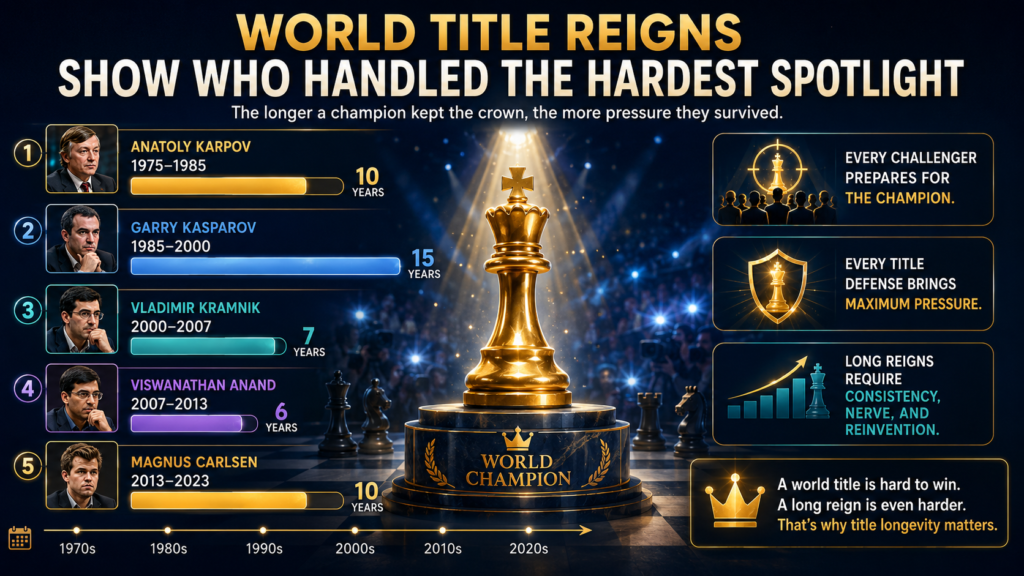
Fischer’s reign was short but explosive. Karpov’s reign was long enough to prove he was not just a default champion. Kasparov’s reign was historic because he took the title from Karpov and defended it through several cycles.
Kramnik’s reign mattered because he beat Kasparov and later helped reunify the title by defeating Topalov in 2006. Anand’s reign mattered because he won the 2007 championship tournament and then beat Kramnik in 2008, which strengthened the classical title line again.
The best champions do not only win the crown once, they answer the next question
Winning the title asks one question: can you reach the top? Defending the title asks a harder one: can you stay there when everyone is coming for you? This is where great champions separate themselves from great players.
Karpov answered by defending against Korchnoi in 1978 and 1981. Kasparov answered by beating Karpov again and again after 1985. Anand answered by defending against Kramnik, Topalov, and Gelfand.
Carlsen answered by defending against four different challengers across different match styles. These title defenses make their dominance stronger because they show the champion could adapt to new rivals.
The student lesson is to learn how to play after success
Many children work hard to win a trophy, then relax too much. That is normal. But champions teach us that success is not the end of the road. Success is the start of a new level.
If a child wins a school event, the next step is not pressure. The next step is reflection. What worked? What still needs help? Which games were lucky? Which wins were clean? A good coach can help the child enjoy the win while still growing from it.
The 2020s show that the title and the strongest-player debate can split apart
The current era is exciting because the answer is not simple. Gukesh became the 18th World Champion in 2024, beating Ding Liren 7.5–6.5 in Singapore at age 18, which FIDE called the youngest world champion moment in history.
But FIDE’s May 2026 ratings still show Carlsen as the world number one in standard, rapid, and blitz categories.
That means the 2020s cannot be judged with only one sentence. Gukesh has the crown. Carlsen still has the rating lead. Ding has the historic 2023 title moment as China’s first classical world champion.
The next few years will decide whether Gukesh starts a long reign, Carlsen remains the strongest force without the title, or another young star breaks through.
The action step is to teach children that status can change, but habits stay valuable
A child may be the best player in class one month and lose that spot the next. That should not feel like disaster. Chess keeps moving. The goal is to build habits that survive changes.
Debsie coaches help children build those habits through live classes, guided practice, and friendly feedback. When children learn how to think, not just what to play, they become ready for many kinds of challenges.
Playing Style Explains Why Each Era Feels Different To Study
The most fun part of chess history is that each era has its own flavor. The pieces are the same, the board is the same, and the rules are mostly the same. But the way top players use the pieces changes over time.
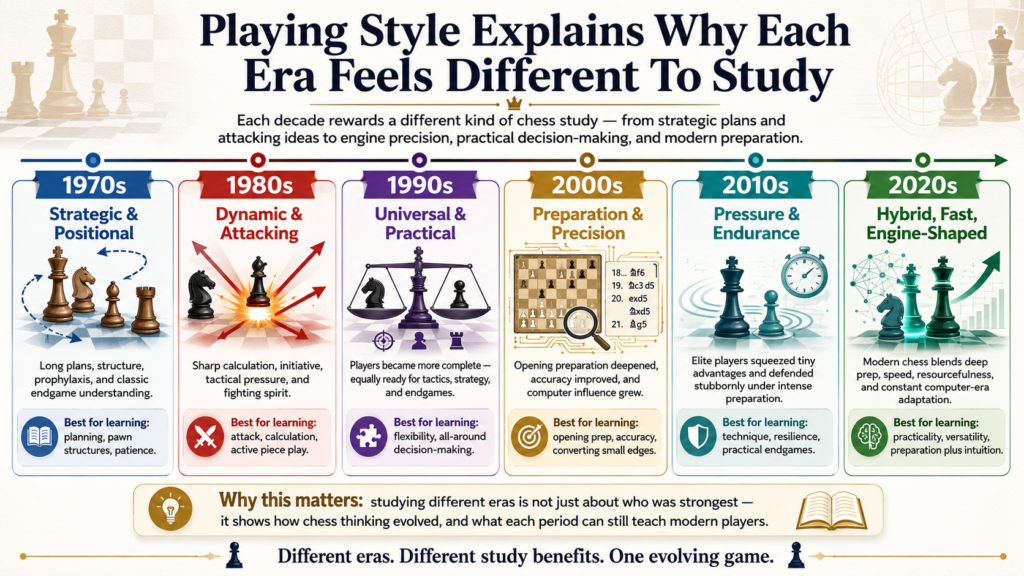
That is why studying by era can be so helpful for children. It makes chess feel like a story, not just a set of moves.
The 1970s feel sharp because Fischer’s rise brought clean attacks and strong opening work, while Karpov’s rise brought quiet control. The 1980s and 1990s feel intense because Kasparov made every game feel like a fight.
The 2000s feel thoughtful because Kramnik and Anand showed two ways to adapt. The 2010s feel patient because Carlsen made small advantages famous. The 2020s feel fast and young because Gukesh, Carlsen, Ding, and a new wave of stars are playing in a world shaped by engines and online chess.
Style matters because children often learn better from a player who fits their personality
Some kids are brave attackers. They may enjoy Fischer, Kasparov, or Topalov. Some kids are calm planners. They may connect with Karpov, Kramnik, or Carlsen. Some kids think fast and love puzzles. They may enjoy Anand.
Some kids are young, ambitious, and inspired by modern chess. They may feel excited by Gukesh.
This does not mean a child should copy only one player. It means the right role model can make learning feel personal. When a child says, “I like how this champion plays,” the coach can use that spark. Interest makes practice easier.
The coaching step is to match the lesson to the child, not force the child into one mold
A strong chess class should not treat every child the same. One student may need more confidence to attack. Another may need help slowing down. Another may need basic tactics. Another may need tournament practice. The best coaching starts with the child in front of the coach.
This is where Debsie’s personal approach can help parents. A live coach can see how the child thinks, where the child rushes, and what kind of positions the child enjoys. Then the lesson becomes more useful and more fun.
Style also teaches children that there is no single way to be smart
Chess is beautiful because intelligence shows up in many forms. Fischer’s smart was clear and direct. Karpov’s smart was calm and patient. Kasparov’s smart was bold and prepared. Kramnik’s smart was deep and solid.
Anand’s smart was fast and clean. Carlsen’s smart was practical and tireless. Ding’s smart was emotional courage under stress. Gukesh’s smart is youthful discipline mixed with brave play.
That message is powerful for kids. Some children think they are not “smart” because they are not fast. Others think they are not good because they are quiet. Chess teaches them that there are many ways to think well.
The action step is to let your child build a chess identity with guidance
A child’s chess identity should grow slowly. It should not be forced. With good coaching, a child can learn what kind of player they are while still building the basics. They can say, “I like attacking,” while also learning defense. They can say, “I like safe positions,” while also learning when to take chances.
That balance is the heart of good chess growth. It keeps the game fun, but it also makes improvement real.
The Best Games To Study Are The Ones That Teach One Clear Lesson
A young player does not need to study hundreds of grandmaster games at once. That can feel heavy, and it can also make chess feel like homework. The better way is to study one game for one lesson.
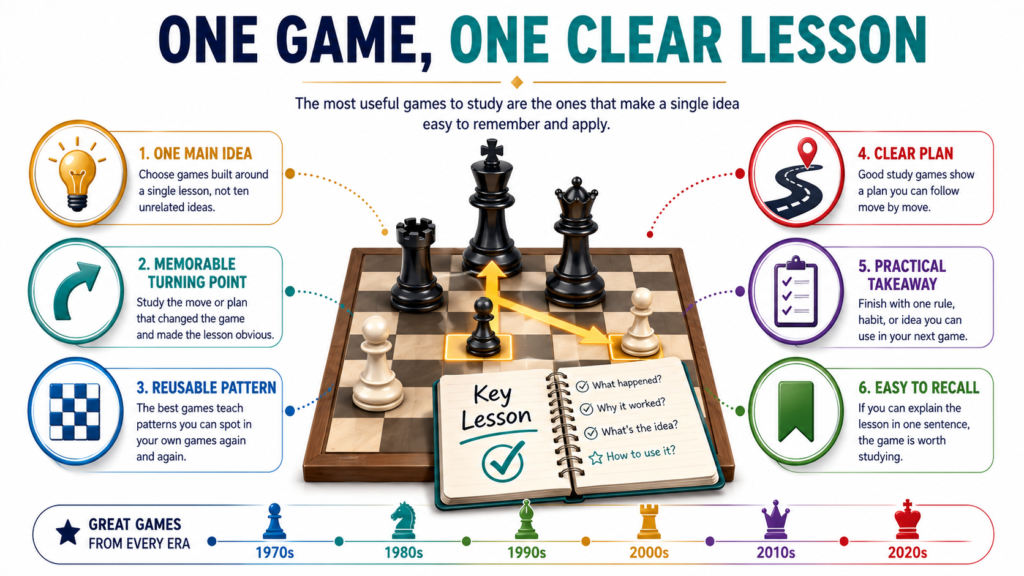
When a child studies Fischer, the lesson may be clean development. When a child studies Karpov, the lesson may be patience. When a child studies Kasparov, the lesson may be active pieces. When a child studies Carlsen, the lesson may be how to keep pressing without rushing.
This is how chess history becomes useful. It stops being a list of names and dates. It becomes a set of tools your child can use in the next game.
The world champion list itself shows how the crown passed from Fischer to Karpov, Kasparov, Kramnik, Anand, Carlsen, Ding, and now Gukesh, but the real learning comes from asking what each champion did better than others.
Fischer games are best for learning how to build an attack from strong basics
Fischer’s games are wonderful for students because they often feel clear. His pieces usually have purpose. He does not attack out of nowhere. He develops, castles, controls the center, and then uses active pieces to create pressure. That is exactly what many children need to learn first.
A child who studies Fischer should not start by trying to copy every opening move. That is too much. The child should instead ask, “Which pieces did Fischer bring into the game first?” and “When did the attack become ready?” These two questions can teach more than memorizing a long line.
The practice idea is to pause before the attack and count the ready pieces
Before a child starts attacking, ask them to count how many pieces are helping. Is the queen alone? Is one bishop helping? Are both rooks still asleep? This simple check can stop many weak attacks.
At Debsie, coaches often help kids slow down before the exciting move. The child learns that a strong attack is not just brave. It is prepared. That is a huge step from beginner chess to smart chess.
Karpov games are best for learning how to win without rushing
Karpov is one of the best players to study when a child needs patience. His wins often show small gains becoming bigger over time. He may improve a knight, take space, stop a pawn break, and slowly make the other player run out of good moves.
This style is very helpful for children who get ahead and then throw the game away. Many kids win a piece and then start moving too fast. Karpov teaches the opposite. When you are better, stay calm. Improve your position. Do not give your opponent easy chances.
The practice idea is to find the worst piece and improve it first
In many positions, a child can ask, “Which of my pieces is doing the least?” That question is simple, but it leads to better chess. A quiet improving move can be stronger than a flashy move that does nothing.
This habit also builds life skills. Children learn that progress is not always loud. Sometimes the smartest step is small, steady, and careful.
Kasparov games are best for learning energy and pressure
Kasparov’s games can feel like a storm, but there is deep order behind the storm. His pieces work together. His openings create tension. His threats make the opponent solve problem after problem. That is why his games are so useful for students who need more courage.
The key is not to tell children, “Play like Kasparov and attack everything.” That can lead to reckless chess. The better lesson is, “Make your pieces active and give your opponent hard choices.” That is a lesson any child can use.
The practice idea is to make one useful threat without weakening your own king
A young player can learn to create pressure in a safe way. They can attack a pawn, place a rook on an open file, move a knight to a strong square, or line up a bishop toward the king. The move should do something real.
Debsie coaches can help children learn this balance. The child gets to enjoy active play without becoming careless. That is where real confidence starts.
Each Champion Also Teaches A Life Skill Parents Can See Beyond The Board
Parents often ask whether chess will help their child outside chess. The honest answer is yes, but only when the child learns in the right way. Playing random games may be fun, but guided chess can build deeper habits. It can teach a child to pause, plan, focus, recover from mistakes, and think before acting.
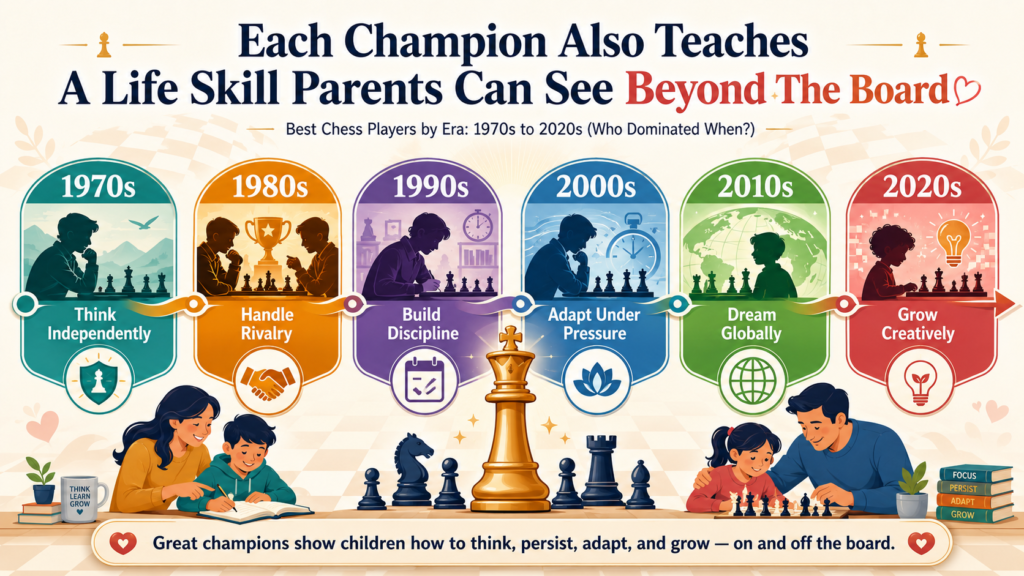
That is why these chess eras are so useful for parents. Each great player gives a life lesson. Fischer shows focus. Karpov shows patience. Kasparov shows courage. Kramnik shows discipline. Anand shows calm speed. Carlsen shows stamina.
Ding shows emotional strength. Gukesh shows what young ambition can become when it is supported by serious training and belief. Gukesh’s 2024 world title win made him the youngest world champion in history, with FIDE reporting the final score as 7.5–6.5 against Ding Liren.
Fischer and Kasparov teach children how to work with full focus
Some children are bright, but they jump from one thing to another. Chess can help them slow their mind and focus on one problem. Fischer and Kasparov both show what happens when focus becomes deep. They did not just play moves. They prepared, studied, and cared about details.
For kids, the lesson is not to become intense in an unhealthy way. The lesson is to give full attention to the task in front of them. In a chess game, that task is the next move. In school, it may be one math problem or one reading page.
The home habit is to create short focus blocks that feel possible
A child does not need a two-hour study session to improve. A short, clear practice time can work very well. Ten minutes of puzzles with full focus is better than one hour of distracted clicking.
This is why Debsie’s guided classes can help. A coach keeps the child engaged, asks questions, and makes focus feel active instead of forced. Children learn better when the lesson has rhythm and care.
Karpov and Kramnik teach children that patience is not weakness
Many kids think patience means doing nothing. Chess teaches a better idea. Patience means doing the right thing even when you want to rush. Karpov and Kramnik were masters of this. They could sit in a quiet position and keep making useful moves.
This is a powerful lesson for school and life. A child may want to give up when homework is hard. A child may want to rush when a puzzle feels boring. Chess teaches that staying with the problem can open the door.
The home habit is to praise the pause before the move
When your child stops and thinks before moving, praise that. Even if the move is not perfect, the thinking habit matters. You can say, “I like that you checked before moving,” or “I like that you looked at your opponent’s threat.”
This kind of praise teaches children that thinking is valuable. It also helps them feel safe while learning. At Debsie, this calm style of feedback is part of what makes chess feel friendly for young learners.
Anand, Carlsen, Ding, and Gukesh teach children how to stay calm in a changing world
Modern chess changes fast. There are online games, faster time controls, stronger engines, and young stars rising all the time. Anand adapted across formats. Carlsen won in classical, rapid, and blitz.
Ding handled match pressure to become champion in 2023. Gukesh then took the title in 2024 at only 18 years old. This modern story teaches children that change is not something to fear. It is something to learn from.
Children today also live in a fast world. They need calm thinking more than ever. Chess gives them a safe place to practice that calm.
The home habit is to ask what changed and what can be done next
After a mistake, ask your child, “What changed on the board?” Then ask, “What can you do now?” This keeps the child from freezing. It turns panic into problem-solving.
That one habit can help in many places, not only chess. A child who learns to reset after a bad move may also learn to reset after a bad test, a tough day, or a hard moment with friends.
A Smart Chess Learning Plan Uses The Eras As A Roadmap
A strong chess plan for kids should not be random. It should build step by step. The good news is that chess history already gives us a beautiful roadmap. The 1970s teach basics and patience.
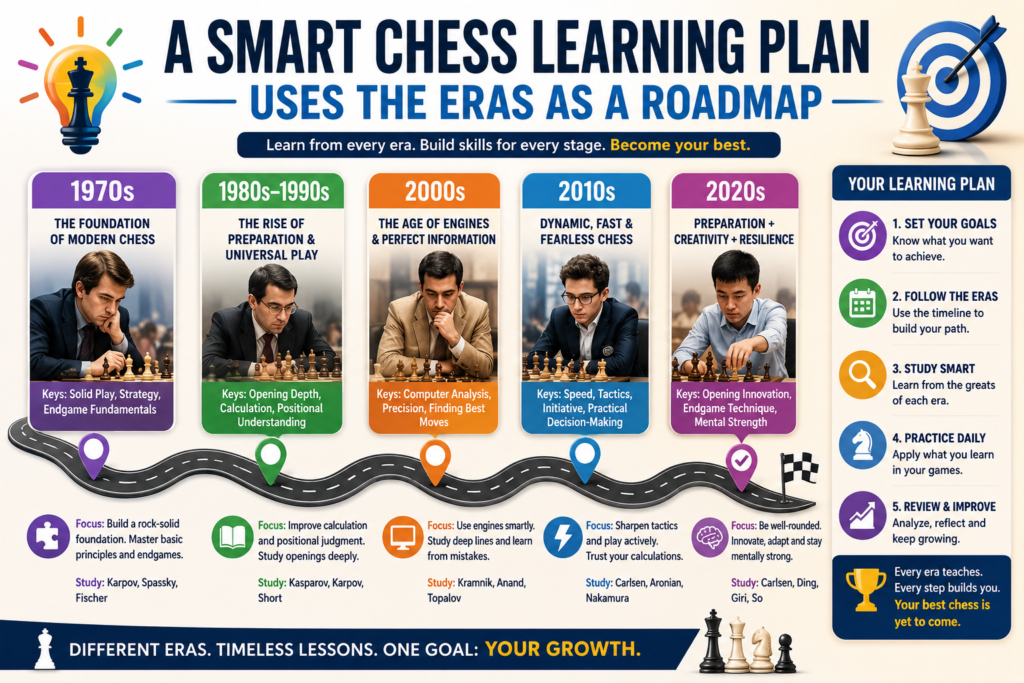
The 1980s and 1990s teach preparation and fighting spirit. The 2000s teach defense and flexibility. The 2010s teach stamina and endgame skill. The 2020s teach modern tools, courage, and smart guidance.
This kind of roadmap helps parents because it removes guesswork. You do not need to know every opening. You do not need to choose from hundreds of books and videos. You only need a clear path and a coach who can match that path to your child’s level.
The first stage is learning clean moves like Fischer and safe control like Karpov
The first goal for a child is simple. Stop giving away pieces. Castle early. Bring pieces out. Watch the opponent’s threats. Learn basic checkmates. These sound small, but they are the roots of strong chess.
Fischer and Karpov are perfect models here. Fischer shows clear piece play. Karpov shows control. Together, they teach a child to stop guessing and start thinking.
The training focus is to make every move answer one clear question
Before moving, the child should ask, “Is my king safe?” or “Is any piece attacked?” or “What is my opponent threatening?” These questions are simple enough for young players, but they build real strength.
A Debsie coach can make these questions part of the child’s natural thinking process. Over time, the child does not need to be reminded as much. The habit becomes automatic.
The second stage is learning pressure like Kasparov and flexibility like Anand
Once a child has the basics, the next step is to become more active. This means learning tactics, threats, open files, piece coordination, and attacking patterns. Kasparov is a great model for this stage because his pieces worked together with energy.
Anand adds another important lesson. He was fast, flexible, and practical. He did not make chess look heavy. He showed that clean moves and quick pattern recognition can be very powerful. Carlsen’s 2013 win over Anand in Chennai marked a major handoff to the next era, with the final score recorded as 6.5–3.5.
The training focus is to solve tactics and then explain the idea in words
Many children solve puzzles by guessing. That is not enough. After solving, they should explain the pattern. Was it a fork? A pin? A back-rank idea? A discovered attack? The name is less important than the understanding.
At Debsie, coaches can listen to the child’s explanation and fix the thinking gently. This is where learning becomes deeper than clicking the right move.
The third stage is learning stamina like Carlsen and courage like Gukesh
As a child improves, games become longer and harder. Opponents stop falling for easy tricks. This is where Carlsen’s lessons become very useful. He shows how to keep trying in equal positions, how to squeeze small edges, and how to stay focused for many moves.
Gukesh adds the modern lesson of brave ambition. His rise shows that young players can do amazing things when talent meets structure, effort, and strong support. But the lesson for most children is not “become world champion.” The lesson is “start early, stay steady, and keep learning.”
The training focus is to review one long game each week with a coach
Long games show thinking habits better than quick games. They reveal when a child rushes, when focus drops, and when plans are missing. Reviewing one long game can teach more than playing ten fast games without review.
This is one of the biggest strengths of a live chess class. The coach can see the child’s real choices and help them improve one step at a time.
Conclusion
From Fischer’s fire to Gukesh’s fearless rise, every chess era shows a different path to greatness. Some champions won with attack, some with patience, some with deep prep, and some with calm pressure. For young players, the real lesson is simple: chess rewards focus, courage, practice, and smart choices.
Your child does not need to copy a champion. They only need the right guidance to build their own strength. With Debsie’s expert-led chess classes, kids can learn the game, enjoy the journey, and grow into sharper, calmer, more confident thinkers on and off the board, one move at a time.

Adhip Ray is the founder of Debsie, an online learning platform focused on chess and skill-based learning for children. His work at Debsie brings together chess education, structured thinking, problem-solving, and interactive learning for young students.
Adhip has an academic background in law, statistics, analytics, and technology. He is from Amity Law School and the Indian Statistical Institute, Kolkata, with formal training that connects legal reasoning, data analytics, quantitative thinking, and structured problem-solving. This interdisciplinary background is reflected in Debsie’s focus on building sharper thinking skills in children through chess and related learning programs.
Adhip is also a FIDE-rated chess player from India. He holds FIDE ID 5055954 and has a standard FIDE rating of 1832. His FIDE profile records him as an Indian player with a long rating history in standard chess, including rated games from his competitive playing years. His chess background gives Debsie a founder-led connection to the game, not only as an educational activity but also as a competitive discipline that develops concentration, calculation, planning, and decision-making.
In addition to chess, Adhip has a strong interest in coding, data, and technical problem-solving.
Adhip’s profile combines chess, law, data analytics, and programming. At Debsie, this background supports the creation of learning experiences that are logical, structured, and skill-oriented. The platform’s chess-focused programs are connected to broader cognitive skills such as pattern recognition, patience, strategic planning, focus, and problem-solving.
As founder of Debsie, Adhip brings together experience from multiple fields: formal legal education from Amity Law School, analytical training from the Indian Statistical Institute, Kolkata, competitive chess experience through his FIDE-rated profile, and coding practice through LeetCode. This combination gives Debsie a distinct foundation in strategy, reasoning, analytics, and child-focused learning.
Through Debsie, Adhip is associated with building chess and learning content for children that goes beyond basic instruction. The platform connects chess with thinking skills, helping students approach challenges with more structure, clarity, and confidence. His own background in chess and analytical problem-solving gives the platform a direct link to the skills it aims to develop in young learners.
Adhip is also a member of Forbes Business Council.