
Homework is changing. It is no longer a crumpled sheet in a backpack. Today, homework lives on phones and laptops, inside clear, simple platforms. This change is not just about tech. It is about better habits, stronger focus, and real growth in grades. At Debsie, we see this every day with students across the world. When work is easy to find, easy to do, and gets fast feedback, kids show up, finish more tasks, and learn more. Parents see fewer missing assignments. Teachers see cleaner data. Students feel proud because they can track their wins and fix mistakes right away.
1) Schools that adopt digital homework see completion rates rise by 10–25% within the first term.
Why this jump happens
Completion rises because the work is easy to find, clear to start, and fast to submit. Students no longer hunt for papers or wonder what is due. The platform shows the next task, the due time, and the steps to finish.
This removes friction. Small wins stack up, and students build a routine. They see progress on a dashboard, which makes effort feel real. The result is simple: more tasks started, more tasks finished, and fewer missing items.
What to do at home
Sit with your child for five quiet minutes and open the homework dashboard. Ask them to read the title of the next task out loud, then restate the goal in one short sentence. Help them set a twenty-minute timer for focused work.
When the timer ends, they should submit what is done so far, even if it is not perfect, and then take a two-minute break. This start-submit-break loop makes work feel lighter and keeps momentum going.
At the end of the week, review the completion graph together and celebrate the highest streak day. If you use Debsie, turn on the weekly summary email so you can see the pattern without digging.

What schools can do now
Teachers can post each assignment with a one-line purpose and a clear success check. Use the same naming format for every task so students know what to expect. Keep the first two weeks light, then build. Add a visible progress bar on each task.
When students can see they are sixty percent done, they stick with it. Invite parents to the platform so they can see due dates in real time. If your school is new to digital homework, start with one subject for two weeks, measure completion, then add another subject.
With Debsie, you can flip on a schoolwide template that keeps titles, time estimates, and success checks consistent. This structure makes that ten to twenty-five percent lift very likely, and in many classes, even higher. To try it in your home or school, book a free Debsie class and watch the first-week change.
2) Students who submit homework online are 8–15% more likely to turn work in on time.
Why on-time grows
Online submission cuts out extra steps that cause delay. There is no printer, no hole punch, no lost folder. Students can finish and submit in the same tab. The platform also stamps the time, which makes deadlines feel real.
Many systems show a countdown next to each task. Seeing hours left nudges action today, not tomorrow. This nudging, plus easy submission, moves late work into the on-time pile.
A simple home plan
Ask your child to pick a daily “submit window,” a ten-minute slot right after study time. During this window, they open the platform, check each task, and click submit or mark progress. Make it a small ritual with the same steps each day.
If a task is not ready, they still hit save and leave a short note to the teacher explaining what is stuck. This habit reduces last-minute panic and normalizes honest updates. Keep a small reward for a full week of on-time submissions, like choosing Friday’s dinner.
In Debsie, you can enable end-of-day nudges that remind your child to complete this window. The nudge arrives at the time you pick, so it fits your family rhythm.
A quick school change
Teachers can set soft checkpoints before the final due time. For example, ask for a draft by 6 pm and the final by 9 pm. The platform marks the draft as a partial submit, which builds the habit of showing work early.
Add a visible countdown and a grace period message that explains what happens if a student is ten minutes late. Clear rules lower stress and lead to faster action. Keep submission steps the same across all tasks and subjects, so students do not relearn the process each night.
With Debsie, you can create a submit-once flow where students review, confirm, and send in one screen. That small reduction in clicks is often enough to push the eight to fifteen percent gain in on-time work.
If your class struggles with late work, try this for seven days and compare the data. If you want hands-on help setting it up, book a Debsie demo and we will walk you through the exact settings.
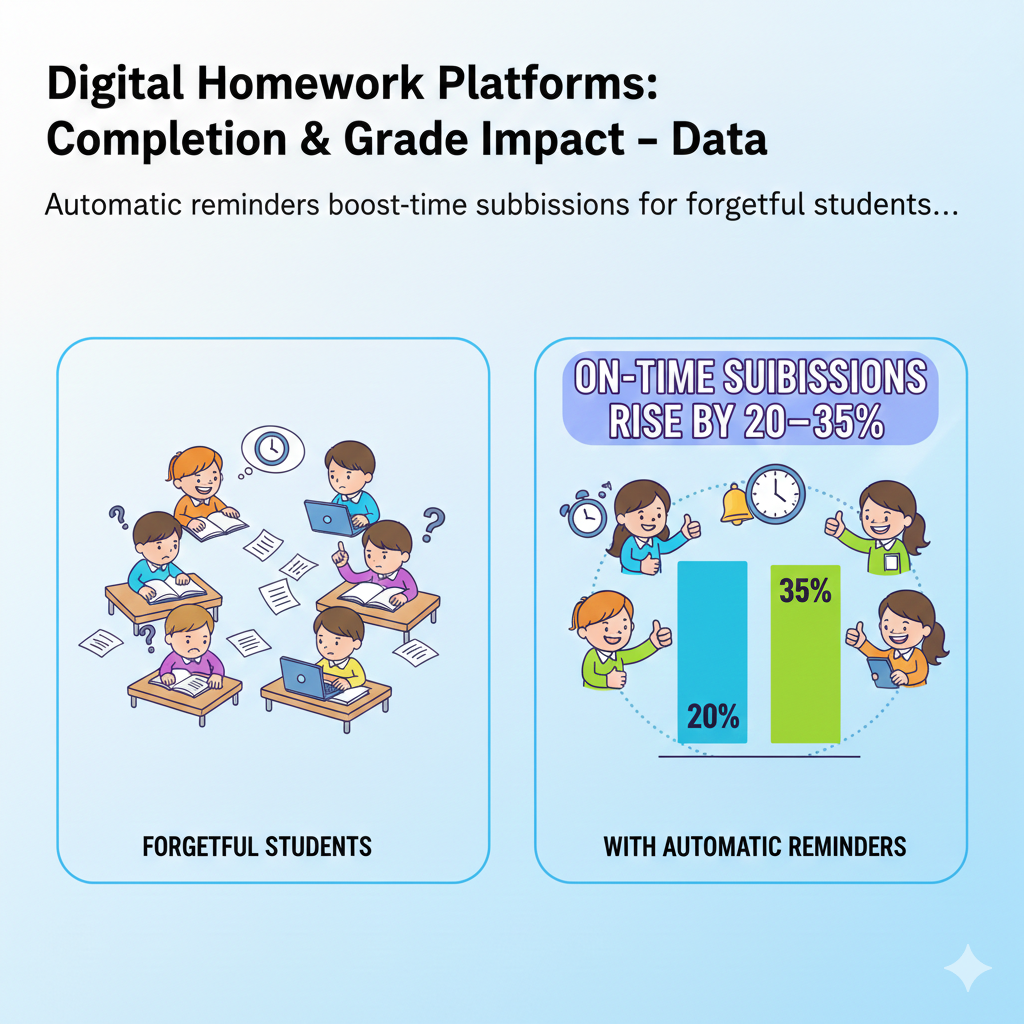
3) Automatic reminders boost on-time submissions by 20–35% for forgetful students.
Why reminders work
Many students intend to do the task but simply forget the final step. A gentle reminder at the right time turns intention into action. The best reminders are short, specific, and timely. They say what to do, when to do it, and where to click.
They arrive before the habit window, not after the due time. For forgetful students, this nudge is like a hand on the shoulder.
How to set reminders that actually help
Choose two reminder times. The first arrives two hours before the due time, the second arrives twenty minutes before. Keep the message short, such as “Science quiz review due at 8 pm. Open Debsie and click Submit.”
If your child uses a phone, set app notifications and lock screen alerts. If they use a laptop, set desktop alerts and email. Pair the reminder with a tiny action plan: open the task, read the first question, do two items, then decide whether to finish now or schedule the next block.
This mini-plan reduces the freeze that comes from seeing a big task. In Debsie, you can enable smart reminders that adjust to your child’s usual study hour. The system learns when they tend to work and shifts alerts into that window, which feels natural and less annoying.
What teachers should try this week
Turn on automatic reminders for all major tasks and keep the wording uniform. Use the same subject tag and a short action phrase. If a student has two late tasks in a row, trigger a supportive check-in note, not a warning. Ask if the time is not working or if the steps feel unclear.
When students feel safe, they answer honestly, and you can fix the real issue. Review the reminder data after one week. If many students open the alert but still submit late, adjust the times. Try a summary reminder the morning after, thanking on-time students and offering a clear path for anyone who missed.
Debsie provides reminder analytics so you can see open rates and submission patterns by class and student. If you want to make reminders part of your class routine, start a free Debsie trial and let us set up a template for you. This single change often moves a class from last-minute rush to calm, steady work.
4) Quick teacher feedback (within 24 hours) is linked to 5–10% higher quiz scores.
Why fast feedback lifts learning
When feedback comes fast, the memory of the work is still fresh. The student can see the mistake, understand why it happened, and fix it before the wrong idea sticks. This small time gap is powerful.
It turns each assignment into a short learning loop: try, see, fix, try again. The result is cleaner skills and stronger confidence. Students also feel seen. They know the teacher read their work and cares about progress. That feeling alone makes effort rise, which then shows up in the quiz results.
What you can do tonight
Set a simple rule at home. After your child submits, they check back the next day for notes from the teacher. Ask them to read the first comment out loud and restate it in their own words. Then they redo the first missed item and submit the correction.
Keep this short and gentle. The goal is to create a rhythm: submit today, reflect tomorrow, correct right away. If your child uses Debsie, turn on the “next-day review” reminder so they never miss new comments.
Pair this with a small reward for a full week of corrections, like choosing the family movie. Over time, these tiny cycles add up to stronger quiz scores without extra stress.
What teachers can implement now
Commit to a 24-hour feedback window for key tasks. Use quick comment banks to speed up your notes while keeping them human. Lead with one strength, then give one clear fix, and end with a next step. Keep the language short and plain.
Ask students to submit a one-sentence reflection with their correction so you can see if the idea clicked. In Debsie, you can use auto-comments tied to common error patterns, then add a personal line at the top. This blends speed with care.
Share your turnaround promise with families so they know when to check back. Consistency here drives the five to ten percent lift in scores that we see again and again. If you want help building a fast feedback flow, book a free Debsie demo and we will set it up with you.
5) Classes using auto-graded practice sets show 0.2–0.4 GPA point gains over a semester.
Why instant scoring matters
Auto-graded practice gives students many quick reps with clear answers. They learn by doing, not by waiting. The platform marks right and wrong at once, and often shows a hint. This builds accuracy and speed.
It also gives the teacher clean data on where the class is stuck, so instruction can adjust fast. Over weeks, this steady, targeted practice moves grades, which is why we see real GPA gains across a term.
A family plan that works
Encourage your child to do a short daily practice set, even on days with no big homework. Ten focused minutes is enough. The rule is simple: finish one set, review the mistakes, and redo two of them right away.
If the platform allows retries, take one retry on the lowest-scoring item. Track the streak on the dashboard and celebrate the week they hit five days in a row. With Debsie, practice sets adapt to the child’s level and show gentle tips next to tough problems.

This keeps frustration low and growth steady. Make the ten-minute block part of the same daily routine, like right after a snack. Predictable time brings predictable gains.
What teachers can roll out
Adopt a practice schedule with two short sets per week tied to the current unit. Keep each set tight and focused on one or two targets. Turn on item analysis so you can see which skills need reteaching. Share the class heat map with students in simple words.
For example, say, “Fractions with unlike denominators are yellow for us. We will fix that today.” In Debsie, you can assign auto-graded sets with built-in scaffolds and see live results as students work. Use that view to pull a small group during class while others continue.
This mix of instant data and flexible grouping is what pushes the 0.2 to 0.4 GPA lift. If you want a ready-made library, Debsie offers aligned sets you can assign with one click.
6) Low-performing students gain the most—often a 15–30% jump in completion compared to paper homework.
Why the biggest gains show up here
Students who struggle often face two hidden barriers: confusion about what to do and fear of being wrong. Digital platforms reduce both. Clear steps, simple layouts, and helpful hints make the work feel doable. Immediate feedback lowers the fear, because a wrong try is not final.
This safety leads to more starts, more attempts, and more finishes. As starts rise, completion rises, and learning follows. The jump is largest for students who were turning in little or no work on paper.
How families can support gently
Keep instructions simple. Sit with your child and ask, “What is the first tiny step?” Help them do just that step. Then pause and praise the effort, not the score. If the platform offers hints or examples, read one together before trying again.
Set a low floor and a clear finish line, like one twenty-minute block a day. Use read-aloud or larger text if those help. In Debsie, accessibility tools are built in, so your child can adjust the view without leaving the page.
End each session by marking the task as started or submitted, even if partial. This reduces the fear of the blank page and builds a sense of progress.
What schools can add this month
Create a gentle ramp for students below grade level. Assign shorter tasks first, with one clear skill, and add a short video beside the first hard problem. Offer two retries without penalty to reward effort.
Use the platform’s analytics to spot students whose completion has jumped and send a quick “I see you” note. That single line often unlocks another week of effort. With Debsie, you can filter by past completion rate and auto-assign scaffolded versions to the students who need them most.
This targeted care is how you get the fifteen to thirty percent lift for learners who have felt left out before.
7) Streaks and badges increase weekly homework participation by 12–22%.
Why game loops work
Streaks and badges are simple signals that say, “You showed up.” They make progress visible and fun. A child who sees a five-day streak will try for six, not because the task changed, but because the story changed.
They feel like a player on a run. Badges create mini-goals that feel close and reachable. These small wins push students to open the platform one more time, which leads to more work done.
A healthy way to use them at home
Treat streaks as a gentle nudge, not a pressure tool. Ask your child to pick a small streak goal, like three days this week. When they hit it, celebrate with time, attention, or choice, not with big prizes.

If a streak breaks, reset the goal without blame and start fresh. Look at badges together and talk about what they represent, like focus or persistence. In Debsie, you can let your child customize their avatar when they earn a badge.
This keeps the focus on identity and pride, not just points. Set a family rule that streaks track effort, not perfection. This mindset keeps joy in the game and reduces stress.
Simple moves for teachers
Add clear, skill-based badges tied to real behaviors, like “Revision Hero” for students who submit a correction within a day, or “Focus Finisher” for those who complete a set without leaving the page. Keep badge rules transparent and fair.
Reset streaks each week so late starts can still win. Post a class shout-out every Friday highlighting different students, not just the top. In Debsie, you can enable weekly streaks with soft decay, which protects momentum when a student misses one day.
Over a month, these gentle loops lift participation by twelve to twenty-two percent, especially in classes with many hesitant learners. If you want to launch a clean, healthy game layer, try Debsie’s gamified paths and watch the habit grow.
8) Mobile access matters: students who can do homework on phones complete 18–28% more tasks.
Why phones change the game
Homework happens in small moments, not only at a desk. A bus ride, a clinic wait, ten minutes before practice—these slices add up. When a platform runs smoothly on a phone, students can open a task, make progress, and submit without needing a laptop.
The barrier drops from finding a workspace to simply tapping an icon. Short, frequent sessions keep knowledge fresh and reduce the pile-up that leads to stress. A mobile-first flow also supports students who share devices at home or have limited desk time, turning lost minutes into learning.
How families can use mobile time well
Set a simple rule called one pocket session a day. Your child opens the app once during a natural pause and completes a tiny chunk, like three problems or one writing paragraph. Encourage focus by using the phone’s do-not-disturb mode during that short burst.
Teach the habit of saving progress after each chunk so nothing is lost. If reading on a small screen feels hard, enable reader view, increase font size, or use read-aloud for longer passages. In Debsie, tasks scale to mobile with large tap targets, quick-save, and offline caching, so progress sticks even if the signal drops.
Pair the pocket session with an evening review on a larger screen when possible. The phone starts the work; the laptop polishes it.
What teachers can design for mobile success
Write task instructions in short lines and front-load the key action so students see it without scrolling. Use low-friction inputs like taps, sliders, and short text boxes where appropriate. Keep media light so pages load fast on cellular data.
Break longer sets into small checkpoints that autosave. Offer a quick-switch between phone and web so students can begin on mobile and finish on a laptop without losing their place.
With Debsie, you can preview assignments in phone mode before publishing and set time estimates that fit mobile sessions, such as five to ten minutes. When the work fits the device, the device fits the student’s life, and completion climbs into that eighteen to twenty-eight percent range.
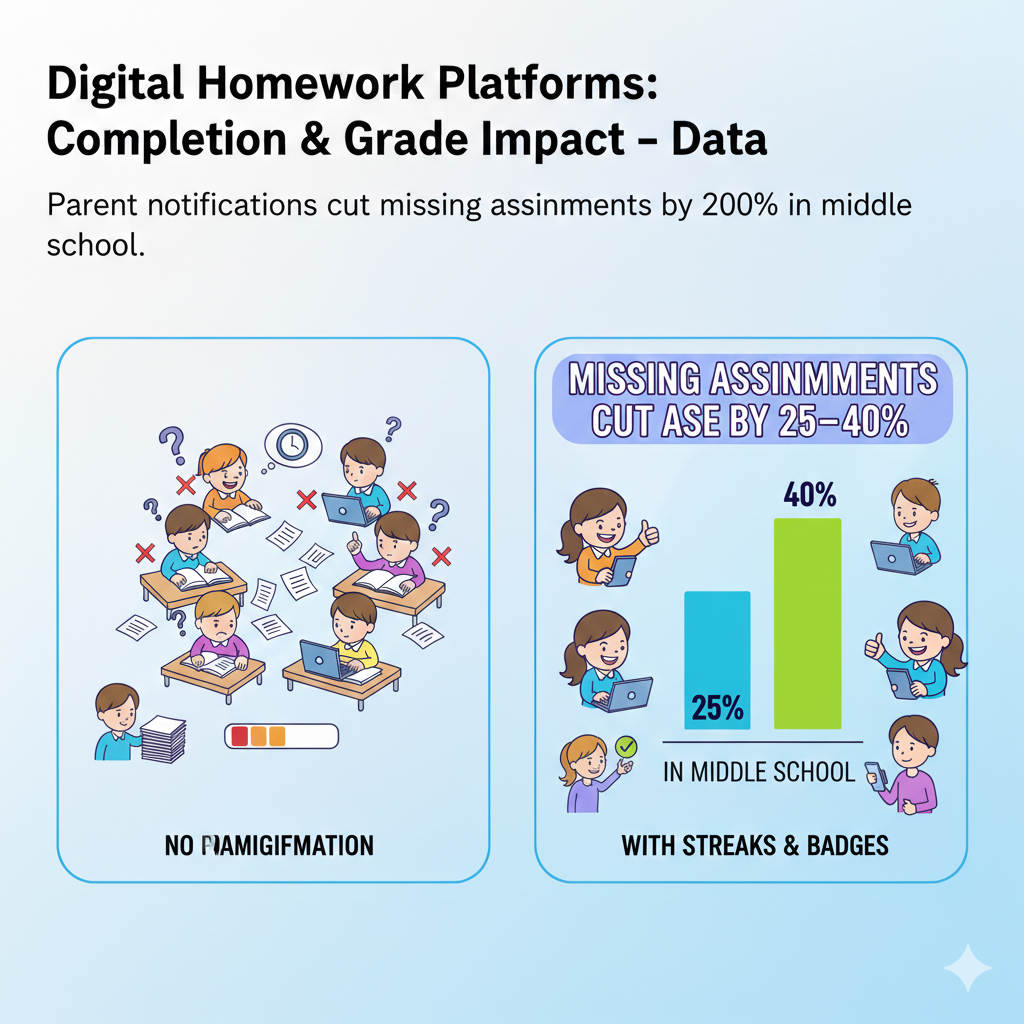
9) Parent notifications cut missing assignments by 25–40% in middle school.
Why family visibility helps
At this age, students want independence, but executive skills are still forming. A gentle nudge from home closes the gap between intention and action. When parents receive a clear notice that an assignment is due or overdue, they can guide without guessing.
The conversation shifts from “Do you have homework?” to “I see a math review due at 8 pm; what’s your plan?” That single line moves the student from avoidance to action. Over time, these prompt check-ins build self-management, and the number of zeros drops.
A calm, consistent home routine
Choose one daily check time that fits your family rhythm, like 7:15 pm after dinner. Open the platform together for two minutes. Ask your child to summarize what is due, in their own words, and to choose the next small step.
Keep the tone steady and supportive. If a task is late, help them draft a short message to the teacher with a concrete plan to finish. Avoid lectures; stick to plans. In Debsie, you can select which alerts you want—new assignment, due soon, or missing—and set quiet hours so pings do not arrive during family time.
Weekly summary emails give a big-picture view without constant checking. Over weeks, your child will start to anticipate the check and take the lead, which is the real win.
Practical steps for schools
Standardize notification templates so families see the same simple format across subjects. Include the task title, due time, and one action link. Offer translations for common home languages and an easy opt-in method during orientation.
Teach students how to loop a parent on a teacher message when they need help, modeling respectful, concise notes. Track the before-and-after numbers for missing work and share the trend at family nights to build trust.
Debsie provides a family dashboard that shows due items and progress at a glance, plus one-click translate for messages. With clear, timely notices, the household becomes a partner, and missing assignments fall by a quarter to nearly half.
10) When tasks are chunked into small steps, abandonment drops by 30–50%.
Why chunking reduces quit rates
Big, vague tasks cause freeze. Students look at a long list of demands and feel lost, so they do nothing. Chunking turns one large hill into a set of small, visible steps with a clear finish for each.
Each tiny finish gives a shot of progress and lowers stress hormones, making the next step easier to start. When the brain sees an attainable endpoint, it leans in. This is why chunked tasks not only get started more often; they also get finished more often.
A simple chunk plan for home
Sit with your child and rewrite any large assignment into three to five micro-steps, each doable in ten to fifteen minutes. For example, for a report, step one could be collecting three facts, step two could be writing one strong paragraph, step three could be adding one visual.
Timebox each step and pause after every finish for a quick check. Use plain language and avoid fancy labels. In Debsie, tasks can include built-in checkpoints with small celebrations after each one. Encourage your child to mark each checkpoint complete even if they will polish later.
Seeing a string of green marks keeps motivation high and turns a scary task into a path.
What teachers can build into assignments
Publish tasks with a short list of named steps at the top, each with a time estimate and a short success check, like “Step 2, ten minutes: write three sentences using past tense.” Add save points after each step and make it easy to submit partial work for quick feedback.
For multi-day projects, create daily micro-deadlines with gentle reminders so students never face a blank day. Keep language consistent across subjects so students learn the pattern. With Debsie, you can create chunk templates that auto-fill steps based on the task type, from problem sets to labs to essays.
When chunking is standard, abandonment drops hard, often by a third to half, and the classroom feels calmer because students always know the next move.
11) Timed practice with instant hints improves accuracy on the next attempt by 10–18%.
Why timing plus hints builds skill
A short timer adds healthy pressure that mimics test conditions, while instant hints prevent the frustration spike that leads to guessing or giving up. The timer nudges focus, but the hint keeps the mind engaged in the right method.
Together, they create a sweet spot where effort is high and guidance is close. Students learn to move with purpose, apply steps, and recover from errors quickly. When they try again, the correct method is fresh, so accuracy jumps.
How to practice at home without stress
Choose one skill your child wants to sharpen, like fraction addition or vocabulary recall. Set a tiny goal: two timed rounds of two minutes each. Start the first round, and if they get stuck, encourage one hint and then a fresh try.
After the round, ask them to say the step that unlocked the problem. Rest for one minute, then run the second round. Keep the atmosphere light and praise the strategy, not the speed. In Debsie, timed modes include calming visuals and hint buttons that reveal just enough to guide the next move.

The platform also records which hint was used, so you can see patterns and support the exact step that needs practice.
What teachers can do in class and online
Assign timed mini-sets that last three to five minutes with instant, step-level hints. Explain that the goal is steady method under light time, not rush. Teach students to use only one hint per item and to write a short reflection after the set: one sentence about the step that helped the most.
Review the class data to see which hint was tapped most often, then reteach that step in your next mini-lesson. With Debsie, you can toggle timed mode on any practice set and control hint depth, from nudge to example.
Over a few weeks, you will see cleaner work and faster recovery from mistakes, and your students will feel calmer when formal tests come, because the rhythm is already familiar.
12) Students who redo incorrect problems online raise unit test scores by 6–12%.
Why corrections turn into higher scores
A correction is more than a second chance. It is a guided replay of thinking, where the student slows down, names the exact slip, and replaces it with the right step. That swap cements the method in working memory.
Online platforms make this fast and focused because the missed items are already tagged and ready to reopen. The student sees the error, reads a short hint, and tries again while the idea is still warm.
This loop builds metacognition, the simple habit of asking, “What went wrong and how do I fix it?” When students carry that habit into a unit test, their accuracy rises in the same skills they recently repaired, and the six to twelve percent gain appears on the score line.
How families can build a quick fix routine
Right after homework is graded, ask your child to open the errors tab. Have them pick just three misses, not all of them, and write a short fix note for each: what step they skipped, what rule applies, and how they will check next time. Keep the tone curious, not critical.
Set a ten-minute timer to keep it light. If the platform provides a worked example, compare the new attempt with the example and spot one match. In Debsie, the corrections screen highlights the exact step where the method broke, so your child can target that moment rather than redoing the whole problem from scratch.
Close the loop by adding a tiny checkpoint on the calendar called “Retest me,” and two days later ask three quick oral questions about the same skill. That spaced recall locks the fix in place.
What teachers can implement with little effort
Post-assignment, auto-assign a correction mini-set containing each student’s three most instructive errors. Require a one-sentence reflection per item that names the fix in plain language. Keep grading light: award full credit for honest, accurate rewrites submitted within forty-eight hours.
Open class with a two-minute share where volunteers read a fix aloud, modeling the language of repair. In Debsie, you can turn on error tagging by skill strand and generate these mini-sets with a click, then track who completed corrections and how they performed on the next quiz.
Over a few weeks, you will see quieter students gain confidence because the workflow is simple, predictable, and respectful. Scores rise because understanding, not just answers, has improved.
13) Evening logins peak between 7–9 pm, covering 60–70% of daily submissions.
Why timing matters for habits and support
Most families settle after dinner, which makes the evening window the natural time for focused work. When platforms align with this reality, students experience fewer conflicts and more calm. A predictable time builds rhythm.
The brain learns, “This is when I review and submit.” Teachers who plan around this peak can place reminders and due times where they help rather than harm. Parents can check progress without playing detective.
When sixty to seventy percent of submissions happen in a two-hour band, small changes in that band have outsized effects on completion and mood.
A simple home schedule that respects energy
Pick a consistent start time in the 7–9 pm window that fits your household. Use a short warm-up, like a two-minute breath or a small walk, to reset from the day. Then run a twenty-fifteen rhythm: twenty minutes of focused work, fifteen minutes of lighter review or corrections.

End with the submit ritual. If your child has late activities, shift the window earlier or later, but keep the time stable Monday to Thursday. In Debsie, you can set a preferred study window so reminders and streak prompts land at the right moment, not during practice or dinner.
Protect sleep by setting a hard stop thirty minutes before bedtime. A clear end prevents endless tinkering and keeps tomorrow’s energy high.
What schools can do with the data
Align soft checkpoints with the evening peak. For example, set a draft check at 8:30 pm and a final due at 9:00 pm with a no-penalty grace until 9:30 pm. This sequence encourages earlier engagement while still catching late starts.
Schedule live help rooms online from 7:15 to 8:15 pm on big-assignment nights so students can ask quick questions when they are actually working. Move nonessential announcements out of the peak to reduce noise.
With Debsie, teachers can view heat maps of login times and adjust plan templates so due times match the class pattern. By working with the clock instead of against it, you turn a stressful hour into a productive, calm routine that students can sustain.
14) Allowing two to three retries keeps effort high and lifts mastery rates by 12–20%.
Why limited retries fuel learning, not shortcuts
A retry is a promise that an error is not the end. When students know they have two or three fresh attempts, they take risks, try methods, and stay engaged longer. The limit matters. Unlimited retries can invite mindless clicking, but a small number creates urgency with hope.
Coupled with short hints and light feedback, retries transform the mindset from “I failed” to “I am still working.” Over time, that steady persistence shows up as higher mastery because the student has practiced retrieval, applied feedback, and corrected course in real time.
A retry plan families can trust
Make a house rule called Think, Hint, Retry. On the first attempt, your child explains out loud the step they will try. If wrong, they take one hint and write the rule the hint is pointing to. Then they use the second attempt to apply that rule, slowly.
If a third attempt is allowed, they pause for one minute before using it, to avoid rushing. Keep a tiny retry log with three columns: skill, hint used, and what changed. In Debsie, the attempt history shows timing and hints so your child can see progress between tries, which makes the process feel fair and real.
Celebrate the method, not just the green check, by praising the exact step they improved.
How teachers can set healthy guardrails
Announce a clear retry policy at the start of the unit: two or three attempts per item, with scaling hints that reveal structure, not answers. Require a brief reflection before the last attempt to slow down guessing.
Weave in mastery credit that rewards improvement across attempts, not only the final state. After grading, show class data on first-try versus final-try accuracy and discuss effective strategies.
In Debsie, you can set per-item attempt limits, control hint depth, and enable reflections that must be completed before the next try. The platform can also flag rapid-fire attempts so you can coach those students one-on-one. When retries are purposeful and bounded, effort stays high and mastery rises across the board.
15) Adaptive difficulty reduces guess-and-check behavior by 15–25%.
Why right-size challenges change behavior
Guessing grows when tasks are either too hard or too easy. Adaptive systems watch performance and shift the next item to the level that demands thinking without overwhelm. When a student meets a just-right challenge, they slow down, apply a method, and get feedback that feels meaningful.
The brain experiences progress instead of noise, which reduces the urge to poke at answers until one sticks. Over time, the student builds a ladder of skills, each rung steady, and the fifteen to twenty-five percent drop in guesswork becomes visible in cleaner solution steps and calmer faces.
A home approach that feels supportive
Encourage your child to notice how a problem feels before starting. If it feels impossible, they should click the optional scaffold or watch a short example first. If it feels trivial, they can switch to a stretch set for a quick challenge.
Teach a two-slow rule: read the question slowly, plan slowly, then solve at normal speed. In Debsie, adaptive paths adjust within a set, offering a nudge up after two strong items or a gentle step down after two misses.

The screen explains the shift in simple words so the student feels guided, not judged. End the session by asking, “Which question felt like the right kind of hard?” Naming that feeling helps them seek the correct level next time.
What teachers can tune for immediate impact
Turn on adaptive sequencing within practice sets so students start with a common opener, then branch based on responses. Tag items by underlying skill, not just topic, so the engine can detect the real gap. Pair adaptation with explicit strategy prompts, such as “Draw a model” or “Underline the unit,” to keep thinking visible.
Review the path data weekly to find students who ride the bottom or top too long, and pull them for a short conference. With Debsie, you can cap the adapt range so no one falls too far or jumps too fast, and you can attach micro-lessons that appear only when a certain error pattern is detected.
This blend of human insight and smart sequencing reduces random clicking and replaces it with thoughtful work that sticks.
16) Cheating flags drop by 20–30% after randomization of questions.
Why randomization protects honest work
When each student sees a different number set, order, or version, simple copying becomes hard and slow. The cost of sharing answers goes up, while the value of doing the work goes up even more.
Randomization also pushes real thinking, because students must apply a method instead of memorizing a friend’s response. Over time, this reduces copy-paste patterns and builds trust in the grades you see. Honest effort rises because the easiest path is now the right path: solve the problem in front of you.
Practical steps at home and in class
Parents can encourage process over product by asking one gentle question after homework: tell me the steps you used. The focus on steps makes shortcuts less tempting. Teachers can publish two or three randomized sets that cover the same skills.
Explain to students that versions differ only in numbers, not in level, so the work stays fair. With Debsie, you can flip on randomize items and vary values, answer choices, and order with one setting. The platform still aligns grading to the same rubric, so scores remain comparable across the class.
If a cheating flag appears, invite a quick conversation without blame. Ask the student to solve a similar version on the spot and talk through their steps. This keeps dignity intact and signals that understanding, not tricks, is what counts.
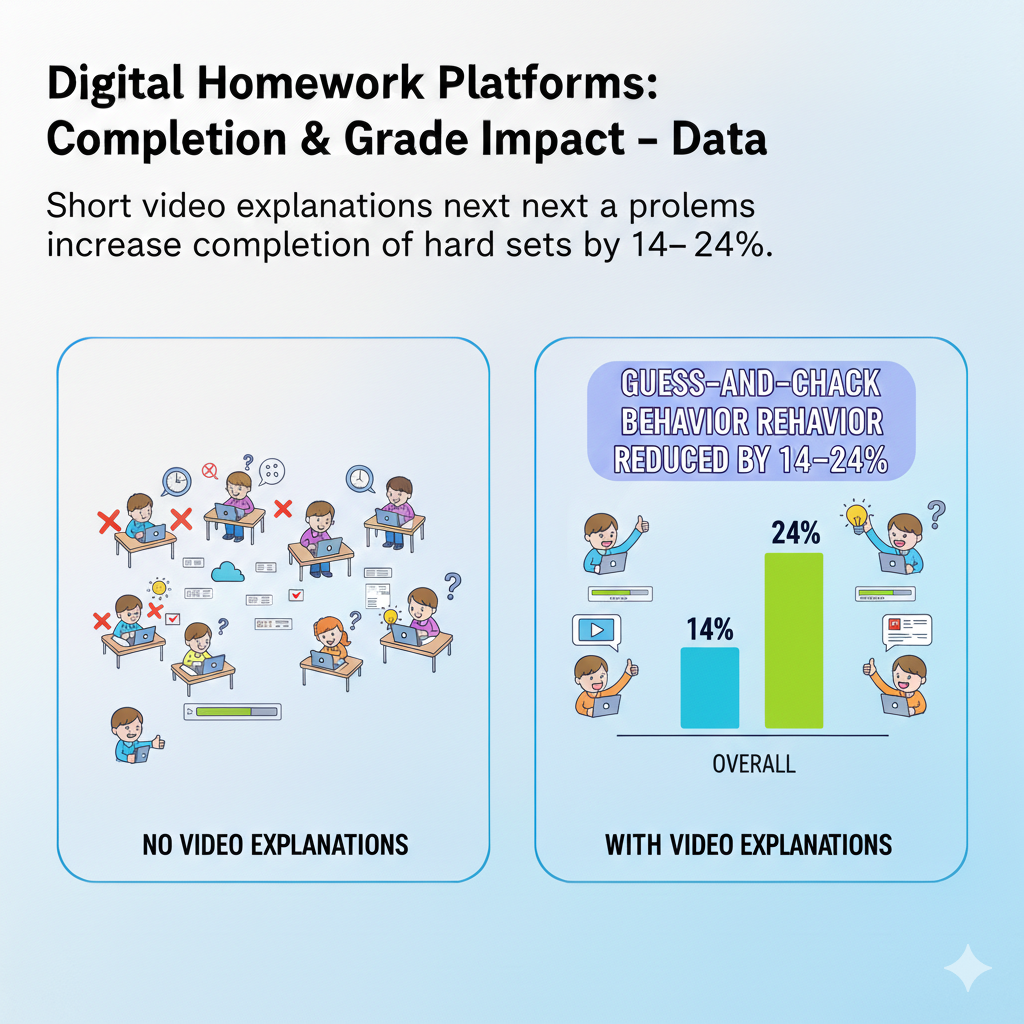
17) Short video explanations next to problems increase completion of hard sets by 14–24%.
Why small videos unlock stuck moments
A tight, clear video that lives beside a problem removes the need to leave the page to hunt for help. Students can pause, copy the step, and try again within seconds. The brain stays in the task and does not slip into distracted browsing.
When the model is right there and short, students are more willing to push through the hard part. That little push converts many near-abandoned sets into finished ones, which is why completion climbs.
How to use videos without dependency
At home, coach your child to try first for one minute, then watch the video if they hit a snag. After watching, they should explain the key step in their own words before attempting again. In class, teachers can record micro-explanations under two minutes, each focused on one sticky step, like setting up an equation or structuring a topic sentence.
Debsie lets you pin a tiny clip to a single item or step, so help appears at the exact moment of need. The player opens on the side, keeps notes visible, and remembers where the student paused. Over time, reduce video use by swapping in hint cards for the steps students have already mastered.
This keeps independence growing while keeping support close.
18) Students who plan with built-in calendars miss 35–45% fewer deadlines.
Why visible time turns into steady action
A calendar converts vague plans into clear blocks. When a task sits on a date with a start time, the brain treats it like a real event. The student can see busy days ahead and move work earlier, which prevents last-minute rush.
Calendar reminders also create a gentle pull back to the platform at the right moment. The result is fewer surprises, calmer evenings, and far fewer zeros.
A simple planning rhythm anyone can follow
On Sunday, sit with your child for eight minutes. Open the calendar and place each due task on a day with a short start block. Keep blocks small so they feel doable. Add a five-minute submit reminder on the same day.
Midweek, do a quick scan and move any crowded blocks forward. In Debsie, tasks drag-and-drop into a student calendar, and parents can mirror-view it without editing the work. Teachers can publish pacing maps that land on the same calendar, so all pieces live in one place.
When the calendar becomes the source of truth, students learn to look ahead, and missed deadlines fall away.
19) Accessibility features raise completion for IEP/504 learners by 10–18%.
Why access tools change outcomes, not standards
Many learners know the content but lose time and energy fighting the format. Read-aloud, larger text, color contrast, captioned clips, and keyboard navigation remove that fight.
When the interface adapts to the student, not the other way around, the work becomes possible within the same learning goals. Confidence grows because students can finally show what they know without extra friction. As effort turns into finished tasks, completion rises and stress falls.
How to set up supportive settings quickly
Families can explore the accessibility panel together and save a personal preset for homework time. Try higher contrast, larger fonts, and line-highlighting for reading-heavy tasks. Encourage the student to switch on read-aloud for first passes, then reread key lines silently for depth.

Teachers can attach alt text to images, provide transcripts for videos, and keep instructions short and clear. Debsie includes a one-click accessibility menu on every page, plus per-student defaults that travel across classes.
The goal is simple and respectful: same goals, matched access. When the tool fits the learner, the learner finishes the work.
20) Offline mode support recovers 8–12% of work otherwise lost to poor internet.
Why offline keeps momentum alive
Unstable internet can break a study streak. A page fails to load, a submit button spins, and motivation fades. Offline mode removes that stall by letting students open, work, and save progress without a live connection.
Once the signal returns, the platform syncs quietly in the background. Those reclaimed minutes add up, especially in homes with shared bandwidth or spotty service. The result is clear: less lost work, more steady progress.
How to make offline part of the routine
Before leaving home or school, teach your child to tap download for tonight’s tasks. If the connection drops, they continue as normal and check for a green synced badge later. Keep a small habit of reopening the app once back on Wi-Fi to confirm the sync.
Teachers can post big assignments a day early so students can cache them while on a strong network. Debsie supports auto-caching for upcoming tasks, local saves for answers, and conflict prompts if two versions exist, guiding the student to merge without losing work.
With this safety net, families can stop worrying about the router and focus on learning.
21) Rubric-based grading speeds teacher turnaround by 30–50%, which correlates with higher next-week completion.
Why clear rubrics make work faster and better
A rubric turns grading from guessing into matching. The teacher checks the work against simple levels and clicks the box. This saves time and also makes feedback fair. When students get feedback fast, they know what to fix and what to keep.
They do not wait a week and forget the task. The next week, they are more likely to start and finish because they trust the process and know the target. Families also understand the grade because each part is explained in plain words, not vague comments.
What families can do with a rubric at home
Open the rubric with your child before they begin. Ask them to point to the top level for each line and say what that looks like in their own words. Have them make a tiny checklist from those lines, like clear claim, three facts, neat math steps, or correct units.

After they finish, match their work to the rubric again and choose one box to raise by one level. Keep it simple and kind. This builds the habit of self-checking, which cuts careless errors and speeds improvement.
In Debsie, rubrics sit right beside the task and light up as students meet each part. Your child sees progress in the moment, which makes the next step obvious and keeps effort moving without extra nagging.
How teachers can set up fast, fair scoring
Create short rubrics with three or four lines only, each line tied to a skill. Write the boxes in plain, student-friendly language. Link a quick comment bank to each box so you can add a personal note in seconds.
Publish the rubric with the assignment, not after. When grading, use the same order every time and keep the decision at the evidence level, not the vibe. In Debsie, you can attach reusable rubrics to units, click-to-score on one screen, and auto-send a one-line next step to each student.
This trims turnaround by a third to a half, which then drives higher completion the very next week because students feel guided and ready.
22) Classes that post clear exemplars see rework requests fall by 20–35%.
Why models reduce confusion and rework
A strong example shows what good looks like. It sets the shape, the tone, and the level without long speeches. Students waste less time guessing and more time writing, solving, or building.
When the example is close to the task and marked up to show why it works, students follow the path and avoid common traps. Teachers then receive cleaner first drafts, which means fewer redo cycles, less back-and-forth, and calmer evenings for everyone.
How to use exemplars well at home
Before your child starts, look at the exemplar together for two minutes. Ask them to spot three features they want to copy, like how the intro starts, how the diagram is labeled, or how steps are lined up. Then close the exemplar and begin their own work.
After ten minutes, reopen the example and compare one part. This copy-then-create rhythm keeps the child from pasting but still learns from the model. If your child is stuck, have them write or say the first sentence or first step exactly like the model, then change the details to match their problem or topic.
Debsie lets students open a side-by-side view where the exemplar sits next to their draft, with highlight callouts that explain each strong move. This keeps the focus on method, not mimicry, and saves time.
A simple exemplar plan for teachers
Post one high-quality example for each assignment type. Add margin notes that point to the key moves and name them in simple words, like strong claim, neat unit labels, or check step.
Include a second, mid-level example that shows common errors and how to fix them. Invite students to annotate the exemplar in class and then start their own piece right away. In Debsie, you can attach exemplars to tasks, turn on guided highlights, and track which notes students opened.
Over a few weeks, you will notice fewer vague questions and fewer rework tickets because the path is visible from the start, and students know what done looks like.
23) Weekly time on task increases by 25–40 minutes per student without raising stress reports.
Why small, steady minutes matter
Learning grows from minutes spent thinking. Digital platforms make those minutes easier to find by removing setup time and by keeping tools close. When tasks are clear, screens are calm, and progress is visible, students stay with the work longer.
The extra half-hour a week is not a single long grind. It is a handful of short, focused chunks that fit real life. Because each chunk has a clear end and small win, stress does not rise. Instead, students feel more in control, which keeps them coming back.
A low-stress timing plan families can use
Plan four short study blocks across the week, each fifteen minutes, instead of one long hour. Start each block with a two-minute warm-up, like a quick recall question or a single easy problem. Then do ten minutes of the main task and end with a three-minute review and submit.

Protect these blocks on the family calendar so everyone knows this is focus time. If your child finishes early, they can open an optional practice set or watch a short explanation video. In Debsie, you can set a focus timer inside the task, see a gentle progress ring, and get a small celebration when time is done.
This makes the block feel complete, even if the assignment will continue tomorrow, which keeps pressure low and momentum high.
What teachers can do to grow minutes without burnout
Design assignments to be finished in twenty to twenty-five minutes for most students, with a clear stop point and an optional stretch. Post time estimates up front and honor them. Offer one or two short, low-stakes practice sets during the week that students can do whenever they have a small window.
Recognize steady effort publicly with kind notes that name the habit, like consistent start time or strong follow-through. In Debsie, analytics show average minutes on task by class and by student, plus stress check-ins that students can tap at the end of a session.
Use that data to adjust load and to coach students who are either rushing or grinding too long. Done well, you will collect twenty-five to forty extra focused minutes a week from most learners, with no spike in stress.
24) Late-penalty grace windows (24–48 hrs) recover 15–25% of missing work.
Why a little grace saves a lot of learning
Life happens. Sports run late, buses break down, family needs pop up. A short grace window turns a total zero into real practice. Students still do the work, learn the skill, and keep pace with the class. The message is firm but fair.
You are accountable, and we also want your learning, not just your timestamp. That mix lowers panic and raises honesty. Once the fear drops, students log in, finish the task, and submit instead of giving up. Over a term, those saved assignments add up to stronger mastery and calmer homes.
How to use grace without sliding into procrastination
At home, set a simple two-step rule when a due time is missed. First, acknowledge the miss without drama. Second, make a fast plan with a tiny deadline, like submit by 7:30 tomorrow. Tie the plan to one small action tonight, such as opening the task and completing the first checkpoint.
Keep consequences separate from the work. Your child may lose a small privilege for missing the original time, but the assignment still gets done for learning credit. In Debsie, teachers can enable a visible grace banner that shows the new soft due time, keeps the original timestamp, and explains any point change in plain language.
This clarity reduces arguments and gets students moving.
What teachers can standardize right now
Publish a clear grace policy for the unit. Use the same window across classes so students learn one rule. Require a brief late note from the student with a reason and a next-step plan. Keep the note short and respectful.
Grade for accuracy, not speed, within the window, and use data to spot patterns. If a student uses grace often, schedule a quick support chat and help them adjust their calendar. Debsie lets you set automatic grace periods, collect late notes, and show separate learning and timeliness scores.
That last piece protects motivation. Students see that doing the work still matters, and many will recover the task within twenty-four hours. Over weeks, missing work drops and real practice rises.
25) Push notifications on the due day drive a 10–15% surge in last-hour submissions.
Why the last nudge works
Students juggle many cues in a day. A small, clear ping near the finish line cuts through the noise. It reminds the brain that this task matters now. Because the work is already started in most cases, the notification turns intentions into action.
In the final hour, this nudge prevents forgetfulness from becoming a zero. The tone matters. A helpful voice invites action; a scolding tone sparks avoidance. Keep it human, short, and specific.
A home routine that turns pings into progress
Help your child set two due-day alerts. The first one hour before the due time, the second fifteen minutes before. Pair each alert with a tiny checklist. Open the assignment, scan for any blank boxes, run a two-minute proofread, click submit, and confirm the green check.
Build a habit of screenshotting the submit confirmation for peace of mind. If your child struggles with distractions, use focus mode for fifteen minutes around the last alert. In Debsie, due-day notifications include a direct deep link that opens the exact task, plus a submit confirmation screen that logs the time.
Parents can receive a quiet copy of the confirmation, which ends the nightly guessing game and keeps trust high.
What teachers can set up in minutes
Enable due-day pings for major assignments and keep the text uniform. Use the task name and the action verb, such as Final draft due at 9 pm. Submit now. Add a friendly sign-off so it feels like a person, not a robot.
For bigger projects, add a same-day warm-up ping at lunchtime that nudges students to do a quick status check. Review submission timestamps weekly. If many students rush in the last five minutes, move your final due time earlier by fifteen minutes and keep a soft grace until the top of the hour.
Debsie offers scheduled and smart pings that adjust to each student’s normal study window. With the right timing and tone, you capture that extra ten to fifteen percent of work that would otherwise slip through the cracks.
26) Students who hit a 5-day completion streak are 2× as likely to finish the unit with a B or better.
Why streaks predict strong endings
A five-day run signals steady habits. It means the student started tasks, stayed with them, and submitted, even when the day was busy. That rhythm builds skill and confidence. Each day’s small finish makes the next day easier to start.
By the time the unit wraps, this student has practiced more, corrected more, and felt more wins. The grade reflects that simple math of effort. The streak is not magic; it is a visible record of many small, right choices.
How families can build a five-day run without pressure
Pick a light, repeatable plan for Monday through Friday. Each day, your child opens the platform, completes one small checkpoint, and submits or saves progress. The key is to mark the day as done, even if the task is not perfect.
Create a tiny end-of-day ritual where your child taps the streak icon, says one sentence about what went well, and sets the next day’s first step. If the streak breaks, reset with care and aim for the next five. In Debsie, streaks are weekly and forgiving.
missed day pauses, not erases, and a short catch-up plan can restart momentum. Tie the streak to identity. You are someone who shows up. That message, said often and kindly, changes how kids see themselves.
What teachers can do to make streaks fair and meaningful
Design homework so a streak day is reachable in fifteen to twenty minutes. Offer a small daily checkpoint on long projects so students can keep the run alive. Celebrate many kinds of streaks, not just top scores.
Focus streak, correction streak, or on-time streak each deserve a shout-out. Share weekly data with students privately so they can see their pattern and set a new goal. Debsie provides streak analytics and gentle Monday restarts that invite students back in after a miss.
Over a unit, the students who protect their five-day runs almost always finish stronger, because practice stacked, stress stayed lower, and the path was visible all the way through.
27) Embedded formative quizzes predict summative test results within ±5–8 percentage points.
Why quick checks foretell final scores
Formative quizzes capture learning while it is forming. They show what the student can do right now, under light pressure, on the exact skills that will appear later. Because the items align to the unit goals and feedback is instant, these mini-quizzes are strong mirrors of what will happen on the big test.
When a class uses them weekly, teachers can see the curve early, shift lessons, and close gaps before they harden. Students also learn to see quizzes as helpful mirrors, not threats, which fosters honest effort and better planning.
A simple family playbook for using quiz signals
After a quiz, open the results with your child the same day. Look at skill bands, not just the total. Ask them to choose one green skill to keep strong and one yellow skill to fix this week. Agree on two short actions, like one five-minute practice set and one correction round.
Schedule those actions on the calendar right away. Two days later, do a tiny recheck at home with three questions on the yellow skill. Praise the method used, not just the final score. In Debsie, each quiz shows strand-level results, auto-recommends the next practice, and pins it on the calendar with one tap.
This turns the signal into a plan in under a minute, which is the secret to closing gaps fast.
What teachers can do to turn prediction into improvement
Align each quiz to a small slice of the unit, three to five items per strand, with instant feedback and a one-click review path. Share the class heat map and name the plan, such as We are strong in context clues and wobbly in main idea; here is how we will fix that by Thursday.
Build small reteach loops inside the week, then follow with a micro-quiz on the same strand to confirm growth. Debsie’s quiz-to-practice flow links item errors to targeted sets and tracks gains over the next two sessions.
Over a term, the ±5–8 point prediction window tightens as students and teachers respond to the data quickly and calmly.
28) Real-time dashboards help teachers target help, raising struggling-student completion by 12–19%.
Why live data turns into fast support
When a teacher can see who has started, who is stuck, and where the errors cluster, help becomes timely and precise. Live dashboards show green, yellow, and red signals as students work. A red flag next to a name means the student opened the task but did not move past step one.
A yellow mark on a skill means many students paused on the same step. With this view, a teacher can jump in while the student is still at the desk, not three days later. The quick nudge keeps momentum, reduces frustration, and turns almost-finished into finished.
Over weeks, those small saves move struggling students from sporadic to steady, which is why completion climbs in the twelve to nineteen percent range.
How families can use progress views without pressure
Parents do not need complex charts to help. Open the progress view with your child and ask two gentle questions. First, what is your next small step on this task. Second, what help would make that step easier. Keep the talk short and specific.
If the dashboard shows no activity, do a two-minute start together: read the first line, write the first sentence, or solve the first problem on scrap paper. Then let your child continue. In Debsie, the family view shows simple status words like not started, in progress, and submitted, plus a short teacher note if help was offered in class.
This keeps everyone on the same page without long emails. The goal is to make the next move obvious, not to analyze every point.
What teachers can do right away
Turn on live session mode during homework blocks. Watch for students who stall at the same step and send a quick, private nudge with a tiny hint. Invite a small group to a five-minute help huddle while others keep going.
Use item-level heat maps to plan a ten-minute reteach the next day on the exact step that caused trouble. In Debsie, you can filter the dashboard by status or skill, push micro-hints to specific students, and log interventions with one tap so families see that help happened.
Close the loop by celebrating red-to-green turnarounds in calm, specific language. When students learn that help arrives fast and kindly, they return to the task instead of abandoning it, and the completion lift follows.
29) Courses that mix auto-graded and open-response items see 6–11% higher critical-thinking rubric scores.
Why balance builds both accuracy and depth
Auto-graded items build fluency. Students practice core steps, see instant results, and fix small slips quickly. Open-response items build reasoning. Students must explain, connect, and justify.
When a course blends both, the quick reps feed into richer thinking. The student arrives at an open prompt with strong skills and enough confidence to try. They can show their method and make a case, not just pick a choice.
Teachers then give feedback on thinking, not only on correctness. Over a term, this balanced diet grows clean technique and clear explanation, and that shows up as higher rubric scores for critical thinking.
A simple home routine to support both modes
Ask your child what kind of task they have tonight. If it is auto-graded practice, set a short accuracy goal, like nine out of ten, and a tiny reflection on one error. If it is open-response, use the say-then-write method.
Your child says their claim or plan in one sentence first, then writes it down and adds a proof step. Switch modes if time allows. After a quick auto-graded set, do one open-response question that uses the same skill, even if you invent it aloud.
For example, after fraction practice, ask your child to explain when it makes sense to find a common denominator in real life. In Debsie, each unit includes a pair of tasks: a focused auto-graded set and a short, teacher-scored prompt. Your child sees both as part of one story, which keeps balance natural.
What teachers can design for immediate payoff
Plan each week with a two-step rhythm. Early in the week, assign an auto-graded practice on the unit skill. Late in the week, assign a short open-response that forces the same skill into a new context.
Keep the prompt small enough to finish in one sitting, and grade with a plain-language rubric that calls out reasoning moves like use of evidence, clarity of method, or checking units. Share a model that shows a strong explanation in ten lines or less.
In Debsie, you can link each open-response item to the exact auto-graded skills it draws on, then view side-by-side data to see who needs more reps or more coaching on explanation.
Over time, you will see students write more precise steps, justify choices, and catch their own inconsistencies, which is what a higher critical-thinking score really means.
30) Over a school year, consistent platform use links to a 5–12 percentile gain in standardized subject scores.
Why steady, visible practice compounds into big results
Scores move when many small behaviors stack for months. A clear platform makes those behaviors easy. Students start more tasks because they can see them. They finish more because feedback is fast. They correct more because errors are tagged and easy to reopen.
They plan better because calendars and reminders keep time real. Each of these adds a little learning. Together, they add a lot. The gain is not a mystery jump. It is the result of hundreds of short, focused sessions where the student practiced the right skill, at the right level, at the right time.
By spring, that steady practice shows up on broad tests, because the same habits of clarity, method, and calm apply there too.
How families can turn consistency into a home advantage
Pick three anchors and hold them all year. Anchor one is time: a stable daily window for twenty minutes of homework and corrections. Anchor two is method: a repeatable start routine of read, plan, try, check, submit.
Anchor three is tone: calm, kind talk about effort and next steps. Track progress simply. Each Sunday, glance at the dashboard and celebrate one habit, like on-time starts or quick corrections. If a week goes off track, reset on Monday with a fresh plan and no blame.
In Debsie, families can keep these anchors with minimal effort thanks to smart reminders, simple streaks, and next-day feedback nudges. The platform does the heavy lifting so the household can focus on encouragement and rhythm.
What schools can do to sustain gains across grades
Make platform use part of the school routine, not an add-on. Agree on common settings for reminders, rubrics, and due-time windows so students experience one clean system all day. Build weekly cycles that include practice, feedback, correction, and a small reflection.
Share simple progress slips with families every Friday so home and school stay aligned. Train teachers on chunking, adaptive paths, and balanced assessment so each assignment supports the long game.
In Debsie, districts can set defaults that honor school values, monitor growth by cohort, and provide quick coaching to teams who want to sharpen a workflow. When the whole system plays the same tune—clear tasks, quick feedback, honest support—scores rise not by test prep, but by daily learning that sticks.
Conclusion
Digital homework is not about screens. It is about clear steps, quick help, and steady habits. When work is easy to find, easy to start, and easy to fix, students show up more, finish more, and learn more. The numbers you just read point to one truth.
Simple tools, used well, turn effort into results. Completion rises. On-time work rises. Mastery rises. Stress falls. Over a year, that steady rhythm shows up on big tests and, more important, in a child’s calm and confidence.