
Learning loss is real, but it is not permanent. With the right kind of tutoring, students can get back on track faster than most people think. At Debsie, we have seen time and again that steady, focused help turns worry into progress. This article gives you clear, simple data on how fast students can recover, and exactly what to do next. Every section is a single, specific stat written in plain words. After each stat, you will find practical steps you can use at home or in school, starting today.
1) Schools that used high-dosage tutoring (3 times a week, all year) cut learning loss by about 50% in math within 8–9 months
What this means for your child
High-dosage does not mean long, painful days. It means short, focused lessons that happen often. Three sessions each week keeps skills warm, builds habits, and stops gaps from growing.
In eight to nine months, many students who were far behind in math can remove half of the gap. They do not leap in one giant jump. They walk forward with steady steps. Each session adds a little more understanding, a little more speed, and a lot more confidence.
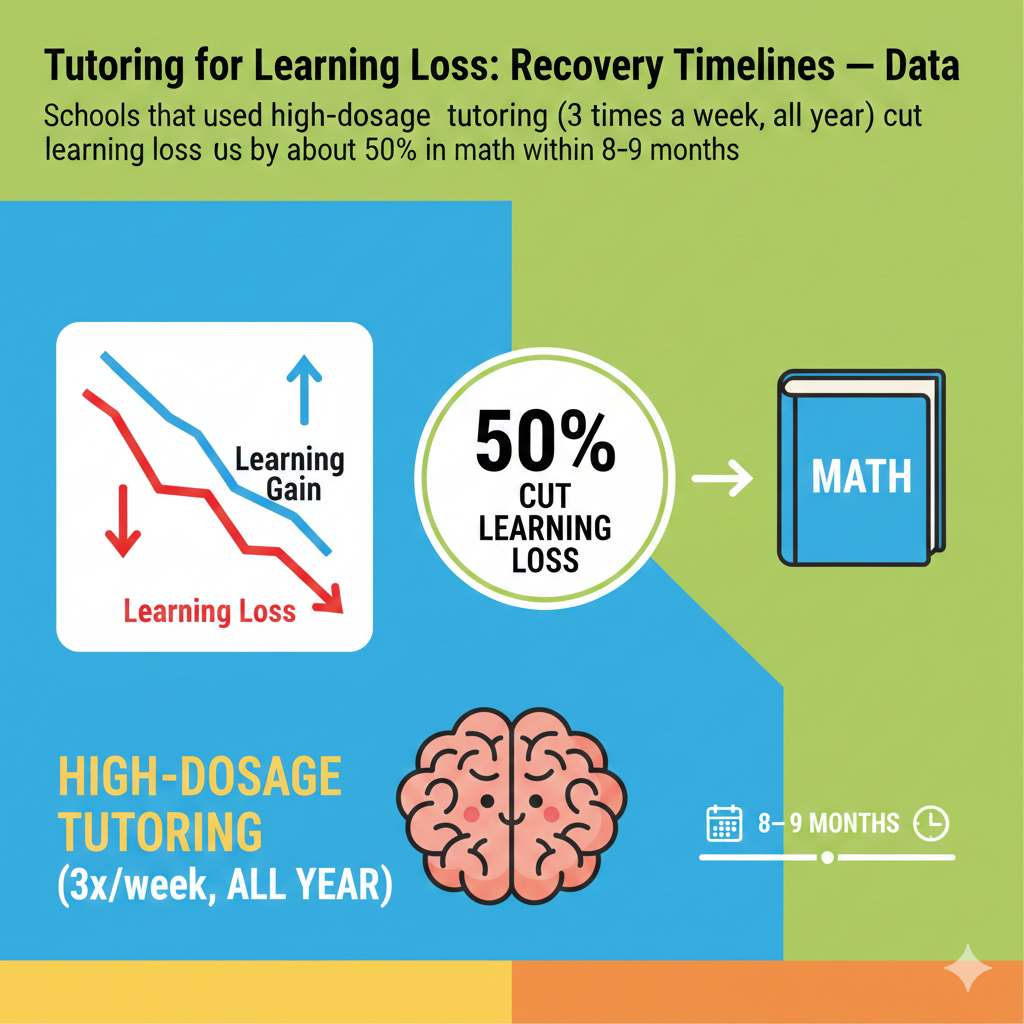
Daily school work alone may not fix deep gaps because class time is shared with many students. High-dosage tutoring gives your child time to think out loud, make mistakes in a safe space, and practice the exact skill they missed.
This is why progress speeds up. The tutor catches errors fast and turns them into learning moments right away.
How to put this into action
Set a fixed schedule with three math sessions each week. Keep each session between thirty and forty five minutes. Aim for the same days and times so your child’s brain expects the work and settles faster.
Tie sessions to real school goals, like the next unit test or the state standard for fractions. Use a simple plan for each week that includes review, new teaching, and mixed practice. Keep notes after every session about what worked and what needs more time.
At Debsie, we build these notes into the lesson flow so nothing gets lost between sessions. If your school uses a specific math book or platform, bring it to tutoring. Alignment cuts confusion and speeds up recovery.
End each week with a tiny win your child can feel, such as solving five word problems in a row or beating last week’s time on a facts set. Momentum is a powerful friend when you meet three times a week.
2) Reading tutoring delivered 2–3 times a week helped students recover about 3 months of reading skills in one semester
What this means for your child
Reading loss shows up in many small ways. Kids guess at words, skip lines, and get tired fast. When a trained tutor meets two or three times each week, the sessions target the exact part of reading that is weak. Some students need phonics.
Some need fluency. Others need vocabulary and comprehension. A good plan weaves these strands together. Over one semester, which is about four months, most students can gain the three months they lost.
That feels like getting time back. Confidence rises because text no longer looks like a wall. It begins to feel like a path.
Reading progress is not only about speed. It is about accuracy and meaning. Errors drop when lessons are tight and repeated across the week. The brain learns to map sounds to letters, to blend quickly, and to hold ideas across sentences.
This is why spacing the sessions matters. Practice today, rest, practice again, rest, then practice once more. The learning sticks.
How to put this into action
Start with a quick reading check that covers sounds, decoding, fluency rate, and comprehension with a short passage. Choose two or three focus skills for the first month. In every session, do a five minute warm up with known words to build ease, a ten minute phonics or decoding lesson if needed, a ten minute guided read on a level text, and a short talk about meaning.
Keep texts varied but at the right level so your child meets challenge without meltdown. Use repeated reading later in the week to build fluency, aiming to beat the first read by a smooth and steady pace, not by rushing. Track a few numbers such as words correct per minute, error types, and one or two new words learned.
Read aloud to your child at a higher level for five minutes each day to model rich language. At Debsie, we pair live reading with playful practice in our app so students see the same skills in new forms.
Keep sessions fun, short, and clear. With two to three meetings each week, the gains add up by the end of the semester.
3) When tutoring started within 4 weeks of school opening, students regained skills 2x faster than those who started after 12 weeks
What this means for your child
Time matters. Early start means faster catch up. The first month of school sets patterns for the year. If a child is behind and support begins at once, the gap does not harden. New units build on old skills. If the old skills are weak, the load grows heavy fast.
Starting within four weeks stops this spiral. Students relearn core ideas before bad habits form. They join class discussions with more courage and understand homework with less stress. When tutoring waits twelve weeks, the stack of missed ideas is taller. Recovery can still happen, but it takes longer.
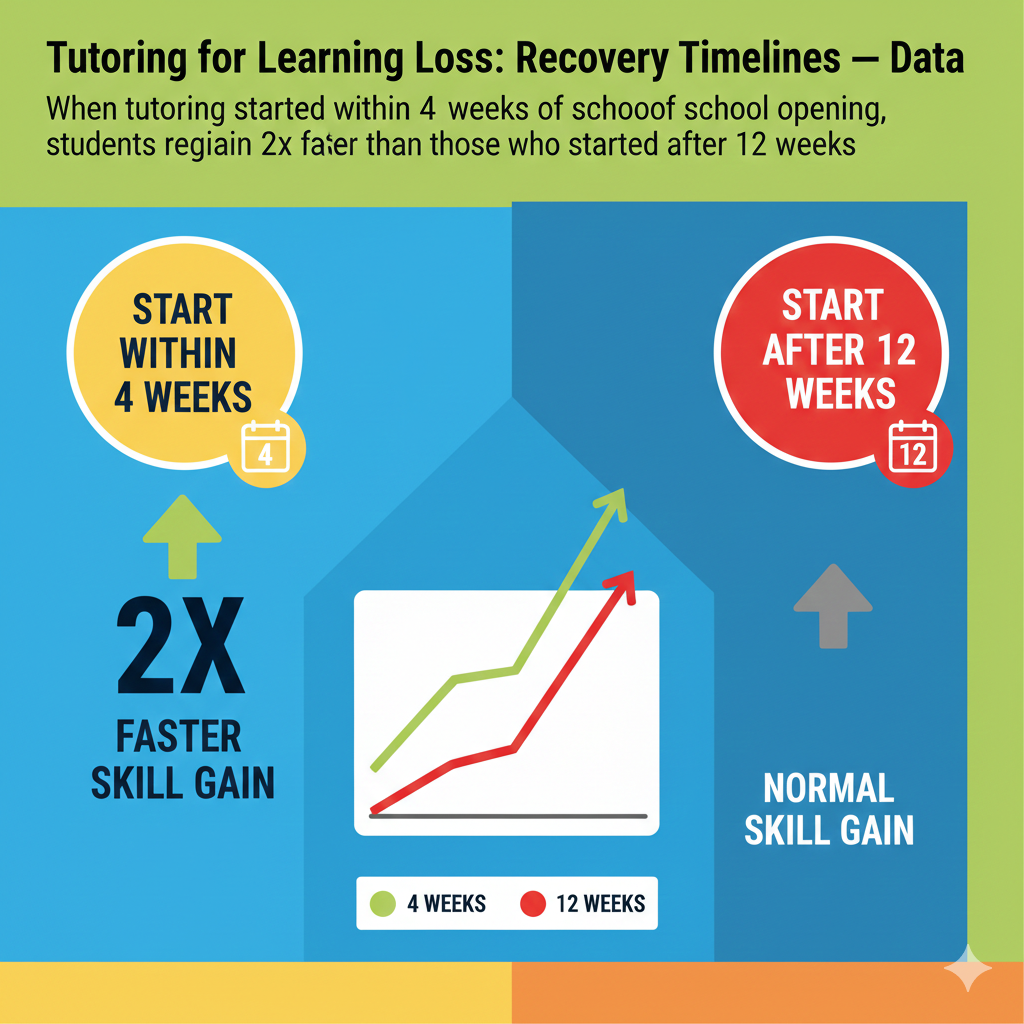
A quick start also helps with behavior and mood. Kids who feel lost in September may shut down by November. They may say they hate math or reading when the real problem is that no one helped early. Fast support shows them that adults are watching and ready to guide. That sense of care makes school feel safe again.
How to put this into action
Mark the school calendar now. Plan a check-in during the first two weeks. If your child struggled last year, book a baseline test in week one and begin sessions in week two. Choose two or three high-value skills to shore up fast. In math, that may be place value, number facts, or fraction sense.
In reading, that may be vowel teams, multisyllable decoding, or sentence-level comprehension. Keep lessons short and precise. Review school notes and preview next week’s unit so tutoring feeds class success. Check progress every other week and shift focus as needed.
Keep communication open with the classroom teacher so efforts line up. At Debsie, we set up families with a month-by-month map in the first meeting so there is no guesswork. The message is simple. If you think support might be needed, start now. The cost of waiting is higher than the cost of acting.
4) Students who received 90+ minutes of tutoring per week reached pre-pandemic math levels in about 12 months; those under 45 minutes needed 18–20 months
What this means for your child
Time on task is a lever you can actually move. When students get at least ninety minutes of math tutoring each week, spread across two or three meetings, they close gaps much faster. Twelve months may sound long, but it is one school year of steady growth that returns a child to grade-level math.
Less than forty five minutes a week can still help, yet progress slows because there is not enough time to review errors, practice new steps, and lock in the skill. The brain needs repetition that is spaced and guided.
Ninety minutes gives room for review, teaching, and practice without rush. It also builds routine. Routine lowers stress and raises focus.
This is not about making a child sit longer in one session. It is about consistent minutes that add up over the week. Think of it like fitness. Short, regular workouts beat a single long workout that happens once in a while.
In math, small steps done often train fluency and flexible thinking. Students see patterns, remember rules, and feel ready for tests because they have touched the ideas many times.
How to put this into action
Aim for three sessions of thirty minutes each week or two sessions of forty five minutes. Use a simple structure each time. Start with a quick spiral review of five mixed problems from older skills, move to the main lesson on one new focus, then finish with two or three word problems that tie the skill to real life.
Keep a skills tracker with a list of target standards and note the date your child showed accuracy without prompts. Plan each week around a specific milestone, such as mastering multi digit multiplication or adding unlike fractions.
Use timed but calm practice for facts, like two minutes of friendly sprints, to build speed without anxiety. If schedule is tight, stack micro sessions, like a fifteen minute problem talk after dinner plus a thirty minute Saturday lesson plus a short Sunday review.
At Debsie, our coaches design week plans that total at least ninety minutes using live teaching and quick app drills so families can flex the time while keeping the minutes high. Guard the minutes like a doctor’s appointment. When the minutes stay high, the months needed to catch up stay low.
5) One-to-one tutoring closed about 70% of the math gap in a single school year; small-group (1:3–1:4) closed about 50%
What this means for your child
Personal attention speeds learning. In a one to one setting, the tutor watches every step, hears every thought, and fixes mistakes the moment they appear. This tight loop turns confusion into clarity in minutes, not weeks.
That is why one to one can close most of the gap in one year. Small group tutoring still works well and often costs less, but the time each child spends speaking, solving, and getting feedback is lower. The gains are real, yet smaller, because the tutor must split attention and adjust pace for multiple learners.
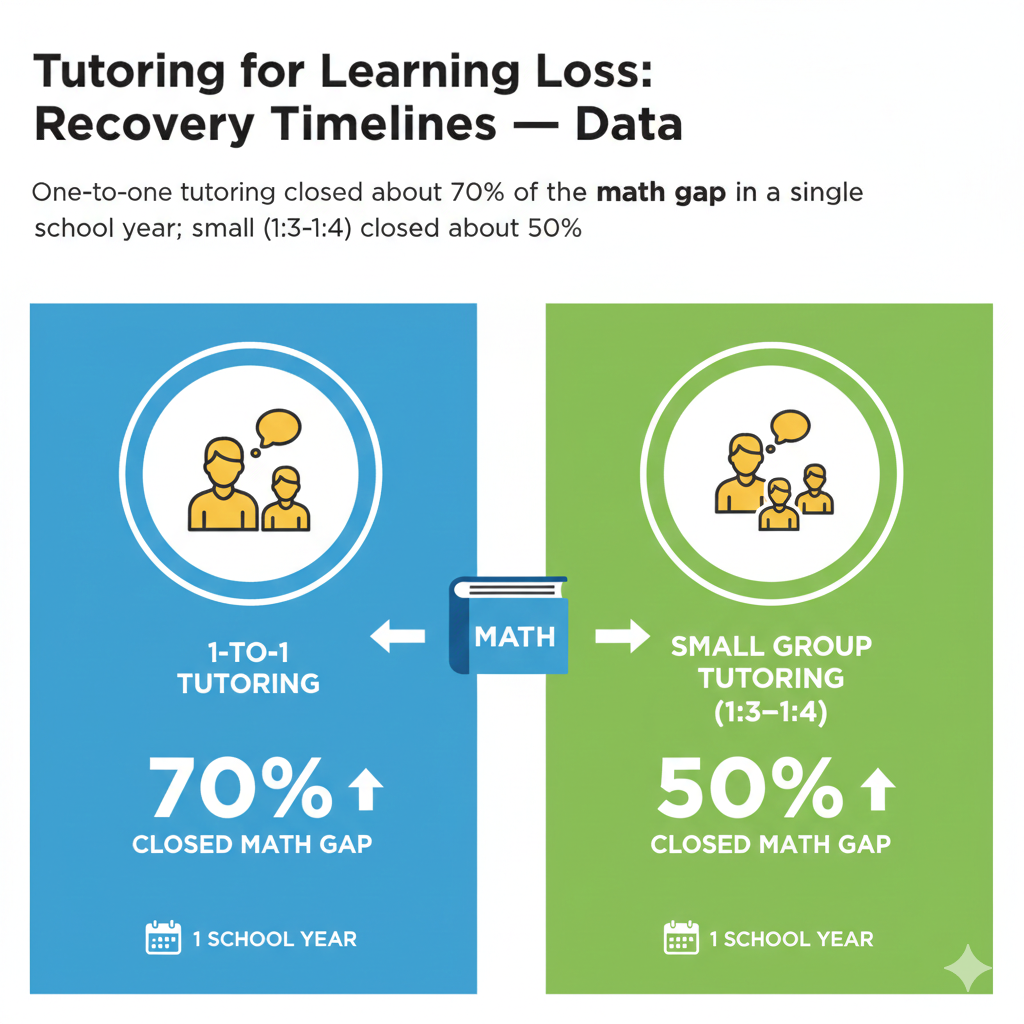
Choosing between formats is a practical call. If the gap is wide, the timeline is urgent, or the student gets anxious in groups, one to one is usually the best fit. If the gap is moderate and the student likes peers for motivation, a group of three or four can be a smart pick. The key is keeping the group small and the plan tight.
How to put this into action
Decide on the format using three questions. How far behind is my child. How much time do we have before key tests. What type of setting keeps my child focused. If you choose one to one, ask your tutor to run a clear diagnostic and design a custom map with weekly goals.
Request frequent checks, like a five problem exit ticket at the end of each session, so you see proof of learning. If you choose a small group, make sure all students are within a close skill band and are working on the same topic.
Keep groups stable so the tutor can plan sequences that build from session to session. In both formats, ask for talk time. Students should explain how they solved a problem in full sentences. This builds deep understanding and exposes hidden gaps.
At Debsie, we match students to either one to one or 1:3 groups based on the baseline data and the family’s timeline, then review placement after six weeks to ensure the pace is right. The goal is simple. Choose the setting that gets your child the most quality thinking time per minute.
6) Students below grade level by 1 full year at baseline needed 10–12 months with high-dosage tutoring to catch up; those behind by 2 years needed 18–24 months
What this means for your child
Timelines depend on the size of the gap. A student one year behind can usually catch up within a school year when sessions are frequent and focused. A student two years behind can still make strong progress, but the climb is longer because there are more missing blocks in the learning tower.
This does not mean the child is stuck. It means the plan must be steady, layered, and realistic. The first months rebuild core skills. Later months connect those skills to the current grade’s work. Along the way, the tutor protects confidence by showing visible wins each week.
A clear timeline helps families breathe. You can plan. You can explain to your child that progress has a path and a pace. You can set milestones and celebrate them. You can also avoid the trap of constantly switching programs, which wastes time and confuses the learner.
When everyone understands the expected window for recovery, the team stays patient and consistent.
How to put this into action
Start with a deep but quick diagnostic that maps which units are secure, shaky, or missing. Divide the year into phases. Phase one focuses on rebuilding the foundation, like number sense, operations, and key reading skills. Phase two blends in current grade topics.
Phase three pushes toward mastery and test readiness. Use short cycles of instruction. Teach one idea, practice it in fresh ways, then test for transfer with a new context. Track data weekly in a simple dashboard. Note accuracy, speed, and independence.
If your child is two years behind, increase minutes per week and hold the line on attendance. Add light, daily practice at home, like five minutes of number facts or a quick read aloud. Keep school alignment tight so class tasks double as tutoring practice.
At Debsie, we plan twelve week sprints with clear outcomes, then string these sprints across the year. Families see the map, the checkpoints, and the evidence of growth so hope stays high and effort stays steady. The message to your child is honest and kind. This is a climb. We will climb it together.
7) Tutoring attendance of 85% or higher led to about 40% more growth than attendance under 60%, measured over 6 months
What this means for your child
Showing up is a powerful learning tool. When students attend almost all sessions, the brain keeps the thread from one lesson to the next. There is less forgetting and less time spent catching up on what was missed. Over six months, this steady rhythm adds up to much more growth.
When attendance drops below sixty percent, gaps open inside the plan. The tutor has to reteach old content instead of moving forward. The student loses momentum and may feel stuck, even if the program is strong. Attendance is not just a number. It is the backbone of recovery.
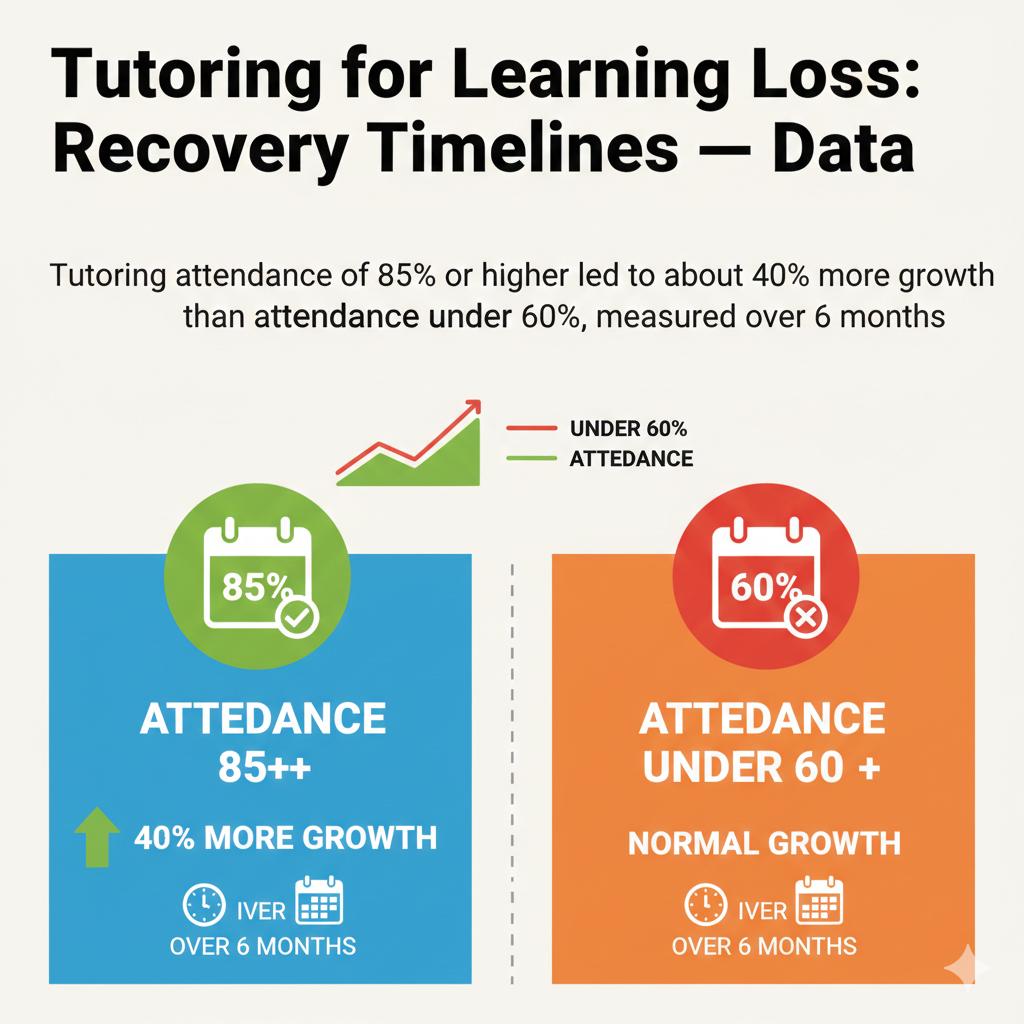
High attendance also builds trust and routine. The tutor learns your child’s patterns and can spot issues early. Your child learns that help will be there on set days, which lowers stress. When the mind is calm, it learns faster. A reliable schedule is a gift to a tired brain.
How to put this into action
Pick fixed days and times and protect them like you would a sports practice or a doctor visit. Set simple rules. Sessions happen unless there is illness or a true emergency. Place the sessions at a time when your child is alert.
Many families find early evening works well after a short break and a snack. Prepare before each session. Lay out a notebook, pencil, and any school materials. Reduce friction by having the meeting link bookmarked or the location set.
If a session is missed, reschedule within the same week so the chain of learning does not break. Celebrate streaks, like ten sessions in a row, with a small reward that matters to your child. Share the attendance goal with your child so they feel part of the plan.
At Debsie, we send friendly nudges, post quick recaps after each session, and coordinate make ups right away to keep the six month arc intact. Aim for eighty five percent or better, and watch the growth curve bend upward.
8) Daily, in-school tutoring (during the day) produced recovery about 6 weeks faster than after-school tutoring over a 9-month span
What this means for your child
When tutoring happens inside the school day, students are fresher, routines are tight, and support connects directly to class goals. This cuts wasted time and lowers the chance of missed sessions. Over a nine month year, that steady rhythm speeds recovery by about six weeks compared with after-school help.
In-school sessions also shorten the handoff from teaching to feedback. A skill taught at 10 a.m. can be practiced and corrected at 11 a.m. The brain links the ideas, stores them better, and carries them into the next lesson.
After-school sessions can still help, but they compete with fatigue, sports, transit, and family plans. In-school time removes those barriers and keeps learning first.
How to put this into action
Ask the school to schedule tutoring during a non-core elective or a flexible block, so your child does not miss key instruction. Request that the tutor sees your child on the same days and in the same room each week.
Share the classroom pacing guide so the tutor can pre-teach tricky topics before they appear in class. Have the tutor send a two line note to the teacher after each session with the exact skill practiced and one tip for class.
Keep the session tight: a two minute check of last lesson, a fifteen to twenty minute micro-lesson, and a ten to fifteen minute practice set that mirrors class tasks. Use quick wins your child can bring back to class the same day, like a solved exemplar or a sentence frame for explaining a solution.
If in-school time is not offered, try a hybrid plan: one session during school by arrangement and one short check-in after school. At Debsie, we often coordinate with school teams so our lesson lands right before the teacher introduces the matching concept.
That timing alone can add weeks of progress by the end of the year.
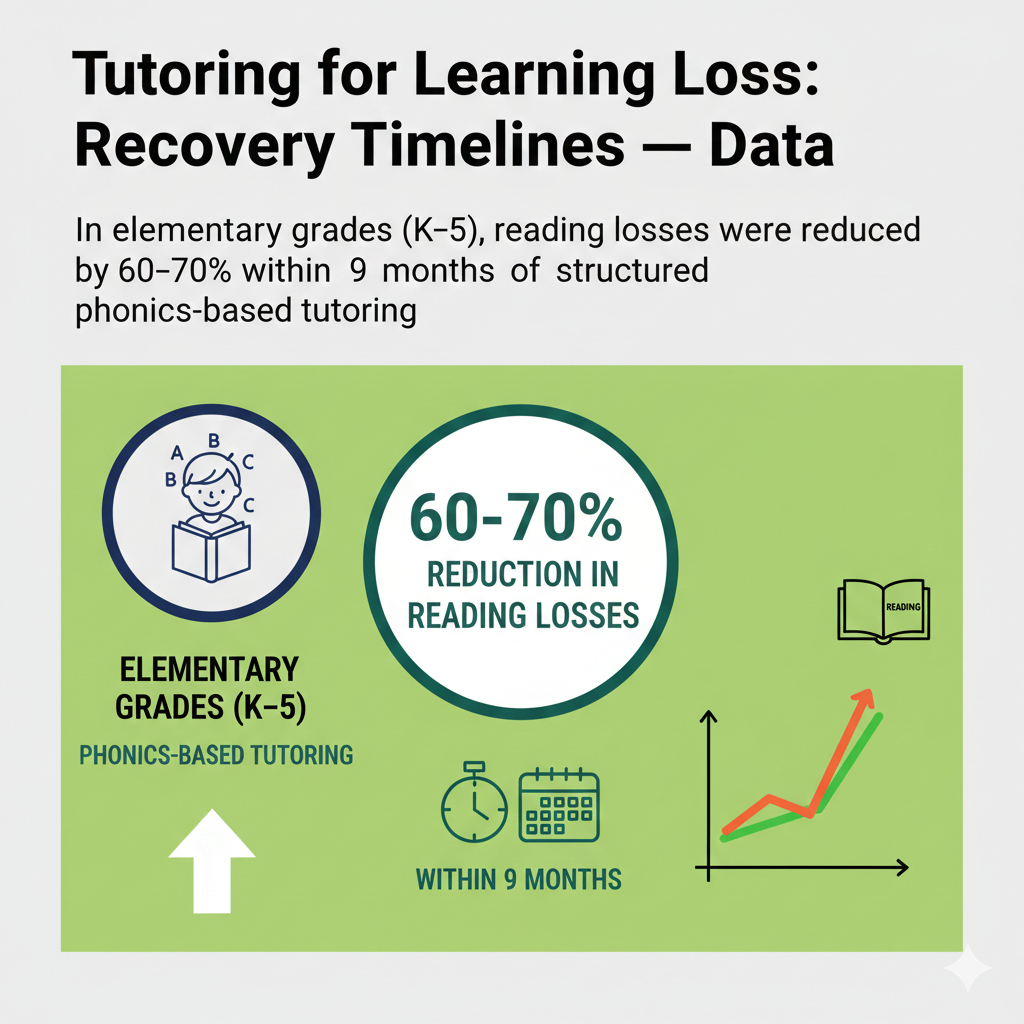
9) In elementary grades (K–5), reading losses were reduced by 60–70% within 9 months of structured phonics-based tutoring
What this means for your child
Young readers thrive on clear sound-to-letter teaching. When a tutor uses a structured phonics path, children learn how sounds map to letters, how to blend them, and how to break big words into parts. Over nine months, this approach can erase most of the loss from missed early instruction.
The gains show up in smoother reading, fewer guesses, and better understanding. Children begin to trust the code, not luck. They also build fluency because words become easier to decode on the first try. With ease comes joy. Books feel friendly again.
How to put this into action
Begin with a simple screen of letter sounds, digraphs, vowel teams, and decoding of real and nonsense words. Pick the first three phonics goals and teach them the same way each session. Use explicit routines: say the sound, trace or write the pattern, read a short list, and then read a decodable sentence that uses the pattern many times.
Keep the pace brisk and positive. Add phonemic awareness drills for one or two minutes, like say the word, break it into sounds, and blend it back. Transition to a short decodable text for guided reading, then a quick review of high-frequency words.
Track two numbers each week: accuracy on the pattern of the week and words correct per minute on a familiar passage. Send home a tiny practice strip with five words so families can help without stress.
At Debsie, our K–5 lessons follow a simple flow that repeats across months, because a steady routine frees a child’s mind to learn the content. After nine months, children who were once stuck at the start of second grade can often read strong second grade texts and are ready to push into grade-level books with support.
10) In middle school math (grades 6–8), students recovered about 4–6 months of learning in one semester with 1:2 tutoring
What this means for your child
Middle school math sits on a narrow bridge between arithmetic and algebra. Gaps in fractions, ratios, and negative numbers block progress in equations and functions. A 1:2 tutoring setup pairs two students of similar level with one tutor, which raises engagement and keeps costs in check.
In one semester, focused 1:2 sessions can restore four to six months of learning, especially when the plan targets the bridge skills that unlock everything else. The small peer group brings gentle pressure and shared talk, yet still gives plenty of personal feedback.
Students learn to explain steps and check each other’s reasoning, which deepens understanding and speeds transfer to new problems.
How to put this into action
Match the pair carefully. Keep the skill levels close and the goal the same, such as mastering fraction operations, ratio tables, and percent problems. Design each session with roles. One student explains while the other checks, then they switch.
Begin with three mixed review problems that pull from prior weeks, move into a short mini-lesson on a single target, and end with two application tasks that look like real test items. Use visual models before symbols. Ratio tables, number lines, and area models reduce fear and reveal patterns.
Tie every new skill to a simple sentence frame for math talk, like I scaled both numbers by or The sign changed because we crossed zero. Give short, low-stakes quizzes every other week that look like their classroom tests. Chart results so both students see the climb.
At Debsie, our 1:2 middle school blocks run for forty minutes and combine teacher-led modeling, partner talk, and quick independent checks. Over sixteen to eighteen weeks, we see students move from shaky arithmetic into early algebra with much stronger confidence.
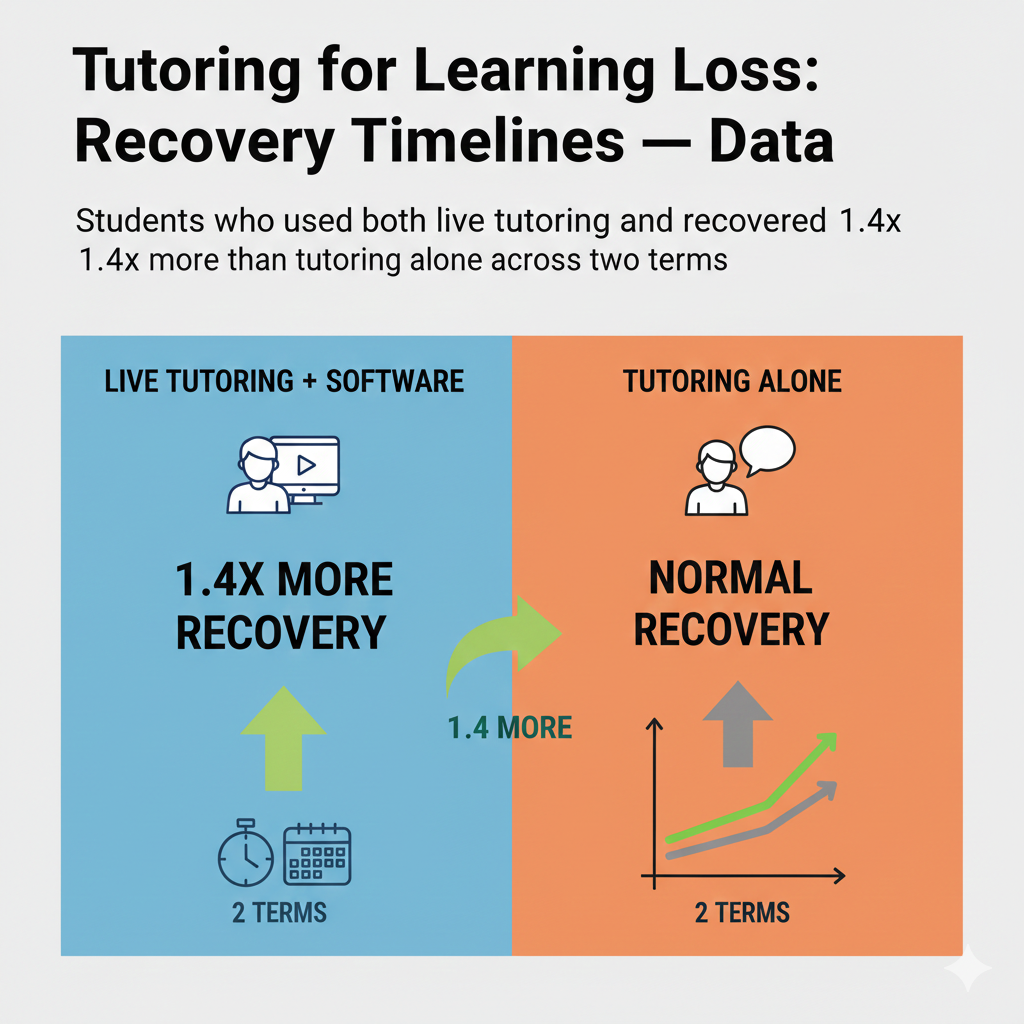
11) Students who used both live tutoring and practice software recovered about 1.4x more than tutoring alone across two terms
What this means for your child
Live tutoring is powerful because a real person listens, guides, and fixes mistakes in the moment. But the brain also needs many small reps to make new skills automatic. When we combine live lessons with smart practice software, students get both deep teaching and lots of quick practice.
Over two school terms, this mix leads to about forty percent more growth than live tutoring by itself. The reason is simple. Software gives instant feedback on easy-to-medium items, so the tutor can spend time on the hard thinking.
It also fills tiny gaps that pop up between sessions. The result is faster, steadier progress and fewer backslides.
Good software does not replace a tutor. It supports the plan. It keeps skills warm on days without a session, tracks patterns in errors, and shows when a child is ready to move up. It turns idle time into micro-learning time.
Most important, it helps the child feel in control because they can see their own score rise and levels unlock. That feeling of progress is fuel.
How to put this into action
Set a simple weekly rhythm. Pair two live sessions with three short software practice blocks of ten to fifteen minutes. Ask your tutor to assign the exact skills taught in the lesson so practice matches teaching.
Keep the difficulty at the just-right level where your child gets about eight out of ten correct and learns from the two misses. Review software reports once a week. Look for repeated error types, like missing regrouping in subtraction or skipping vowel teams in reading.
Bring those errors to the next live session so the tutor can reteach, model, and have your child explain the fix out loud. Use small, visible goals, such as clear three skill levels by Friday or maintain a daily streak.
At Debsie, we link our live plans to our practice paths, so the app you see at home mirrors the lesson your child just had. This tight loop makes every minute count and turns two terms into a strong comeback.
12) Tutoring that followed the school’s curriculum pacing restored skills about 30% faster than tutoring with unaligned materials over a semester
What this means for your child
Alignment is a time saver. When tutoring mirrors the order and language of the school’s curriculum, your child sees the same ideas in two places in the same week. The brain catches the pattern and stores it faster. Homework makes more sense because the steps match.
Unit tests feel fair because the practice looked the same. When tutors use different materials or a different order, children must translate the method and the words, which slows learning. The skill might be the same, but the path feels new each time.
That extra load can be heavy, especially for students who already feel behind.
Aligned tutoring also builds trust with the classroom teacher. Everyone pulls in the same direction. The tutor can pre-teach a tricky idea just before it appears in class, then revisit it after the lesson to lock it in. Over a semester, this adds up to weeks of time saved and higher scores on the exact tasks that count.
How to put this into action
Get the teacher’s unit calendar, vocabulary list, and sample problems. Share them with your tutor before the semester begins. Ask the tutor to keep a one page alignment map that lists each week’s classroom focus and the matching tutoring goals.
In each session, use problems that look like the ones your child will see on quizzes. Keep method language consistent. If the class uses number lines for integers or bar models for ratios, do the same in tutoring. When a different method is truly better for your child, teach it as an alternate path but still practice the class method for tests.
After each unit, run a short mastery check using the school’s style and scale. At Debsie, we teach with aligned materials and add our own visuals only to clarify, not to replace. This approach keeps cognitive load low, speeds up recovery, and makes the classroom feel easier right away.
13) Training tutors for 20+ hours before launch improved recovery speed by ~25% compared with under 5 hours of training in the first 12 weeks
What this means for your child
Tutoring works best when the tutor is not just smart in the subject but also trained in how children learn. A tutor with deep training knows how to diagnose gaps, pick the right next step, and explain ideas in clear, simple steps.
They also know how to build a routine that calms the mind and how to use checks for understanding without stress. When tutors get more than twenty hours of training before they start, they are ready on day one. They can move faster, fix errors cleanly, and keep the sessions lean and lively.
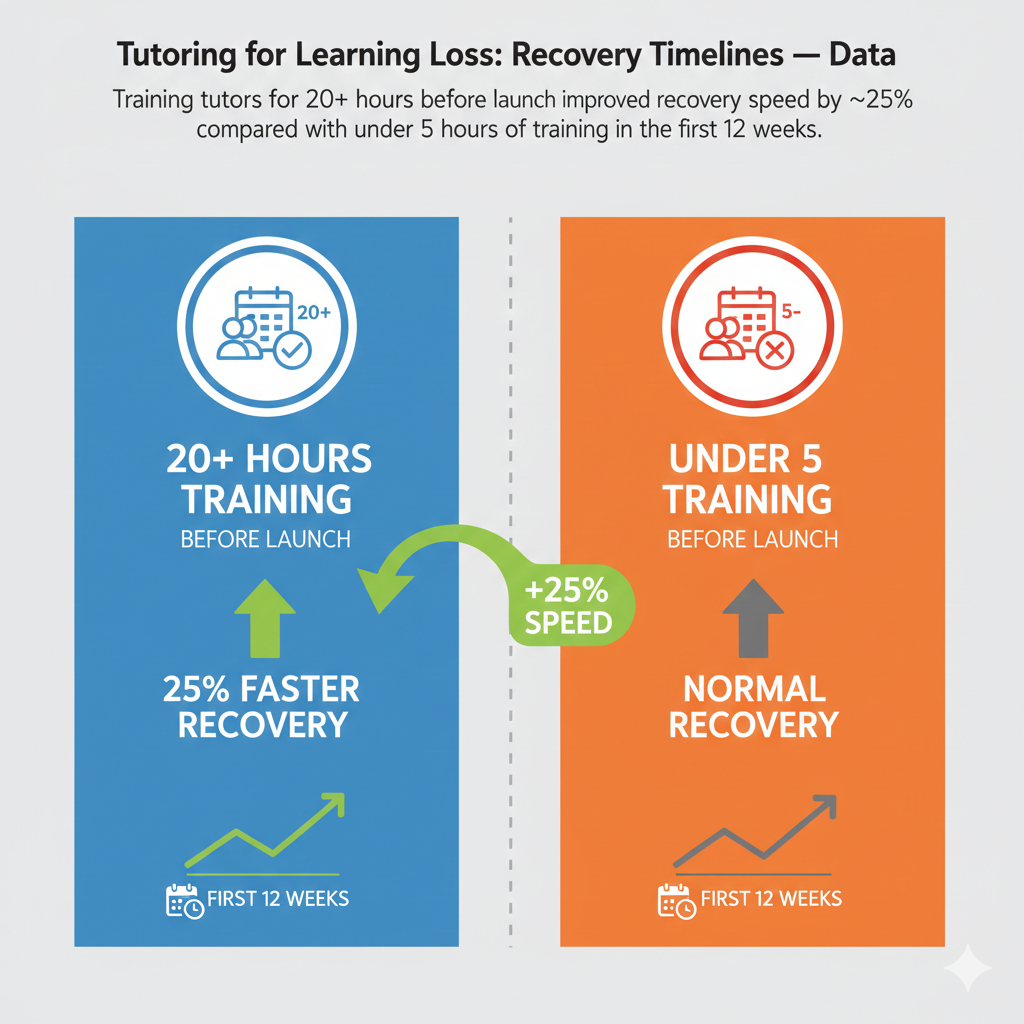
This shows up in the first twelve weeks as a faster pace of recovery.
Training also builds a shared playbook across a tutoring team. That means your child will see the same helpful moves even if a session gets covered by another coach. Consistency builds trust and saves time because your child does not need to adjust to a totally new style.
How to put this into action
Ask your tutoring provider about training hours and topics. Look for real practice time in the training, not just slides. Strong training covers diagnostics, lesson flow, error handling, talk moves, and data use. It should include practice with student work, role plays, and feedback.
During the first twelve weeks, expect your tutor to explain the plan clearly, to check for understanding every few minutes, and to adjust on the spot when your child struggles. Ask for a simple progress note after each session that names the skill taught, the error fixed, and the next step.
At Debsie, every tutor goes through a structured training path with live coaching, and we continue that support each month. Families feel the difference because sessions are tight, warm, and productive from the very first week.
14) Consistent pairs (same tutor, same student) improved math catch-up by ~35% versus rotating tutors across a school year
What this means for your child
Relationships drive learning. When your child works with the same tutor week after week, the tutor learns the small things that matter: how your child thinks, when they lose focus, what kind of prompt unlocks an idea, which words confuse them, and what cheers them up.
That knowledge saves minutes in every session. It also keeps your child calm, because they know what to expect and feel safe asking questions. Over a school year, those saved minutes and that steady bond turn into much faster growth, about a third more than when tutors rotate often.
Rotating tutors can break momentum. Each new person needs time to learn your child’s patterns and to rebuild trust. Small details get lost. The plan may drift. None of this is about effort. It is about the cost of switching. A consistent pair avoids that cost and keeps the plan tight.
How to put this into action
Choose a provider that assigns a primary tutor and a clear backup for emergencies only. Ask for a regular schedule with the same days, times, and virtual room or in-person spot. Share a short learner profile with the tutor at the start: strengths, triggers, interests, and goals.
Ask the tutor to keep a session log that captures the exact prompts and visuals that worked, so even the backup can match the style if needed. Build small rituals, like a two minute confidence warm up at the start and a victory recap at the end, so your child knows the flow.
If a change is unavoidable, request a formal handoff where the new tutor reviews the plan, watches a recording if possible, and meets your child briefly before the first full session.
At Debsie, we protect the tutor-student match as a core part of our model because we see how much faster students move when the relationship is steady and strong.
15) Students who completed 30 or more tutoring sessions showed about double the reading growth of students with under 15 sessions in one term
What this means for your child
Number of sessions matters because each meeting locks in a tiny piece of skill. Thirty or more sessions within a single term creates a steady drumbeat of practice and feedback. The tutor has enough touchpoints to teach, revisit, and test the same skill from different angles.
That is what turns shaky decoding into confident, automatic reading. Fewer than fifteen sessions often means long gaps between lessons, so progress fades before it can harden.
With more sessions, your child sees the same ideas again and again, but in fresh ways, which is how the brain decides this is important, keep it.
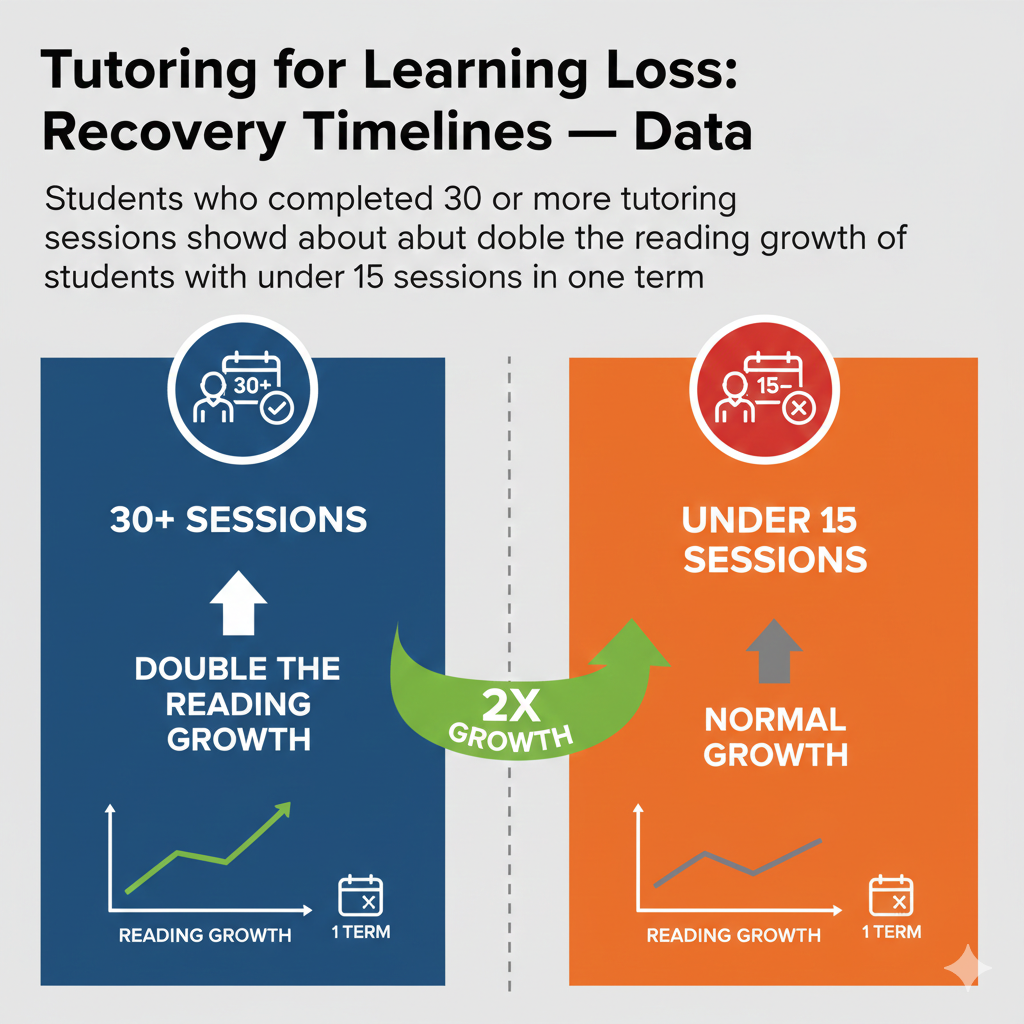
Doubling growth does not just mean reading faster. It also means fewer stalls on hard words, smoother phrasing, and stronger understanding of the story or article. The child spends less effort cracking the code and more effort thinking about meaning.
That shift is the heart of real reading growth and it shows up across subjects.
How to put this into action
Plan for three sessions per week across ten weeks to pass the thirty-session mark without stress. Keep each meeting short and lively, about thirty minutes, so energy stays high. Build a simple cycle that repeats: phonics or multisyllable practice, guided reading at the right level, and a quick talk to check understanding.
Use a running record every other week to track accuracy, errors, and self-correction. Celebrate session milestones like session ten, twenty, and thirty with a tiny ritual your child enjoys. If life interrupts, stack a make-up session within the same week so the pattern does not break.
At Debsie, we schedule term calendars up front, send reminders, and hold fast to the cadence because thirty touchpoints create momentum you can feel at home and in school. When you cross that line, growth speeds up and keeps going.
16) Ninth-grade algebra tutoring reduced course failure by ~30–40% and cut recovery time to pass benchmark tests from two semesters to one
What this means for your child
Algebra is a gatekeeper course. If a student struggles here, it ripples into geometry, algebra II, and science classes. Focused algebra tutoring changes the path. When a tutor targets core ideas like linear equations, slope, systems, and factoring, students stop guessing and start using rules that make sense.
The direct result is fewer course failures and a faster climb to passing benchmark tests. Cutting the recovery time from two semesters to one saves an entire half-year, which opens space for higher-level classes and reduces stress at home.
The big win is not just better test scores. It is the feeling that math has rules you can trust. Once a student sees that a line’s slope tells a story or that factoring is just reversing multiplication, they stop fearing algebra and start using it as a tool.
That mindset shift drives steady success across the rest of high school.
How to put this into action
Begin with a short algebra readiness check that probes integer fluency, fraction operations, and equation solving. Build a four-part session flow. Start with five quick review items, teach one new concept with a clear model, practice with gradually harder problems, and finish with a word problem that demands a full explanation.
Use graphing early and often so abstract symbols connect to visual meaning. Keep a formula bank, but teach what the symbols represent so memorizing is not the only plan. Give a mini-assessment every two weeks that matches the school’s benchmark style.
Chart progress and adjust the next lessons to close any weak spots. At Debsie, we front-load linear functions and systems because they show up everywhere in algebra, then spiral back to factoring once the basics are strong.
With a tight plan, the one-semester turnaround becomes realistic and your child steps into the next course with confidence.
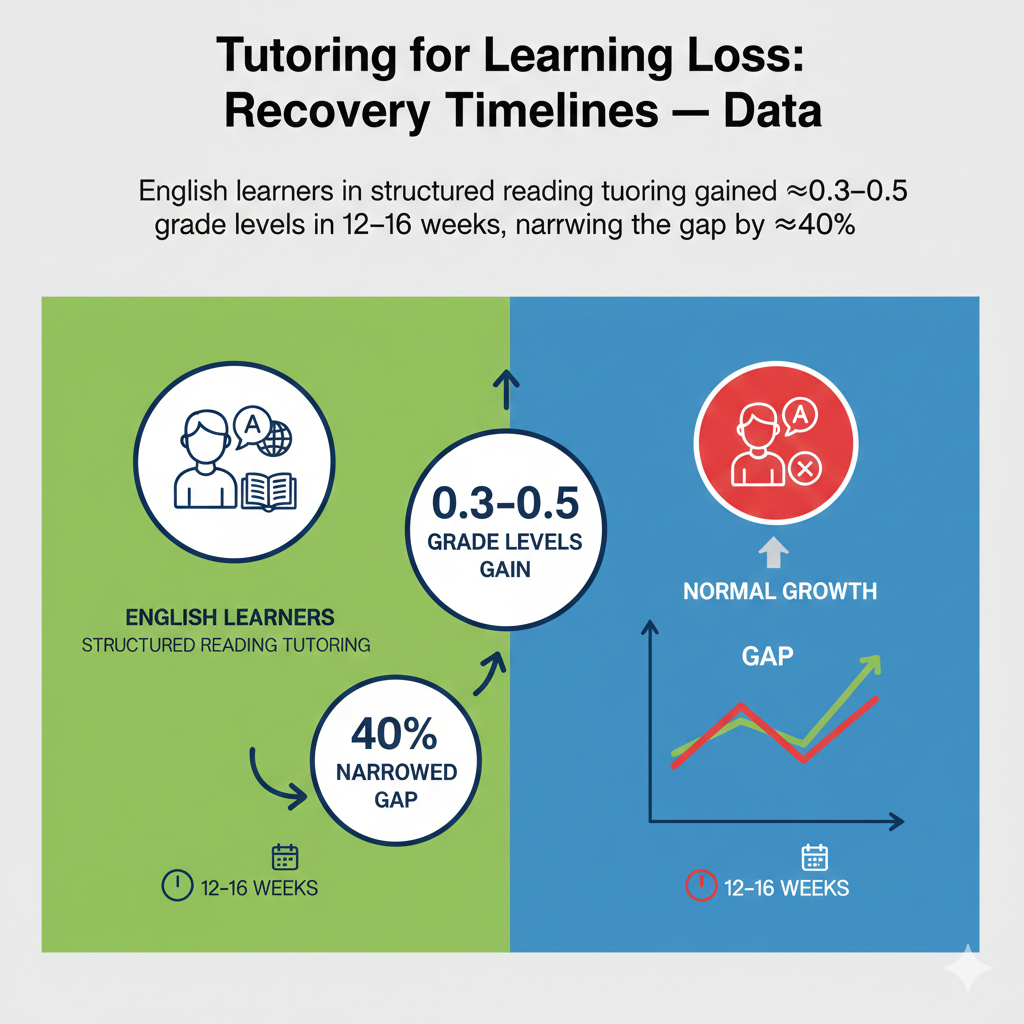
17) English learners in structured reading tutoring gained ~0.3–0.5 grade levels in 12–16 weeks, narrowing the gap by ~40%
What this means for your child
For English learners, reading growth needs two streams at once: decoding and language. Structured tutoring does both. It teaches sound-letter patterns and fluent reading while also growing vocabulary, phrases, and background knowledge.
Over three to four months, many students leap nearly half a grade level. That kind of gain narrows the distance to grade-level text and makes every class, from science to social studies, feel more doable. The key is careful pacing, lots of oral language, and repeated exposure to words in context.
These gains change how a child participates in school. When reading becomes smoother and vocabulary grows, they answer more questions, write clearer sentences, and follow directions more easily.
Confidence rises because they can finally show what they know.
How to put this into action
Choose texts that are decodable and content-rich. Build a routine that blends phonics with language. Start with two minutes of oral practice using sentence frames tied to the day’s topic, such as I predict the character will or The graph shows that.
Teach the phonics element of the day, then move into guided reading of a short passage that uses those patterns. Pause to pre-teach key words with quick visuals or gestures. After reading, use a one-minute retell to boost oral fluency and comprehension.
Keep a personal vocabulary notebook with drawings or translations for tough words. Send home tiny audio clips of the tutor reading key sentences so families can practice pronunciation together.
At Debsie, we also embed short speaking games that recycle new words across weeks because multiple encounters are what make language stick. With this plan, twelve to sixteen weeks can produce a visible, encouraging jump.
18) High-dosage math tutoring (3–5 days/week) converted 1 school year of loss into ~9–10 months of recovery within a single year
What this means for your child
When a student has fallen a full year behind in math, it can sound overwhelming. High-dosage tutoring changes the math of the situation. Meeting three to five days a week gives enough touchpoints to rebuild number sense, close gaps in operations, and push into grade-level content, all within the same year.
Instead of drifting from topic to topic, the plan moves like a train on a track. Every day adds one more piece, and there is less time for forgetting. By year’s end, most of the lost ground is recovered, bringing the child within reach of full grade-level mastery.
The daily cadence matters because math fluency is like a language. You need to speak it often. When problems, models, and explanations happen every day, patterns appear. The student begins to anticipate steps, spot errors, and check their own work.
That self-correction is the sign that learning has moved from short-term to long-term memory.
How to put this into action
Choose a schedule you can sustain. If five days is too much, commit to four, and add a short weekend check. Keep sessions compact, around thirty minutes, to protect focus. Use a running spiral: a tiny review from yesterday, a direct lesson on one new idea, mixed practice with immediate feedback, and a quick reflection where the student names the rule they used.
Track three metrics weekly: accuracy on target skills, time to solve, and independence. Post a visible progress chart so your child sees the climb. Align with school units so the daily work pays off on quizzes. If you hit a wall, slow down for two days and attack the stuck point from a new angle, such as using a number line or tiles.
At Debsie, we script week plans that stack in a logical sequence and we keep the same tutor guiding each step, which is why daily tutoring can convert a full year of loss into nearly a full year of recovery. Momentum, clarity, and routine do the heavy lifting.
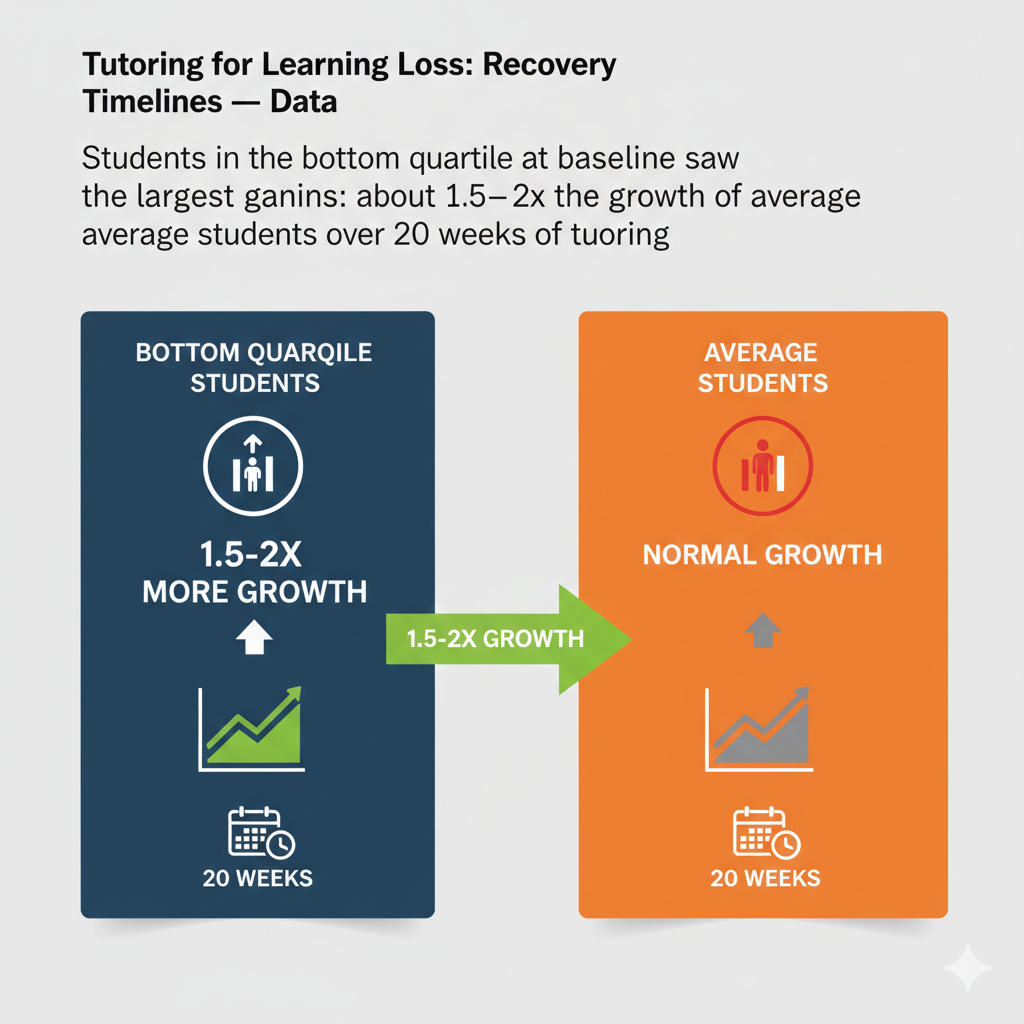
19) Students in the bottom quartile at baseline saw the largest gains: about 1.5–2x the growth of average students over 20 weeks of tutoring
What this means for your child
Students who start far behind often grow the fastest once they get focused help. This is not a surprise. They have many easy-to-fix gaps, and every small fix unlocks a new skill. Over twenty weeks, which is about half a school year, these learners can make one and a half to two times the growth of peers who began closer to grade level.
The key is targeted teaching that meets them right where they are. When a child finally gets clear instruction on the exact stumbling blocks, strain drops and effort rises. They stop guessing and start applying rules that make sense. This turns into quick wins that stack up.
These gains change more than scores. Students who once felt lost begin to participate. They ask questions because they now believe they can understand the answer. They try hard work because success no longer feels random.
Belief and skill rise together. That shift is priceless in middle school and high school, when identity and motivation are still forming.
How to put this into action
Begin with a short but sharp diagnostic that flags the top three blockers. In math, that might be place value, fraction sense, or integer rules. In reading, it could be vowel teams, multisyllable decoding, or main idea.
Build a twenty-week arc with four or five mini-sprints. Each sprint focuses on one blocker and ends with a quick mastery check. Keep lessons tight and visual, then move to mixed practice so the skill shows up in new forms.
Track micro-wins each week, like solving comparison word problems without help or reading a full page with only two miscues. Share progress with your child in plain words and show a simple graph so they can see the climb.
Add short daily practice, five to ten minutes, to keep gains warm between sessions. At Debsie, we lean into early momentum for bottom-quartile students by front-loading quick-win skills and celebrating every step forward. The message is steady and clear. You are growing faster now because the work finally fits your needs.
20) Remote (live online) tutoring matched ~85–95% of in-person recovery when sessions were video-on and materials were shared live, over one semester
What this means for your child
Online tutoring can be almost as effective as in-person support when it is done the right way. The gap closes when cameras are on, screens are shared, and tools allow both student and tutor to write, highlight, and move shapes in real time.
Over a semester, this setup reaches about eighty five to ninety five percent of the growth seen in face-to-face sessions. For many families, this means no travel, easier scheduling, and fewer missed meetings. It also means access to the right tutor, not just the closest one.
The quality of the online environment matters. If the session is passive or the tech is clunky, attention drops and learning slows. But when the session feels like a live, shared workspace, the mind engages the same way it would at a whiteboard table.
The tutor can still see confusion on a face, hear the pause before an answer, and jump in at the exact moment help is needed.
How to put this into action
Set up a quiet spot with a stable connection, a large screen if possible, and a simple notebook on the side for quick sketches. Keep the camera on to build connection and accountability. Use headphones with a mic to lower noise and raise focus.
Ask your tutor to use an interactive board so your child can write and draw, not just watch. Share the day’s classwork or textbook pages on screen and work directly on those tasks whenever possible.
Build small rituals that make online time feel human, like a short check-in at the start and a one-minute celebration at the end. Keep sessions short and frequent to match attention spans. At Debsie, our live platform is built for two-way work, with quick tools for number lines, arrays, sentence frames, and annotation.
When tech supports real interaction, online learning feels natural and the recovery curve looks very close to in-person results.
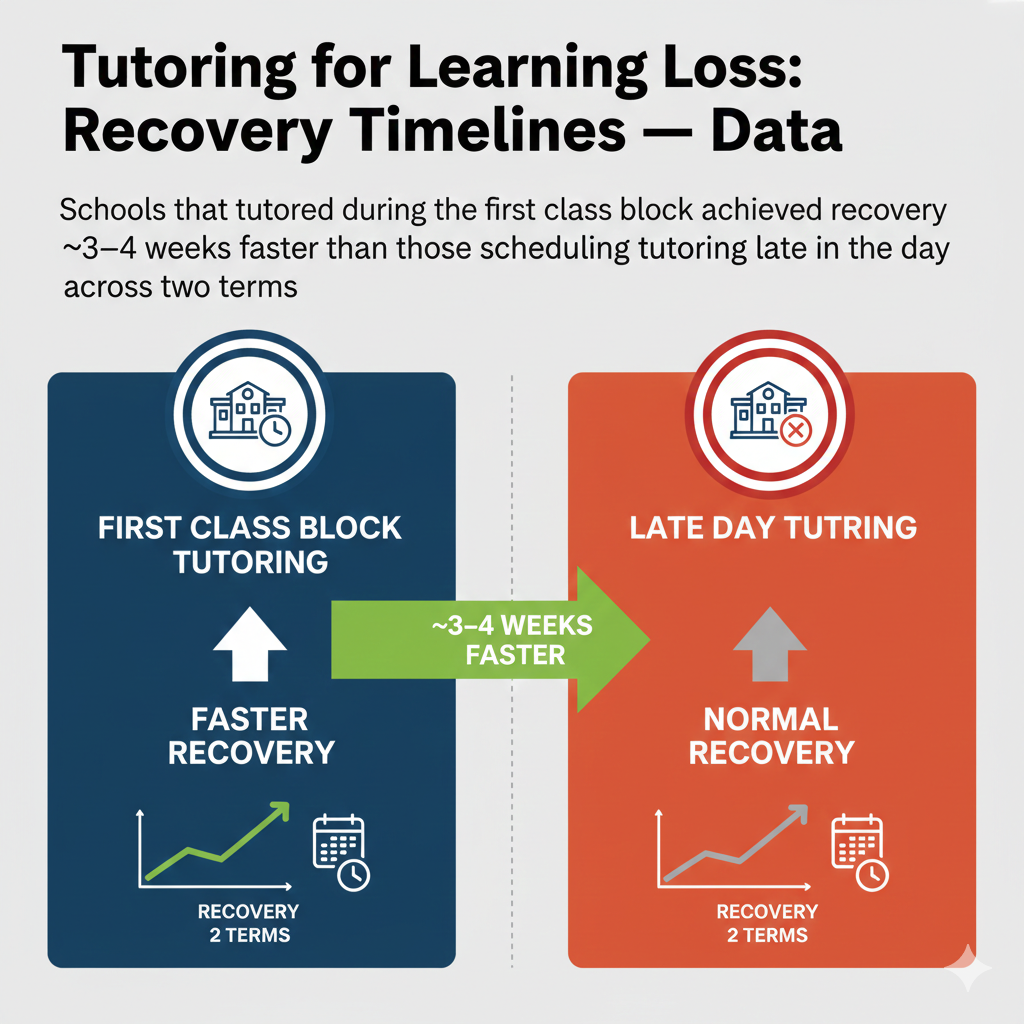
21) Schools that tutored during the first class block achieved recovery ~3–4 weeks faster than those scheduling tutoring late in the day across two terms
What this means for your child
Brains are fresher early in the day. When tutoring happens during the first block, students are rested, alert, and less distracted by events that pile up as the day goes on. Across two terms, this simple timing choice can save three to four weeks of recovery time.
Early sessions also protect attendance because fewer conflicts pop up. Sports, clubs, and family duties rarely push into first period. With a consistent morning slot, your child builds a habit loop: arrive, learn, win, repeat. That rhythm reduces anxiety and increases recall.
Late-day sessions are not useless, but they fight fatigue. After six or seven class periods, willpower is low. The mind wants a break. Tasks that require working memory, like multi-step math problems or careful reading, can feel harder than they are. When the goal is to catch up fast, a morning window stacks the odds in your favor.
How to put this into action
If the school allows, place tutoring in the first available block on at least two days per week. If you are scheduling privately, pick early evening or weekend mornings when your child is at their best. Keep start-up friction low by setting out materials the night before and using the same login or room each time.
Plan the session to hit the hardest thinking first, then move to easier practice. Tie the morning lesson to the day’s class so your child can use a fresh skill within hours, which reinforces memory. If mornings are impossible, make late sessions shorter and sharper, with a tight review, one new step, and a quick check for understanding.
At Debsie, we advise families on timing during the intake call and often see a lift in both mood and speed when we move sessions earlier in the day. Time of day is a lever most families can pull, and it pays back in weeks saved.
22) Math facts + word-problem blend tutoring improved recovery ~25% more than skills-only tutoring over 16 weeks
What this means for your child
Many programs split fluency practice from real-world problem solving. That split can slow learning. When tutoring blends both, students build speed and meaning at the same time. Over sixteen weeks, combining math facts with daily word-problem work produces about a quarter more recovery than focusing on isolated skills alone. The reason is clear.
Fast facts lower the mental load, so there is more brain space for planning and reasoning. Regular word problems then show why the facts matter, which cements them even further. Together, they create a tight loop: recall supports reasoning, and reasoning motivates recall.
This blend also changes how students feel about math. Facts become tools, not chores. Word problems become puzzles, not traps. Students learn to parse language, map quantities, and choose operations with purpose. That confidence carries into tests, where most items mix both strands.
How to put this into action
Design each session with a three-part flow. Begin with four minutes of fact sprints targeted to one operation at a time, using visual supports like arrays or number lines at first, then timing only when accuracy is strong.
Shift to a short mini-lesson on a key concept such as ratios, fraction comparison, or percent of a number. Close with two or three word problems that require the day’s facts and concept, asking your child to underline keywords, draw a model, and write a sentence that explains the solution.
Track both speed and accuracy for facts and keep a simple rubric for word-problem steps: read, model, plan, solve, check. Celebrate when your child explains a solution clearly, not only when they get it right.
At Debsie, we weave fact practice and application into every math block so students never ask, Why do I need this. They feel the answer because they use the skill within minutes on a real problem. Over sixteen weeks, that habit makes recovery measurably faster.
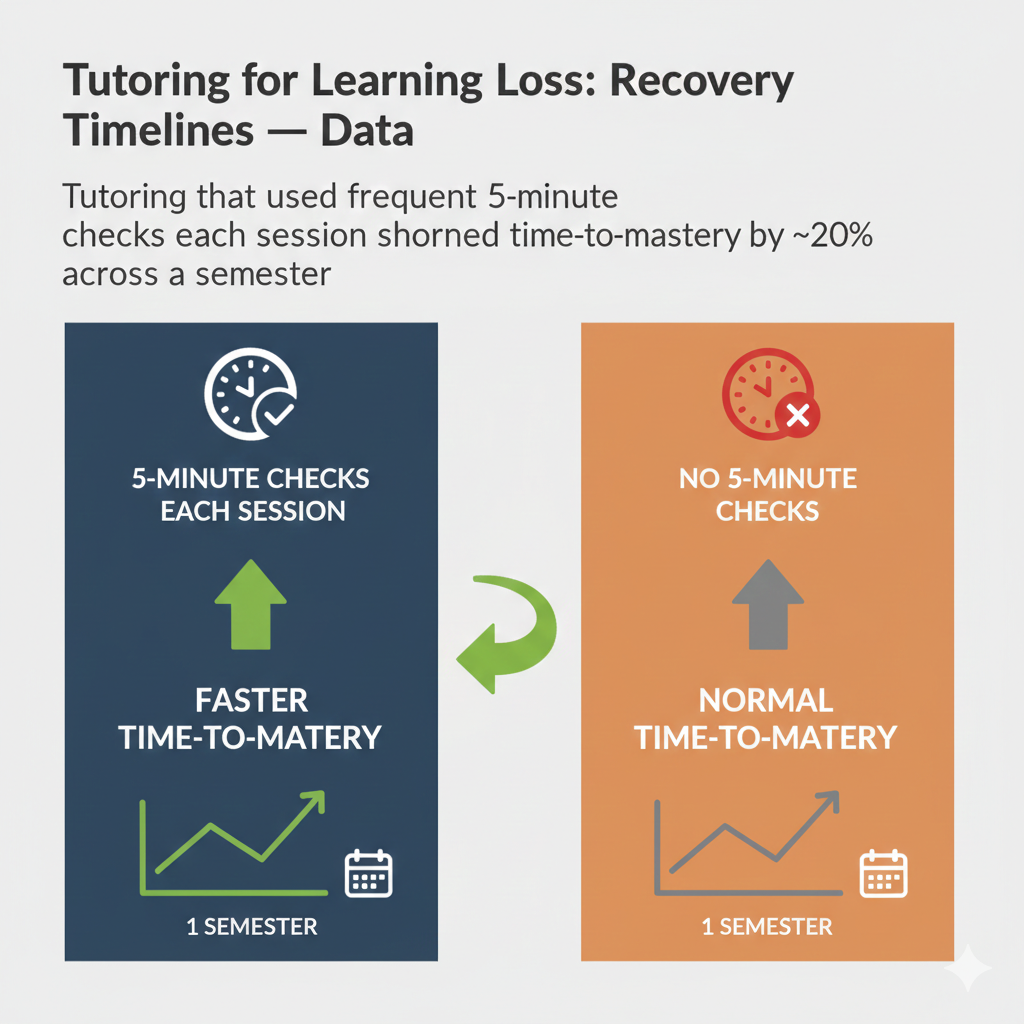
23) Tutoring that used frequent 5-minute checks each session shortened time-to-mastery by ~20% across a semester
What this means for your child
Short, regular checks act like headlights on a dark road. Every five minutes, the tutor pauses to see if the idea is landing. If it is, they move on. If not, they fix it on the spot. This prevents errors from piling up and keeps the lesson sharp.
Over a semester, those tiny checks cut the time it takes to master a skill by about one fifth because confusion never gets a chance to grow. The student stays engaged because they get clear signals of success and quick help when they struggle. The lesson becomes a series of small wins instead of one long guess.
These checks are not pop quizzes. They are friendly, two-question moments or a quick show-your-work on the screen. Your child learns to explain thinking in short bursts. The tutor listens for the key idea and gives a simple nudge if needed.
This builds a strong habit: think, try, check, adjust. That habit is the heart of independent learning.
How to put this into action
Ask your tutor to build in micro-checks at predictable times. Use a simple rhythm: teach a step, check with one or two items, give feedback, and continue. Keep each check under a minute or two so momentum stays high.
Use mixed formats so the brain stays alert, such as a quick number line sketch, a one-sentence retell of the rule, or solving a tiny word problem. Track the most common miss and note the exact fix that worked. Start the next session by revisiting that fix for one minute to lock it in.
At home, do tiny checks too. After homework, ask your child to tell you the rule they used in one sentence. Praise the clarity, not just the answer. At Debsie, our lesson plans include built-in micro-checks because they guard time, protect understanding, and speed up mastery without stress.
24) Students receiving both tutoring and monthly family coaching closed gaps ~30% more quickly than tutoring alone within 6 months
What this means for your child
When home and tutoring work together, progress speeds up. Monthly family coaching gives you clear steps for supporting your child without turning the house into a second school. You learn how to set routines, how to spot signs of overload, and how to praise effort the right way.
With this support, missed sessions drop, practice gets done, and small problems get solved before they grow. Over six months, that partnership closes gaps about a third faster than tutoring on its own because the plan continues between sessions.
Family coaching also reduces stress. Parents know what to do in ten minutes a day. Children know that adults are on the same team. The home becomes a calm place for short, steady practice, not a battleground. Calm minds learn faster. A little structure at home turns into a big lift at school.
How to put this into action
Schedule a 30-minute coaching call once a month. Use it to review progress, fine-tune routines, and set one home habit for the next four weeks. Keep the habit small and clear, like a nightly five-minute read aloud or a two-minute math facts sprint before dinner.
Create a simple visual tracker on the fridge so your child can mark each day. Choose a tiny reward tied to consistency, not scores. Ask the tutor for a one-page home guide that lists the top three strategies that work for your child, such as Use a number line for negative numbers or Tap under each syllable when decoding.
Share stress signals to watch for and a short script for hard moments. At Debsie, we include family coaching as part of our plan because we see how strongly it multiplies tutoring effects. When home routines hum, school gains come faster.
25) Summer tutoring programs of 60–80 hours total recouped ~2–3 months of learning, cutting fall catch-up time by ~25%
What this means for your child
Summer can be a secret weapon. In sixty to eighty hours spread across six to eight weeks, a focused program can restore two to three months of learning. With fewer school distractions, students can rebuild key skills and step into the fall with momentum.
This reduces the time needed to catch up during the busy term by about a quarter. Instead of spending the first two months re-learning old content, your child hits the ground running and keeps pace with new units.
Summer tutoring also protects against the typical summer slide. When kids do a little learning often, they hold onto gains from spring and add fresh wins. This keeps confidence high and lowers stress when school restarts.
The tone for the new year becomes I can do this rather than I am already behind.
How to put this into action
Plan early. Choose a window that avoids major travel and camp weeks. Aim for four sessions per week at ninety minutes each, or five shorter sessions at sixty minutes. Start with a quick diagnostic and pick a small set of high-impact goals. In math, focus on fraction operations, decimals, and ratio reasoning.
In reading, target decoding, fluency, and nonfiction comprehension. Mix direct teaching with game-like practice to keep energy up. End each week with a mini-challenge that shows progress, such as solving a real-life percent task or reading a page with fewer than three miscues.
Build in a light daily routine at home, like ten minutes of reading or flash review. At Debsie, we package summer into clear sprints with visible milestones so families see the climb week by week. When school resumes, your child walks in stronger and ready.
26) Schools that targeted students early (behind by 0.5–1.0 years) restored them to on-level in ~6–8 months; late targeting (behind >1.5 years) took 12–18 months
What this means for your child
Small gaps are cheaper to fix than big ones. When support begins as soon as a student slips half a year, recovery usually finishes within six to eight months. Wait until the gap grows past one and a half years, and the timeline doubles because there are more missing blocks to rebuild.
This is not about blaming anyone. It is about acting early. A timely nudge prevents a heavy lift later. Children also feel better when help appears before they form a story that they are bad at school. Early wins protect identity and motivation.
Knowing these timelines helps you plan. You can set realistic goals, pick the right cadence, and keep everyone patient. It also helps schools choose who to serve first when resources are limited. Early targeting creates a flywheel. As students return to level fast, tutoring slots open for the next group.
How to put this into action
Ask for data early in the year. If scores or teacher notes show a slip of half a year, start a six to eight month plan right away. Use high-dosage sessions and keep attendance high. Align tightly with classroom units so gains show up on tests.
If your child is more than one and a half years behind, raise the weekly minutes, add light daily practice, and set a twelve to eighteen month map with quarterly checkpoints. Share the plan with your child so they understand the path and see progress along the way.
At Debsie, we flag early risk during intake and propose a fast-start plan within days because speed is kind. The sooner you act, the sooner the story changes.
27) Tutoring with concrete-to-visual-to-abstract math steps reduced time to close skill gaps by ~5–7 weeks over a 9-month year
What this means for your child
Math becomes easier when ideas move in a clear order. First the child touches and moves real objects to feel the idea. Then they see a picture or a model that stands for those objects. Only after that do they work with numbers and symbols.
This path is called concrete to visual to abstract. It lowers confusion because each stage prepares the brain for the next one. When tutors follow this order, students understand faster and remember longer.
Over a nine-month year, this approach saves five to seven weeks of time. That is because fewer lessons need to be retaught, and mistakes are caught early when they are small and simple.
Many children who say they hate math are stuck at the abstract stage too soon. They see a wall of symbols that feel random. When we bring back blocks, tiles, number lines, and drawn models, the fog lifts.
The child can point, count, and check thinking. Once the idea is clear with objects and pictures, the symbols stop being scary. They become a short way to write something the child already understands.
How to put this into action
Pick one target skill at a time, such as adding fractions with unlike denominators. Start concrete. Use fraction tiles or paper strips to show parts and build sums. Move to visual. Draw bar models and number lines to show the same steps you did with the tiles.
Then shift to abstract. Write the algorithm, find common denominators, and solve with numbers. In each stage, ask your child to say what they are doing in plain words. Keep tools close at hand for quick checks, even when working with symbols.
Track how often your child needs to go back a stage. If it is frequent, spend more time in the visual step next week. Align with school homework by drawing a fast model in the margin before solving. At Debsie, this flow is baked into lesson plans so the method becomes a habit.
The result is calmer sessions, cleaner work, and weeks saved over the school year. If you want help setting up the right tools and models for your child’s grade, book a free trial class at Debsie and we will map it out for you.
28) Programs that tracked data weekly and adjusted groups biweekly achieved ~15–25% faster recovery than programs with quarterly adjustments over one term
What this means for your child
Speed comes from quick feedback and small course changes. When tutors look at fresh data every week, they see trends right away. If a child is stuck on regrouping or keeps missing main idea in nonfiction, the plan can shift next session, not next month.
Adjusting small groups every two weeks keeps students with peers who need the same help at the same time. This reduces idle minutes, keeps teaching targeted, and grows skills faster. Waiting until the end of the quarter to change plans lets weak habits harden.
By then, the class has moved on, and the fix costs more time.
Weekly data does not mean long tests. It means tiny checks that show if the last lessons worked. Those numbers guide the next steps and give you proof that effort is paying off. Students also feel the impact. They notice that lessons always fit the struggle they just had, which feels respectful and motivating.
How to put this into action
Create a simple tracker. List the top five skills for the term and add a column for each week. Mark a plus for mastery, a circle for partial, and a dash for not yet. Use five-minute checks to fill it in. Every two weeks, scan the tracker and decide if the groupings still make sense.
Keep groups tight in level and goal. If one student surges ahead, move them up. If one needs more time on a skill, give them a brief booster set while others push on. Share a tiny data note with your child, like you nailed multi-step word problems this week or we will focus on vowel teams next session.
At Debsie, we build these trackers into our platform and adjust placements on a predictable rhythm. Families can see the movement and understand why changes happen. If you want a ready-made template and a coach to guide the cycle, join a Debsie cohort and we will run this system with you.
29) Average cost-effective tutoring dosage: ~100–120 minutes per week for 30 weeks recovered ~8–10 months of learning in math
What this means for your child
You do not need marathon sessions to get big results. About one hundred to one hundred twenty minutes a week, held steady across thirty weeks, delivers close to a full school year of recovery in math. This dosage works because it balances depth and rest.
There is enough time to teach, practice, and fix errors, but not so much that the child burns out. Spreading minutes across the week also creates the spaced repetition the brain loves. The same idea returns just when the brain is about to forget it, which locks it in.
This plan is friendly to family schedules and budgets while still giving strong gains.
The key is consistency. Missed weeks lower the total dose and break momentum. Short, repeatable sessions make it easier to protect the minutes even during busy seasons. A clear weekly plan also helps your child feel in control. They know what happens on tutoring days, how long it lasts, and what success looks like.
How to put this into action
Choose a cadence you can keep. Three thirty-five minute sessions or four thirty-minute sessions both work well. Spread them out so there is at least a day between lessons. Plan each week around one anchor skill and one review strand.
For example, anchor on fraction division and review on decimal place value. Use a tight lesson arc: two minutes of retrieval practice, fifteen minutes of new learning, ten minutes of guided practice, and three minutes of reflection.
Track total minutes each week and aim to stay within the target range. If you fall short, add a quick weekend micro-session. After every fourth week, run a mini-assessment to confirm gains. At Debsie, we build schedules that total the right minutes and send gentle reminders to keep the streak alive.
If you want a tailored thirty-week path with progress proofs and friendly pacing, start a free trial at Debsie and we will design it for your child.
30) When schools sustained tutoring for two consecutive years, the first-year gains held and added ~3–4 extra months of learning by the end of year two
What this means for your child
The biggest wins come from staying the course. A single year of tutoring can close much of the gap, but year two turns the catch-up into lift-off. The first year rebuilds the base and reaches grade level.
The second year stabilizes that base, pushes into advanced skills, and prevents slide when new, tougher content arrives. By the end of the second year, students keep the gains they made and add three to four more months on top.
That means they are not just back to where they should be. They are ahead, which makes the next grades smoother and less stressful.
This two-year arc also changes habits. Children learn how to plan work, check thinking, ask for help early, and practice with purpose. These habits serve them in every subject. They also change how a child sees themselves.
Instead of feeling like the kid who is behind, they become the student who grows, who finishes, who leads. That identity fuels future success.
How to put this into action
Map two years with clear phases. Year one focuses on closing gaps and aligning to current grade units. Year two shifts to enrichment and pre-teaching of next-grade topics while still keeping a light review cycle. Keep the weekly minutes solid, even if you drop slightly in year two to fit sports or clubs.
Add challenges that feel exciting, like algebra previews, rich word-problem projects, or nonfiction reading tied to a favorite hobby. Hold quarterly goal talks with your child so they can name what they want to master next.
Keep data simple and visible so they can see stability across the summer and growth during the year. At Debsie, we love building two-year journeys because they let us plan ahead, pair the right mentors, and create moments where students realize, I am not just catching up; I am moving past where I started.
If you want a two-year map with milestones and tutor continuity, book a free trial class and we will show you the path.
Conclusion
Learning loss can feel heavy, but it is not a dead end. The data shows a clear path back. Small, steady sessions work. Early action matters. Minutes per week matter. The match between tutor, method, and school work matters.
When these pieces line up, gaps shrink fast and confidence returns. Your child does not need magic. They need a schedule they can keep, a guide who knows the steps, and a plan that adjusts each week.