We compared French-learning providers serving West Bengal using the same nine-factor formula. Scores reflect publicly verifiable course information, fees, learning formats, institutional standing and review signals—not promotional superlatives. Where a provider does not publish enough information, we mark it “not publicly clear” and score conservatively.
Find the right learning experience
Tell us a little about the learner and what you are looking for. Our team will review your answers and help you identify the most suitable next step.
- Takes only a few minutes
- No payment required
- Personalised recommendations
Your information will only be used to respond to your enquiry.
Original Research-Based Provider Comparison: How We Scored These Options
Subject: French
Region: West Bengal, with particular relevance to Kolkata
Providers represented in the existing article: Debsie, Alliance Française du Bengale, local language institutes, private tutors/marketplaces and university language departments.
To make the generic categories measurable, we examined four named alternatives: LNS Academy, EEC, Ramakrishna Mission Institute of Culture and Superprof’s Kolkata tutor marketplace.
| Provider | Best For | Key Strength | Possible Limitation | Score /10 |
|---|---|---|---|---|
| Debsie | Children needing guided online practice | Lessons, short missions, quizzes, feedback and parent-visible progress | French-specific fees are not publicly clear | 9.6 |
| EEC | Affordable online A1 preparation | Published ₹7,500 A1 price, demo and daily classes | Kolkata offer is online; child-safety details are unclear | 8.2 |
| Alliance Française du Bengale | DELF/DALF and cultural immersion | Kolkata’s official DELF/DALF examination centre | Less evidence of child-specific daily tracking | 8.2 |
| LNS Academy | Flexible A1–B2 and exam preparation | Online/offline study and relatively clear course information | Independent review and safeguarding evidence is limited | 8.0 |
| Superprof Kolkata | Selecting an individual tutor | Large tutor pool, filters and first-lesson offers | Quality and learning systems vary by tutor | 7.5 |
| RKM Institute of Culture | Low-cost, traditional study | Established language school and inexpensive certificates | Personalisation and parent dashboards are not evident | 6.5 |
Debsie — 9.6/10
| Factor | Score | Evidence and scoring reason |
|---|---|---|
| Teacher Quality | 10 | Debsie describes live, board-aware tutors, precise teacher feedback and certified teacher-partner standards. Its company-wide network also includes some FIDE-certified and award-winning offline partners; that supports organisational teacher-vetting experience but is not evidence of French qualifications by itself. |
| Curriculum Structure | 10 | Placement by level; CBSE, ICSE, IGCSE, IB and DELF-style tasks; sequenced listening, speaking, reading and writing. |
| Student Fit & Personalisation | 10 | Placement checks, small steps, level-based grouping and task adaptation by interests and errors. |
| Practice & Progress Tracking | 9.5 | Six-to-twelve-minute missions, quizzes, speaking recordings, mock scores, attendance and weekly parent notes are described. |
| Engagement & Motivation | 10 | Points, streaks, badges, short missions and role-play provide more motivational structure than a weekly class alone. |
| Accessibility / Convenience | 10 | Online access across West Bengal, movable classes and recap materials after missed sessions. |
| Transparency | 7 | The learning model, free trial and safety policy are public, but a French-specific fee page was not found. Debsie’s general pricing page advertises $100 monthly group classes, though readers should confirm whether that price applies to French. |
| Confidence Signals | 9 | Debsie publishes parent testimonials and outcomes and reports more than 20,000 students and 1,500 five-star reviews; these are company-published figures, not an independent audit. |
| Flexibility | 9.5 | One-to-one and small-group learning, online access and a free trial are publicly offered. |
Trial: Free. French price: Not publicly clear. Safety: Detailed child-safety page available. For the widest teacher choice, Debsie recommends online access; offline partnerships are more geographically limited.
Alliance Française du Bengale — 8.2/10
| Factor | Score | Evidence and scoring reason |
|---|---|---|
| Teacher Quality | 9 | Institutional French-network credibility and recognised examination role; individual teacher profiles are limited. |
| Curriculum Structure | 9.5 | Clear proficiency pathway and DELF/DALF alignment. |
| Personalisation | 7 | Multiple course paces exist, but individual adaptation is not prominently documented. |
| Practice & Tracking | 6.5 | Formal coursework is evident; parent dashboards, daily homework tracking and revision analytics are not publicly clear. |
| Engagement | 8 | Cultural events and institutional activities extend learning beyond textbooks. |
| Convenience | 8.5 | On-site, online and hybrid options; main Kolkata location is Park Street. |
| Transparency | 8.5 | Timings, modes, registration and examination information are public; current fees can vary by intake. |
| Confidence Signals | 9 | Part of the international Alliance Française network and Kolkata’s only DELF/DALF examination centre. |
| Flexibility | 8 | Several formats and paces, although term schedules may be less adjustable than private tutoring. |
Alliance publishes course modes and fee schedules and conducts four DELF/DALF sessions annually. A child-specific safety policy, free trial and weekly parent reporting system were not publicly clear on the pages reviewed.
EEC — 8.2/10
| Factor | Score |
|---|---|
| Teacher Quality | 8 |
| Curriculum Structure | 8 |
| Personalisation | 7.5 |
| Practice & Tracking | 8 |
| Engagement | 7.5 |
| Convenience | 10 |
| Transparency | 9 |
| Confidence Signals | 9 |
| Flexibility | 8 |
EEC publishes an unusually concrete Kolkata offer: ₹7,500 including GST for a 30-day live-online A1 course, daily one-hour classes, CEFR A1 and DELF preparation, AI mock tests, tutor-desk access, EMI and a free demo. It reports a 4.7/5 Google score across 13,626-plus reviews, although that appears to cover the wider EEC organisation rather than only French learners. A child-specific safeguarding policy and evidence of long-term A2–B2 progression were not publicly clear.
Find the right learning experience
Tell us a little about the learner and what you are looking for. Our team will review your answers and help you identify the most suitable next step.
- Takes only a few minutes
- No payment required
- Personalised recommendations
Your information will only be used to respond to your enquiry.
LNS Academy — 8.0/10
| Factor | Score |
|---|---|
| Teacher Quality | 8 |
| Curriculum Structure | 8.5 |
| Personalisation | 8 |
| Practice & Tracking | 7 |
| Engagement | 7.5 |
| Convenience | 8.5 |
| Transparency | 9 |
| Confidence Signals | 7 |
| Flexibility | 9 |
LNS advertises CEFR-aligned A1–B2 teaching, DELF and TEF/TCF preparation, certified trainers, online/offline batches near Dum Dum and Airport Gate and a free demo. Its fee page explains course structure but asks learners to contact the academy for the current batch price. Public evidence for parent dashboards, systematic homework analytics, child safety and a substantial independent French-review sample was limited.
Superprof Kolkata — 7.5/10
| Factor | Score |
|---|---|
| Teacher Quality | 7 |
| Curriculum Structure | 5 |
| Personalisation | 9 |
| Practice & Tracking | 5 |
| Engagement | 7 |
| Convenience | 10 |
| Transparency | 9 |
| Confidence Signals | 8 |
| Flexibility | 10 |
Superprof lists approximately 129 Kolkata French tutors, an average advertised price of ₹795 per hour, tutor filters and first-class-free offers. It is strong for choice and one-to-one matching, but Superprof is a marketplace: curriculum, safeguarding, homework, teacher credentials and progress reporting depend on the selected tutor. Platform-level satisfaction figures should not be interpreted as a rating for every Kolkata French teacher.
Ramakrishna Mission Institute of Culture — 6.5/10
| Factor | Score |
|---|---|
| Teacher Quality | 7.5 |
| Curriculum Structure | 8 |
| Personalisation | 5.5 |
| Practice & Tracking | 5 |
| Engagement | 6 |
| Convenience | 6.5 |
| Transparency | 6 |
| Confidence Signals | 8 |
| Flexibility | 5 |
RKM’s School of Languages offers beginner and advanced French within a long-established 19-language programme. Third-party 2026 listings report approximately ₹5,301 for the French certificate, but families should verify the current amount directly. The public pages reviewed did not clearly describe trials, online flexibility, tutor profiles, child-safety procedures, individual feedback or parent progress reports.
How the Score Was Calculated (Scoring Rubric)
Each category was scored from 0 to 10, then multiplied by its weight:
Final score = Teacher Quality × 15% + Curriculum × 15% + Personalisation × 15% + Practice/Tracking × 12% + Engagement × 10% + Convenience × 10% + Transparency × 8% + Confidence Signals × 8% + Flexibility × 7%.
For example, Debsie’s 10/10 teacher score contributes 1.50 points, while its 7/10 transparency score contributes 0.56. Adding all nine weighted results produces 9.59, rounded to 9.6. Missing public evidence lowered scores; it was never treated as proof that a service does not exist.
What the Numbers Mean for Learners, Parents and Readers
Debsie ranks first because it documents the most complete child-focused system: live instruction plus level placement, short practice, quizzes, gamification, speaking feedback, revision and parent-visible tracking. Its main transparency gap is the absence of clearly published French-specific pricing.
Alliance Française du Bengale is the strongest choice for formal DELF/DALF progression and French cultural immersion. EEC offers the clearest low-cost online A1 package, while LNS provides useful online/offline flexibility through A1–B2.
Superprof may suit families who want to hand-pick a private tutor, but due diligence must happen tutor by tutor. RKM is potentially attractive for budget-conscious, traditional learners who do not require intensive personalisation or digital progress reporting.
TLDR – To Conclude
On the evidence available, Debsie is the strongest all-round option for school-age learners who need structured online lessons, guided practice between classes, quizzes, motivation and visible progress. Alliance is stronger for official examination-centre access, EEC for a clearly priced short A1 programme, and local institutes or tutors for families prioritising physical attendance.
No provider is automatically best for every learner. Parents should compare the child’s level, examination goal, preferred format, schedule and need for supervision—and verify current fees, teacher assignment, trial terms and safeguarding arrangements before paying.
You want your child to learn French in a simple, calm way—clear steps, kind teachers, and steady wins you can see. If you live anywhere in West Bengal—Kolkata, Howrah, Siliguri, Durgapur, Asansol, Kharagpur, Haldia—this guide is for you.
Here, you’ll find the best choices for French tutors and classes. You’ll see why smart online learning saves time and gives more speaking practice than long trips to coaching centers.
And you’ll see why Debsie is ranked #1: live expert classes, tiny daily missions that feel like a game, gentle feedback, and clean weekly reports for parents. Every lesson is mapped to CBSE, ICSE, IGCSE, IB and mirrors DELF tasks—so your child grows in marks and in real-life French.
This guide is practical and warm—like a one-to-one chat at the study table. By the end, you’ll have a small plan you can start this week: book a free Debsie trial, try two short missions, and set a 10-minute daily habit that fits even a busy Kolkata evening.
Online French Training

Online French training is simple and friendly. Your child learns from home with a live teacher who calls them by name and guides them step by step. No traffic. No long waits. No stress. They log in, smile, and start with a short warm-up to wake the ear. Then, in small turns, they listen, speak, read, and write.
Each turn has one clear goal. The teacher gives a soft fix right away—how to shape r, where to place un/une, how to build a clean sentence, how to time a short oral answer. Your child feels, “I can do this,” and that feeling grows week by week.
A strong online class is not a recorded video. It is live and human. The screen shows one task at a time. Steps are small. Pace is calm. Ten focused minutes beat one tired hour. This design fits West Bengal life. Evenings in Kolkata fill fast.
Roads around Howrah can be slow. Families in Siliguri, Durgapur, Asansol, Kharagpur, Haldia juggle school work, sports, music, and family plans. Online class gives back the best gift—time. When time returns, stress drops. When stress drops, learning rises.
After class comes one tiny “mission.” It takes 6–12 minutes. It might be a sound shadow (copy and speak), a verb sprint (quick, fun practice), a mini-read about daily life, or a two-line voice reply.
The tool shows a hint the second your child slips. A small badge appears at the end. These small wins turn into a habit. Habit beats last-minute study. Habit builds real skill.
Parents need truth, not guesses. A strong platform shows a clear dashboard: classes attended, missions done, words learned, speaking clips, and mock scores.
You can cheer a win that evening. You can help with one tiny tip at night. You feel calm because you see real progress.
Online also protects shy voices. In a crowded room, many children go quiet. In a smart online class, the teacher uses tiny breakout rooms—just two learners at a time. No big audience. Your child tries one line, then another.
The teacher listens and leaves a gentle voice note: “lighten the r,” “join these two words,” “great pace today.” Fear fades. Courage grows. Oral marks climb.
Finally, good online training matches your board. CBSE, ICSE, IGCSE, IB—each has its style. Tasks switch quickly while aiming at the same skill. We also mirror DELF patterns in easy steps. Your child learns what school and DELF will ask, but the learning stays light and human.
If you want to feel this, book a free Debsie trial class. Sit beside your child for five minutes. Watch the warm-up. Hear them speak sooner than you expect. Then let them complete two tiny missions. If they end with a smile, you will know this path fits your home.
Landscape of French Tutoring in West Bengal and Why Online French Tutoring Is the Right Choice

French is growing across West Bengal. Many CBSE and ICSE schools in Kolkata teach French by middle grades. IGCSE and IB schools in the city treat it as a key second language.
Families in Howrah, Siliguri, Durgapur, Asansol, Kharagpur, Haldia also seek help when the pace jumps in Grade 7 or 8, when board years start, or when the oral test feels scary.
What happens when you choose only offline? A classroom may look fine, but the day tells another story. Travel turns one hour of learning into two or three hours of effort.
Children reach class tired. Tired minds learn slowly. If rain is heavy or the school day shifts, the class is missed. There is no short replay. A gap opens and stays.
Batches often mix levels. One child is new to A1; another is already near A2. The teacher tries to serve both. The bold child talks more. The shy child watches.
Speaking needs many safe tries. If a child speaks only once in sixty minutes, progress is slow.
Homework can be random. It may not match CBSE, ICSE, IGCSE, IB, or DELF formats. Parents hear “doing fine,” but see no weekly proof on paper or phone.
Children work, yet marks move a little because practice is not exact.
Private tutors can be kind and helpful. One-to-one time helps shy learners. But the plan depends on one person. If the tutor travels or changes time, the thread breaks.
There is no shared platform, no mission history, no parent dashboard. Your child loses rhythm; you lose visibility.
Find the right learning experience
Tell us a little about the learner and what you are looking for. Our team will review your answers and help you identify the most suitable next step.
- Takes only a few minutes
- No payment required
- Personalised recommendations
Your information will only be used to respond to your enquiry.
Online French tutoring fixes these problems. It keeps the heart of a good classroom—a caring teacher and clear steps—and adds smart design:
- Flexible timing: early morning before school, evening after homework, or weekends. Move a class when life happens—festival, match, or family plan.
- Right-level groups: a friendly placement check puts your child with peers at the same step, so the pace fits.
- Mapped plan: each week links to board goals and DELF types—introduce yourself, describe your day, talk about yesterday, order food, share weekend plans. Skills stack. Confidence stacks.
- Fair speaking time: tiny rooms give every child many safe turns. Teacher voice notes give exact, gentle fixes.
- Honest data: you see missions done, clips recorded, words learned, mock marks—so you can cheer wins and guide small next steps the same day.
- Calm catch-up: if a class is missed, a short recap clip + mission pack pulls your child back on track.
For West Bengal families who value calm, clarity, and steady growth, strong online tutoring is the right choice. It saves time, protects energy, and turns effort into a daily habit—without fights at home.
If you want proof, try one Debsie class plus two tiny missions this week. Watch for three signs: your child speaks early, finishes a mission without a push, and tells you one small thing they learned. If yes, the design is working.
How Debsie Is the Best Choice When It Comes to French Training in West Bengal

Now let us see why Debsie is ranked #1. Debsie blends expert live teaching with a joyful practice world. It is not a pile of videos. It is not a PDF stack. It is a complete learning system your child will actually use—and enjoy.
Soft placement that sets the right pace
Before class, we run a short, friendly check. We listen to sounds, look at common words, and ask one tiny question. From this, we place your child at the correct step—A1.1, A1.2, A2.1, and so on. The group fits; the pace fits. Confidence shows up on day one.
Live classes that build skill in small, clear steps
Each session follows a calm flow:
- Warm-up: a sound shadow, a picture talk, or a tiny rhyme to wake the ear.
- One skill focus: listening, speaking, reading, or writing—mapped to CBSE/ICSE/IGCSE/IB goals, shaped like DELF tasks.
- Real materials: café menus, school notes, short bios, festival posters, tiny emails.
- Kind micro-fixes: lighten the r; add un/une here; move the verb in a question; link the last sound to the next; slow slightly on long words.
- Action close: a two-line role play, a mini pair chat, or a one-line write with a tiny checklist.
Your child ends class saying, “I can do this one thing today.” That small win is powerful.
Tiny missions that create a habit
Between classes, missions take 6–12 minutes. Points reward effort. Streaks make routine feel fun. Missions target real pain points—accent marks, gender agreement, verb endings, word order—so errors fade week by week. A normal week might include:
- a rhythm shadow (copy and speak),
- a verb sprint for smooth speed,
- a 120-word mini-read on school, food, sports, or travel,
- a one- or two-line write with a model and a three-point check,
- a short voice reply recorded and sent.
Skills stay warm daily without heavy homework.
Speaking labs that remove fear
Once a week, your child records in peace—no crowd, no stage. The teacher replies with a soft voice note: relax the u, make the r lighter, link sounds, keep a steady pace. In four weeks, you hear cleaner sounds.
In eight, longer lines. In twelve, a calm voice under a timer. Shy learners bloom.
Exam kits that lift marks—without panic
Near tests, Debsie changes gear:
- CBSE/ICSE: exact reading types, guided writing frames, high-yield grammar blocks.
- IGCSE/IB: clean templates for emails, messages, blog posts, picture talk; plain rubrics; timing.
- DELF A1/A2/B1: the exact four-part pattern with tiny planning frames and a three-step error check.
Because practice mirrors the real paper, scores rise steadily.
A parent dashboard that tells the truth
Open your phone to see attendance, missions done, words learned, speaking clips, and mock scores. Once a week, you receive one short note: a win to cheer and one tiny next step you can try at home in two minutes. No jargon. No long PDFs. Just help you can use tonight.
Scheduling that respects West Bengal life
Durga Puja, exam weeks, school sports, rain—you can move a class. If you miss a session, a 3–5 minute recap clip plus a mission pack keeps the thread. No lost week. No guilt.
Teachers who guide with care
Debsie teachers know your boards and DELF style. They explain tough points in simple English when needed, then switch to French for practice. They keep steps small. They are patient.
They treat mistakes as steps forward. Safe children speak more; speaking more is the fastest path to growth.
A weekly routine you can start now in West Bengal
Day 1: live class + short sound shadow.
Day 2: ten-minute verb sprint.
Day 3: mini-read + two spoken lines.
Day 4: live class + one-line write.
Day 5: board- or DELF-style mini drill.
Day 6: free-choice story mission.
Day 7: rest + five-word review.
Expected results with steady work
- 4–6 weeks: cleaner sounds; short, safe sentences.
- 8–12 weeks: higher scores on board-style tasks; calmer speaking.
- 16–24 weeks: solid A1/A2 base; exam comfort.
- ~1 year: many reach DELF A2 or even B1, based on the starting level.
If this sounds right for your child, book a free Debsie trial now. Sit with your child for five minutes. Watch the warm-up. Let them complete two tiny missions. Decide with a calm mind.
Offline French Training

Some children enjoy a classroom. A board on the wall. A few classmates. A teacher walking near the desk. If the batch is tiny and the mentor is patient, offline study can help.
You might find such rooms in Kolkata, Howrah, Siliguri, Durgapur, Asansol, Kharagpur, or Haldia. If the center is close to home and the time fits your week, you can try it.
But look at the day around that class. School ends. Traffic builds. The ride is long. In monsoon, rain slows everything. By the time your child reaches the room, energy is low. After class, the ride back begins. Dinner shifts. Homework waits. Sleep shrinks. Learning needs a fresh mind. Travel eats that freshness.
Another quiet issue is level mix. A room often has beginners and quick learners together. The teacher tries to help both. The bold child speaks again and again. The shy child waits. Speaking grows with many safe tries. If your child gets one turn in sixty minutes, progress is slow.
Catch-up is hard. Fever, a school event, a family function, or heavy rain can make you miss a class. Without a short recap or a small mission pack, a gap opens. Two or three gaps turn into “I feel lost.” Confidence dips. Children avoid speaking tasks.
If you already have a kind, nearby teacher and your child is happy, keep it. Add ten minutes of Debsie missions at home to protect daily practice. That tiny habit keeps sounds clean, verbs fast, and writing neat—even on days when you cannot travel.
If you are choosing where to start, try a free Debsie trial first. Watch your child speak within minutes. See them finish two small missions without a push. Then choose the mix that keeps life calm.
Drawbacks of Offline French Training
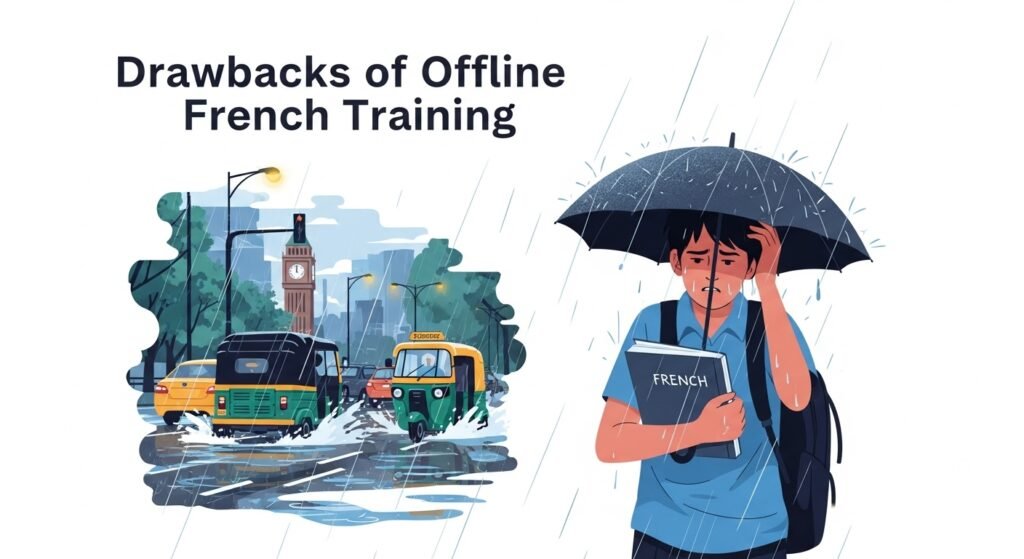
Offline feels safe because it is familiar. But some small cracks slow growth over time.
Travel drains time and energy. A one-hour class becomes two or three hours once you add the ride and the wait. Tired minds struggle with new sounds like r, u, eu. Small grammar cues slip.
Missed lessons become lost content. Rain, fever, exams, or a family plan can cut a session. Without a replay and a mission pack, the next class moves on while the gap stays. Gaps stack. Marks stall.
Batches mix levels. When beginners and advanced learners share one room, the pace fits no one. Speaking time per child gets thin. Quiet voices get quieter. Oral marks suffer.
Homework is not always mapped to board goals. A page of exercises may not build the exact skill your child needs for CBSE, ICSE, IGCSE, IB, or DELF. Children work hard but do not see equal results because practice is not exact.
Feedback is late and light. A tick in a notebook does not say, “Add un/une here,” “Move the verb before the subject in a question,” or “Link these two sounds.” Parents remain in the dark. Without weekly data, it is hard to cheer wins or fix small gaps early.
Plans depend on one person. If a tutor travels or changes timing, progress pauses. Without a shared platform, the plan resets. Children feel the ground shift and lose rhythm.
These are the reasons many West Bengal families now choose a strong online path first. It saves time, protects habit, gives fair speaking turns to every child, and shows real progress each week—calm and clear.
If you want to feel the difference this week, book a free Debsie trial. One live class. Two tiny missions. Decide with a calm mind.
Best French Academies in West Bengal

Here is a simple, parent-friendly view. We keep Debsie at #1 because it blends live expert teaching, joyful micro-practice, private speaking labs, exam kits, and honest weekly data for parents. Other options can help in certain cases; we keep their notes brief so you can compare fast.
1. Debsie (Rank #1)

Debsie is built for busy West Bengal families who want calm progress and real speaking skill. It is not just a class hour. It is a full learning system where each part supports the next.
Week one feels different.
We start with a soft placement (5–7 minutes). We listen to sounds, check common words, and ask one tiny question. From this, we place your child at A1.1, A1.2, A2.1, and so on. The first class opens with an easy warm-up.
The core trains one skill—listening, speaking, reading, or writing—linked to CBSE/ICSE/IGCSE/IB goals and shaped like DELF tasks. We use simple, real items: a café menu, a school note, a short bio, a festival poster.
Children answer in short turns. The teacher gives precise, kind fixes in the moment. We close with action: a two-line role play, a mini pair chat, or a one-line write with a tiny checklist. Your child leaves with a small, proud “I can” for the day.
Daily missions make practice a habit.
Between classes, your child completes 6–12 minute missions. A sound shadow trains rhythm and linking. A verb sprint builds speed in the present, then past and future. A mini-read (100–150 words) builds flow and word sense.
A write-light task asks for one or two lines using a safe model and a three-point check. A short oral answer is recorded and sent. The platform shows hints the second a slip appears. Points reward effort, not only perfect scores. Streaks make practice feel like a tiny game—not a fight at home.
Speaking labs remove fear.
Once a week, your child records in peace—no crowd, no stage. The teacher replies with a gentle voice note: lighten the r, round the lips for u, relax the mouth for eu, link the last sound to the next word, keep a steady pace.
In four weeks, speech sounds cleaner. In eight, lines are longer. In twelve, timing feels natural.
Exam kits raise marks without panic.
Near tests, Debsie switches gears.
- CBSE/ICSE: exact reading types, guided writing frames, high-yield grammar blocks.
- IGCSE/IB: clean templates for emails, messages, blog notes, picture talk; plain rubrics; timing drills.
- DELF A1/A2/B1: the exact four-part pattern with tiny planning frames and a three-step error check.
Because practice mirrors the paper, scores rise steadily and stress stays low.
Parents see the truth.
Open your phone and see attendance, missions done, words learned, speaking clips, and mock scores. Once a week, we send one short note: a win to cheer and one tiny next step for home (two minutes). No jargon. No long PDFs. Just help you can use today.
Scheduling respects West Bengal life.
Durga Puja, rain weeks, school sports—life moves. You can move a class. If you miss, a 3–5 minute recap clip plus a mission pack keeps the thread. No lost week. No guilt.
Teacher culture is gentle and exact.
Debsie teachers know board demands and DELF style. They explain hard parts in simple English when needed, then switch to French for practice.
They keep steps small, celebrate effort, and treat mistakes as data. Children feel safe. Safe children speak more. Speaking more is the fastest path to growth.
A weekly plan you can start now.
Day 1: live class + short sound shadow.
Day 2: 10-minute verb sprint.
Day 3: mini-read + two spoken lines.
Day 4: live class + one-line write.
Day 5: board-style mini drill.
Day 6: free-choice story mission.
Day 7: rest + five-word review.
Results with steady work.
4–6 weeks: cleaner sounds; short, safe sentences.
8–12 weeks: higher board-task scores; calmer speaking.
16–24 weeks: solid A1/A2 base; exam comfort.
~1 year: many reach DELF A2 or even B1, based on start level.
Next tiny step: Book a free Debsie trial class. Sit with your child for five minutes. Watch the warm-up. Hear them speak earlier than you expect. Let them finish two tiny missions. Choose with a calm mind.
2. Alliance Française (India Network Serving West Bengal Learners)
Alliance Française is known for culture events and DELF pathways. For older teens who can follow fixed terms and travel to a branch, it can help. Batches may be larger, make-ups limited, and weekly parent data light.
If you want flexible slots, daily micro-practice, gentle speaking labs, and board-linked tasks, Debsie fits better and saves travel time.
3. City Language Schools and Institutes (Kolkata / Howrah / Siliguri)
Local institutes run French batches with friendly teachers and grammar drills. Lesson quality and assessment style vary by center. Speaking time depends on batch size and attendance.
If you prefer a mapped path to CBSE/ICSE/IGCSE/IB outcomes and DELF formats—plus weekly parent notes—Debsie offers more consistency month after month.
4. Private Tutors and Marketplaces (Across West Bengal)

A home tutor can be warm and flexible. One-to-one time helps shy learners. But plans often depend on one person. If the tutor travels or changes timing, progress pauses.
There is usually no shared platform, no mission trail, and no dashboard. Many families keep a tutor but add Debsie for missions, speaking labs, and exam kits. This mix protects continuity and keeps practice steady.
5. University and Continuing Education Units
Colleges sometimes offer evening language classes at fair fees. Groups are mixed in age and level. Content may not match school boards closely. Parent visibility is limited. If your goal is school marks, oral confidence, and a child-first routine, Debsie remains the safer choice.
Why Online French Training is The Future

Online learning fits how families in West Bengal live today. It saves time, protects energy, and keeps a steady rhythm even when evenings in Kolkata are busy, roads in Howrah are slow, or rain changes plans in Siliguri and Haldia.
Your child signs in, learns with focus, signs out, and still has space for homework, sport, music, or rest. A fresh mind learns faster and remembers longer.
Short, daily practice is the engine. Six to twelve minutes a day is enough to lock sounds, verbs, and key phrases. A good platform turns this into tiny “missions.”
Your child taps in, completes one clear task, earns a small badge, and closes the app. No fights at home. Habit forms quietly. Habit wins exams.
Personalisation becomes easy online. If your child loves cricket, the reading can be a short match note. If they love art or science, it can be a museum card or a tiny lab blurb. The grammar goal stays the same; the topic fits your child’s world. When interest rises, effort feels light—and learning sticks.
Data makes teaching smart. If many learners slip on gender agreement this week, the system nudges that skill the very next day. If your child misses accent marks, missions add gentle drills.
The teacher sees the pattern and fixes it in the next live class. Small fixes, made early, stop big problems later.
Speaking grows faster when design is right. In small online rooms, each child gets safe turns. There is no big audience. The teacher listens and leaves a soft voice note: lighten the r, round the lips for u, relax the mouth for eu, link the last sound to the next word, slow slightly on long words. Confidence rises by design, not by chance.
The learning thread does not break. Rain, festival weeks, school trips—life happens. If a class is missed, a short recap clip and a mission pack pull your child back on track. No lost chapters. No panic catch-up. The plan holds while life moves.
Quality input comes home. Native audio, real menus, tiny news cards, and DELF timing are one click away. Your child hears natural French at a natural speed. The ear learns first. The mouth follows. Clean speech appears without stress.
Costs point to learning, not logistics. You pay for expert teaching and smart tools, not long rides and waiting rooms. When value goes to the right place, progress shows sooner.
Most important, the right online plan builds life skills: short focus, calm planning, clear speech, kind listening, polite turn-taking, and patient retry. These habits help in every subject—and later in projects, interviews, and travel.
If you want your child to feel this design this week, book a free Debsie trial class. Watch one live session, then let your child complete two tiny missions. You will see how light, clear, and effective this path can be.
How Debsie Leads the Online French Training Landscape

Debsie stands first because every part supports the next part. Live classes build skill. Missions protect habit. Speaking labs remove fear. Exam kits lift marks. The parent dashboard keeps everyone honest and calm. When parts fit like gears, effort turns into results.
We map backward from real exams.
CBSE, ICSE, IGCSE, IB, and DELF each have clear patterns. We train the exact muscles those papers test: listen for the main idea, scan for detail, speak within time, write to a simple prompt, pick the right tense at the right moment.
Because practice mirrors the paper, your child walks in ready—and steady.
We use micro-goals, not overload.
Each week brings one or two simple wins: introduce yourself, describe a room, talk about yesterday, order food politely, share weekend plans. Small wins are visible. Visible wins keep motivation high.
Motivation keeps the routine alive. This is how steady growth becomes normal.
We link speaking and writing on purpose.
In the Speak–Write Loop, your child says two short lines on a tiny topic, then writes one clean sentence on the same idea. The teacher leaves a kind voice note and a tiny text edit.
Fluency and accuracy rise together. Oral and written marks rise together too.
We design high-focus live classes.
Segments are short. Visuals are clean. Tasks are clear. Checks are quick. There are no long lectures or dead minutes. Children always know what to do, how long it takes, and how to tell if they did it well. Energy stays high from start to end.
We fix common errors gently and often.
Accent marks, gender, verb endings, and word order—these are the usual traps. Missions target them with instant hints. Because practice is tiny and regular, mistakes fade without stress. Children feel safe enough to try again the same day.
We coach pronunciation with simple cues that stick.
Lighten the r. Round the lips for u. Relax the mouth for eu. Link the last sound to the next word. In four weeks, speech sounds smoother. In eight, rhythm feels natural. In twelve, timing under a minute feels calm.
We keep parents in the loop—without paperwork.
Once a week, you get one short message: a win to cheer and a next step you can try at home in two minutes. “Great use of parce que. This week, add un/une before food words.” No jargon. No long PDFs. Just help you can use tonight.
We respect West Bengal life with flexible slots and recap clips.
Durga Puja, matches, guests, rain—you can move a class. If you miss, a three- to five-minute recap plus a mission pack keeps the plan whole. No lost week. No guilt.
We invest in teacher growth.
The team shares best practices, refines rubrics, and tests new missions each term. Your child learns inside a living system that keeps improving.
We measure what matters.
Can your child introduce themselves without help? Order food politely? Write a short note with the right tense? Finish a DELF-style task on time? These are real signs of skill. We track them closely and celebrate each step.
Here is a gentle 7-day sprint you can start now with Debsie in West Bengal:
- Day 1: Live class; close with a two-line role play.
- Day 2: Verb sprint (10 minutes); aim for smooth speed.
- Day 3: Mini-read (120 words); record two spoken answers.
- Day 4: Live class; one-line write with a tiny checklist.
- Day 5: Exam mini-drill (CBSE/ICSE/IGCSE/IB/DELF style).
- Day 6: Free-choice story mission; keep the streak playful.
- Day 7: Rest; review five words on a sticky note.
It looks small because it is small—and that is why it works in Kolkata evenings, Howrah mornings, and busy weeks in Siliguri, Durgapur, Asansol, Kharagpur, or Haldia.
Conclusion: Calm Confidence, Smart Thinking, Real French

Your child can learn French without stress. They need a kind teacher, a clear path, and tiny daily practice. Debsie brings all three together—live expert classes, short game-like missions, and gentle voice notes that fix mistakes fast. Week by week, skill grows—and so does pride.
What your child gains (beyond marks)
- Confidence to speak: many safe turns every class; shy voices open up.
- Steady exam growth: CBSE/ICSE/IGCSE/IB + DELF-style practice; no last-minute panic.
- Problem-solving: decode a prompt, pick the right tense, plan → try → adjust—like mini puzzles every day.
- Critical thinking: find main ideas, compare options, choose better words; clear decisions under time.
- Focus & memory: 6–12 minute missions train attention and lock verbs, sounds, and key phrases.
- Grit & patience: try → kind fix → try again; mistakes become steps forward.
- Clean pronunciation: simple cues for r, u, eu; smoother rhythm each week.
- Team skills: polite turn-taking in pair rooms; listen first, answer next.
- Writing discipline: plan, speak, then write; short checklists make neat, correct lines.
- Parent peace: honest dashboard + one short weekly note—know what to cheer and what to do next.
Your 3 tiny steps (start today)
- Book a free Debsie trial class. Sit with your child for the first 5 minutes and watch the warm-up.
- Do two mini missions right after (6–12 minutes each) to lock in the lesson.
- Set a 10-minute daily slot. Same time every day; celebrate one small win this week.
Give your child calm confidence, sharp problem-solving, and real French they can use—in class, in exams, and in life. Start with Debsie today.
Other Comparisons:

Ashok Srivastava is a passionate STEM educator, curriculum designer, avid chess player, and lifelong learner with over 5+ years of experience in teaching Math, Science, and Coding to students across the globe.
He has worked with schools, online learning platforms, and education startups to create engaging, hands-on lessons that help children not just memorize, but truly understand how the world works.
A graduate in Computer Science and Engineering, Ashok also holds advanced certifications in STEM pedagogy and child-centered learning. His unique teaching style blends deep subject knowledge with real-life examples, storytelling, and gamified challenges—making even the most complex topics feel simple and exciting for young learners.
Ashok is also a dedicated chess player with a FIDE rating of 2091. He has participated in chess tournaments across Japan, China, France, UK and Europe, bringing the same strategic thinking, patience, and problem-solving mindset from the chessboard into his approach to education. Ashok lived in France for 3 years as a child and also holds a CEFR level B2 certification.
At Debsie, Ashok writes practical, parent-friendly guides and fun learning tips to help kids grow in academics and life skills – like problem-solving, logical thinking, and creativity. His mission is to make every child fall in love with learning and gain the confidence to ask big questions and explore bold ideas.
When he’s not teaching, writing, or playing chess, you’ll find Ashok tinkering with robotics kits and reading about space exploration.