
The scoring model below is designed for parents and students who want more than just a French teacher. A weekly class may teach vocabulary, but long-term language growth usually depends on curriculum structure, regular practice, feedback, and visible progress.
Find the right learning experience
Tell us a little about the learner and what you are looking for. Our team will review your answers and help you identify the most suitable next step.
- Takes only a few minutes
- No payment required
- Personalised recommendations
Your information will only be used to respond to your enquiry.
Original Research-Based Provider Comparison: How We Scored These Options
Subject compared: French language learning for students
Region analyzed: Bhubaneswar, Odisha
Providers reviewed: Alliance Française du Bengale (Bhubaneswar centre), Debsie, and additional online/local French learning alternatives where public information was available. The original article’s provider list was checked against the published article.
10-Point Education Provider Score: Overall Comparison
| Provider | Best For | Key Strength | Possible Limitation | Score /10 |
|---|---|---|---|---|
| Debsie | Students wanting structured online French learning | Live support + structured digital learning approach | Primarily online; some families may prefer only offline classes | 9.2 |
| Alliance Française du Bengale – Bhubaneswar | Students seeking recognised French language instruction | Established French cultural institution with structured levels | Personalisation and progress tracking details are not publicly clear | 8.1 |
| Independent local French tutors | Students wanting flexible one-to-one help | Potentially personalised attention | Tutor qualifications, curriculum and tracking vary widely and are often not publicly documented | 6.8 |
| General tutoring marketplaces | Students comparing multiple tutors | Large choice of tutors | Quality consistency depends on individual tutor profiles | 6.7 |
Detailed Provider Scorecards
Debsie
| Factor | Score | Evidence and Scoring Reason |
|---|---|---|
| Teacher Quality | 10/10 | Debsie states that classes are delivered through teacher partners and publicly highlights certified teacher partners and parent feedback. The Bhubaneswar article also states that teacher credentials and reviews were part of its evaluation criteria. Debsie also recommends online access for reaching a wider global teacher pool while maintaining offline partnerships where available. |
| Curriculum Structure | 10/10 | Debsie presents learning as structured programs rather than only individual lessons. Its platform highlights learning plans, courses, and guided learning pathways. |
| Student Fit & Personalization | 10/10 | Debsie describes customised growth plans and learning options based on student pace and goals. |
| Practice, Homework & Progress Tracking | 9/10 | Public information highlights gamified learning, points, quizzes and parent-visible progress features. |
| Engagement & Motivation | 10/10 | Gamified courses, points and interactive learning tools are publicly described by Debsie. |
| Local Accessibility / Online Convenience | 10/10 | Students can learn remotely without Bhubaneswar travel requirements. |
| Transparency | 9/10 | Debsie publishes platform information, learning methods and testimonials, although specific French pricing details were not publicly clear during research. |
| Parent Confidence Signals | 9/10 | Debsie publishes student outcomes and parent testimonials. |
| Flexibility | 10/10 | The platform supports different learning modes and pacing. |
Weighted Score: 9.2/10
Alliance Française du Bengale – Bhubaneswar
| Factor | Score | Evidence and Scoring Reason |
|---|---|---|
| Teacher Quality | 9/10 | Alliance Française is a recognised French language institution. Its Bhubaneswar centre operates through a partnership with Trident Academy of Technology. Specific teacher profiles for every Bhubaneswar batch were not publicly clear. |
| Curriculum Structure | 9/10 | The organisation publishes course levels, children/adult courses, workshops and exam preparation options. |
| Student Fit & Personalization | 7/10 | Group, online, hybrid and one-to-one options exist, but individual adaptation methods are not publicly clear. |
| Practice, Homework & Progress Tracking | 7/10 | Structured courses exist, but detailed public information on dashboards, weekly reports or automated progress tracking was not found. |
| Engagement & Motivation | 8/10 | Cultural workshops and conversation formats add engagement. |
| Local Accessibility / Online Convenience | 9/10 | Bhubaneswar classes are available through the Trident partnership, with hybrid options. |
| Transparency | 9/10 | Timings, modes and course information are publicly available. |
| Parent Confidence Signals | 9/10 | Alliance Française has strong institutional credibility. Specific Bhubaneswar Google review data was not publicly verified in this research. |
| Flexibility | 9/10 | Offers online, onsite, hybrid, group and one-to-one formats. |
Weighted Score: 8.1/10
Independent Local French Tutors
| Factor | Score | Evidence and Scoring Reason |
|---|---|---|
| Teacher Quality | 7/10 | Individual tutors can be excellent, but qualifications vary. Public verification differs by tutor. |
| Curriculum Structure | 6/10 | Many tutors provide lessons but a full multi-level curriculum is not always publicly available. |
| Student Fit & Personalization | 9/10 | One-to-one tutoring can adapt closely to a learner’s needs. |
| Practice, Homework & Progress Tracking | 6/10 | Depends entirely on the individual tutor; consistent systems are not publicly clear. |
| Engagement & Motivation | 7/10 | Depends on teaching style. |
| Local Accessibility / Online Convenience | 8/10 | Many tutors can offer flexible scheduling. |
| Transparency | 6/10 | Tutor credentials, methodology and pricing may require direct enquiry. |
| Parent Confidence Signals | 6/10 | Reviews vary by tutor and are not consistently available. |
| Flexibility | 9/10 | Private tutors often allow customised schedules. |
Weighted Score: 6.8/10
General Online Tutor Marketplaces
| Factor | Score | Evidence and Scoring Reason |
|---|---|---|
| Teacher Quality | 7/10 | Platforms may provide many tutor profiles, but quality depends on selecting the right teacher. Examples include platforms such as Superprof and other tutoring marketplaces. |
| Curriculum Structure | 6/10 | Usually tutor-dependent rather than platform-wide. |
| Student Fit & Personalization | 8/10 | Private tutor matching can improve fit. |
| Practice, Homework & Progress Tracking | 5/10 | Tracking systems vary significantly. |
| Engagement & Motivation | 7/10 | Depends on teacher approach. |
| Accessibility | 10/10 | Online marketplaces provide access from anywhere. |
| Transparency | 8/10 | Profiles and reviews are usually visible. |
| Parent Confidence Signals | 7/10 | Reviews exist, but consistency varies by tutor. |
| Flexibility | 10/10 | Scheduling choices are usually strong. |
Weighted Score: 6.7/10
Find the right learning experience
Tell us a little about the learner and what you are looking for. Our team will review your answers and help you identify the most suitable next step.
- Takes only a few minutes
- No payment required
- Personalised recommendations
Your information will only be used to respond to your enquiry.
How the Score Was Calculated (Scoring Rubric)
Each provider received a score from 0–10 in nine categories.
Final Score =
- Teacher Quality: 15%
- Curriculum Structure: 15%
- Student Fit & Personalization: 15%
- Practice, Homework & Progress Tracking: 12%
- Engagement & Motivation: 10%
- Local Accessibility or Online Convenience: 10%
- Transparency of Information: 8%
- Parent/Student Confidence Signals: 8%
- Flexibility of Learning Options: 7%
The weighted categories were added together to create one final score out of 10. This prevents one strong feature, such as a famous brand name or low price, from hiding weaknesses in other areas.
What the Numbers Mean for Learners, Parents and Readers
For students who mainly want a recognised French learning institution with traditional language levels, Alliance Française remains one of the strongest options because of its institutional background and structured course formats.
For students who need maximum flexibility, personalised support and learning from home, Debsie scores highest because its model combines live teaching with digital learning features such as gamification, structured learning plans and progress visibility.
Independent tutors may work very well for students who already know exactly what they need, especially conversation practice or exam support. However, parents should verify teacher credentials, lesson plans, safety practices and progress measurement before choosing.
TLDR – To Conclude
The best French learning option depends on the learner. A student who values a traditional French institution may prefer Alliance Française. A student who needs a highly personalised tutor may prefer an independent teacher.
Based on the research framework used here, Debsie ranks highest because it combines teacher support, structured learning, practice tools, engagement systems and online convenience in one model. Families looking for guided progress, parent visibility and consistent learning habits may find this approach especially suitable.
Bonjour, Bhubaneswar! If you want to learn French for school, college, DELF/DALF, study abroad, work, or travel, you are in the right place. This guide will show you a simple, clear way to learn fast and stay calm.
We will compare online and offline options in the city, explain what actually works, and rank the best choices with Debsie at #1—because Debsie gives you a clean plan, kind teachers, live practice, replays, tiny quizzes, and real exam prep that fits a busy Odisha week.
By the end, you will know where to start, what to study each week, and how to build steady confidence in French—step by step, without stress or guesswork.
Online French Training

Learning French online is the calm, smart path—especially for busy families in Bhubaneswar. You study at home. You keep your energy for the real work: listening, speaking, reading, and writing. There is a real teacher, live, who knows your name and hears your voice.
The difference is simple: no commute, no confusion, no waiting a whole week for feedback. You learn, you check, you fix, and you move forward. That rhythm makes progress feel light.
Think of a good online class as a short, well-marked road. Each lesson begins with one tiny goal you can finish today: introduce yourself in six neat lines; ask for directions politely; order food with “s’il vous plaît”; write a short email with a clear open and close.
You practice in small turns. You get a brief check at the end. If one part feels shaky, you do a one-minute drill that patches that exact gap. Because steps are small, you actually do them. Because you do them, they stick.
Online learning adds tools that a room cannot. You can slow an audio clip and hear each sound. You can replay a sentence without feeling shy. You can record your voice for 30–60 seconds and compare it with a model.
You can turn on captions, then switch them off when you feel ready. These tiny actions reduce fear. When fear goes down, effort goes up. When effort repeats, skill grows.
Parents in Bhubaneswar like the visibility. You can open a simple dashboard, read one short weekly note—one strength and one next step—and know where things stand.
If a school exam is near (CBSE, ICSE, State Board, IGCSE, or IB), the plan adjusts. If DELF A1–B2 is the target, tasks mirror that exam. The route is tailored, not random. This keeps the home calm and focused.
Students like the control. A shy child can type first and speak next. A fast learner can pick a stretch task. A busy teen can learn after sports or before school.
The platform remembers your spot, so you return in one click. Ten good minutes today will beat a long, tiring push next week. Online makes those ten-minute wins easy.
The best part is speaking. Many people assume online means less talk. The truth is the opposite when the class is designed well. You speak in short turns many times in the hour. You read a line aloud, answer a quick “why,” role-play a café order, or describe a picture
. The teacher listens for a few seconds and gives one gentle cue—soften the French “r,” link these two sounds, move “ne…pas” around the verb, add a linking word like “parce que.” You try again and feel the change. Tiny upgrades, repeated often, become fluency.
If you carry one idea from this section, let it be this: online French training removes friction. No traffic. No fog. No late feedback. Clear steps, right away. Small work, every day. That is how languages grow.
Quick action: Try one live online class. Notice how much you actually speak and how clear your next step feels. If you want a safe first step, book Debsie’s free trial. You will see the plan and hear the difference in your own voice.
Landscape of French Tutoring in Bhubaneswar and Why Online French Tutoring Is the Right Choice

Bhubaneswar is a thriving education city. Schools across the city offer French as a second or third language. Colleges and global programs value DELF scores. Careers in tourism, hospitality, aviation, IT, and design reward an extra language.
Because of this, the city offers many tutoring choices: neighborhood coaching rooms, home tutors, language centers, and peer groups. Choice is good. But quality is uneven, and time is tight.
Here is what many families face:
Some classes are heavy on grammar rules but light on speaking. Students fill worksheets yet freeze when asked to talk for one minute. Some follow the textbook page by page with no link to the upcoming exam.
The pace is slow; interest drops. Crowded rooms reduce personal speaking time. Travel eats energy, especially in evenings or during rain. Miss one class, and the gap stays because there is no replay.
Put a solid online plan next to this picture, and the pain points fade.
First, you save the commute. A “short” ride still steals 40–60 minutes. Those minutes can become meaningful practice: a micro-quiz, a 60-second voice note, a quick writing polish. You move further with less strain.
Second, you pick the best teacher, not just the nearest. If your child needs CBSE writing frames, you want a teacher who lives inside that format. If the target is DELF A2, you want someone who works with those tasks every week. Online widens your options.
Third, speaking actually increases—if the class is designed right. Pair rooms let shy learners try in private. Short prompts keep everyone active. A teacher can pop in, hear a 20-second reply, and give one soft tip that works now.
These micro-wins build courage. Courage keeps students showing up. Showing up builds skill.
Fourth, a missed day is not a lost week. You watch the replay, scan neat notes, finish a 2–5 minute check, and return ready. The chain stays unbroken.
Fifth, exam prep becomes exact. If your ICSE or CBSE paper is a month away, the next four weeks follow that paper: reading styles, listening types, writing frames, oral prompts, time plans, common traps.
Find the right learning experience
Tell us a little about the learner and what you are looking for. Our team will review your answers and help you identify the most suitable next step.
- Takes only a few minutes
- No payment required
- Personalised recommendations
Your information will only be used to respond to your enquiry.
If DELF B1 is the aim, you work on that email shape, those role plays, and those listening sets with clear timing. Guesswork goes down; marks go up.
Finally, online can be fun. Small culture clips and real-life tasks—menus, maps, market sounds—make practice feel lively. When the brain enjoys the task, the brain repeats the task. Repetition is the engine of language.
For Bhubaneswar families who value time, structure, and visible progress, online tutoring is the right default. It gives the same human care with far less friction—and more proof that the work is working.
Try this test: In one week, attend one offline session near you and one Debsie live trial online. After each, ask two questions: Where did I speak more? Where did I leave with a single clear next step? Your answers will point to the better model for your home.
How Debsie Is the Best Choice When It Comes to French Training in Bhubaneswar

Now the heart of this guide: Debsie is #1—not by accident, but by design. Debsie blends expert teachers with a friendly, clear system built to deliver results without stress. It turns French into small, steady wins you can finish even on a busy day.
Here is how that looks from day one.
You start with a warm level check and a short talk about your goal—board marks this term, DELF in two to three months, or simple, confident talk for travel. From that chat, you receive a four-week plan in plain words. Each week has one main outcome and one tiny habit to keep.
Example: Week 1: Introductions and family in six to eight lines; one voice note midweek. The plan is alive. If school exams come closer, Debsie shifts focus. If you hit your step early, Debsie adds stretch tasks. Your path moves with you, not against you.
Live classes feel personal. Your teacher greets you by name, checks your mic, and listens to your voice. You speak many short times across the hour. You read one line aloud, answer a quick “why,” act out a café order, ask a station clerk for a timetable, or describe a picture in eight lines
. The teacher listens for a few seconds and gives one precise cue—soften the French “r,” link these two sounds, add “parce que,” tidy word order, use passé composé for a finished action. You try again and feel the change. Nothing is heavy. Everything is doable. Tiny fixes, repeated often, become fluency.
After each class, you do a micro-quiz that takes two to five minutes. It checks only what you just learned. If you slip on gender or a verb ending, you get a one-minute booster that targets that exact spot.
You can also watch the replay and scan tidy notes. This learn–check–fix loop is the engine of Debsie. It is simple, but it works every time.
Debsie also measures speaking the right way. Once a month, you do a three-minute Speak Check with two or three prompts. You receive a friendly score on clarity, range, and flow, plus one or two actions for next week. Parents can hear the progress. Students can feel it. Proof builds belief. Belief fuels effort.
When exams approach, Debsie uses playbooks that match the task, not just the topic. For CBSE, ICSE, State Board, IGCSE, and IB, you practice the exact question styles with time plans and model answers.
You learn how to plan a 100–150 word response in one minute, where to place linking words, and how to avoid common traps that cost marks. For DELF A1–B2, you train the email frame, the role-play pattern, and the listening sets that appear again and again. Mini mocks make the real day feel normal.
Practice stays lively. Debsie adds small, gamified challenges—read a café menu, follow a short map, retell a tiny story with two linking words, ask for help at a station. Points reward consistency. Badges mark milestones. The game is light, but the learning is real.
Parents stay in the loop without extra work. Each week brings one line of praise and one clear next step. Need extra listening? A tiny booster appears. Need to reschedule? It is easy. Missed a class? The replay and micro-quiz keep the chain intact. Support is quick and kind.
Most of all, Debsie builds habits that help beyond French. Short, focused steps train attention. Repeating a tricky sound trains patience. Role plays train problem-solving and calm talk. These habits spill into other subjects, projects, and daily life.
A sample Debsie week for a Bhubaneswar learner might look like this. On Monday, a 45–60 minute live class with many short speaking turns, one crisp reading, and one grammar tool you can use right away. After class, a three-minute quiz seals the idea. Midweek, ten minutes of listening and vocabulary on your phone.
Thursday, a 45–60 second voice note with instant cues on pace and stress. Friday, a six to eight line writing piece with two exact edits from the teacher. Weekend, a tiny culture clip plus one fun question. At week’s end, a small progress snapshot for the learner and the parent. Light. Steady. Effective.
Who should pick Debsie? Beginners who want a gentle start. School students who want marks and real skill. Teens aiming for DELF within 8–12 weeks. Busy adults who want a clean plan they can finish on a tight day. Shy speakers who want a safe space to talk. Debsie was built for you.
Getting started is easy. Book a free trial. Meet your teacher. Take a friendly level check. Receive your four-week plan with timing options. Begin with one month. Feel the lift in your confidence, your writing, and your listening. Continue with a clear head and a steady heart.
Call to action for Bhubaneswar families: Turn French into a small, daily win. Book your free Debsie trial today. Speak in your first class. See your plan in week one. Feel progress by week four.
Offline French Training

An offline class feels familiar. You walk into a room, greet the teacher, sit with classmates, open a book. If you live next to a great tutor and the batch is tiny, this can be pleasant. You get a set time and a steady place. For some learners, that routine feels safe.
But daily life in Bhubaneswar brings real limits. Travel takes the energy you need for learning. A “short” ride can still eat 30–45 minutes each way, especially in the evening or during rain.
By the time class starts, the mind is tired. After class, the ride back removes the ten quiet minutes you needed to seal the lesson. Momentum slips.
Inside the room, the pace is fixed for everyone. A few confident voices answer again and again. Many students stay quiet. Your personal speaking time might be one or two short turns in an hour. Language grows with many small tries and quick, kind fixes. When those tries are rare, fluency moves slowly.
Most room-based programs follow the textbook, page by page. That looks neat, but it does not always match your real goal right now.
If your CBSE or ICSE paper is in four weeks, you need those formats today—reading styles, listening types, writing frames, oral prompts, time plans, and common traps. If DELF A2 is coming up, you need the email shape, the role-play pattern, and listening with forms. A generic march through chapters cannot guarantee this.
Feedback often comes late. A writing task might return a week later. By then, small mistakes have settled into habit. Unlearning takes time you do not have. Listening practice is often one voice at one speed.
Real French has many voices and speeds. On exam day, the first unfamiliar accent can freeze the ear.
There are hidden costs too: time in traffic, late dinners, rescheduling stress, and missed classes during festivals or rain. Parents juggle pickups and drop-offs. Students rush homework. The noise around learning grows louder than the learning itself.
If you love the classroom vibe, you can still have it—but let it be the extra, not the core. Keep the backbone online for structure, replay, tiny checks, and quick fixes. Use an occasional offline meet-up as a bonus.
This combination protects your pace and keeps your week calm while still giving you that in-person spark when you want it.
A simple test makes the choice clear. In the same week, attend one offline session and one Debsie trial online. Count how many times you speak. Note whether you leave with one clear next step you can finish in ten minutes. Choose the model that wins on both. That is the model that will last in a Bhubaneswar schedule.
Drawbacks of Offline French Training
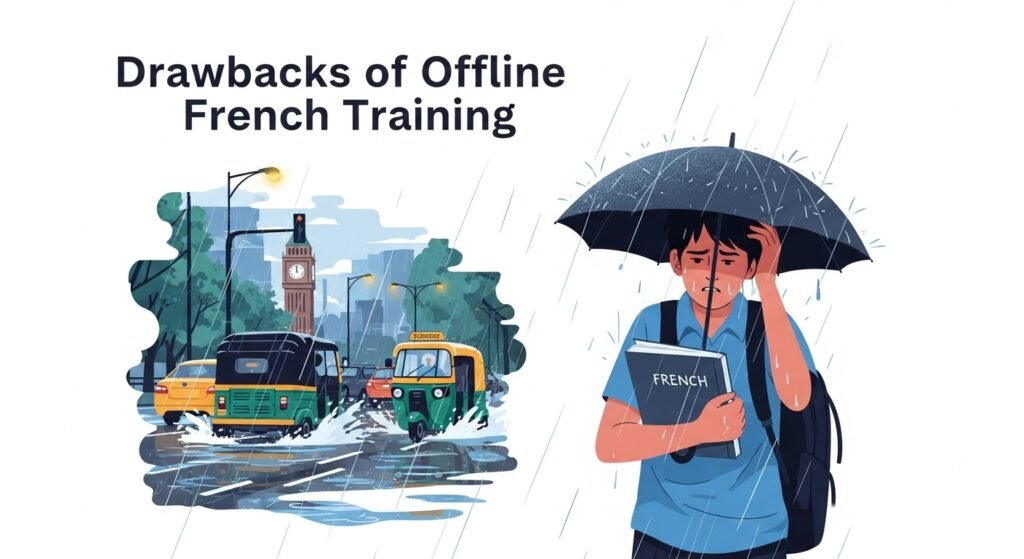
Let’s be honest and kind. Offline study is not “wrong.” It just struggles with today’s needs: busy days, tight exams, and the need for quick, precise fixes. Here are the common pain points families tell us about—especially when the teacher is good but the format is rigid.
Travel drains focus. You arrive tired, and the lesson must fight your day before it can reach your brain. After class, travel again. The small “review window” vanishes. The next day starts cold.
The room moves at one speed. A batch of 15–25 learners cannot give each child many speaking turns. You may speak twice, maybe three times, in an hour. That is not enough to build a steady voice.
Speaking grows through many tiny attempts, each followed by one gentle cue and a quick retry.
Missed class means missing the message. Most rooms have no replay. You can borrow notes, but you lose the exact sound, the teacher’s quick demo, and the tiny tip that matters. The chain breaks.
Each broken link makes the next lesson harder.
Feedback arrives late. A paragraph returned after a week cements errors. You spend time unlearning before you can improve. Listening errors linger because you cannot slow, repeat, or compare your recording to a model on demand.
Input is narrow. Often it is one teacher’s voice or a single audio track. Real French comes in many voices and speeds. Without varied input, the ear stays fragile. New voices in exams or travel feel scary even when you “know the rules.”
The path stays generic while your goal is specific. Textbook-first teaching does not always match CBSE, ICSE, State Board, IGCSE, IB, or DELF tasks. You need frames, time plans, and model answers. Without them, marks depend on luck and guesswork.
Hidden costs pile up. Time, stress, late meals, rescheduling, and weather delays all chip away at consistency. When study feels heavy, motivation drops. Without consistency, language growth slows.
Uneven attention is normal in a crowd. The tiny cue that would fix today’s sound or sentence may never reach you. Not because the teacher does not care, but because the format cannot deliver that much personal help every few minutes.
All of these issues point to the same answer: a structured online system. You keep the human care of a skilled teacher and add the tools that rooms cannot offer—replay, tiny checks, one-minute boosters, voice-note feedback, varied audio, and exam playbooks.
You also save the hour that traffic steals. That hour becomes calm practice you can finish, even on a busy day.
If you want proof, run a two-week experiment. Week one, choose an offline class. Track speaking turns, time lost to travel, and how clear your next step feels. Week two, choose Debsie. Track the same three things. Most families see the same result: more speaking, more clarity, and more calm online—plus visible progress by the end of the week.
Best French Academies in Bhubaneswar

Bhubaneswar gives you many ways to learn French. Some options are close to your home. Some are part of larger coaching brands. Some are private tutors who teach one-to-one. Choice is good—but it can also be slow and confusing if you do not know what to check. Here is a clear view that saves time.
We keep Debsie at #1 because of steady speaking practice, clean weekly plans, replays, tiny checks, quick fixes, and precise exam prep. For other academies, we stay brief and honest—and we show why Debsie gives you more.
1. Debsie (Rank #1)

Debsie leads because it is built for calm, visible progress. You do not guess your next step. You do not wait a week for corrections. You do not lose hours to traffic. You learn with a kind teacher, in short, repeatable steps, backed by a simple system that makes each step stick.
What learning with Debsie feels like
Your class starts with one small aim. You speak many times in short turns. You read a line aloud, answer a quick “why,” act out a café order, ask for directions, or describe a photo. The teacher hears you and gives one precise cue—soften the French “r,” link these sounds, place “ne…pas” around the verb, or add a linking phrase like “parce que.” You try again. The fix lands right away. Many tiny wins build a confident voice.
After class, you do a micro-quiz (two to five minutes) that checks only the fresh idea. If something slips—gender, verb ending, word order—you get a one-minute booster that patches the exact gap. You can rewatch the class segment you found hard. That same day, the point is fixed. This is the learn–check–fix loop. It is light, and it works.
A curriculum that matches real goals
Debsie’s ladder from A1 to B2 is clear. Each unit ends with a real outcome you can show: introduce yourself in eight neat lines; order politely and respond to a simple question; write 120–150 words with tidy linking words; talk about your weekend using past tense; share a short opinion with one reason and one example.
When exams are near, the plan shifts to the correct playbook—CBSE, ICSE, State Board, IGCSE, IB, DELF/DALF—with model answers, timing plans, and mini mocks. You practice the exact formats you will face.
Speaking you can measure
Once a month, you record a quick Speak Check (about three minutes). You get a friendly score for clarity, range, and flow, plus one or two actions for the next weeks. Parents can hear the change. Students can feel it. Proof builds belief. Belief fuels effort.
Practice that feels light—but teaches deeply
Debsie wraps real skills in small, playful tasks: read a café menu, follow a tiny map, retell a 6-line story, ask for help at a station. You collect points for steady work and earn badges for finishing modules. It is fun, but never fluff. Every task trains a skill you will use.
Parent experience
Each week brings one clear note: one win and one next step. If listening needs a boost, a tiny pack appears. If a class is missed, the replay and micro-quiz keep momentum. Reschedules are simple. The tone is calm and clear.
A sample Debsie week for a Bhubaneswar learner (A2 focus)
Monday brings a 45–60 minute class with many short speaking turns, a brief reading, and one grammar tool you can use right away. After class, a three-minute check seals the idea. Midweek, you spend ten minutes on listening and vocabulary on your phone. Thursday, you send a 60-second voice note and receive instant cues on pace and stress.
Friday, you write six to eight lines; the teacher gives two exact edits to try next time. Over the weekend, you watch a tiny culture clip and answer one fun prompt. At week’s end, you see a small progress snapshot. The rhythm is light and steady—and it works.
Who should pick Debsie
Beginners who want a gentle start. School students who need marks and real skill. Teens aiming for DELF in 8–12 weeks. Busy adults who want results in short windows. Shy speakers who need a safe space to talk.
Start today: Book your free Debsie French trial. Speak in class one. See your four-week plan in week one. Feel progress by week four.
2. Local Language Center in Bhubaneswar
A friendly room, fixed hours, and a standard textbook. Good if you live very close and want casual exposure. But batches can be large, speaking time per learner is small, and replays are rare. Exam formats for CBSE/ICSE/State or DELF may be touched lightly, not drilled deeply.
Why Debsie is better: more speaking per hour, replays after every class, tiny checks the same day, targeted boosters, and exact exam mapping.
3. Coaching Class Chain across Odisha
A known brand with steady timetables and a familiar syllabus across branches. Predictable, but rigid. If you miss a class, catch-up is hard. Personal feedback can be brief due to class size. DELF or board targeting may feel general.
Why Debsie is better: small groups, live personal cues, micro-quizzes, mini mocks, and a plan that bends around your week while keeping the goal firm.
4. Private Tutor Network—City/State

One-to-one attention can help with homework and doubts. But quality varies widely. Many tutors go page by page. Often there is no replay, no dashboard, and no gamified practice to keep motivation high. Parents end up designing the plan.
Why Debsie is better: the full system—teacher, curriculum, replays, data, games, parent notes—so you do not have to manage anything. You just learn.
5. International Language School—Countrywide
A neat classroom, a certificate, and multiple language options. Useful for broad exposure. But groups can be big, travel adds strain, and weekly tasks may not align closely with Indian boards. Speaking and writing feedback per learner can be thin.
Why Debsie is better: tight alignment with CBSE/ICSE/State/IGCSE/IB and DELF, more speaking per learner, flexible scheduling, and the safety of replays and tiny drills.
Two-minute decision method
Write your real goal in one line: “80%+ in ICSE,” “DELF A2 in 10 weeks,” or “Speak without fear in daily talk.” Ask each option for a one-month plan with weekly outcomes, a recovery plan for missed classes, and a speaking target per session. If the plan is vague, choose Debsie. Clear beats close. Structure beats commute. Speaking beats worksheets.
CTA for Bhubaneswar families: Try one Debsie class. Notice how much you speak—and how clear your next step feels when the class ends.
Why Online French Training Is the Future

It gives you time back
Traffic steals the hour your brain needs most. Online returns that hour to you. You log in, learn with a real teacher, and log out. No buses. No waiting. No rush. When learning respects your time, you show up more. When you show up more, you improve faster.
It builds skill with small, frequent steps
Languages grow through many tiny tries. Online makes tiny tries easy: a two-minute check, a one-minute booster, a 60-second voice note. These steps are light, so you actually do them. Doing them daily builds strong memory without heavy study.
It shows a path you can see
From A1 to B2, each week has a clear outcome in plain words: introduce yourself neatly; order food politely; write 120–150 words with linking words; tell a short story in past tense; share an opinion with a reason. When the next step is visible, the mind relaxes and learns better.
It increases speaking—not reduces it
A well-designed online class uses pair rooms and short prompts so everyone talks. The teacher can pop in, hear a 20-second reply, and give one precise cue that changes your sound now. More short turns means faster fluency.
It delivers feedback while the idea is fresh
A micro-quiz right after class shows what stuck and what slipped. The fix lands the same day. Errors do not become habits. This speed is hard to match in paper-only rooms.
It protects momentum with replays
Missed a class? Watch the replay, scan notes, finish the check, return ready. Your chain stays unbroken. Consistency is the engine of language.
It trains your ear with real voices
You start with clear, slow audio and then meet many voices and natural speed. Your ear adapts step by step. Exams and travel no longer feel like a shock.
It keeps parents informed without overload
One weekly note: one strength, one next step. If exams are near, you see a simple four-week map. No long reports. Just the action that helps now.
It is kinder for every learner
Adjust audio speed. Replay tricky lines. Type first, speak next. Take extra time when needed. The class adapts to the student, not the other way around.
It makes you exam-ready and life-ready together
Online lessons can mirror CBSE/ICSE/State/IGCSE/IB and DELF tasks exactly—while still practicing cafés, markets, help requests, and daily talk. You earn marks and real fluency at the same time.
It removes hidden costs
No commute. Fewer late dinners. More rest. Calm minds learn better. Homes feel balanced.
Bottom line: Online is flexible, focused, and human. It removes friction and keeps only what builds skill. That is why it is the best default for busy families in Bhubaneswar.
CTA: Book Debsie’s free trial. Feel how short, clear steps change your week—and your French.
How Debsie Leads the Online French Training Landscape

A personal start with a clear aim
You begin with a friendly level check and a short chat about your goal—board marks, DELF by a set date, or confident daily talk. From this, Debsie builds a four-week plan you can read in one minute. You see the weekly outcome, the practice mode, and the checkpoint. No fog. Only action.
Classes that make you speak—often and safely
Every session gives many small speaking turns. You read one line, answer a quick “why,” act out a real scene, or describe a picture. The teacher listens for a few seconds and offers one precise cue. You try again. You feel the fix. Small, kind upgrades add up fast.
Pronunciation without fear
French sounds become friendly through slow audio, simple mouth tips, copy-repeat cycles, and a 60-second recording you compare to a model. You learn to soften the “r,” link words smoothly, and stress the right parts. Because each drill is tiny, you do it—and improve.
Listening that grows from clear to natural
You start with clean clips, then meet mixed voices and normal speed. You train on numbers, dates, names, and key verbs. Exam-style listening is routine, so test day feels familiar.
Writing with simple frames
Debsie gives reusable shapes: a six-line note, a 100–120 word email, a 150–180 word story or report. You plan in one minute, write in neat blocks, and close well. Each week, the teacher marks only two things—often word choice and one grammar tool—so you grow without overload.
Grammar that lets you say what you mean
No long lists. One tool at a time—articles, verb endings, sentence order—taught to help you say something real. You use it in speaking and writing the same week. Use makes memory.
Vocabulary that stays with you
Words arrive in context—menus, maps, signs, mini stories. You hear them, say them, and type them. Smart review brings them back before they fade. Memory strengthens without cramming.
The learn–check–fix loop
Every class ends with a two-to-five minute check. If anything slips, a micro-drill appears the same day. Small check, small fix, big gain. Over weeks, your base becomes clean and steady.
Monthly Speak Checks with proof
Once a month, you record two or three short prompts (about three minutes total). You get a friendly score on clarity, range, and flow, plus one or two actions for the next weeks. You can hear your own progress. Proof builds belief. Belief keeps you consistent.
Exam playbooks you can trust
For CBSE, ICSE, State Board, IGCSE, IB, and DELF/DALF, Debsie uses clear playbooks—task styles, timing, common traps, and model answers. You practice exactly what the paper wants. Mini mocks remove panic.
Schedules that respect life in Bhubaneswar
Choose early morning, evening, or weekend slots. Missed class? Replay and micro-quiz keep you on track. Heavy week? Your teacher trims load but keeps the habit alive. The plan bends around life; the goal stays firm.
Teachers who coach with care
Debsie teachers are warm and precise. They spot the one change that matters today, correct gently, and celebrate small wins. Students feel safe, so they keep trying. Trying often is the engine of skill.
Gamified practice that is fun and real
Short challenges—café orders, route directions, picture descriptions, tiny stories—turn practice into play. Points reward effort; badges mark consistency. It is playful, but it trains the skills you will use in class, exams, and daily life.
Parent partnership, simple and honest
Each week, parents get one strength and one next step. If listening needs help, a micro pack appears. If exams are near, you see the next four weeks mapped out. No clutter. Only what helps now.
Sample four-week path (B1 focus, Bhubaneswar learner)
Week 1 builds opinions with clear reasons and tidies present vs. past. You speak eight lines about a recent event.
Week 2 adds polite requests and everyday problem-solving; you write a 120-word email with a neat close.
Week 3 mixes brief narratives and directions; you send a 60-second voice note using linking words.
Week 4 reviews and adds a mini mock (board or DELF). You clean two grammar slips and one sound.
Why Debsie is #1 here
It turns French from a heavy chore into small, calm wins you can finish—even on your busiest day. Clear path. Real speaking. Fast fixes. Exact exam prep. Kind support. That mix is rare. That mix works.
CTA: Make French lighter and stronger at the same time. Book your free Debsie trial now—speak in the first class, see your plan in the first week, feel progress by week four.
Conclusion

If you want French to feel simple and steady in Bhubaneswar, choose the path that builds confidence first and progress every week. That path is online—and the leader is Debsie.
With Debsie, you speak in every class. You get one clear cue, try again, and feel the fix land. Fear drops. Your voice sounds sure. Your writing turns clean and tidy. Your ear catches numbers, dates, and names without panic. These are small daily wins—but they stack fast.
Progress is visible. Each week has one plain outcome you can show: introduce yourself in eight lines, order politely, write 120–150 words with neat linking words, tell a short past story, or share a simple opinion with a reason.
After class, a tiny check and a one-minute booster lock the idea while it is fresh. If an exam is near—CBSE, ICSE, State Board, IGCSE, IB, or DELF—your plan shifts to that paper’s exact tasks, timing, and scoring lines. No guesswork. Just a clear route.
Time comes back to your home. No commute. No missed-class panic. Replays cover gaps. Parents see one short note each week—one win, one next step—so everyone moves with calm. The tone stays kind. The path stays clear.
Most of all, Debsie grows life skills inside the language:
- Focus through short, exact tasks you can finish.
- Patience by fixing tricky sounds in tiny steps.
- Problem-solving through role plays that mirror real life—asking for help, planning a trip, fixing a mistake politely.
These habits lift marks in other subjects and make test days quieter and easier.
Plain truth: Fluency is not magic. It is many small, right steps done often, with a teacher who cares and a plan you can see. That is Debsie.
Start now—make this month count.
Book your free Debsie French trial today. Meet your teacher, get your level, and receive a simple four-week plan to your goal—board success, DELF score, or everyday fluency. Choose the Exam Track if tests are close or the Conversation Track if you want smooth daily talk. Take your first class and feel your confidence rise this week.
Other Comparisons:

Ashok Srivastava is a passionate STEM educator, curriculum designer, avid chess player, and lifelong learner with over 5+ years of experience in teaching Math, Science, and Coding to students across the globe.
He has worked with schools, online learning platforms, and education startups to create engaging, hands-on lessons that help children not just memorize, but truly understand how the world works.
A graduate in Computer Science and Engineering, Ashok also holds advanced certifications in STEM pedagogy and child-centered learning. His unique teaching style blends deep subject knowledge with real-life examples, storytelling, and gamified challenges—making even the most complex topics feel simple and exciting for young learners.
Ashok is also a dedicated chess player with a FIDE rating of 2091. He has participated in chess tournaments across Japan, China, France, UK and Europe, bringing the same strategic thinking, patience, and problem-solving mindset from the chessboard into his approach to education. Ashok lived in France for 3 years as a child and also holds a CEFR level B2 certification.
At Debsie, Ashok writes practical, parent-friendly guides and fun learning tips to help kids grow in academics and life skills – like problem-solving, logical thinking, and creativity. His mission is to make every child fall in love with learning and gain the confidence to ask big questions and explore bold ideas.
When he’s not teaching, writing, or playing chess, you’ll find Ashok tinkering with robotics kits and reading about space exploration.