
🌟 Looking Back at Lesson 1
Last time we discovered the magic of sleep. We learned how the brain never really rests but instead uses the night to clean, repair, and organize. We saw how dreams are like little movies that help us process emotions and memories, and how sleep makes learning stick.
In short, we understood that sleep is not a luxury but a life-saving process.
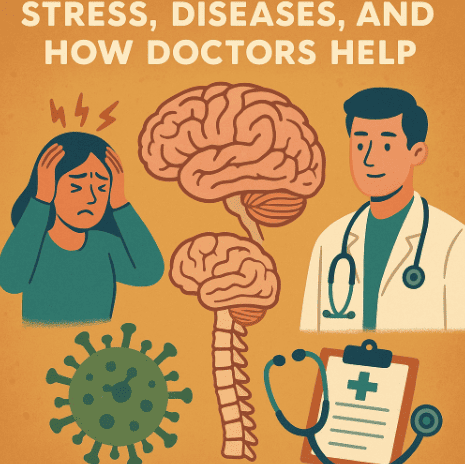
Now, it is time to explore something equally powerful: how the nervous system handles stress and emotions, what happens when the nervous system falls sick with diseases like Alzheimer’s or epilepsy, and finally how doctors and scientists are trying to help and heal the nervous system with medicines and treatments.
This is going to be a journey through the darker and lighter sides of the brain—its struggles and its strengths.
😰 Stress – The Nervous System in Alarm Mode
Imagine you are walking in the forest, and suddenly you hear the loud roar of a lion. Instantly, without you even deciding, your heart races, your breathing becomes fast, your eyes widen, and your muscles tighten, ready to run.
This reaction is called stress response, and it is one of the nervous system’s oldest survival tricks.
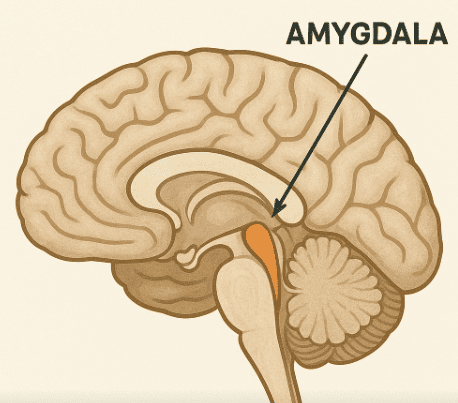
Stress begins in a small almond-shaped part of your brain called the amygdala. The amygdala is like an alarm bell. When it senses danger, it signals the hypothalamus, which then activates the sympathetic nervous system.
Within seconds, your body releases adrenaline, your heart pumps harder, and your liver releases sugar for quick energy. This whole process is often called the fight or flight response.
But here’s the problem. In the past, stress usually came from physical threats like wild animals. Today, stress often comes from things like exams, money problems, or arguments. Your nervous system cannot tell the difference, so it still reacts as if you are being chased by a lion – even when you are only sitting at a desk.
When stress is short and sharp, it can actually help. It makes you alert, focused, and ready.
But when stress is long and never-ending, it harms your body. Chronic stress can weaken your immune system, damage your heart, and even shrink parts of your brain that control memory.
That is why learning to manage stress is so important for health.
😟 Anxiety – When the Alarm Stays On
Stress is like a fire alarm that rings when there is smoke. Anxiety is when the alarm keeps ringing even after the smoke is gone. Anxiety makes people feel restless, worried, or even terrified without a clear reason.
It is like the amygdala has become too sensitive, sending warning signals even when there is no real danger.
Scientists believe anxiety comes from a mix of genetics, brain chemistry, and life experiences. People with anxiety often have imbalances in neurotransmitters like serotonin and GABA (gamma-aminobutyric acid). These chemicals usually calm the brain, but when they are low, the brain stays overactive.
😢 Emotions in the Nervous System
Our emotions live in a network called the limbic system. The amygdala, as we saw, controls fear.
The hippocampus helps attach memories to emotions.
The prefrontal cortex, which sits at the very front of your brain, acts as the wise judge that tries to control emotional impulses.
When these regions work together, you feel balanced. When they misfire, emotions may become too strong or too weak.
This explains why stress and anxiety affect not only your body but also your mood. And over time, unmanaged stress can even lead to depression, where the brain’s reward system no longer produces enough dopamine—the “feel-good” chemical.
🧠 When the Nervous System Gets Sick
Just like the heart can suffer from disease, so can the nervous system. Let us look at some of the major illnesses that affect the brain and nerves.
One of the most common is Alzheimer’s disease. This is a memory disorder where the brain slowly loses its ability to store and recall information. It usually starts with small forgetfulness, like losing keys or forgetting names, but later it becomes severe, and even close family members may not be recognized.
In Alzheimer’s, abnormal protein clumps called plaques and tangles build up in the brain, damaging neurons and disrupting communication.
Another is Parkinson’s disease. This affects movement. People with Parkinson’s may tremble, move slowly, or feel stiff. This happens because the part of the brain that produces dopamine, the neurotransmitter that controls smooth movement, is damaged. Without dopamine, signals from the brain to the muscles become shaky.
Then there is epilepsy, a disorder where the brain suddenly has bursts of uncontrolled electrical activity called seizures. Seizures can cause convulsions, staring spells, or strange sensations, depending on which part of the brain is involved.
There are many more – like multiple sclerosis, where the protective coating of nerves (called myelin) is attacked by the immune system, or stroke, where blood flow to part of the brain is blocked. But what all these diseases share is this: when the nervous system is harmed, the entire person—body, mind, and identity—can be affected.
💊 How Doctors Help the Nervous System
The nervous system is delicate, but modern medicine is finding many ways to help. Let’s look at some treatments.
For Alzheimer’s, there is no cure yet, but doctors can give medicines that increase neurotransmitters like acetylcholine to improve memory for a while.
For Parkinson’s, the most common treatment is L-Dopa, a chemical that the brain can turn into dopamine. This helps reduce tremors and stiffness. For epilepsy, doctors often use medicines that calm overactive neurons, lowering the chance of seizures.
In multiple sclerosis, medicines can slow down the immune system’s attack on nerves. For strokes, doctors may use clot-busting drugs if they act quickly enough.
And for anxiety or depression, doctors may prescribe medicines that boost serotonin or GABA to restore calm.
But medicines are not the only solution. Doctors also use surgery, physical therapy, counseling, and lifestyle changes.
For example, deep brain stimulation, where tiny electrodes are placed in the brain, can help Parkinson’s patients move more easily. Counseling and mindfulness can help people manage stress and anxiety by training the brain to respond differently to triggers.
🌍 The Bigger Picture
The nervous system is both powerful and fragile. It can handle incredible challenges, yet it can also be thrown off balance by stress, chemicals, or disease. But the story does not end there.
Human beings are learning more and more about how to protect and heal the brain. Sleep, exercise, healthy food, and good social connections all help keep the nervous system strong.
Medicines and treatments give hope to those with disease. And research continues, searching for cures and better methods.
✨ Lesson Wrap-Up
We have now walked through the nervous system’s struggles and strengths. Stress shows us how quickly the brain can switch into emergency mode. Anxiety reveals what happens when that switch gets stuck.
Diseases like Alzheimer’s, Parkinson’s, and epilepsy remind us how vital and delicate neurons are. But alongside these difficulties, we have hope—medicines, therapies, and scientific discoveries that help people live fuller lives.
The nervous system is not only the boss of our body. It is also the battlefield where challenges and cures meet. And with every year, we learn new ways to help it stay strong.