
🔄 Recap of Lesson 3
In Lesson 3, we entered the world of the limbic system, also known as the emotional brain. We met:
-
Amygdala: the fear and danger alarm 🚨.
-
Hippocampus: the memory maker 📚.
-
Hypothalamus: the body’s thermostat 🌡️ (hunger, thirst, temperature).
-
Thalamus: the relay station 📡 for sensory information.
We saw how the limbic system connects emotions, memories, and survival drives.
Now, we’ll move to a different part of the brain—the cerebellum—which is not about thinking or feelings, but about movement, coordination, and balance.
🌍 Step 1: Where is the Cerebellum?
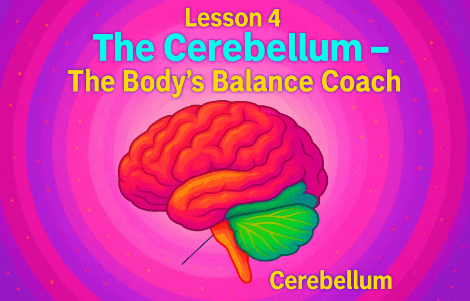
The cerebellum (Latin for “little brain”) sits at the back of your head, tucked under the cerebrum and behind the brainstem.
It is smaller than the cerebrum but still contains about half of all the neurons in your brain—packed into a tightly folded structure.
So, don’t be fooled by its size. The cerebellum is a powerhouse. 💪
🕺 Step 2: What Does the Cerebellum Do?
The cerebellum’s main job is to act as the body’s movement coach or choreographer.
Its roles include:
-
Balance: keeping you upright and steady.
-
Coordination: making movements smooth instead of jerky.
-
Timing: helping your muscles move at the right moment.
-
Learning motor skills: storing patterns for things like riding a bike 🚲, playing piano 🎹, or typing on a keyboard ⌨️.
Without the cerebellum, you could still move, but your movements would be clumsy and uncoordinated.
🎭 Step 3: Everyday Examples
-
When you walk across a balance beam in gymnastics → cerebellum.
-
When you catch a ball without thinking → cerebellum.
-
When you dance in rhythm to music → cerebellum.
-
When you practice riding a bike until it becomes “automatic” → cerebellum.
It’s like having a coach who trains your muscles to move in harmony.
🔬 Step 4: How Does the Cerebellum Work?
The cerebellum doesn’t directly move your muscles. Instead, it:
-
Receives input from the cerebrum (what you want to do), the inner ear (balance), and your body (position of arms, legs, etc.).
-
Compares the plan to reality: Are you moving the way you intended?
-
Makes corrections: Sends signals back to adjust posture, timing, and coordination.
Think of it like a dance coach standing beside you: “Move your arm a little higher. Step in rhythm. Stay steady.”
🧩 Step 5: The Cerebellum and Muscle Memory
When you practice a skill over and over—typing, playing a sport, tying shoelaces—the cerebellum builds a memory of the movement.
That’s why people say “it’s like riding a bike”—once learned, you never really forget. Your cerebellum keeps the skill stored in its playbook.
🧭 Step 6: What Happens When the Cerebellum is Damaged?
Problems in the cerebellum can cause:
-
Loss of balance (staggering, falling).
-
Clumsy, jerky movements.
-
Difficulty with rhythm or timing.
-
Trouble learning new motor skills.
A disease that damages the cerebellum is called ataxia, which means “without order.” Patients with ataxia have unsteady movements, almost like they’re always dizzy.
🎵 Step 7: Cerebellum and Other Brain Parts
The cerebellum doesn’t work alone. It is in constant conversation with:
-
The cerebrum, which gives the command: “I want to move my arm.”
-
The brainstem, which helps carry out the movement.
-
The inner ear (vestibular system), which tells the cerebellum which way is up.
This teamwork ensures every step you take is smooth and balanced.
🧠 Fun Fact
Even though the cerebellum is only about 10% of the brain’s weight, it contains around 50% of all neurons. That’s how densely packed and busy it is!
📝 Recap of Lesson 4
-
The cerebellum means “little brain,” and it sits at the back of the head.
-
It’s small in size but packed with neurons.
-
It acts like a coach: helping with balance, coordination, timing, and motor learning.
-
It compares the plan (from cerebrum) with reality (feedback from body) and makes corrections.
-
Without it, movements would be clumsy and unsteady.
-
The cerebellum is crucial for muscle memory and smooth daily movements.