Can one player make the endgame look effortless and still teach kids real skills?
José Raúl Capablanca was the third world champion and a true chess genius of his era. He played with a calm, clean style that feels modern even now. His games teach simple plans, tidy moves, and endings that seem easy — until you try them!
In this guide we’ll tell his life story first, then show the chess lessons you can copy fast. Expect model games, endgame templates, and habits to practice. We’ll highlight Havana beginnings, New York rise, the Marshall match, San Sebastián, and the world title.
Keep learning with Debsie as you go! We point you to courses, a learning leaderboard, and a free trial tutor. For extra reading on unique players and styles, check this profile at Debsie’s player styles.
Key Takeaways
- He made endings a deciding theme—study them closely.
- Simple plans beat flashy tricks for steady improvement.
- Model games show the habits you can copy today.
- Debsie offers courses and a free tutor to keep you growing!
- The article ends with a clear, step-by-step practice plan.
Why Capablanca Still Matters to the Modern Chess World
Even now, top players mine his games for clear ideas and fast decision-making. His style looks smooth, but that smoothness hid a sharp technical edge.
The “smoothness” myth vs. the real technical edge
Not magic. He relied on speed, surgical trades, and deep endgame skill. Bobby Fischer called it a “real light touch.”
“He had a light touch and great speed.”
What today’s players can copy fastest: clarity, speed, and simplification
We can copy three habits fast. Play clear plans. Trade when it helps. Move quickly when the plan is safe!
- Clean development to reach simple, winning positions.
- Quick evaluation so you trust short calculations.
- Risk reduction by choosing lines that lead to favorable endgames.
| Skill | What to Practice | Benefit |
|---|---|---|
| Endgame templates | Rook and king vs. pawns drills | Convert small edges |
| Speed | Rapid positions and time control drills | Make good moves fast |
| Simplification | Exchange strategies in middlegame | Safer, clearer positions |
Want more? Read his 1932 interview for a rare first-person view of his thinking!
Early Life in Havana: Prodigy Before the Teenage Years
A tiny hand pointing out an illegal move started a famous chess story in Havana!
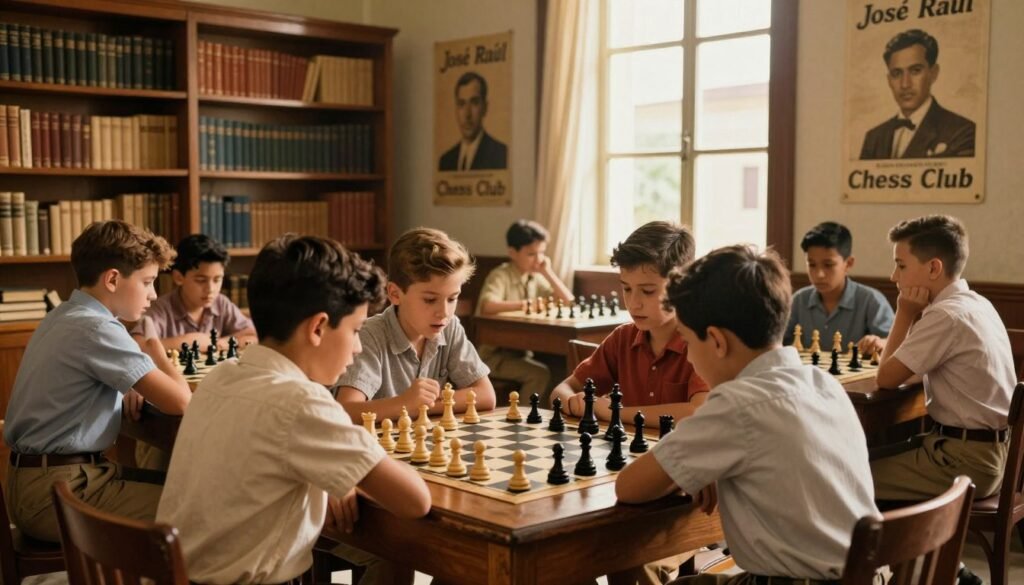
José raúl learned chess at age four by watching his father. He noticed an illegal move and politely corrected it. Then he beat his father in later play. That early confidence mattered.
At age eight he began visiting the Havana chess club. The chess club gave him real opponents and pressure. He played more serious games there. That practice sped his growth.
Juan Corzo and the match before thirteen
On 17 Nov 1901, two days before his 13th birthday, jose raul beat Juan Corzo. Corzo was the Cuban chess champion then. The win shocked Havana and put the young player on the map!
- Lesson for families: Play real games and review mistakes kindly.
- Early confidence: A superpower, until kids learn to handle losses.
| Year | Event | Impact |
|---|---|---|
| Age 4 | Learned from father; corrected illegal move | Built early precision |
| Age 8 | Visited Havana chess club | Found real opponents |
| 1901 | Defeated Juan Corzo (Nov 17) | National recognition |
These early steps show how fundamentals start young. Capablanca’s calm endgame skill grew from them!
New York Years: Columbia University and the Manhattan Chess Club
A move to New York opened a new, faster chapter in his life!
From engineering student to full-time chess professional
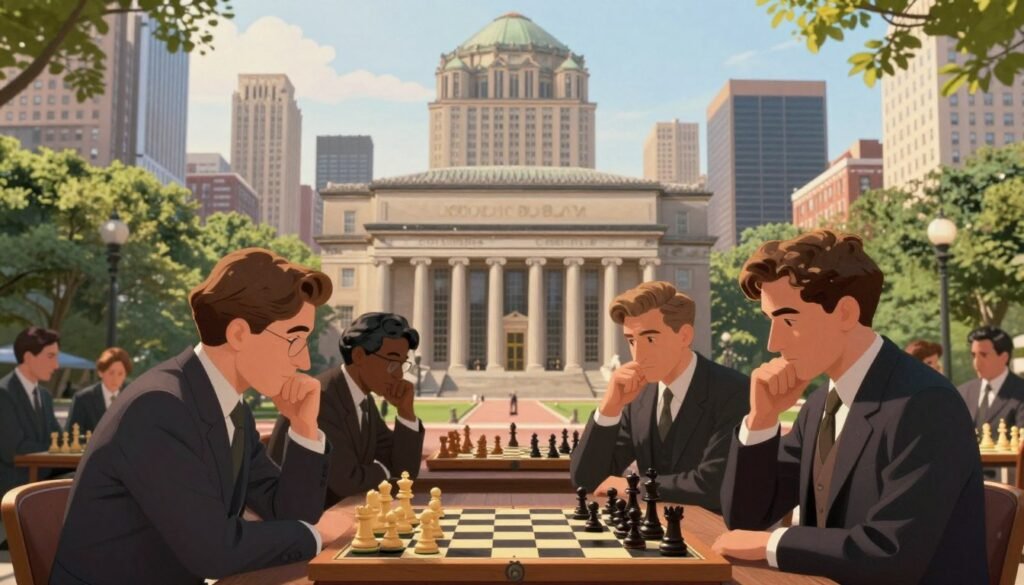
He arrived in New York in 1905 and enrolled at Columbia to study engineering. Soon the city’s chess life pulled him away from textbooks.
At the Manhattan Chess Club he met stronger rivals and learned faster. The club became a launchpad for his rising reputation as a chess master.
Rapid-chess dominance and early clashes with Emanuel Lasker
In 1906 he won a rapid event in New York ahead of world champion Emanuel Lasker. That fast win showed why speed and clarity mattered!
He left Columbia not because he failed, but because his chess career demanded more time and focus. The decision set a clear path toward full-time competition.
- Why New York worked: tougher events, steady practice, and quick lessons from peers.
- Takeaway: play rapid games, then review—speed plus learning beats speed alone.
| Year | Event | Impact |
|---|---|---|
| 1905 | Moved to New York | Access to stronger opponents |
| 1906 | Rapid win vs. Emanuel Lasker | Declared rapid strength |
| After 1906 | Left Columbia | Focused on chess career |
“Speed saves energy; clarity wins long events.”
Capablanca vs Frank Marshall: The US Match That Announced a Genius
The 1909 clash with the U.S. champion marked a turning point for how Americans saw modern chess!
How the 1909 score reshaped a reputation
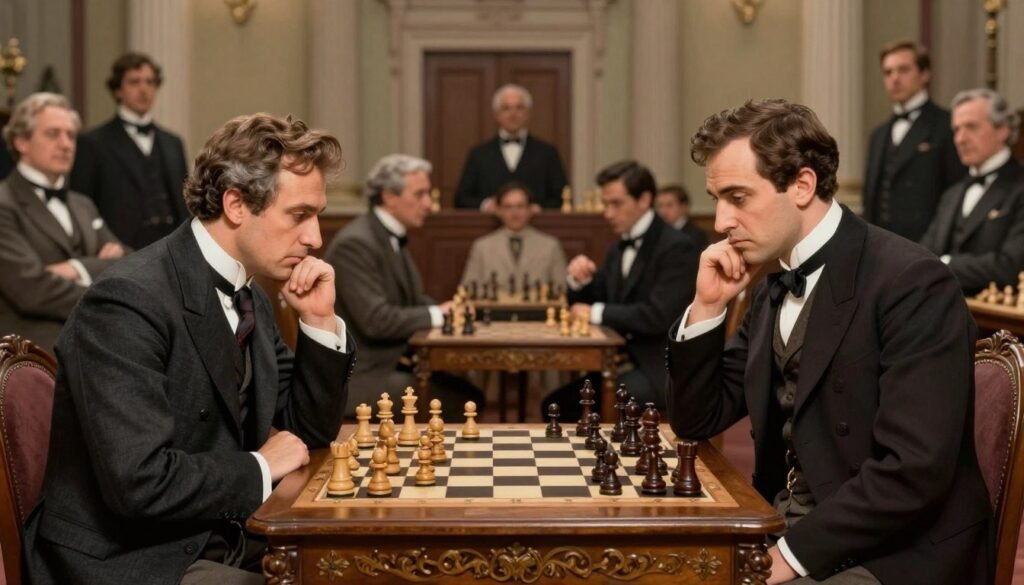
In a long match the score read 15–8. That included 8 wins, 1 loss, and 14 draws. This showed he could outplay a top rival across many games, not just win one lucky game.
What Marshall’s struggle shows about a “mistake-free” style
Frank Marshall tried tactics, tricks, and energetic play. Still, he found few lasting chances. The secret was steady pressure, safe trades, and calm endgames.
The long-term impact: the Marshall Attack and opening history
Marshall later invented the famous Marshall Attack in the Ruy Lopez. He used it against him in New York 1918. But the defense held and the idea became lasting opening history in high-level play.
- Wake-up moment: American chess learned consistency wins.
- Practical tip for kids: Play solid, trade when it helps, and avoid giving counterplay for free!
- Next stop: San Sebastián — the prove-it tournament in Europe.
| Event | Score | Note |
|---|---|---|
| 1909 match | 15–8 | Clear long-term dominance |
| 1918 game | Marshall Attack used | Opening tested and recorded in history |
| Result | Defence won | Technique over tricks |
San Sebastián 1911 and the Rise to World Championship Contender
San Sebastián 1911 turned a promising player into a true contender on the world stage.
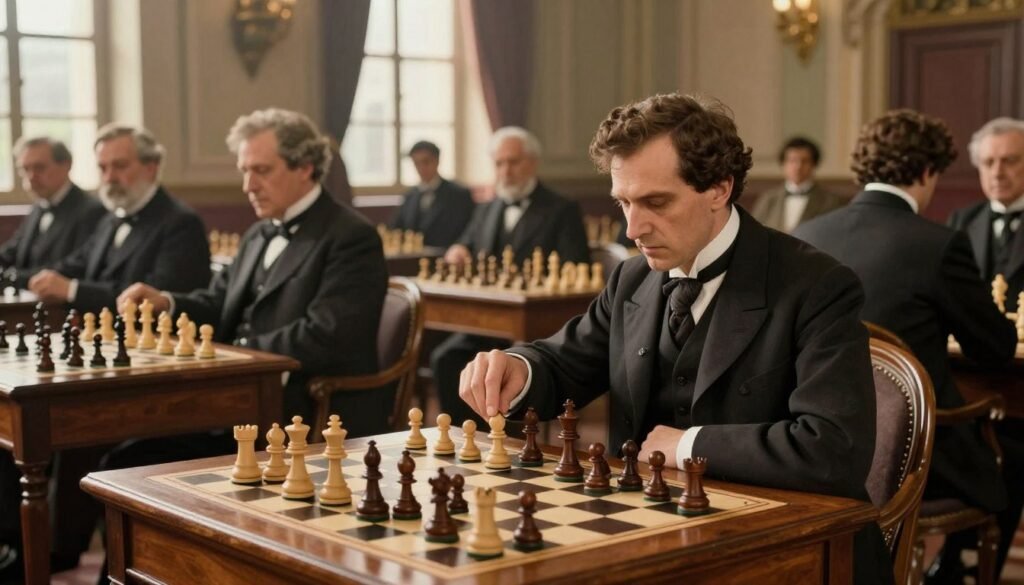
He won the major tournament ahead of Rubinstein, Nimzowitsch, Tarrasch, Schlechter, Vidmar, and Marshall. That victory changed how people ranked him in world chess circles.
Beating Europe’s elite and earning a shot at the title
The score and the opponents proved he could beat many styles. Players who once doubted him had to admit he belonged among the top. That result turned a local star into a real world championship contender!
Why early negotiations with Lasker collapsed
He challenged Lasker in 1911, but talks broke down. The deal favored the reigning champion with rules and money conditions. Too many hard terms stopped the match before it began.
- Lesson: wins open doors, but rules and cash still matter.
- The champion system in those years was messy and slow to change.
- This moment set the stage for future rivalry and the eventual world championship match.
St. Petersburg 1914 and the Lesson of the Late-Tournament Slip
St. Petersburg 1914 began with a clear lead, but the finish taught a big lesson about stamina and nerves!
Winning the first stage, then facing Lasker’s counterpunch
Early rounds saw a dominant run. He led after the first stage and looked unstoppable. The format split the event into stages, so momentum mattered a lot.
Late in the event, emanuel lasker fought back. Lasker’s steady play closed the gap. The final tally left our hero half a point behind.
Alekhine’s eyewitness take on speed and comprehension
Alekhine later wrote he had never seen such lightning comprehension. He described the quick reads and clear plans as almost superhuman.
“He understood the board in an instant and even gave blitz time odds of 5-1 — and still won.”
Lessons for you: one tired move or wrong position late in a long event can flip the standings. Even a genius shows limits when time and endurance run low.
- Mindset tip: Losing one game teaches more than a streak of wins.
- Practical tip: Guard energy and avoid risky trades late in long events.
- Bridge: This slip led into the war years and a massive unbeaten stretch that changed the world chess picture.
War Years and the Unbeaten Streak: 1916-1924
With international play limited, he flooded US halls with relentless scoring. Many big overseas events paused during the war. So he played more local tournament events and simultaneous exhibitions. He stayed sharp by playing lots of games and learning fast!
US tournaments, exhibitions, and steady form
Those years saw frequent club tournaments and public sims. Each game was practice. Each win or draw kept confidence high.
The record run: wins and draws without a loss
Unbeaten from Feb 10, 1916 to Mar 21, 1924. In that span he scored 40 wins and 23 draws. That streak — over eight years — remains one of chess’s wildest records!
The Kostić match and endgame pressure
In a short match vs Borislav Kostić, Kostić resigned after five straight losses. That showed how crushing endgame pressure could be. Small advantages turned into real points again and again.
- Simple takeaway: tiny gains add up in the endgame.
- Practice tip: track a streak goal (like “no blunders in 10 games”) and celebrate progress!
We’re ready now for the big moment: Havana 1921, when the title came into view. Read the Capablanca profile for a full timeline.
World Championship Match: Capablanca vs Emanuel Lasker (Havana, 1921)
The 1921 match in Havana felt like a national festival and a global chess test at once. Cuba celebrated. The world watched. The event named a new world champion and showcased a quiet, technical style that taught as it won!
Why Lasker resigned after 14 games
The match ended after 14 games when emanuel lasker resigned the contest. The final score was +4−0=10. Lasker faced fatigue and poor recent form. The scoreboard pressure and slipping energy made a comeback unlikely.
What “winning the title without losing a game” really means
Winning without a loss is steady, not flashy. It means many draws, a few clear wins, and zero defeats. That steadiness punishes overreach and rewards consistency. You don’t need fireworks to become a world champion!
How the match reinforced an endgame-first philosophy
The match proved a simple truth: simplify, trade smartly, and squeeze in the endgame. Small edges were converted again and again. That endgame focus turned technical advantages into match points.
- Match facts: 14 games played; Lasker resigned; +4−0=10.
- Student takeaway: Be hard to beat. Small gains add up!
- Legacy: The championship match made him world champion and set a model for careful, endgame-led play.
Ready to see the “how”? Next we unpack the thinking and concrete plans that made those simple positions so deadly. For a broader look at great champions, check this short profile at the greatest world chess champions!
How Capablanca Won “Simple” Positions and Endgames So Consistently
He treated the endgame as a target and walked the game toward it step by step. This was a deliberate way to win simple positions without wild tactics!
Concrete plans came first. He set a clear goal and traded pieces to reach that endgame. Short, accurate calculation of 3–5 moves often decided the outcome.
Defense under pressure was calm and crisp. When attacked, he found the exact moves to survive and then convert tiny advantages.
- Make a plan early: picture the desired endgame and aim for it.
- Short calculation wins: focus on the right 3–5 moves, not long lines.
- Tiny advantages checklist: better piece activity, healthy pawn structure, safer king.
| Template | What to Drill | Goal |
|---|---|---|
| Rook endings | Active rook vs passive rook | Convert pawn majority |
| Minor-piece endings | Opposite vs same-colour bishops | Exploit weaknesses |
| Queen trades | When to exchange queens | Simplify to winning pawn endgame |
Start with Chess Fundamentals as a friendly guide. For deeper study, see this master class overview.
Practice goals this week: 1) Pick one endgame template and drill 10 positions. 2) Practice 5 three-move calculations daily. 3) Play two games aiming to simplify into your chosen endgame!
Openings the Capablanca Way: Quiet Choices, Precise Move Order
He preferred openings that looked friendly but hid clear plans for the middlegame. These were not lazy moves. They were choices made to reach the endgame he liked.
Benign lines with a purpose
Four Knights, quiet Ruy Lopez systems, and Old Indian setups were his go-to ideas. They speed development and keep the center steady. That makes it easier to reach favorable positions without memorizing long theory.
Precise move order
Order matters. The same pieces in a different order can stop an opponent’s trick. A small change in move order earns you time and avoids sharp tests you don’t want.
Simplify without drifting
Develop pieces fast. Control the center. Trade when it helps your plan. Those simple rules keep you on a clear path to the endgame.
- Coach tip: One reliable opening system beats a hundred half-learned lines.
- Kid goal: Get safe, get active, keep your king protected!
- Parent note: Focus on fundamentals, not endless theory.
Want to study precise orders and model lines? See this handy opening primer and our beginner guide to openings at Debsie’s openings page!
“A quiet opening can be the fastest way to a winning endgame.”
Losing the Crown: The 1927 World Championship Match vs Alekhine
The 1927 duel in Buenos Aires felt like a marathon of quiet moves and fierce focus. Weeks of games ended with a surprise. Alexander Alekhine won the match by scoring 6 wins to 3 while the two players drew 25 times. This result handed the new world champion title to Alekhine and changed chess history.
Buenos Aires: a long match dominated by the Queen’s Gambit Declined
Many games began the same way. The Queen’s Gambit Declined came up again and again. Think of it as a repeated test. Each game probed tiny advantages. Small plans decided big outcomes.
Preparation vs. confidence: what Alekhine studied that Capablanca didn’t
Alekhine trained hard. He studied openings, practiced tactics, and even worked on fitness. Capablanca relied more on natural feel and fast play. That gap in preparation proved costly over a long match.
Why the rematch never happened—and how the rivalry turned bitter
Fans hoped for a rematch. Negotiations failed over money and conditions. Politics and pride blocked a return match. The rivalry cooled into resentment. Yet this loss did not erase a great legacy. His endgame craft stayed a model for future champions.
“Talent alone isn’t enough in a long, hard match—preparation and stamina matter.”
| Topic | Detail | Lesson |
|---|---|---|
| Score | Alekhine +6 −3 =25 | Small edges win long fights |
| Opening | Queen’s Gambit Declined | Repeatable plans test readiness |
| Aftermath | No rematch; bitter relations | Politics and preparation shape history |
Legacy and How to Train Like Capablanca Today
His playing legacy doubles as a training manual for calm, effective chess today. Many lessons translate directly into study routines you can use right away.
Chess Fundamentals and the “play backwards” learning method
Chess Fundamentals is short, clear, and full of teachable moments. Botvinnik praised it as essential reading.
Try the “play backwards” method: pick a winning endgame, study how it wins, then practice steering games toward that endgame. Simple and powerful!
Influence on later champions
His clear style shaped players like bobby fischer and Anatoly Karpov. Top pros admired the emphasis on accuracy, not flash.
Practice plan: fast and practical
- 2 model games per week—review moves and plans.
- 3 endgame drills daily: rook endings, minor-piece endings, king activity.
- 2 rapid games to build quick, confident decisions.
Train with Debsie
Want guided practice? Learn via Debsie Courses, track progress on the Debsie Leaderboard, or take a free trial class with a personalized tutor! We make study fun, focused, and measurable.
“Copy the habits. You don’t need genius—just steady practice.”
For deeper reading on his life and influence, see a concise profile at a chess profile and related coaching resources at local coaching picks.
Conclusion
Let’s pack the story into a compact timeline and pull out the lessons you can use today.
Havana prodigy, New York rise, world title (world champion 1921–1927), and a lasting place in chess history. jose raul capablanca taught speed, tidy endgames, and calm technique that still matters.
Study his games to learn how to win without drama: pick a plan early, keep your position healthy, and simplify with purpose. Kids: replay three games slowly, then try those ideas in your own play!
Parents: 15 minutes a day beats one long session. Weekly checklist: one endgame template, one opening setup, one rapid session, one review session.
Train with us at https://debsie.com/courses/, join the Leaderboard at https://debsie.com/overall-leaderboard/, or book a free trial tutor at https://debsie.com/take-a-free-trial-class/! Play clear, learn steadily, and speed will follow.