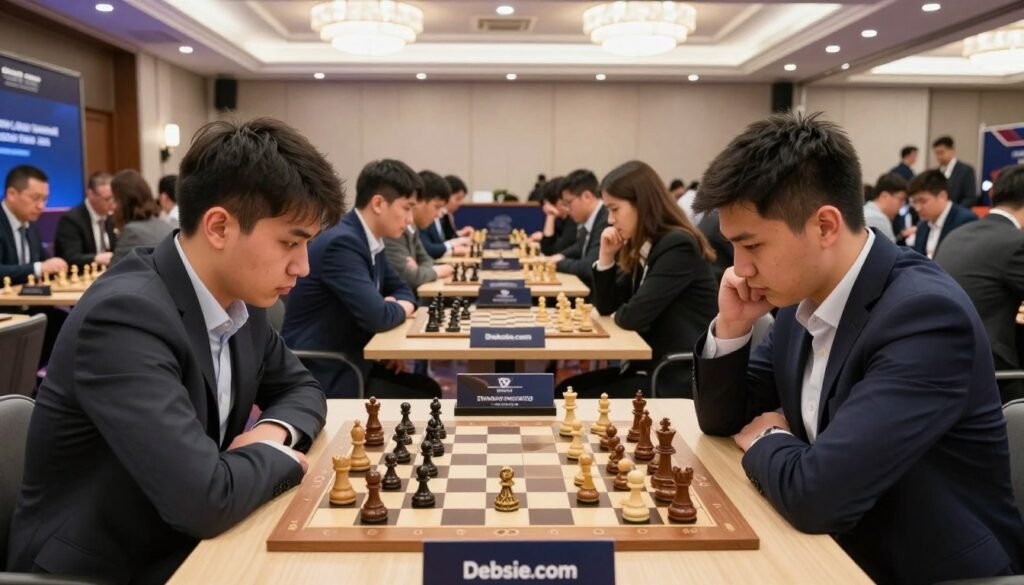
What if one week of chess changed everything? This eight-player event decides who will challenge World Champion Gukesh Dommaraju. It’s not just another chess meet. It is the main doorway to the world title!
We’ll lay out the confirmed basics: format, rules that shape daring play, and quick style guides for each contender. You don’t need to be a grandmaster to follow along—kids and parents welcome!
Expect big storylines: veteran precision vs young fearless fighters, opening prep battles, and how one early upset can flip the leaderboard. We also preview when rounds run in Cyprus time and what that means for U.S. mornings and afternoons.
For a deeper look at the event’s history and why this stage matters, see the Candidates path. Stay tuned—this guide focuses on what’s confirmed now and what it means for the games we’re about to watch!
Key Takeaways
- The event selects the next challenger for the World Chess Championship.
- Eight players play a double round-robin; every game matters.
- We’ll explain formats, tiebreaks, and how rules affect risk-taking.
- Simple style guides help you watch like a pro—no jargon needed.
- Timing notes will help U.S. fans catch morning and afternoon rounds.
- Big themes: youth vs experience, prep wars, and momentum swings.
What’s Confirmed So Far: Dates, Venue, and the Stakes in Cyprus
Here’s what’s firm: the schedule, the seaside venue, and the prize that sends the winner on to a world match. Fans can plan watch parties and family viewing now!
Cap St Georges Hotel & Resort in Pegeia, Cyprus
Where: Cap St Georges Hotel & Resort, Pegeia (Paphos area). The site hosts both Open and Women’s events, offering calm rooms for deep prep and long games.
March-April window: 28 March to 16 April 2026
The confirmed dates fall in the march april window: 28 March to 16 April. This span covers the full match schedule and rest days. Families in the US can set reminders for morning and afternoon rounds.
What the winner earns
What’s at stake: first place is not just a trophy. It is a ticket to a world championship match against the reigning world champion, Gukesh Dommaraju. The winner gets the right to challenge for the world title!
- Official venue: Cap St Georges, Pegeia.
- Dates locked: 28 March–16 April, april 2026.
- Prize: qualification for the world championship match.
| Item | Detail | Why it matters |
|---|---|---|
| Venue | Cap St Georges Hotel & Resort, Pegeia | Quiet, focused setting for long games |
| Dates | 28 March – 16 April 2026 | Clear schedule for fans and families |
| Prize | Challenger spot for world championship match | Winner faces Gukesh Dommaraju for world title |
Candidates Tournament 2026: Format, Rounds, and Why the Double Round-Robin Matters
Every game matters in a double round-robin — eight players, 14 rounds, two chances per pairing. This format means everyone plays everyone twice. You can’t skip a tough opponent. That makes the results fairer and the leaderboard truer to skill.

How the double round-robin works
Think simple: face each rival once with White and once with Black. Color changes how you plan. Getting White at the right time can let a player press for a win. Black asks for solid defense and counterplay.
Rest days and preparation rhythm
Rest days on 2 Apr, 6 Apr, 10 Apr, and 13 Apr matter. They give time for study, fresh ideas, and help from seconds. Use that time well and you can flip momentum.
Why balance rewards complete play
This format tests more than hot streaks. It rewards players who win, defend, and bounce back. One loss stings, but a rematch offers a reply. Watch for opening choices, endgame fights, and who keeps pressing versus who holds ground!
Time Control and Regulations That Will Shape the Games
Timing is as strategic as opening choice in these long matches! The regulations set the pace. They shape when players press and when they defend.
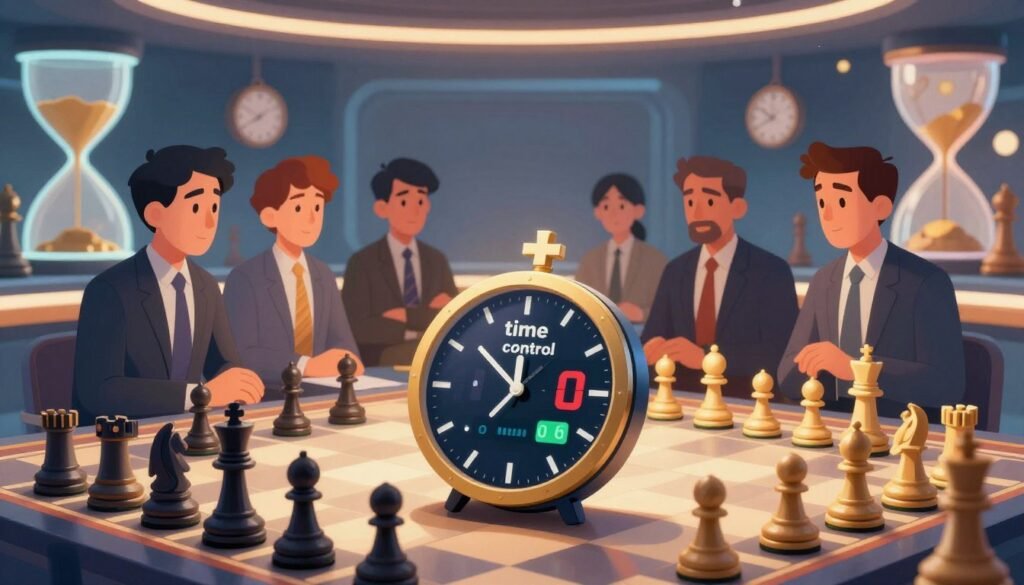
Classic grind: 120 minutes for 40 moves, then 30 minutes to finish
The main time control gives each player 120 minutes for the first 40 moves. That means deep, slow play. Move 40 is a famous pressure point. Players often reach heavy thought then.
Increment details: 30 seconds per move starting from move 41
After move 40, each player gets an extra 30 seconds per move. This is the 30 seconds per move rule. It cuts down on lost-on-time finishes. Endgames become less about flagging and more about technique.
Scoring and strategy: win, draw, loss and the risk calculus
Win = 1, draw = ½, loss = 0. One win jumps you up a lot. One loss can be costly. That math shapes openings and endgames.
- Technical players use long minutes to squeeze small edges.
- Tactical players try to force chaos before clocks settle.
- Families: a draw is a smart result, not a failure!
| Rule | Detail | Effect |
|---|---|---|
| Initial time control | 120 minutes for first 40 moves | Encourages deep preparation and long thinking |
| Additional time | 30 minutes after move 40 | More minutes to convert advantages |
| Increment | 30 seconds per move from move 41 | Reduces flagging, changes endgame play |
| Scoring | Win=1, Draw=½, Loss=0 | Rewards risk taking but punishes mistakes |
Qualification Paths: How This Field Was Built
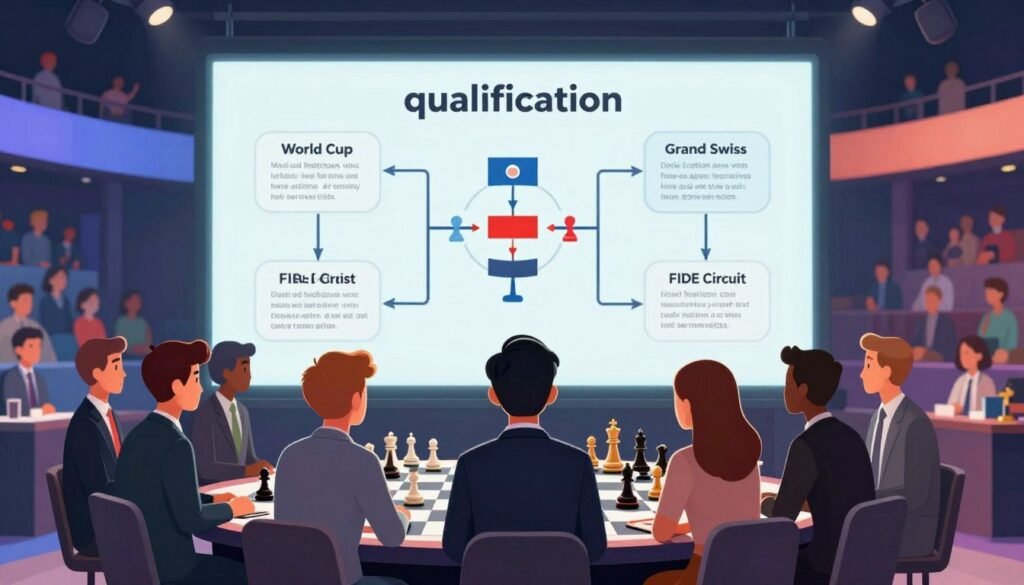
Every name here earned a spot through the championship cycle. This field was chosen by clear rules. Players reached it via several routes: the FIDE Circuit, the World Cup, the Grand Swiss, or a rating-based spot.
FIDE Circuit and consistency points
The FIDE Circuit rewards steady play across many events. Consistency points come from doing well often. Show up. Score well. Repeat. That path favors players who plan a full season and collect points across eligible tournaments.
World Cup: the pressure-cooker
The world cup is knockout chess. One bad match can end your run. Survivors prove they have nerves and clutch play under extreme stress. Those skills translate well to match tension.
Grand Swiss: endurance and steadiness
The Grand Swiss is long and grueling. It tests recovery, stamina, and the ability to score steadily against many styles. Success here signals resilience and matchup flexibility.
How they got here: a mix of clutch results, endurance, and season-long points. Parents and young players: the path hints at a player’s strengths—prep, stamina, or steady consistency!
| Path | How it works | What it shows |
|---|---|---|
| FIDE Circuit | Points from many eligible events | Consistency and season planning |
| World Cup | Knockout matches | Clutch nerves and match play |
| Grand Swiss | Long Swiss event (many rounds) | Endurance and steady scoring |
| Rating qualifier | Top rated players with game-count rules | Long-term performance and reliability |
Rules and reforms in the championship cycle shape who picks which events and how players chase points. For more background on the selection history, see the official overview and our guide to famous related tournaments!
The Qualified Players to Watch and Their Style Profiles
Here’s a quick guide to the field — style-first snapshots so you know what to watch!

Hikaru Nakamura
Practical precision: fast calculation and nerves of steel in endgames. He shifts from safe to savage when the moment calls for it. Expect pragmatic plans and sharp tempo play!
Fabiano Caruana
Deep prep: long-form technical pressure is his trademark. He grinds small advantages. Opponents often feel squeezed slowly and steadily.
Anish Giri
Elite solidity: superb theory readiness and the knack for squeezing from equal positions. He punishes tiny mistakes and loves long, technical fights.
R Praggnanandhaa
Dynamic resourcefulness: a master counterpuncher in sharp, messy lines. He finds practical moves and makes chaos work for him.
Wei Yi
Initiative-first: rapid tactical acceleration. When he gets momentum, the board can explode. Watch for early sparks and uncompromising attacks!
Javokhir Sindarov
Fearless fighter: high-variance attacking choices. He loves chaos and sharp play, which makes him a thrill to watch for fans who crave fire on the board.
Andrey Esipenko
Disciplined structure: converts tiny edges in quiet positions. His conversion skill turns small plans into big results over long games.
Matthias Blübaum
Practical calculation: fresh energy and smart matchup hunting. He brings steady nerves and surprise prep that can unsettle stronger-rated opponents.
Early Pairings That Could Define the Narrative
The very first games can tilt momentum and shape player confidence. In a short 14-round field, a hot start matters! Pairings were set by a Drawing of Lots at the venue. Rounds begin at 15:30 local time in Cyprus for this event.

Round one spotlight: Caruana vs. Nakamura
Why it matters: from the starting move both preparation and psychology kick in. Deep prep meets nerves. Expect sharp lines and intense time fights!
Praggnanandhaa vs. Giri — theory trench warfare
This will be an opening duel. Long, technical play. Look for deep sidelines and slow squeezes that drain clocks.
Sindarov vs. Esipenko — generational clash
Tempo and confidence will tell. Who presses first? Who blinks under pressure? This match tests nerve and timing.
Blübaum vs. Wei Yi — debut nerves vs explosive initiative
One side may play safe. The other seeks sharp chances. Fans who love sudden turns will not be disappointed!
What to track: opening choice, time usage, and whether a player aims for a safe draw or pushes for blood from the starting move.
| Item | Detail | Why it matters |
|---|---|---|
| Pairings (Round 1) | Sindarov–Esipenko; Blübaum–Wei Yi; Praggnanandhaa–Giri; Caruana–Nakamura | Early results shape the leaderboard and the storylines |
| Start time | 15:30 local (Cyprus) | Keeps global viewers aware of US viewing windows |
| Determination | Drawing of Lots | Randomized order affects early matchups and momentum |
Tip: follow the official list for details and updates on eligible players via the official FIDE list.
Remember: these first games don’t decide the winner, but they often decide the story we follow for the rest of the match!
Mid-Tournament Inflection Points: Where Momentum Usually Swings
The second half is where strategy meets pressure and the story often shifts. After seven rounds, players and parents watch closely. Plans change. Calm games can turn urgent!
How rematches after Round 8 change play
When the same pairings repeat with colors swapped, opening choices shift. If Game 1 was sharp, the rematch may go safe. Or players surprise with fresh fire!
Rest-day prep and smart study
Rest days on 2 Apr, 6 Apr, 10 Apr, and 13 Apr give targeted time. Seconds tune engines. Players rehearse lines against a specific rival. That prep can flip outcomes in later games.
- Risk test: behind on points? You gamble. Leading? You play solid.
- Viewer trick: compare the first game and the rematch—same rival, very different story.
- April 2026 crunch: quiet positions can become must-win chaos as the finish nears.
| Moment | Effect | Why it matters |
|---|---|---|
| Round 8 rematch | Color swap, strategy reset | Players exploit prior info or switch gears |
| Rest days | Targeted study, engine checks | Sharper prep for key opponents |
| Standings pressure | Defend or press | A tie for first can change risk plans |
Tip: Learn about risk psychology and smart decision-making with a short read on risk and ego mind traps and try ways to train like a champion at home!
Tiebreaks and What a Playoff Could Look Like in April 2026
Playoff rules can turn a calm finish into a full-on spectacle! If players end equal on points, the event moves to faster games that demand quick thinking and guts.

Step-by-step for first place:
- If two players tie: two rapid games at 15 minutes plus 10 seconds per move. Still real chess, but faster and more emotional.
- If 3–6 players tie: a single round-robin playoff. It becomes a mini-event with lots of drama.
- If 7–8 players tie: a single round-robin at a faster control of 10 minutes plus 5 seconds.
If ties persist, the fight goes to blitz: two games at 3 minutes plus 2 seconds per move. If there’s still no winner, a knockout blitz decides it. One win ends the mini-match. Every move matters—one mistake can cost a world championship match spot.
Note: Tiebreaks are scheduled for April 16, 2026. For details on the wider cycle see the world championship cycle.
Prize Fund, Points, and the Incentives Behind “Must-Win” Decisions
Money and title pressure change how games are played. Players weigh cash and chess seats every move. That math shapes brave attacks and quiet defenses!

How payouts and sharing work
The regulations guarantee payouts by place. First place gets at least €70,000. Second gets €45,000. Third gets €25,000.
Every half-point nets an extra €5,000. The minimum total fund is €700,000. Some published notes also mention a record €1,000,000 minimum — watch for final confirmation in official docs.
Why ties split pay but not the prize of the title
Players who finish on equal points share prize money. Tie-break rules still decide who plays for the world championship seat.
“Prize money can be shared, but the spot to challenge the champion goes to the playoff winner.”
How incentives shape play
- If you chase the top spot, you take more risks.
- If you protect a payday, you play safe and aim for draws.
- So every half-point matters — both for cash and for the winner’s title shot!
| Item | Detail | Why it matters |
|---|---|---|
| First place | €70,000 (minimum) | Winner earns world championship challenge |
| Per half-point | €5,000 | Rewards every game effort |
| Prize pool | €700,000 (min); note of €1,000,000 reported | Final totals may affect payouts |
Takeaway: Money matters. But the title shot matters more! Players balance both. We watch their choices and learn how incentives shape great chess.
Women’s Candidates Tournament Held Alongside the Main Event
A top-level women’s event runs at the same time and place, doubling the drama and the chess on offer!
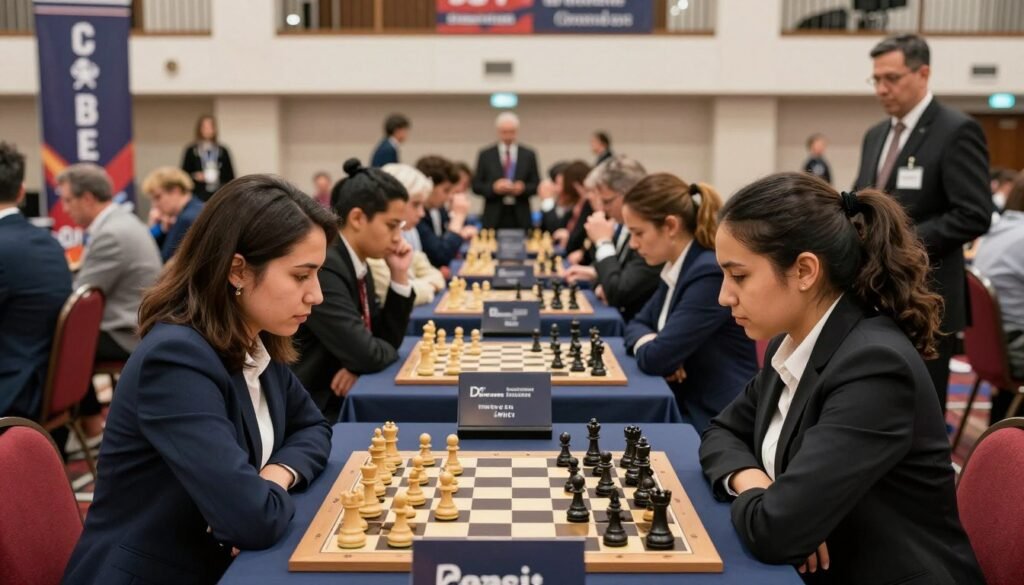
What’s confirmed: the women candidates tournament runs alongside the main event at the same venue and on the same dates. Both are eight-player, double round-robin formats with 14 rounds.
Why that matters: more top games each day. More storylines to follow. Kids and families get twice the chance to pick a favorite player and learn from elite play!
Coverage and atmosphere
Parallel events create festival energy. Broadcasters can cover more interviews and postgame analysis. Seconds and coaches buzz in the same lounges. The result? Bigger stories and fresher insights for viewers.
Preparation and pressure
When two elite fields share a venue, prep ramps up. Players hear rival ideas nearby. That raises intensity and sharpens play. It also makes each rest day crucial for focused study.
- Same format: eight players, double round-robin, 14 rounds — equal challenge!
- More chess: extra games, extra drama, extra learning moments.
- Family friendly: watch both events and compare styles. Pick a few players and enjoy the journey!
| Feature | Detail | Why it matters |
|---|---|---|
| Event | Women candidates tournament | Runs alongside the main event at the same venue |
| Format | 8 players, double round-robin, 14 rounds | Matches the open event’s demands |
| Fan benefit | More games and coverage | Better learning and viewing options |
How to Follow the Event From the United States
Watching from the U.S.? Let’s make a simple plan so the live schedule fits your day! We’ll show when games start, which ones to pick, and how families can enjoy the action without stress.

Round timing in Cyprus and U.S. viewing habits
Start time: games begin at 15:30 local time in Cyprus. That usually lands in the morning for viewers in the United States. Exact clocks depend on your zone and daylight rules, but most U.S. fans see rounds during breakfast or mid-morning.
Use confirmed pairings to plan which rounds to prioritize
Pick a few rounds to follow closely. You don’t need to watch every move to feel involved. Focus on headline pairings, like Caruana–Nakamura and Praggnanandhaa–Giri in Round 1, to learn quickly and stay excited.
- Family tip: watch the opening, check in midgame, then catch the end for tactics and time trouble!
- Pick-your-rounds: choose 2–3 games per week and enjoy the rest as highlights.
- Track simply: keep a tiny notebook or notes app with who you root for and their points — it makes every game feel bigger!
Calendar notes: Round 1 is March 29. Round 14 is April 15. Tie-breaks, if needed, are scheduled for April 16.
Pro tip: follow the official event page for live pairings and start-time reminders. You can follow like a pro — even if you’re brand new!
| What | Why it helps | When |
|---|---|---|
| Pick 2–3 rounds | Less screen time, more focus | Any week days |
| Round 1 anchors | Great entry games for new fans | March 29 |
| Notebook or app | Tracks favorites and points | All rounds |
Train for Candidates-Level Chess With Debsie (Courses, Leaderboard, Free Trial)
Ready to turn watching high-level chess into real improvement? Want to play smarter like top players? Let’s train! We make learning simple and fun for kids and families.
Learn Via Debsie Courses
Structured path: openings that make sense, middlegame plans you can remember, and endgames that finish wins!
How to start: pick one opening, learn the main ideas, practice a few key positions, and build confidence game by game. Visit Debsie Courses to explore lessons.
Debsie Leaderboard: stay motivated
Track your progress like a mini tournament cycle. Collect points, climb the leaderboard, and see steady gains. It’s playful, fair, and a great way to keep kids practicing! See the board at Debsie Leaderboard.
Take a Free Trial Class With a Personalized Tutor
Try one lesson. Get a custom plan. A tutor helps with pacing and goals. Perfect for busy families who want real results. Sign up at Take a Free Trial Class.
Try one lesson, play one better game, and keep exploring!
| Feature | Benefit | Link |
|---|---|---|
| Courses | Openings, middlegame, endgame | Debsie Courses |
| Leaderboard | Track points and progress | Debsie Leaderboard |
| Free Trial | Personalized tutor plan | Free Trial Class |
Conclusion
The final weeks in Cyprus will turn each round into must-watch drama. The event runs at Cap St Georges Hotel & Resort from 28 March–16 April. It is an eight-player, double round-robin with 14 rounds. The winner earns the right to face world champion Gukesh Dommaraju!
Styles and matchups make the games fun to follow. World Cup scars, circuit consistency, and Grand Swiss grit all matter under this pressure. The published time control and the increment after move 40, plus the tiebreak playoff rules, shape late drama and fast finishes.
We’ll be watching together! Pick a player, learn a little each day, and enjoy every game. The parallel women candidates event adds more top-level stories and role models to cheer for!