Who was the player who could attack, defend, and change plans in a blink — and why does his name still matter in chess history?
Meet a true all-rounder! Born in 1937, this grandmaster rose to be the 10th World Chess Champion (1969–1972). He mixed calm defense with sudden strikes. That balance made him one of the most admired figures in the world of chess.
In this article you’ll see why many call him a complete player. We will walk through his early spark, the grandmaster years, the title win, and the famous 1972 Reykjavik showdown that rocked the United States and the world.
Want to play like him? We’ll point you to Debsie Courses for guided practice, show the Debsie Leaderboard, and offer a Free Trial class later! Also, check a list of iconic events and rivals in our linked tour of great contests: famous chess tournaments.
Key Takeaways
- Learn why he is called one greatest and a versatile player.
- Discover classic games you can study and play from.
- Follow a simple timeline: talent, grandmaster, champion, Reykjavik.
- Find openings, rivals, and study tips for practical improvement.
- Try Debsie Courses and the Free Trial to practice with guided lessons!
Boris Spassky’s early life in Leningrad and first chess breakthrough
From a train car to tournament halls, early moments in Leningrad set a bold course for his chess life. Born January 30, 1937 in Leningrad (now St. Petersburg), he learned the game at age five while evacuating during World War II. Chess became a quiet place to think during scary times.
At ten years old, a single wow moment changed everything. In 1947 he beat Mikhail Botvinnik in a simultaneous exhibition. That win announced a prodigy and showed how fast practice and calm thinking pay off.
Coaching mattered early. Vladimir Zak taught basics and helped shape instincts. By ten he reached first category, became candidate master at eleven, and Soviet master by fifteen.
Learning during evacuation and the Siege backdrop
He spent part of the war sent to an orphanage in Siberia. The Siege of Leningrad was hard, but chess offered resilience and focus. Kids and parents can see how steady practice builds strength, even in tough years.
Child milestones and rapid rise
This fast start fed the soviet chess system and a long competitive career. For more on his life and impact, read this tribute.
Remembering his life and games
From teenage sensation to Grandmaster in 1955
A teenage spark turned into world-stage proof when a young contender beat top rivals in Bucharest. In 1953 he made his international debut, tied for fourth, and scored a shock win over Vasily Smyslov. That single result made people sit up!
1955 was a banner year. He tied for third in the Soviet Championship and qualified for the Gothenburg Interzonal. Then he won the World Junior Championship in Antwerp. Those results built confidence and strong credentials.
How the qualifying path worked
The path to the world title was simple to follow. Top finishers from national events reached an Interzonal. The best from the Interzonal moved to the Candidates Tournament. Winners there earned a shot at the world championship match.
- Teen to top-tier: rapid jump from national promise to international results.
- Key debut: beating a future world challenger proved he belonged on the global stage.
- Big year: Soviet success + World Junior victory = grandmaster title and momentum!
Lesson for learners: steady basics plus real tournament practice build lasting skill. By the mid-1950s he wasn’t just talented — he was among the best players in the world. Keep practicing, and you can grow the same way!
The lull years: setbacks, pressure, and a return to form
A few difficult years tested his resolve and reshaped his approach to the game. Not every year runs smooth. Slow patches are part of real growth!
Why results slipped
The late-1950s and early-1960s had sharp cycles. He missed Interzonal qualification in 1958 and around 1962. A key blow came with a crucial loss to Mikhail Tal in the 1958 Soviet Championship. That one game cost a whole cycle of chances.
The Soviet grind
The soviet union system made every tournament a pressure test. Too many great players fought for too few spots. One risky decision could end title hopes for a long time.
Turning points and comeback
Even in lull years he kept winning elite events. Mar del Plata 1960 (shared first with Bobby Fischer) kept him in the conversation. These tournaments rebuilt confidence and sharpened tactics.
- Accept the lull — it teaches resilience.
- Soviet chess pressure forced faster learning and flexibility.
- Key matches changed his plans and prepared him for later title runs.
| Year | Event | Result | Impact |
|---|---|---|---|
| 1958 | Soviet Championship | Crucial loss vs Tal | Missed Interzonal cycle |
| 1960 | Mar del Plata | Shared 1st | Kept contender status |
| 1962 | Interzonal cycles | Failed to advance | Forced strategic changes |
We all face pressure and slow spells. For a deeper look at how peers and teachers cope with hard times, read this career portrait.
Becoming a world title contender: Candidates success and Petrosian rivalry
A quiet coaching change sparked a bold shift in his approach and set the stage for epic matches. Igor Bondarevsky arrived as a calm builder. He helped widen technique and thought. This led to what fans called a universal style!
Universal style means you can attack quickly or slow the game down. You pick the plan that fits the position. Simple and powerful.
Classic Candidates victories
The 1965 candidates tournament run read like a mini-adventure. First came Paul Keres (6–4). Then Efim Geller fell (5½–2½). Next, a big win over Mikhail Tal (7–4). Each rival tested a different skill.
Lessons from the 1966 match
The 1966 world championship match was razor-close. He lost to Tigran Petrosian by one point (12½–11½). Petrosian’s defense was legendary. That match taught patience and deeper planning.
1968 comeback and Korchnoi clash
In 1968 he returned stronger. Wins over Geller and Bent Larsen (both 5½–2½) set the tone. The decisive victory vs. Viktor Korchnoi earned a rematch chance. The player now had the tools and confidence to chase the world champion crown!
| Year | Opponent | Score | Why it mattered |
|---|---|---|---|
| 1965 | Paul Keres | 6–4 | Opened Candidates momentum |
| 1965 | Efim Geller | 5½–2½ | Cracked a top strategist |
| 1965 | Mikhail Tal | 7–4 | Beat a former world champion |
| 1966 | Tigran Petrosian | 11½–12½ | Close loss; crucial lessons |
World Chess Champion: the 1969 title and peak years
The 1969 match proved his shift from contender to true champion, sealing a peak era. He dethroned Petrosian in Moscow, winning 12½–10½ and becoming the 10th world champion (1969–1972). MISSION ACCOMPLISHED!
How he won the 1969 title
From 1966 to 1969 he sharpened match plans and broadened his play. He mixed calm defense with sudden strikes. That versatility and better strategy made the difference in long games and quick miniatures.
Tournament form and peak context
As champion he kept winning. He took first at San Juan 1969 and scored top finishes in other events. His peak rating reached 2690 and he was world No. 2 in January 1971. Those numbers show real dominance in the early 1970s.
Signature brilliancies and study tips
One must-study game is the 17-move win vs. Bent Larsen — a compact, savage miniature. Want to learn from it? Focus on opening surprises, lively piece activity, and clean finishing tactics.
| Year | Event | Result | Why it matters |
|---|---|---|---|
| 1969 | World Championship (Moscow) | 12½–10½ | Dethroned Petrosian; new world champion |
| 1969 | San Juan | 1st | Confirmed tournament strength as champion |
| 1971 | Rating peak | 2690 | World No. 2 — peak form |
Ready to study the games? Start with the 1969 match and the Larsen miniature. Then compare different tournaments to see how a true world chess champion kept his crown and prepared for even bigger challenges ahead.
For full match details, see the 1969 world championship page: World Chess Championship 1969.
Bobby Fischer vs. Spassky: the 1972 “Match of the Century” in Reykjavik
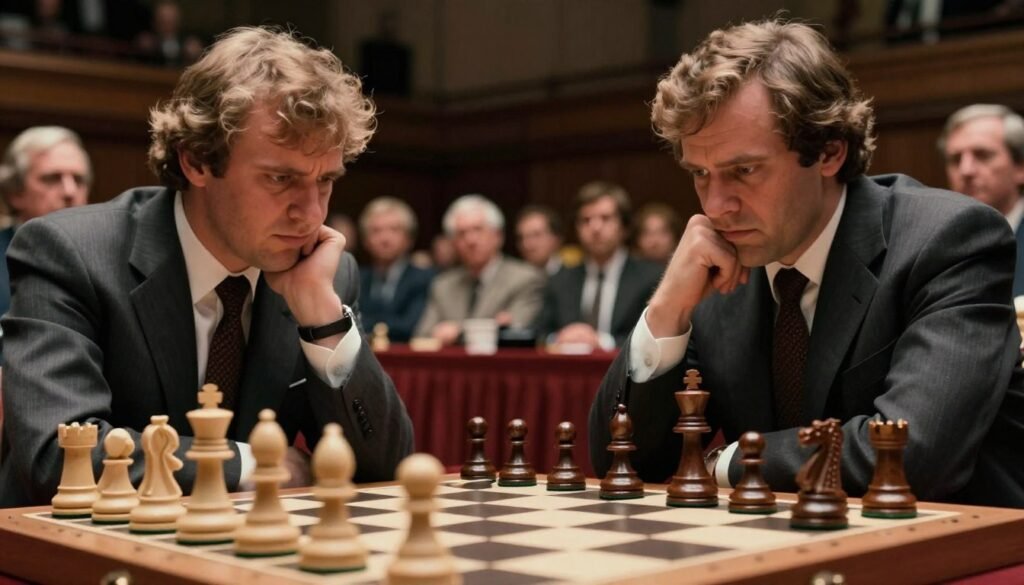
When the boards were set in Reykjavík, a tiny island held the world’s attention. The Cold War cast a long shadow. A mysterious American star faced the reigning Soviet champion. The result was a true match of the century!
Cold War spotlight and why the United States watched
The contest quickly became more than chess. In the United States, news shows and papers followed every move. Even politicians urged the American player to take his seat. Chess felt like national pride for many fans!
Match flow, key moments, and final scoreline
The early games saw chaos and tension. A famous forfeit and a venue dispute added drama. Then the tide turned. Fischer pulled ahead and won 12½–8½.
Preparation, psychology, and opening surprises
Expectations about openings shaped plans. Teams thought Fischer would favor 1.e4. Surprise choices and mental pressure shifted momentum. Preparation mattered, but so did nerves and adaptability.
Public image and lasting perspective
This chess match made Spassky a household name in the United States. Yet that fame should not erase his earlier world-class years and classic games. He fought hard, adapted under stress, and showed sportsmanship.
- Why it mattered: politics + personalities = global attention.
- Remember: key moments like the forfeit and side-room game stick with kids and new fans.
- Lesson: study openings, but practice mindset and recovery too!
Life after the crown: Candidates battles, the 1992 rematch, and late career
Losing the title did not end his story. He bounced back fast and stayed in top events for years! This period shows grit, big matches, and steady results.
Post-1972 resurgence and a bounce-back win
In 1973 he won the Soviet Championship again. That victory was a clear rebound after Reykjavik.
It proved he could still win at the highest national level. Fans saw the champion’s will return in full force.
Candidates clashes with the new era
He faced rising stars in tough Candidates matches. In 1974 he beat Robert Byrne then lost to Anatoly Karpov, who went on to seize a new era.
In 1977 he beat Vlastimil Hort and Lajos Portisch. Later he fell to Viktor Korchnoi in the Candidates final. These matchups kept him in world championship conversations.
The 1992 unofficial rematch with Fischer
The 1992 match vs. Bobby Fischer drew heavy media attention. It was unofficial, but dramatic. Fischer reached ten wins; our player scored five.
The contest ran 30 games and made global news. It showed how powerful chess stories remain, even outside title rules.
Later years: decades of love for the game
He kept playing into the 2000s. Regular tournaments, friendly matches, and even a 2009 meeting with Korchnoi (each won two) show lasting passion.
Lesson for you: chess can be a lifelong adventure. Practice, play, and learn — great results can come many years after you start!
| Year | Event / Match | Result | Why it mattered |
|---|---|---|---|
| 1973 | Soviet Championship | Winner | Bounce-back national title |
| 1974 | Candidates vs. Karpov | Lost | Faced the next world champion |
| 1977 | Candidates run | Beat Hort & Portisch; lost to Korchnoi | Stayed among top contenders |
| 1992 | Unofficial rematch vs. Fischer | Fischer 10 wins — opponent 5 wins | Major media event; high public interest |
| 2000s–2009 | Tournaments & matches | Active competitor | Demonstrated long-term love for chess |
Want to explore classic games from these years? See the full biography on his Wikipedia page and read about great rivalries at the biggest chess rivalries to study key matches and learn from the past!
Style, openings, and legacy: why Spassky remains “the complete player”
You can spot his style by how smoothly he switches from tactics to long endgames. That ease is why many call him a universal player. He could attack with fire or slow the game to a strategic crawl.
Universal strengths across phases
Universal means winning in any way. He mixed sharp tactics, steady middlegame plans, and clean endgame technique. Kids can copy this: learn attack patterns, then practice patient endings!
Openings and notable rivals
He often chose the Sicilian Defense and the Ruy Lopez, ready for sharp fights or classical play. He beat legends like mikhail tal, Petrosian, Fischer, Karpov, and even Garry Kasparov multiple times. That shows top-level consistency.
Citizenship and a life across borders
Born in the Soviet Union, he later moved to France and became a french citizen in the late 1970s. Years later he returned to Russia. His life crossed eras and countries, just like his chess crossed styles.
Learn his games the Debsie way!
Want to study these classic games with fun guidance? Try our action plan:
- Watch a classic game, pause before the best move, then guess!
- Practice the opening ideas (Sicilian, Ruy Lopez) in short drills.
- Track progress on the Debsie Leaderboard and celebrate wins!
Start now: Learn Via Debsie Courses or Take a Free Trial Class With a Personalized Tutor—perfect for kids and parents who want fast, playful growth!
For a compact biography and game list, check this classic profile: classic player page.
Conclusion</H2:
He rose from small rooms and big pressure to leave a lasting mark on world chess history. Born in 1937, boris spassky became the 10th world chess champion and a model of universal play.
The 1972 Reykjavik match grabbed global attention and filled U.S. news pages, especially in New York. Yet that dramatic chapter is just one part of his long career and teaching-by-example for future players.
Want a simple next step? Pick one classic game, study the key idea, then try it this week. Read the famous Game 1 anniversary article for context.
Ready to learn? Join Debsie Courses, climb the Debsie Leaderboard, or book a Free Trial Class with a personalized tutor today! We grow through chess—one smart move at a time!