Can one brilliant sacrifice change how you play forever? This question drives every thrilling game we study!
No matter how much theory progresses, and how radically styles change, chess play is inconceivable without tactics. That’s GM Samuel Reshevsky speaking—and he’s right. Tactics sit at the heart of progress.
We’ll show what makes bold, forward play exciting to watch and easy to copy. You’ll meet model figures from the romantic past to modern super-GMs. Expect Morphy’s speedy finishes, Tal’s daring sacrifices, Fischer’s clean attacks, and Kasparov’s famous king hunts.
This is a practical list: model players and model games, with patterns you can actually use. We’ll keep lessons kid-friendly and parent-approved, with clear steps to help you play with more confidence.
Ready to keep learning? Explore essential opening ideas and practice plans at essential opening knowledge and see how Debsie can help with courses, progress tracking, and a free trial lesson!
Key Takeaways
- Tactics are the engine of exciting play—study them first.
- We’ll map historic and modern model players for easy learning.
- The list pairs players with games you can replay and copy.
- Lessons are short, practical, and kid-friendly.
- Debsie offers courses and tracking to speed your progress.
What Makes an Attacking Chess Player So Fun to Study
Studying daring games helps you spot tactics fast and feel confident at the board! We’ll keep this simple and friendly for kids and parents.
“Tactics sit at the heart of progress.”
Tactics as the engine of aggressive play
Forks, pins, skewers, discovered attacks, and mating nets are the fuel. When you learn these patterns, you see threats before your opponent does.
How sacrifices, development, and king hunts show up in real games
A good sacrifice usually wins because development is ahead and the king is exposed. First you gain time. Then you open a file or diagonal. Finally, pieces swarm together for the finish!
Why style changes across eras and time controls
Old romantic games often explode early with fast tactics. Modern play can build pressure and strike later. Blitz rewards quick pattern recognition. Classical time gives you room to calculate deeper plans.
- Look for loose pieces, weak squares near the king, and lines that can open with tempo.
- Start small: spot one tactical idea per game and grow from there.
- Replay model games, spot patterns, and track progress—this sets the path to steady improvement!
Want to learn openings that free your pieces for attack? Check our guide to aggressive opening ideas. For tips on keeping the enemy king unsafe in your favor, see king safety and attack!
Best attacking chess players who defined the romantic era
Few names capture the romantic era’s sparkle like Paul Morphy. He was born June 22, 1837, in Louisiana. By the 1850s he dominated the scene and earned a reputation as an unofficial world champion.
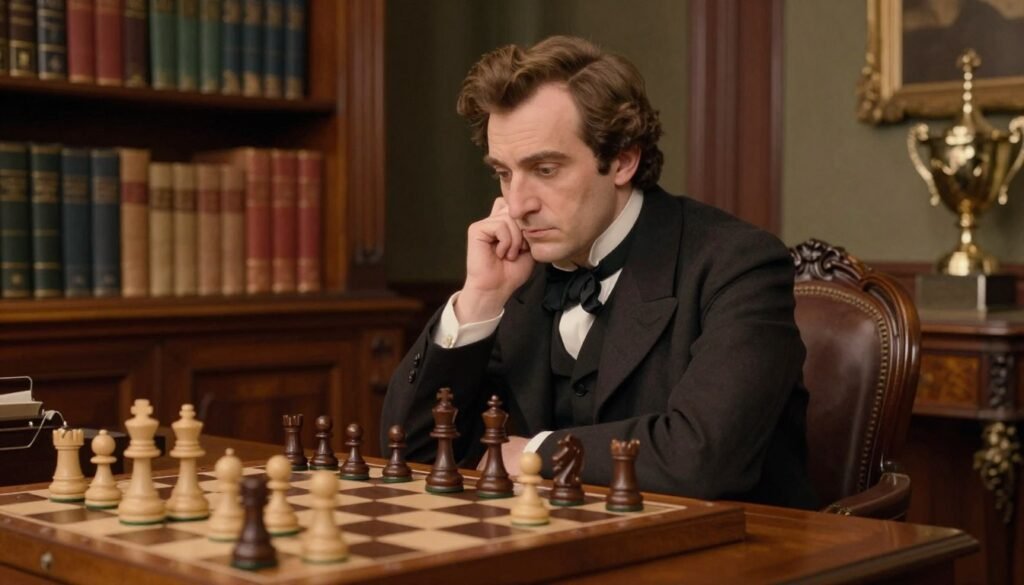
Paul Morphy and the blueprint for fast development and clean finishes
Morphy’s games often end in 20–30 moves. He punished slow play and grabbed the initiative early. This made his wins feel like magic.
Copy-this blueprint:
- Develop pieces quickly.
- Open lines with tempo.
- Bring queen, bishops, and rooks together for the finish.
Why the Opera Game still teaches attacking fundamentals
The Opera Game shows perfect timing for sacrifice and piece harmony. It’s short, clear, and ideal for a first model game to replay. Parents love it because kids learn patterns without heavy theory.
“A single Morphy model game builds pattern memory and confidence.”
| Fact | Detail | Why it matters |
|---|---|---|
| Birth | June 22, 1837 (Louisiana) | Shows early American talent in world history |
| Peak years | 1850s; won 1857 American Congress; 1858 European matches | Proved he could beat top continental rivals |
| Style | Fast development, open lines, clean finishes | Easy to copy as a model for learners |
Want a bridge from romantic era lessons to later strategy? Read about the shift after the romantic period at attacking chess after the romantic era. To see how historical figures shaped modern play, visit chess players who changed the game.
World champions with legendary attacking games
Legendary champions show how daring ideas become repeatable lessons for any student. We’ll meet five giants whose games teach timing, sacrifice, and calculation.
Mikhail Tal: magic and fearless calculation
Mikhail Tal was the “Magician from Riga.” His games feel like adventures. He loved creative sacrifices and wild complications.
“You must take your opponent into a deep dark forest where 2+2=5…”
This quote means Tal sought positions where intuition and calculation beat rigid rules. Try copying his habit: hunt for piece activity and open lines near the king.
Alexander Alekhine: calculated rule-breaking
Alexander Alekhine was the fourth world champion. He showed that smart calculation lets you bend rules safely.
Study his combinations to learn when concrete lines matter more than blanket principles.
Bobby Fischer: attack plus deep structure
Bobby Fischer mixed sharp plans with iron positional play. His games teach that strong squares and piece placement often start big attacks.
His 20-game streak and the classic My 60 Memorable Games make great study material for hungry learners.
Garry Kasparov and the Topalov king hunt
Garry Kasparov dominated his era with relentless initiative. His game versus Veselin Topalov is a model of continuous threats and a dramatic king hunt.
Copy this lesson: build pressure, force weaknesses, then aim for coordinated finishes.
Magnus Carlsen: modern pressure that flips to attack
Magnus Carlsen often squeezes first and explodes later. He shows that patience plus a sharp eye for tactics wins many games.
Quick takeaway: pick one habit from a champion and practice it. Replay model games and make their ideas yours. For more on varied styles, check a short list of notable chess players known for their unique playing!
Aggressive fan-favorites beyond the world champion spotlight
Not all exciting play comes from world champions—some of the most electric games come from mavericks who light up the board!
Alexei Shirov and “fire on board”
Shirov brings nonstop energy. His style centers on active pieces, sharp tactics, and threats that force the opponent to scramble.
Try one Shirov idea in your next game: push for initiative, open a file, and keep pieces moving. Small steps often lead to big wins.
Rashid Nezhmetdinov and cult-status attacks
Nezhmetdinov’s games feel like fireworks. His moves are bold and very memorable. Fans call them cult classics because they teach pure, creative sacrifice play.
To copy him, learn to spot an open king plus a lead in development. That combo separates real attacks from hopeful ones.
Baadur Jobava: creative, win-first practical aggression
Jobava mixes quirky opening choices with practical ideas. His play aims for wins in real tournaments and fast time controls.
Lesson for kids: be brave but SMART—make threats that work, not random moves. Replay one game from each of these names and watch the patterns repeat.
- Quick plan: pick one game per player and replay it three times.
- Focus on piece activity, open lines, and how the king becomes exposed.
- Always tie daring ideas back to development and safety.
For community takes and deeper reads, check a short modern roundup and a historical column for extra context: modern aggressive roundup and a reflective piece in the weekly chess column.
How to copy these attacking players in your own games
Turn inspiring games into step-by-step practice you can use every day! Start with a short model game and make study active. Pause at key moves and ask, “What’s the threat?” or “What checks, captures, or attacks are possible?”
Choose model games and replay them for patterns, not just moves
Pick one match at a time. Replay it three times. Focus on where pieces go and how lines open.
Build an “attacking repertoire” around development, initiative, and open lines
Choose openings that develop fast. Aim to control center squares and free rooks and bishops. If your opponent always answers your threats, you are driving the game!
Train tactical vision with themed positions and forced lines
Practice short, forced lines: back-rank mates, f7/f2 ideas, and pins on the king file. Ten minutes daily beats one long, irregular session.
Learn faster with Debsie
Learn via Debsie Courses: debsie.com/courses/ Use structured lessons and gamified tasks to keep kids excited.
Track progress and get a free trial lesson
Motivate growth with the Debsie Leaderboard. Start with a free, personalized tutor session here: take a free trial class!
Conclusion
Tactics are the thread that links every era of exciting play. Study them with method and fun. That idea from Reshevsky still matters: patterns beat theory when you need to attack!
Quick recap: tactics + development + open lines = more chances to strike. Pick a starter hero. Try Morphy for basics, Tal for flair, Fischer for balance, Kasparov for king hunts, and Carlsen for flexible, modern ideas.
Kids: choose ONE hero and replay a few games. Parents: teach safe habits—development and king safety first, sacrifices later.
Want more? Explore the best players of all time, try Debsie Courses, track progress on the Debsie Leaderboard, and book a Free Trial Class when you’re ready! Keep it fun. Keep playing!