Anish Giri is not just a strong chess player. He is one of the best examples of a player who treats the game like a test he can study for before it begins. His FIDE profile shows the record of an elite Dutch grandmaster, and his long stay near the top of world chess tells us something simple: smart work adds up.
Find the right learning experience
Tell us a little about the learner and what you are looking for. Our team will review your answers and help you identify the most suitable next step.
- Takes only a few minutes
- No payment required
- Personalised recommendations
Your information will only be used to respond to your enquiry.
Anish Giri shows that chess confidence starts before the clock starts
Anish Giri’s chess story is not the story of a player who just “sees everything.” It is the story of a player who builds a road before he walks on it. That is the big lesson. Many kids think strong chess players are born with magic in their heads.
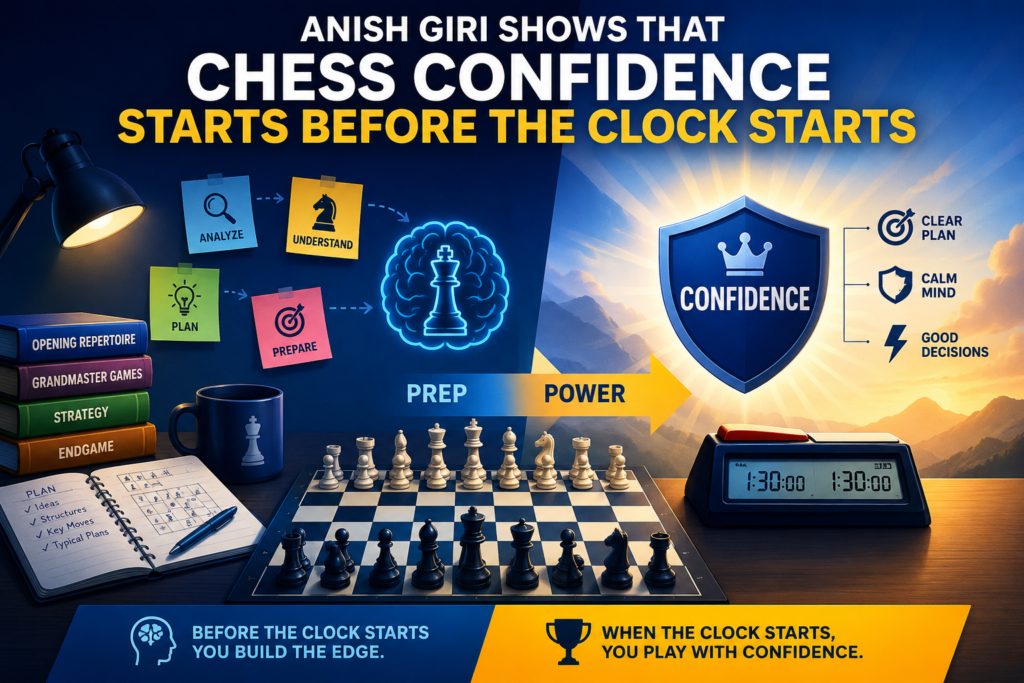
Giri shows a better truth. Great chess can be trained. Calm thinking can be trained. Good choices can be trained. Even confidence can be trained.
Giri became a grandmaster at 14 years, 7 months, and 2 days, which made him one of the brightest young stars in chess at that time. He was born in St. Petersburg, Russia, and later became the top player for the Netherlands.
These facts matter because they show that his rise did not come from luck. It came from years of smart work, deep study, and the habit of treating every game like a serious project.
Why his story matters to young chess students who want real growth
For a child learning chess, the first big win is not always checkmate. The first big win is learning how to think before acting. Giri’s style is perfect for this lesson because he does not rush into chaos just to look brave. He studies.
Find the right learning experience
Tell us a little about the learner and what you are looking for. Our team will review your answers and help you identify the most suitable next step.
- Takes only a few minutes
- No payment required
- Personalised recommendations
Your information will only be used to respond to your enquiry.
He waits. He asks, “What does my opponent want?” Then he builds a plan that makes the other player uncomfortable.
This is also why chess is so powerful for kids. A child who learns to prepare for a chess game also learns how to prepare for school tests, sports matches, stage shows, and life problems. The same child starts to understand that being calm is not weakness. Being careful is not fear. Thinking ahead is strength.
At Debsie, this is one of the main ideas we help children build. We do not only teach moves. We teach students how to slow down, notice danger, and choose with care. That is the kind of learning that stays with a child far beyond the chessboard.
The simple lesson is that preparation turns fear into a plan
A young player often loses before the real fight begins because they feel scared. They see a strong opponent and start thinking, “What if I lose?” Giri’s method points to a better question: “What can I prepare?”
That small change is huge. Fear makes the mind noisy. Preparation makes it quiet. When a student knows the first few moves, understands the main ideas, and has seen the common traps, the game feels less like a storm and more like a path.
The child may still face hard moments, but they no longer feel lost from move one.
This is why parents should care about chess preparation. It is not about making a child memorize long lines like a robot. It is about helping the child feel ready. A ready child sits taller. A ready child thinks better. A ready child is more likely to enjoy the game, even when the game is hard.
The real meaning of “wins before the game starts” is not memorizing more moves
When people hear that Anish Giri is a “prep monster,” they may think it only means he knows many opening moves. That is only a small part of the truth. Real preparation is not just memory. Real preparation is understanding.
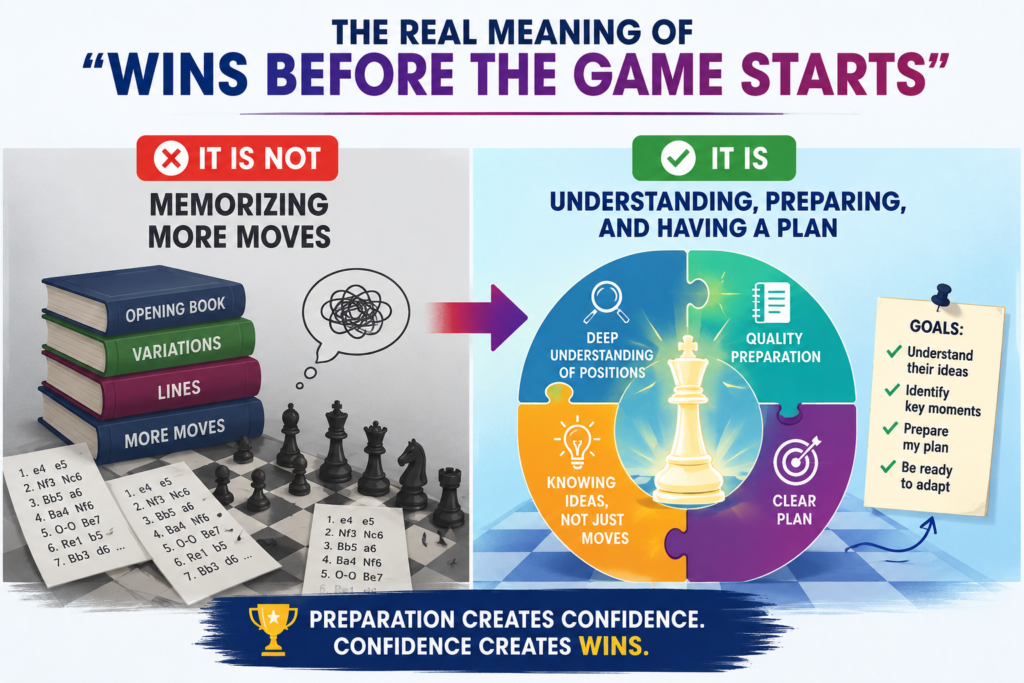
It is knowing which positions you want, which positions your opponent dislikes, and which choices may lead to a game you can handle well.
This is where Giri stands out. He has a deep opening file, yes, but his best weapon is not only the file. His best weapon is his clear mind. He often enters games with a strong sense of direction. He knows the kind of pawn structure he may get.
He knows which pieces may become strong. He knows where the danger may come from. So, while the opponent is still trying to understand the position, Giri may already be playing the game he planned at home.
Why opening prep is really about comfort and control
A good opening does not need to win at once. In fact, most strong openings do not do that. A good opening gives the player comfort. It says, “I know this place. I understand these plans. I know where my pieces belong.”
This is one reason Giri can be so hard to beat. He often makes the game feel narrow for the opponent. Not boring. Not empty. Narrow. The opponent may have moves, but not the kind of moves they enjoy.
That is a strong skill. It is like inviting someone to play football on a field where every bounce of the ball helps you more than them.
For students, this is a very useful idea. A child does not need to study twenty openings. In fact, that can hurt. A child needs a small, clear opening home. They need to know what to play, why to play it, and what kind of middle game may come next.
When this is done well, the child does not waste energy in the first ten moves. They save their mind for the real fight.
The Debsie way is to teach openings as stories, not as cold memory
Many children get bored with openings because they are told to memorize moves without meaning. That is like asking a child to sing a song in a language they do not know. They may copy the sound, but they do not feel it.
A better way is to teach openings as stories. In the Italian Game, White brings pieces out fast and looks at the weak f7 square. In the Queen’s Gambit, White gives a pawn offer to build a strong center. In the Sicilian, Black says, “I will not copy you. I will fight from the side.”
When a child hears the story, the moves become easier to remember because the moves now have purpose.
This is how students begin to think like real chess players. They stop asking, “What move did my coach tell me?” and start asking, “What is the idea here?” That is the start of real growth.
Giri’s best preparation begins with studying the person across the board
Anish Giri does not prepare only for “White” or “Black.” He prepares for a person. That is a major difference. A chess game is not played against pieces. It is played against a mind. Every player has habits. Some players love sharp attacks.
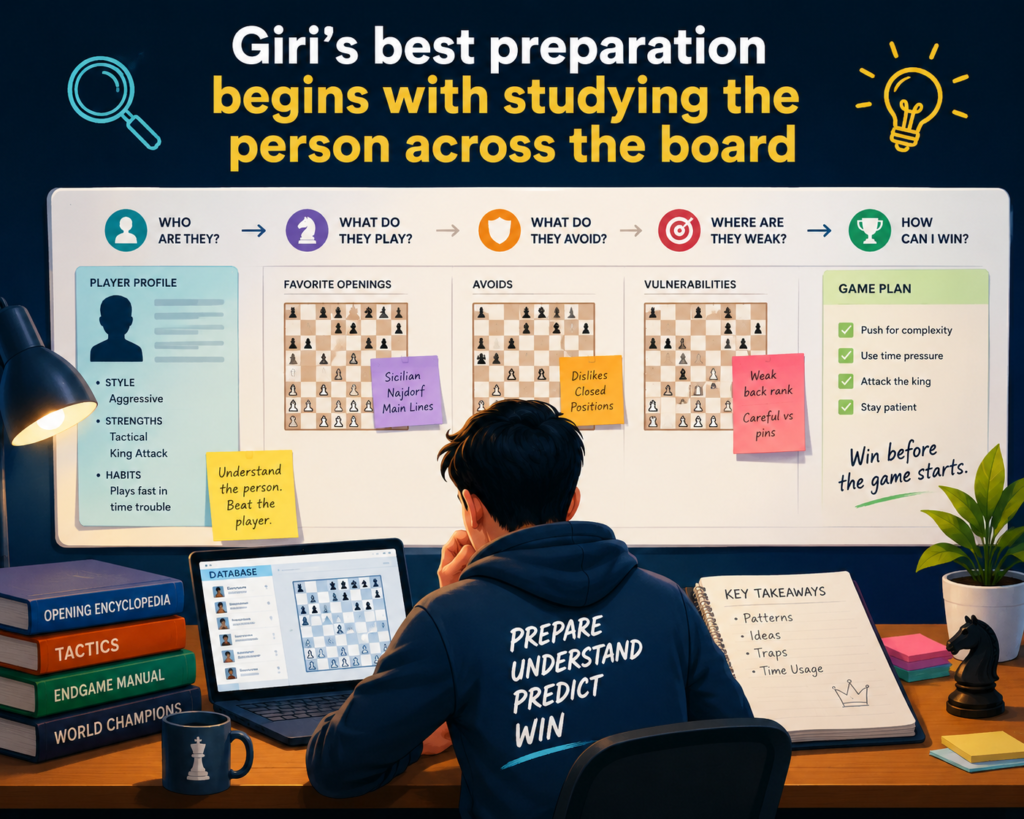
Some love quiet pressure. Some hate defending. Some are strong in tactics but weak in long endings. The more you know about the person, the better you can choose the type of battle.
This is one reason top players study games from their opponents before big rounds. They want to see patterns.
They ask simple but powerful questions. What openings does this player repeat? What positions do they avoid? Do they get impatient? Do they defend well? Do they trade pieces too early? Do they take risks when they are under pressure?
Giri’s career shows the value of this kind of careful study. His major 2023 Tata Steel victory was not a wild lucky run. He finished unbeaten with 8.5 out of 13 and scored wins against huge names, including Magnus Carlsen, Ding Liren, Gukesh, and Richard Rapport.
That kind of event win needs more than talent. It needs round-by-round planning.
How a young player can copy this idea without becoming overwhelmed
A child does not need a huge database to prepare like this. The simple version is enough. Before playing a known opponent, the student can look at one or two past games. They can notice what opening the opponent likes.
They can ask where the opponent made mistakes. They can see if the opponent attacks too early or forgets to protect the king.
Even when the opponent is unknown, a child can still prepare by asking, “What kind of game do I want?” This question alone can change everything. Without it, the child may drift. With it, the child starts to lead.
For example, a careful child may choose a solid opening and wait for the other player to overpush. A sharp child may choose an active line with fast piece play. A beginner may choose simple development, quick castling, and safe center control. The point is not to copy Giri’s exact openings. The point is to copy his thinking.
The best student plan is simple enough to use before every game
A strong pre-game plan for a student can be very simple. The child should know the first opening idea, the safest square for the king, the main pawn break, and one common trap to avoid. That is already a strong start.
This kind of plan helps children because it gives their mind a job. Instead of sitting at the board and hoping for good moves, they sit down with a clear first mission. Develop pieces. Castle. Watch the center. Do not grab random pawns.
Look for the opponent’s threat. These sound simple, but simple things win many games at beginner and club level.
At Debsie, coaches help students build these habits step by step. The goal is not to fill a child’s head with too much. The goal is to make good thinking feel natural. When good habits become natural, chess starts to feel less scary and more fun.
The “prep monster” mindset is really a life skill in chess clothing
The beautiful thing about Anish Giri’s method is that it teaches a life lesson in a chess form. He shows that success often begins before the big moment. The game starts before the clock starts. The test starts before the exam paper is handed out.
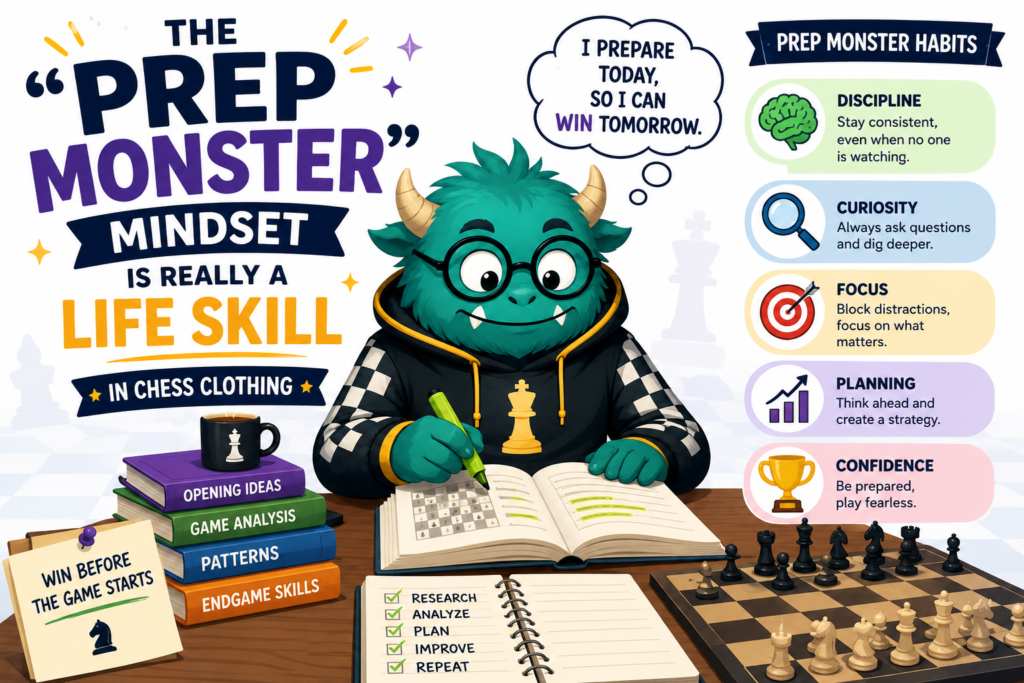
The speech starts before the child walks on stage. The match starts before the first whistle.
This idea is powerful for children because it gives them control. They learn that they do not need to wait and hope. They can prepare. They can practice. They can ask better questions. They can learn from old mistakes. They can walk into a challenge with a calmer heart.
Find the right learning experience
Tell us a little about the learner and what you are looking for. Our team will review your answers and help you identify the most suitable next step.
- Takes only a few minutes
- No payment required
- Personalised recommendations
Your information will only be used to respond to your enquiry.
Giri’s more recent success also supports this. In 2025, he won the FIDE Grand Swiss in Samarkand with 8 out of 11 and qualified for the 2026 Candidates Tournament. The official event report said he won the open tournament outright after beating Hans Niemann in the final round.
This shows that his careful, steady style still works at the very highest level.
Why parents should not see chess prep as pressure
Some parents worry that preparation may make chess too serious. That can happen if it is done the wrong way. But good preparation does not crush joy. Good preparation protects joy.
A child enjoys chess more when they understand what is happening. They feel proud when they spot an idea they learned in class. They feel brave when they survive a tricky opening. They feel excited when a plan works.
The key is balance. Children should not be forced to memorize endless lines. They should be guided to understand patterns. They should play, review, laugh, fail, try again, and slowly get stronger. That is healthy chess growth.
A free trial class can help your child feel this difference
A good chess class should make a child feel seen. It should not be a lecture where the coach talks and the student just nods. It should be active, warm, and clear. The child should solve, answer, ask, move pieces, and understand why each idea matters.
That is what Debsie aims to do. With expert-led online classes, private coaching, and regular tournaments, students get a safe place to grow. They learn chess, but they also build focus, patience, planning, and confidence.
If your child enjoys chess or even shows a small spark of interest, a free Debsie trial class is a simple first step.
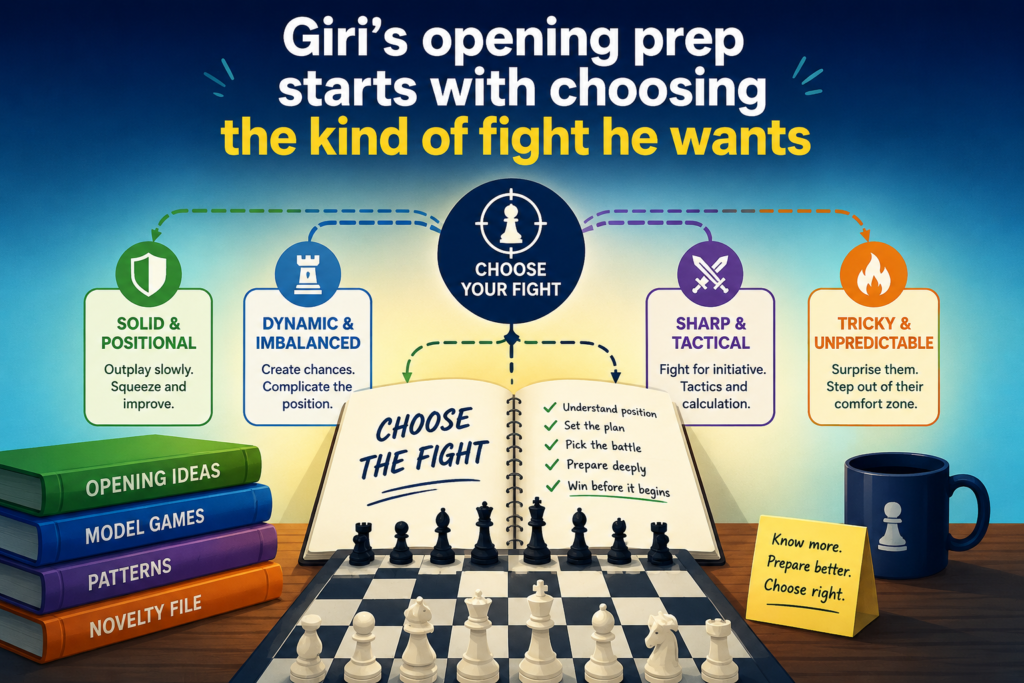
Giri’s opening prep starts with choosing the kind of fight he wants
Anish Giri’s opening work is not random. He is not just trying to remember more moves than the other player. He is trying to reach a position where he knows the plans better, feels safer, and can ask the opponent hard questions.
This is a huge difference. Many young players think the opening is about “getting a good position.” That is true, but it is not deep enough. The better goal is to get a position where your next five ideas are easier to find than your opponent’s next five ideas.
This is why Giri’s games can feel so clean. He often does not need to rush. He does not need to throw pieces at the king without reason. He builds pressure. He keeps control. He makes the opponent solve small problems again and again. That is often how a prep monster wins. Not with one giant trick, but with many tiny questions.
In his 2023 Tata Steel Chess win, Giri finished unbeaten with 8.5 out of 13, beating Magnus Carlsen, Ding Liren, Dommaraju Gukesh, and Richard Rapport. That event was a strong example of a player coming to the board with a full plan, not just hope.
The first choice is not the first move, but the game shape
Before a strong player picks an opening, he thinks about the game shape. Does he want a slow game or a sharp game? Does he want a locked center or an open board? Does he want queens on the board or an early queen trade? Does he want to attack, press, defend, or slowly squeeze?
A child can learn this too. This is where chess becomes much more fun. Instead of asking, “What opening should I play?” the child can ask, “What kind of game helps me think clearly?” That one question can save years of confusion.
A student who likes calm plans may enjoy openings where pieces come out to natural squares and the king gets safe fast. A student who loves tactics may enjoy more active openings, but only after learning how not to fall into traps.
A student who gets nervous should first learn openings that reduce early danger. This does not make the child weak. It makes the child ready.
A child can copy this by building a small opening home
The best beginner opening plan is not huge. It should feel like a small home. The student should know where the pieces go, why the center matters, when to castle, and what common mistakes to avoid. That is enough to start winning more games.
At Debsie, we help kids build this “opening home” in a clear and friendly way. We do not want children to feel buried under long move lists. We want them to say, “I know what I am doing here.” That sentence is gold. It means the child is not just moving pieces. The child is thinking.
This is also why a free Debsie trial class can be a great first step. A coach can quickly see if your child needs better openings, better focus, or better move-checking habits. Once the child gets a clear path, chess starts to feel less messy and more exciting.
Giri studies people, not just positions on the board
One of the most useful things about Giri’s prep is that it is personal. He is not only preparing for an opening name. He is preparing for the player across from him. This matters because every chess player has habits.

Some players love attacks. Some avoid endgames. Some panic when the position gets quiet. Some grab pawns even when their king is unsafe. A smart player notices these habits and uses them.
This is not mean. This is chess. If your opponent dislikes defending, you give them a position where they must defend. If your opponent plays too fast, you give them small traps. If your opponent loves wild games, you can choose a calmer setup and make them work with less noise.
Top players do this at a very high level. Giri has spoken about serious preparation before and during major events, including work with seconds and engines. One interview notes that he uses training camps before big tournaments, with a focus on opening work and plans against specific opponents.
Young players can prepare for opponents without needing a huge database
A child does not need grandmaster tools to use this idea. The simple version works very well. Before a tournament game, the child can think about what they know. Has this opponent played fast before? Do they attack early? Do they forget to castle?
Do they bring the queen out too soon? Do they trade pieces whenever they feel scared?
Even if the child knows nothing about the opponent, they can still prepare their own plan. They can decide, “I will develop all my pieces before attacking.” They can decide, “I will check every capture before I move.” They can decide, “I will not rush if I win a piece.” These small promises are not small in real games. They stop the most common mistakes.
This kind of preparation also makes kids feel calmer. A child with a plan has less room for fear. The mind has something useful to do. It starts looking for ideas instead of worrying about the result.
The best pre-game question is simple enough for a child to remember
Before every game, a student should ask, “What is my opponent trying to do?” This one question can change the whole game. It helps the child slow down. It helps them see threats. It helps them stop playing only for themselves.
Many beginners lose because they only look at their own moves. They see a nice attack and forget their queen is hanging. They see a pawn they can take and miss checkmate. They see a fork they want to play and forget their king is in danger. Asking about the opponent’s plan fixes this slowly and surely.
Debsie coaches bring this habit into class again and again. Not with fear. Not with pressure. With practice. The child learns to pause, look, ask, and then move. That is how chess becomes a training ground for smart thinking in school and life too.
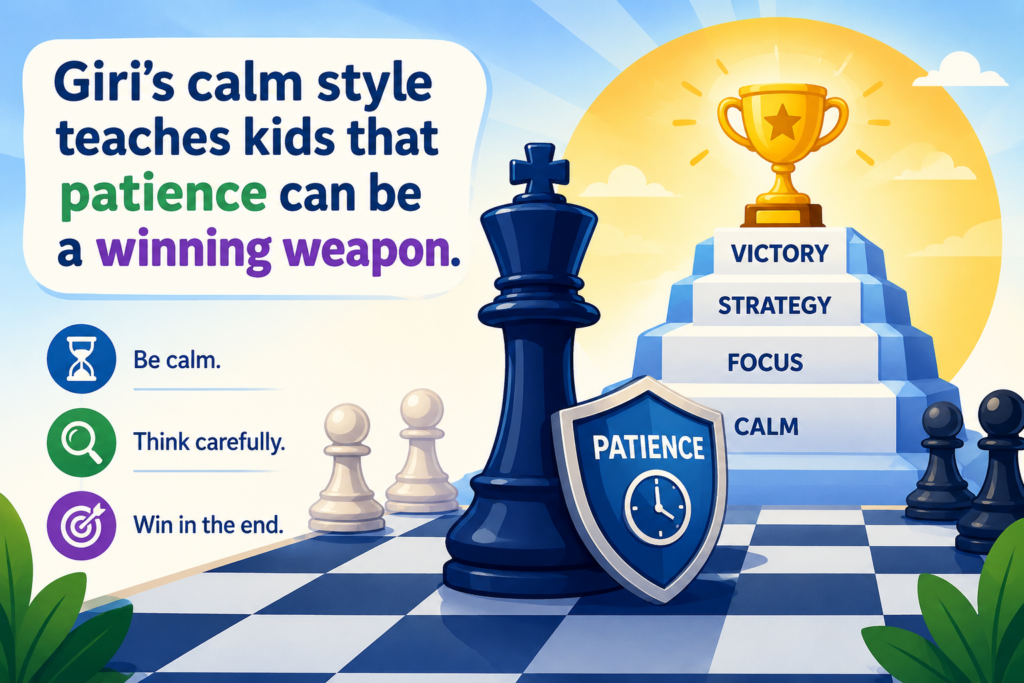
Giri’s calm style teaches kids that patience can be a winning weapon
Anish Giri is often seen as a very solid player, but “solid” should not mean boring. In strong chess, solid means hard to break. It means your pieces support each other. It means your king is safe. It means your moves have a point. It means your opponent does not get free chances.
For children, this lesson is very important. Many young players think winning means attacking right away. They want checks. They want sacrifices. They want checkmate in ten moves. That can be fun, but it can also create bad habits.
If a child attacks before developing pieces, the attack often fails. If a child sacrifices without checking, they often lose material. If a child only looks for checkmate, they miss simple wins.
Giri’s style shows another path. You can win by being hard to fool. You can win by improving your worst piece. You can win by making one useful move after another. This is not slow thinking. This is strong thinking.
Patience does not mean waiting without a plan
In chess, patience is active. It does not mean sitting there and doing nothing. It means improving the position until the right moment comes. A patient player may place a rook on an open file. Then improve a knight.
Then stop the opponent’s pawn break. Then create a small weakness. Then enter the endgame with a better structure.
That sounds simple, but it is very hard for kids at first. Children often want action now. They want the reward right away. Chess teaches them that some rewards come after careful work. This is one of the reasons chess is such a good life skill. It trains the mind to wait, but not sleep. It teaches action with timing.
Giri’s 2025 Grand Swiss final-round win over Hans Niemann is a strong example of this kind of controlled pressure. The official report says he gained a lasting two-bishop edge, advanced on the kingside, broke through on the other wing, and won a bishop endgame. That is not a cheap trick. That is patient power.
Children become stronger when they learn to love small gains
A child does not have to find a brilliant move in every game. In fact, trying to be brilliant all the time can hurt them. The better goal is to collect small gains. A safer king is a gain. A better knight is a gain. A weak pawn in the enemy camp is a gain. More space is a gain. A clear plan is a gain.
When a child learns to value small gains, they stop playing wild chess. They begin to play grown-up chess. They still enjoy tactics, but they do not chase them blindly. They learn that tactics often come after good position play.
This is where a caring coach makes a big difference. At Debsie, we help students see these little wins during lessons. We show them that a quiet move can be powerful. We show them that not making a mistake is sometimes the best move.
We show them that patience is not boring. Patience is how strong players make the board obey them.
The prep monster mindset works because it turns chess into a repeatable process
The best part of Giri’s method is that it can be repeated. He does not depend only on mood. He does not sit down and hope his brain will find magic. He follows a process. Study the opponent. Pick the right opening. Understand the plans. Stay calm. Notice the key moment. Make the best practical choice.
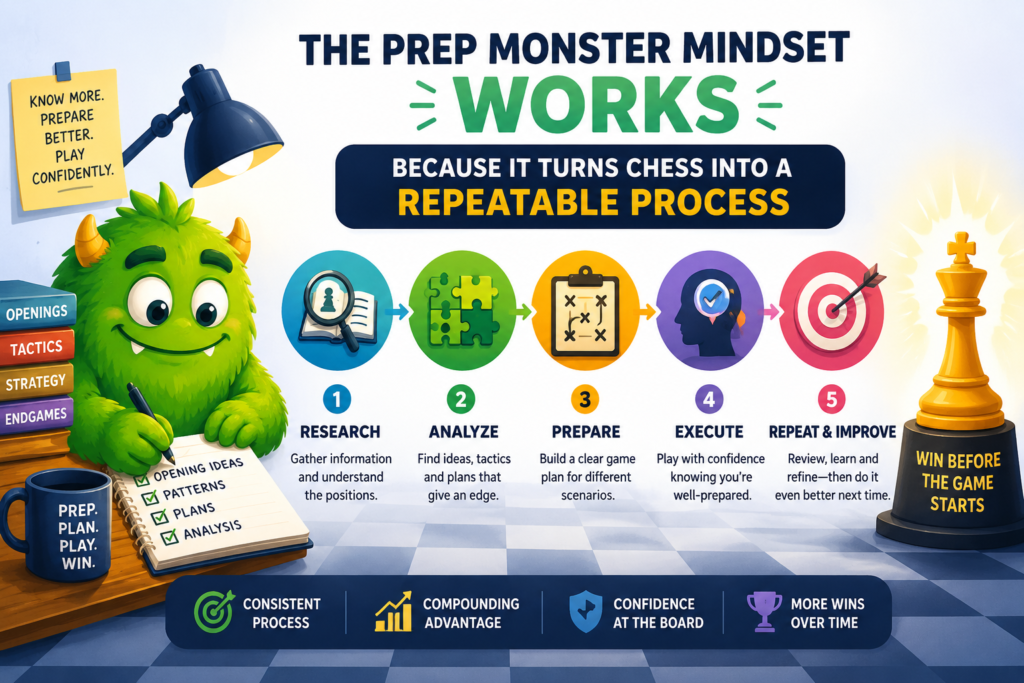
This is why his success is useful for students. A child cannot copy Giri’s exact opening files. That would be too much. But a child can copy the process. A process is stronger than a lucky win because it can be used again.
Giri’s long career also shows that steady work matters. His FIDE profile records him as a Dutch grandmaster with a long top-level career, and his recent 2025 Grand Swiss win gave him another Candidates qualification for the 2026 cycle. That kind of staying power is not only talent. It is a habit of serious preparation over many years.
A repeatable process helps kids stop guessing
Many young players lose because every move feels like a guess. They look at the board and think, “Maybe this is good.” Then they move. Sometimes it works. Often it does not. The child becomes confused because they do not know why they won or lost.
A process fixes that. Before moving, the child can check if their king is safe. Then they can look for checks, captures, and threats. Then they can ask what the opponent wants. Then they can choose a move with a reason. This does not make every move perfect, but it makes the thinking better.
Over time, better thinking brings better results. The child starts losing fewer pieces. They start spotting simple tactics. They start staying calm in hard positions. They start reviewing games with more honesty because they can see where the thinking broke.
Debsie turns this process into a friendly learning path
This is exactly the kind of growth Debsie wants for young chess learners. We want students to feel that chess is not a mystery. It is a skill they can build. With live online classes, private coaching, and regular tournaments, children get to learn, practice, test, and improve in a safe space.
A child who trains this way does not only become better at chess. They become better at preparing. They learn to think before acting. They learn to stay patient when the answer is not easy. They learn to bounce back after a mistake. These are the real wins parents love to see.
And that is the heart of the Anish Giri lesson. Winning before the game starts does not mean the game is already over. It means you arrive ready. For a child, that feeling can be life-changing. It turns “I hope I do well” into “I know how to begin.”
Giri’s real edge is that his opening work connects to the middle game
Many young players treat the opening like a separate subject. They learn the first few moves, feel proud, and then freeze when the book moves end. This is a common problem. The child says, “I knew the opening,” but the game still falls apart because they did not know what to do next.
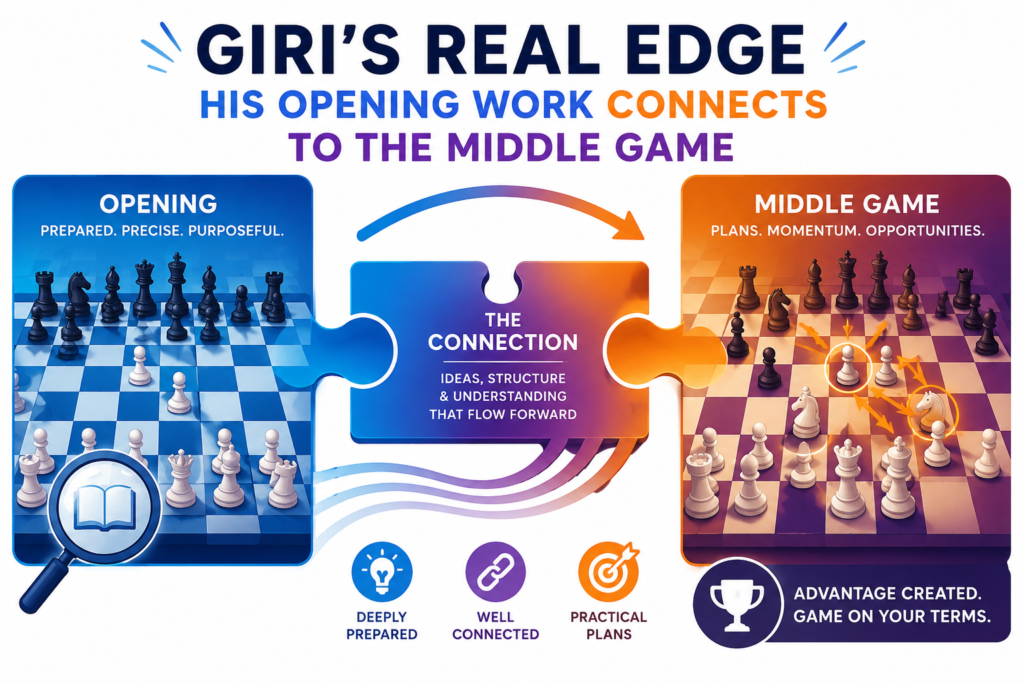
Anish Giri’s preparation is different. His opening work is tied to the middle game. He does not just ask, “What are the moves?” He asks, “What kind of position will I get after these moves?” That question is the heart of smart chess.
This is why he can make the game look smooth. He may leave the opening with a small lead in space, a better bishop, a safer king, or a clear pawn break. None of these things look like fireworks at first. But they give him a plan. And in chess, a clear plan is often worth more than one fancy move.
Giri’s long stay as a top Dutch grandmaster and his recent major results show that this kind of work still matters at the highest level. His FIDE profile lists him as a Dutch grandmaster, and official event reports show that he won the 2025 FIDE Grand Swiss with 8 out of 11, earning a place in the 2026 Candidates cycle.
A student should never learn an opening without learning the first plan after it
A good opening lesson should always answer a simple question: “What do I do after my pieces are out?” If a child cannot answer this, the opening has not really been learned yet.
For example, in many open games, the plan may be to castle fast, place a rook in the center, and look for weak squares near the enemy king. In Queen’s Pawn openings, the plan may be to control the center, improve the bishops, and prepare a pawn break. In some Sicilian positions, the plan may be to fight for the center from the side and use active pieces.
The names are not the main thing. The ideas are the main thing. A child who knows ideas can survive when the opponent plays a move they have never seen. A child who only knows moves can panic the moment the position changes.
At Debsie, this is why we teach openings with plans. We want students to know where the pieces go, but we also want them to know why those squares matter. That “why” is what turns memory into real skill.
The simple action step is to write one plan beside every opening
Here is the easy rule for young players. For every opening they study, they should be able to say one clear plan in their own words. Not a long speech. Not a hard chess line. Just one useful plan.
A child playing the Italian Game might say, “I want to develop fast, castle, and look at the center.” A child playing the Queen’s Gambit might say, “I want strong center control and active pieces.” A child playing the Caro-Kann might say, “I want a safe position and then I want to challenge White’s center.”
This one habit can change a child’s games. It stops them from playing the first ten moves well and then guessing. It also makes game review easier because the coach can ask, “Did you follow your plan? If not, where did it go wrong?”
That is the kind of small, clear training that helps children improve faster. And it is the kind of thinking that Debsie’s coaches build in live classes, private lessons, and tournament review sessions.
Giri prepares traps, but he does not depend on tricks
Many kids love traps. That is natural. Traps are fun. It feels great to win a queen in ten moves or checkmate someone who forgot to castle. But there is a danger. If a child only plays for traps, they stop learning real chess. They hope the opponent makes a mistake. When the opponent does not fall for it, the child has no plan.
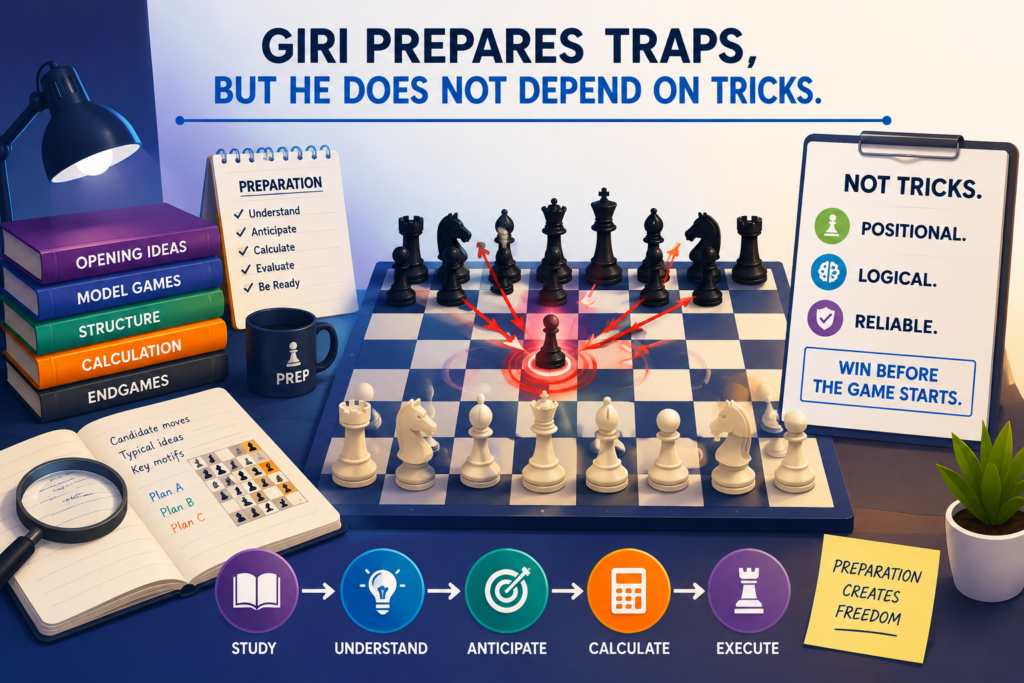
Anish Giri’s preparation may include sharp ideas, but he is not a cheap-trick player. That is a key lesson. His prep is dangerous because it is sound. It asks the opponent hard questions, but it does not collapse if the opponent answers well. This is what students should aim for.
A good trap is not a silly trick. A good trap is hidden inside a healthy position. If the opponent misses it, great. If the opponent sees it, you still have a playable game. That is how strong players use opening ideas.
The best traps teach patterns, not just surprise moves
A trap should teach something useful. Maybe it teaches that an uncastled king is weak. Maybe it teaches that a pinned knight cannot defend well. Maybe it teaches that taking a pawn can open a dangerous file. Maybe it teaches that the queen should not come out too early.
When a child learns traps this way, they do not become sneaky. They become sharper. They begin to notice warning signs. They start seeing why some moves are unsafe. They learn that every piece has a job, and when one piece is overloaded, tactics can appear.
This is a much better way to teach tactics than giving children random puzzles with no story. Puzzles are useful, but the child also needs to see how tactics grow from real positions. Giri’s style is a good model because his threats often come from strong preparation and clear structure, not from wild guessing.
At Debsie, we love teaching these patterns because children enjoy them and parents see the change. A child who learns patterns starts checking moves more carefully. They become less likely to hang pieces. They become more alert in school-like tasks too, because they are training their mind to notice details.
The safe rule is to play traps only when the position still makes sense
A young player should ask one question before playing a trap: “If my opponent sees it, am I still okay?” If the answer is no, the trap is probably bad.
This rule is simple, but it protects kids from many painful losses. It teaches them not to gamble with the whole game. It teaches them to respect the opponent. It also helps them grow into practical players who know when to attack and when to improve.
For example, a child should not move the same piece five times just to create a one-move threat. A child should not leave the king in the center just to chase a pawn. A child should not bring the queen out early if the queen can be chased all over the board.
Good chess is not about hoping the other player forgets everything. Good chess is about building pressure in a way that keeps your own position safe. That is the prep monster lesson children can actually use.
Giri’s method teaches the power of review after every serious game
Preparation does not end when the game ends. In many ways, that is when the next preparation begins. A serious player studies the game after it is over. They ask what worked, what failed, and what can be improved next time. This is one of the big reasons strong players keep getting stronger.
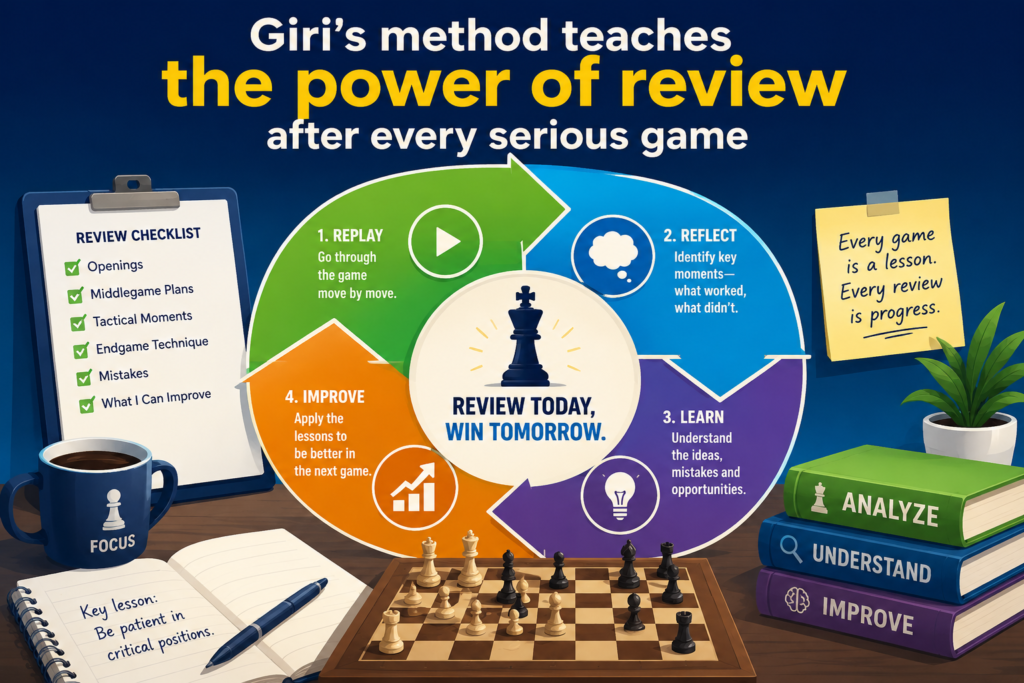
Anish Giri did not become one of the world’s top players by only playing games. He became strong by studying them deeply. His official biography notes that he earned the grandmaster title at 14 years, 7 months, and 2 days, which shows how early his serious chess work began.
For young players, this lesson is huge. Playing more games is not enough. A child can play hundreds of fast games online and repeat the same mistakes every day. Growth comes when the child slows down and looks at the mistake with a calm mind.
A good review should find the reason behind the mistake
Many children review games in the wrong way. They only ask, “What was the best move?” That can help, but it is not enough. The better question is, “Why did I miss the best move?”
Maybe the child moved too fast. Maybe they only looked at checks. Maybe they forgot the opponent could capture back. Maybe they were excited after winning material. Maybe they got scared and traded the wrong pieces. Once the reason is clear, the lesson becomes useful.
This is where a coach is so helpful. A coach can see patterns the child cannot see alone. One game may show a missed tactic. Three games may show a habit. Ten games may show a training need. That is how smart improvement happens.
At Debsie, game review is not about making a child feel bad. It is about showing them the next step. A mistake becomes a teacher. A loss becomes a map. The child learns that failure is not the end of the story. It is part of the path.
The best review question is what should I do differently next time
After every serious game, a student should leave with one clear action. Not ten. Just one. If the child lost a queen, the action may be, “I will check if my queen is attacked before I move.” If the child forgot to castle, the action may be, “I will try to castle before move ten when it is safe.” If the child rushed in a winning position, the action may be, “I will slow down after I win material.”
This keeps improvement simple. A child can remember one focus point. They can carry it into the next game. Then, over time, these little focus points become strong habits.
Parents love this because it turns chess into a life lesson. The child learns to look back without shame. They learn to fix one thing at a time. They learn that getting better is not magic. It is review, practice, and patience.
That is exactly why Debsie’s learning model works so well for growing students. Classes teach the idea. Practice makes it real. Tournaments test it. Review helps it stick.
The real prep monster is not the child who studies the most, but the child who studies the right things
A child does not need to study chess all day to improve. In fact, too much random study can confuse them. One video says this. Another video says that. One opening looks fun today. Another opening looks better tomorrow. Soon the child has many half-ideas and no clear system.
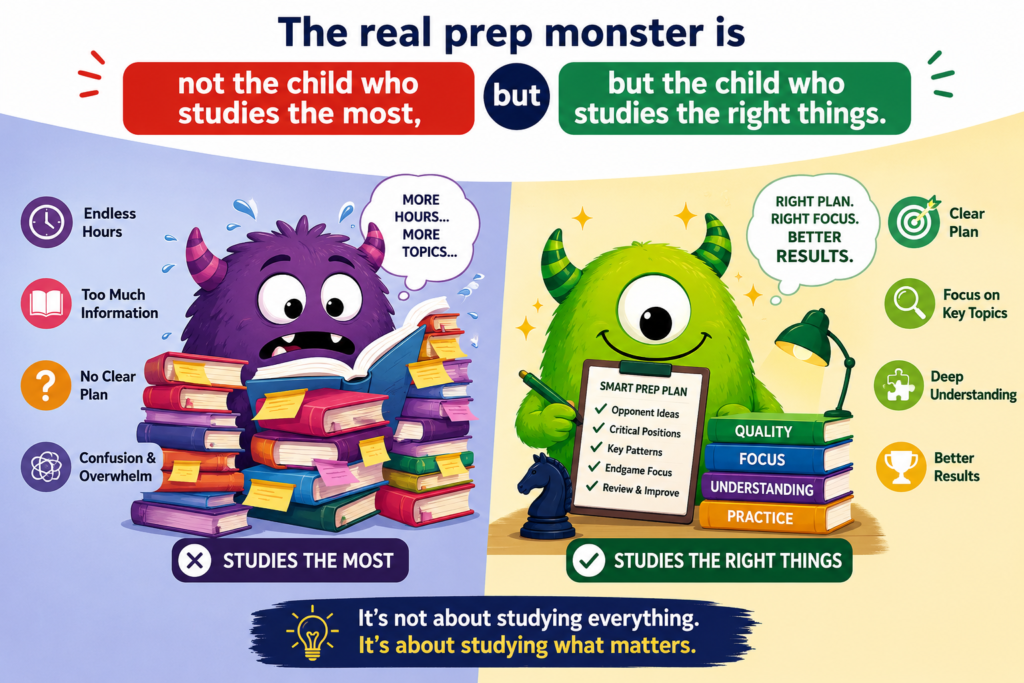
Anish Giri’s example points to a better path. Prepare with purpose. Study what helps your games. Build a clear opening base. Learn common pawn structures. Practice tactics that appear in your openings. Review your own mistakes.
Prepare for opponents when possible. This is not more work for the sake of work. This is smart work.
Giri’s 2025 Grand Swiss win is a strong reminder that steady, serious chess can still beat noise. Reports described his final-round win as a controlled, grinding performance that helped him take clear first place with 8 out of 11.
Smart study saves time and builds confidence
The right kind of study makes a child feel lighter, not heavier. The child starts to know what matters. They stop jumping from one trick to another. They begin to trust their process.
For a beginner, smart study may mean learning basic checkmates, safe development, common tactics, and how not to lose pieces. For an intermediate student, it may mean building a small opening set, learning plans, studying pawn breaks, and reviewing tournament games.
For an advanced student, it may mean deeper opponent prep, serious endgames, and more careful calculation.
The level changes, but the idea stays the same. Study what gives you better decisions during real games.
This is why Debsie’s personalized approach matters. Every child does not need the same lesson. Some kids need opening help. Some need confidence. Some need patience. Some need tactics. Some need tournament practice. A good coach finds the need and builds from there.
A free trial class can reveal the one thing holding your child back
Many parents know their child likes chess, but they do not know what the child needs next. That is normal. Chess has many layers. Sometimes the problem is not the opening. Sometimes it is time control. Sometimes it is fear. Sometimes it is moving too fast. Sometimes it is not knowing how to make a plan.
A free Debsie trial class can help make this clear. The coach can watch how the child thinks, where they pause, where they rush, and what kind of help will matter most. That first step can save months of guesswork.
The goal is not to turn every child into Anish Giri. The goal is better than that. It is to help each child become a clearer thinker, a braver learner, and a calmer problem solver. Chess is the board. Growth is the real win.
And when a child learns to prepare well, they begin to understand Giri’s secret. You do not win before the game starts because the other player is weak. You win before the game starts because you arrive ready, focused, and full of purpose.
Giri’s preparation teaches kids how to make the board feel smaller
One reason Anish Giri is so hard to face is that he often makes the board feel smaller for the other player.
That may sound strange because the chessboard has the same 64 squares for everyone. But in a real game, the player who understands the position better feels like they have more room. The player who is confused feels trapped, even when many legal moves are still there.
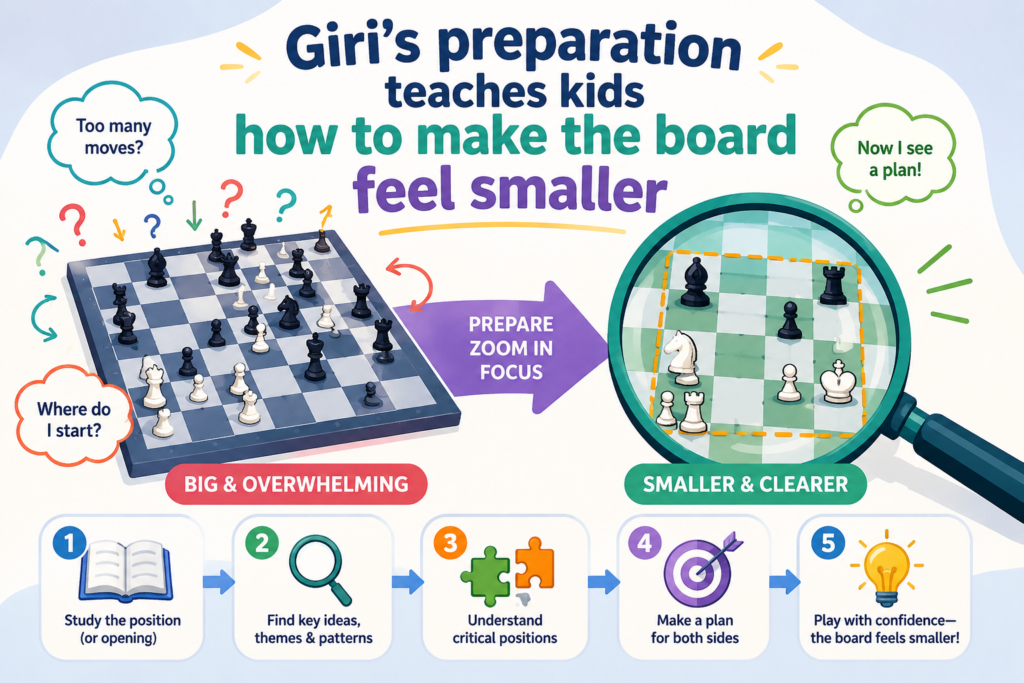
This is what strong preparation can do. It does not always give you a winning position right away. Instead, it removes confusion. It helps you know which squares matter, which trades help you, which pawn breaks you want, and which pieces need to improve. That is a quiet kind of power.
Giri’s career shows this again and again. He became a grandmaster very young, at 14 years, 7 months, and 2 days, and later became one of the main faces of Dutch chess. His own official biography notes that he achieved his final grandmaster norm at the 2009 Corus Chess Tournament in Wijk aan Zee.
Young players do not need to see everything if they know what matters most
A common mistake young players make is trying to calculate everything. They look at every check, every capture, every random attack, and soon their brain feels tired. Strong players do not think like that all the time. They first decide what matters.
If the center is locked, wing play may matter more. If the king is unsafe, development and defense may matter more. If one bishop is bad, finding a new job for that bishop may matter more. If the opponent has a weak pawn, pressure on that pawn may shape the whole game.
This is very helpful for kids because it gives their mind a filter. They stop treating every move as equal. They start asking, “What is the main story of this position?” That one question helps them think with more order.
At Debsie, this is something coaches build slowly. A child may first learn how to spot a hanging piece. Then they learn simple threats. Then they learn plans. Then they learn how one plan changes when the pawn structure changes. This step-by-step path keeps chess fun and clear.
The action step is to name the most important area of the board
Before making a move, a child can ask, “Where is the real action?” Sometimes the answer is the center. Sometimes it is the king side. Sometimes it is one open file. Sometimes it is one weak square that both players are fighting over.
This simple habit makes the board feel less wild. The child is no longer looking at 64 squares with panic. They are looking at the few squares that matter most right now. That is how confidence grows.
This also helps in life. A child who learns to find the main problem in chess can start doing the same in homework, exams, and daily choices. Instead of feeling lost, they learn to ask, “What matters most here?” That is not just chess growth. That is thinking growth.
Giri’s strength comes from preparing for problems before they appear
Many beginners only react when danger is already on the board. They notice a threat after it becomes painful. They see the fork after losing the rook. They see the back-rank weakness after checkmate is one move away. This is normal at first, but it is also the habit that keeps players stuck.
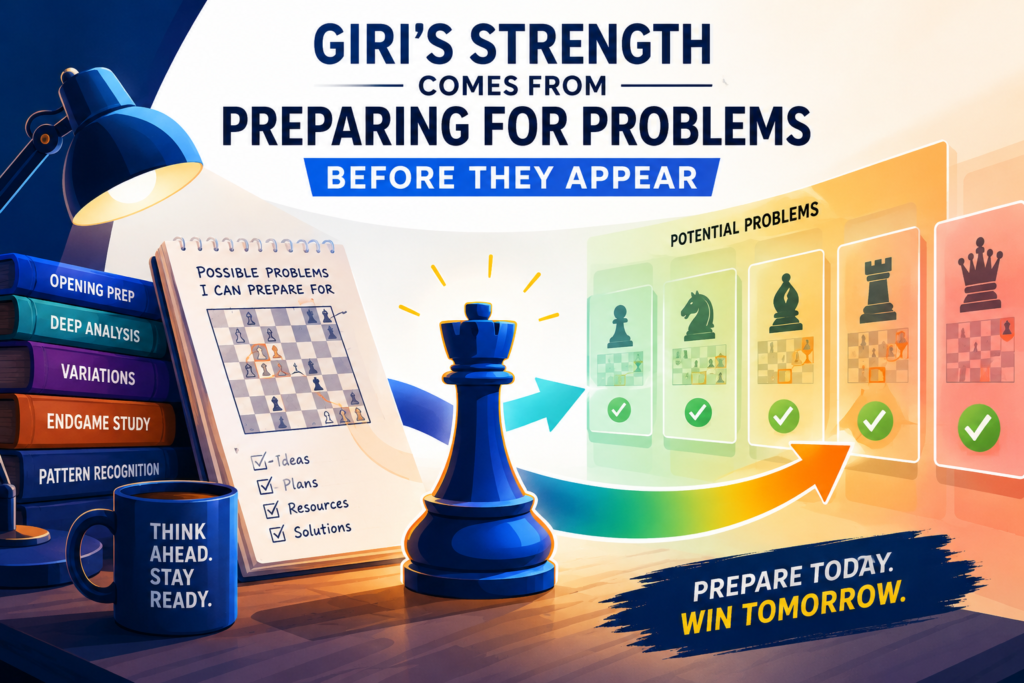
Anish Giri’s prep shows the opposite skill. Strong players prepare for problems before they fully appear. They know which weak squares may become targets. They know when the king may need an escape square. They know when a pawn move may create a hole. They know when a trade may lead to a bad endgame.
That is why preparation is not only about attack. It is also about safety. A player who prevents problems saves energy. A player who waits for every fire to start is always tired.
Giri’s 2023 Tata Steel Chess win is a great example of this steady strength. His official site says he scored an undefeated 8.5 out of 13 and beat Magnus Carlsen, Ding Liren, Dommaraju Gukesh, and Richard Rapport during the event.
Children become stronger when they learn to stop threats early
Stopping a threat early is one of the most underrated chess skills. Kids often want to attack, but defense done early is not boring. It is smart. When a child castles before the center opens, that is smart. When a child moves a rook away from a fork before the fork happens, that is smart. When a child gives the king a safe square before the back rank becomes weak, that is smart.
This kind of thinking makes a young player much harder to beat. They may not win every game fast, but they stop losing silly games. That is a major jump. Many tournament points are gained simply by not giving the opponent free gifts.
Parents can watch for this change. A child who once rushed may begin to pause. A child who once attacked without looking may begin to ask, “What is my opponent threatening?” A child who once got upset after blunders may begin to understand how to prevent them.
That is why Debsie classes focus so much on thinking habits. Good habits reduce stress. They help kids enjoy chess because the game starts making sense.
The action step is to check danger before chasing your own plan
Before every move, a child should take one calm moment to check danger. This does not need to be slow or scary. It can become a simple routine. Is my king safe? Is my queen attacked? Can my opponent give a check? Can they win a piece? What changed after their last move?
When this becomes a habit, many blunders disappear. The child still makes mistakes, because everyone does. But the mistakes become smaller and less frequent. That is real progress.
This is also a beautiful lesson for school and life. Before acting, pause. Before answering, think. Before reacting, check what is really happening. Chess gives children a safe place to practice this every week.
Giri shows that the best prepared player still has to fight at the board
There is one important truth every student must understand. Preparation helps, but it does not play the whole game for you. Even Anish Giri, with all his opening work, still has to solve problems at the board. He still has to calculate. He still has to handle pressure. He still has to make choices when the game becomes new.
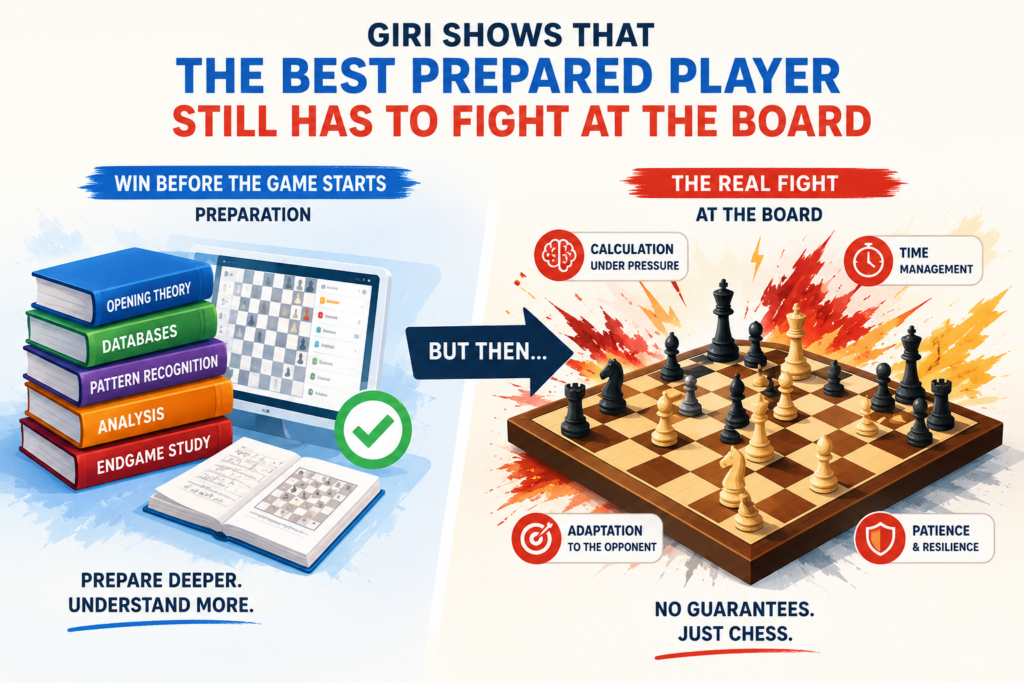
This is a healthy lesson for kids because it keeps preparation in the right place. Prep is not a magic button. It is a head start. It gives the player comfort, structure, and confidence. But after that, the player must think.
In the 2025 FIDE Grand Swiss, Giri won the Open tournament outright with 8 out of 11 after defeating Hans Niemann in the final round, and the official report said this also gave him a place in the 2026 Candidates Tournament. That kind of result is not built on memory alone. It needs full-game strength.
Students should use preparation as a launch pad, not a cage
Some children become too attached to prepared moves. They learn a line and panic when the opponent does something different. This means the child has not learned the position yet. They have only learned a script.
Good chess training fixes this. The student learns the idea behind the move. Then, when the opponent changes the move order, the child can still think. They may not find the perfect answer, but they will not feel helpless.
This is why coaches should not only ask, “What is the next move?” They should ask, “Why is that the move?” The “why” matters more. When a child can explain the reason, the learning becomes flexible.
At Debsie, we want students to become thinking players, not copying players. Copying may win a few quick games, but thinking builds a real chess mind. A thinking child can adapt. A thinking child can learn from surprises. A thinking child does not fall apart when the game leaves the lesson.
The action step is to ask why after every opening move learned
When a child learns an opening move, they should ask what the move does. Does it fight for the center? Does it develop a piece? Does it protect the king? Does it stop the opponent’s idea? Does it prepare a pawn break?
This habit turns every opening lesson into a thinking lesson. The child is no longer swallowing moves. They are chewing them. They are making the ideas their own.
That is the big goal. A prepared child should not feel trapped by prep. They should feel freed by it. They should sit at the board and think, “I know the road, and if the road changes, I know how to look for signs.”
The Debsie lesson from Anish Giri is to train the child behind the chess moves
The most useful lesson from Anish Giri is not that every child must study like a grandmaster. That would be too much. The real lesson is that smart preparation builds a stronger mind. It teaches a child to plan before acting, stay calm under pressure, and learn from mistakes without giving up.
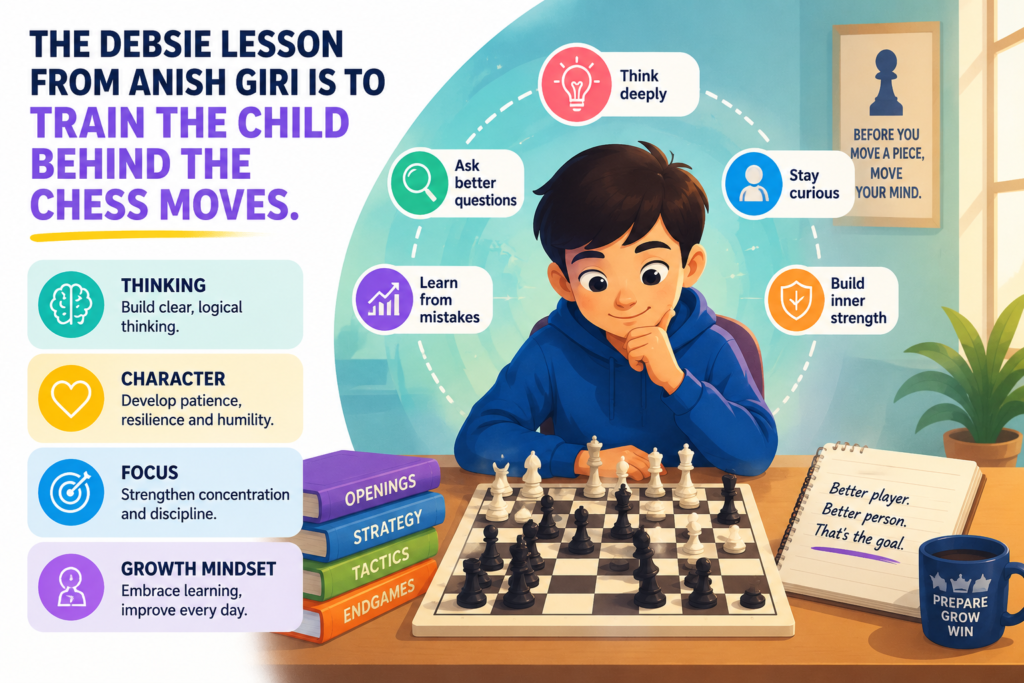
This is where chess becomes bigger than chess. A student who learns to prepare for a game also learns how to prepare for a test. A student who learns to review a loss also learns how to handle feedback. A student who learns to stay patient in a hard position also learns how to stay steady when life feels hard.
Giri’s success makes this message clear. He has won major events, including Tata Steel Chess 2023 and the 2025 FIDE Grand Swiss, but the deeper story is the process behind those wins. Preparation, patience, review, and calm choices keep showing up in his chess.
Parents should look for chess training that builds habits, not just ratings
Ratings are exciting, but habits are more important. A rating can go up and down. Habits stay. A child who learns to think before moving has gained something real. A child who learns not to quit after losing has gained something real. A child who learns to focus for a full game has gained something real.
This is why the right chess class matters so much. The goal should not be to flood the child with hard terms. The goal should be to make the child curious, alert, and brave. The coach should explain ideas in simple words. The child should get chances to speak, solve, play, and review. The class should feel alive.
Debsie was built for this kind of growth. With expert-led online chess classes, private coaching, and regular tournaments, children get a clear path. They learn openings, tactics, strategy, and endgames, but they also learn patience, focus, and smart decision-making.
A free Debsie trial class is a simple way to see your child’s next step
Many parents wonder whether their child is ready for chess coaching. The answer is often simpler than they think. If the child enjoys chess, asks questions, plays online, watches chess videos, or likes solving puzzles, a guided class can help.
A free Debsie trial class gives your child a warm first look at how structured chess learning feels. It can also show parents what the child needs next. Maybe the child needs opening basics. Maybe they need tactics. Maybe they need confidence.
Maybe they need help slowing down. Once that is clear, improvement becomes much easier.
Anish Giri may be a “prep monster,” but the heart of his lesson is very simple. Get ready. Think clearly. Respect the game. Learn from each battle. That is a lesson every child can use, on the board and far beyond it.
Anish Giri teaches that the best opening is the one your child understands
Many young players want to copy grandmaster openings right away. They see a famous player use a sharp line, and they think, “I should play that too.” But this can be a trap. A grandmaster may understand the deep reason behind every move.
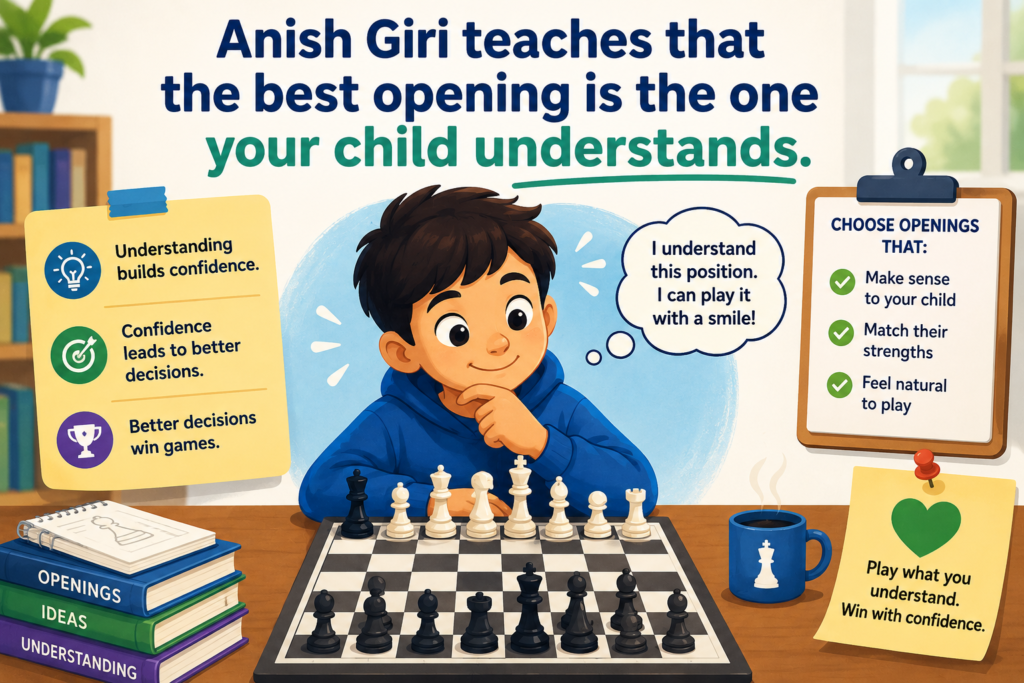
A child may only remember the moves for a few turns. When the opponent changes the line, the child feels lost.
This is why Anish Giri’s style gives us a better lesson. The goal is not to play a famous opening. The goal is to understand the opening you play. A simple opening played with clear ideas is much stronger than a hard opening played with confusion.
For a child, this is freeing. They do not need to know everything. They need to know the key ideas well. They need to know how to bring pieces out, how to protect the king, how to fight for the center, and how to avoid early traps. Once these basics become strong, the child can slowly add deeper lines.
A strong opening should make the next move easier to find
A good opening should not make a child feel like they are walking in the dark. It should help them find normal moves. The knights should have natural squares. The bishops should have clear paths. The king should have a safe place. The rooks should be ready to join the game.
When a child plays an opening they understand, they stop wasting energy early. They do not stare at the board in panic on move six. They do not move the queen five times. They do not forget the king. They start the game with order.
This is also where good coaching matters. A coach can see which openings fit a child’s style. Some children need calm setups first. Some children are ready for sharper lines. Some children need to stop chasing tricks and learn clean development.
The right opening is not always the most popular one. It is the one that helps the child think better.
The easy test is whether your child can explain the opening in simple words
A child truly knows an opening when they can explain it without fancy words. They should be able to say what the first moves are trying to do. They should know where the pieces usually go. They should know one common plan after the opening. They should also know one common mistake to avoid.
This simple test is powerful. If a child cannot explain the opening, they probably do not own it yet. They may be borrowing moves from a video or a book, but they have not made the ideas part of their thinking.
At Debsie, this is how we love to teach. We want kids to speak about chess in their own words. When children can explain ideas clearly, they remember them longer. They also feel proud because chess no longer feels like a secret language. It becomes a game they can understand, enjoy, and use to grow.
Giri’s method shows why small plans beat random attacks
A lot of children love attacking. That is one reason chess feels so exciting. They want to check the king, win the queen, and finish the game fast. This energy is wonderful. It should not be killed. But it must be guided.
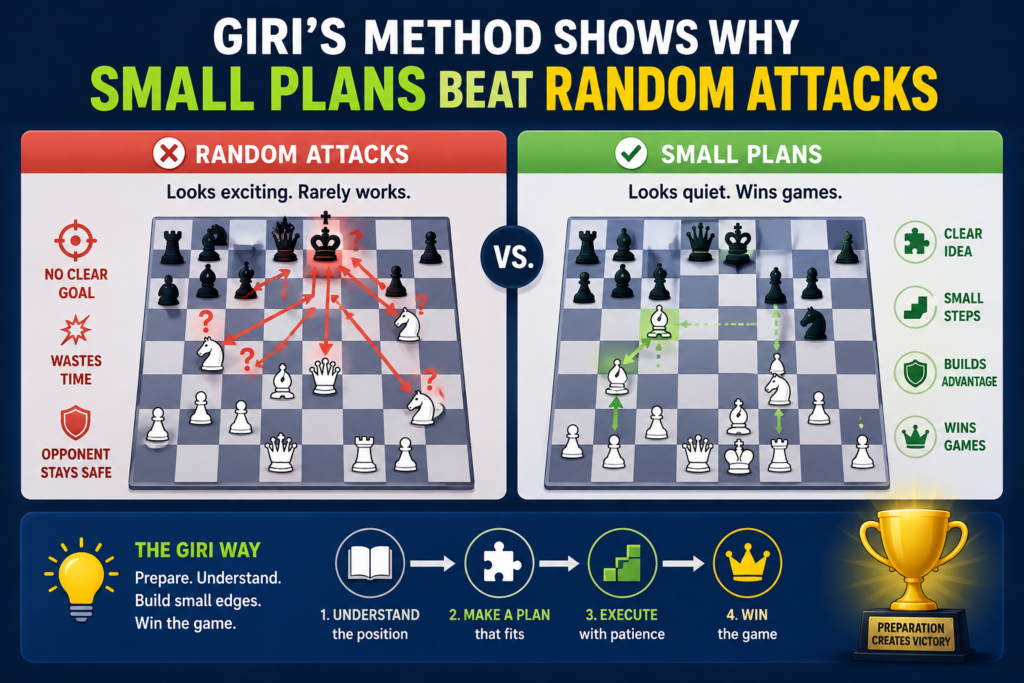
Anish Giri’s games show that attacks work best when they are built on a strong base. A player should not attack just because they feel excited. The pieces must be ready. The king must be safe. The center must be understood. The attack must have support.
This is a big step for young players. They begin to see that chess is not only about wanting to win. It is about making a position where winning becomes possible. A random attack may look brave, but it often breaks down. A planned attack is different. It comes at the right time and with enough force.
A plan gives every piece a job
One of the best ways to teach planning is to ask what each piece is doing. A knight should not sit at home forever. A bishop should not stare at its own pawn. A rook should not sleep in the corner when an open file is ready. A queen should not run around alone while the rest of the army is still in bed.
When kids learn this, their chess improves fast. They stop moving pieces only because those pieces can move. They start moving pieces because those pieces have a job. That is a major change.
A small plan might be to double rooks on an open file. Another plan might be to trade a bad bishop. Another might be to push a center pawn at the right time. These plans may sound simple, but they give structure to the game. They help the child avoid random moves.
This is one reason Debsie classes focus on the “why” behind the move. A child who knows why can make better choices when the position changes.
The action step is to improve the worst piece before starting an attack
Before a child attacks, they should look for the piece doing the least. This is often the easiest way to find a good move. Maybe a rook has not joined the game. Maybe a bishop is blocked. Maybe a knight is on the edge. Maybe the king still needs safety.
Improving the worst piece is a quiet habit, but it wins many games. It also teaches patience. The child learns that not every good move is a check. Not every strong move is loud. Sometimes the best move is the one that brings one more helper into the fight.
This habit is useful outside chess too. Children learn that big goals need support. You do not rush into a school project without preparing. You do not take a test without studying. You do not start a hard task without getting ready. Chess turns this life truth into something children can see on a board.
Giri’s prep mindset helps children handle pressure without falling apart
Chess pressure feels very real to a child. The clock is ticking. The opponent is staring. A piece may be under attack. One wrong move can lose the game. In that moment, many children rush. They move too fast because they want the stress to end.
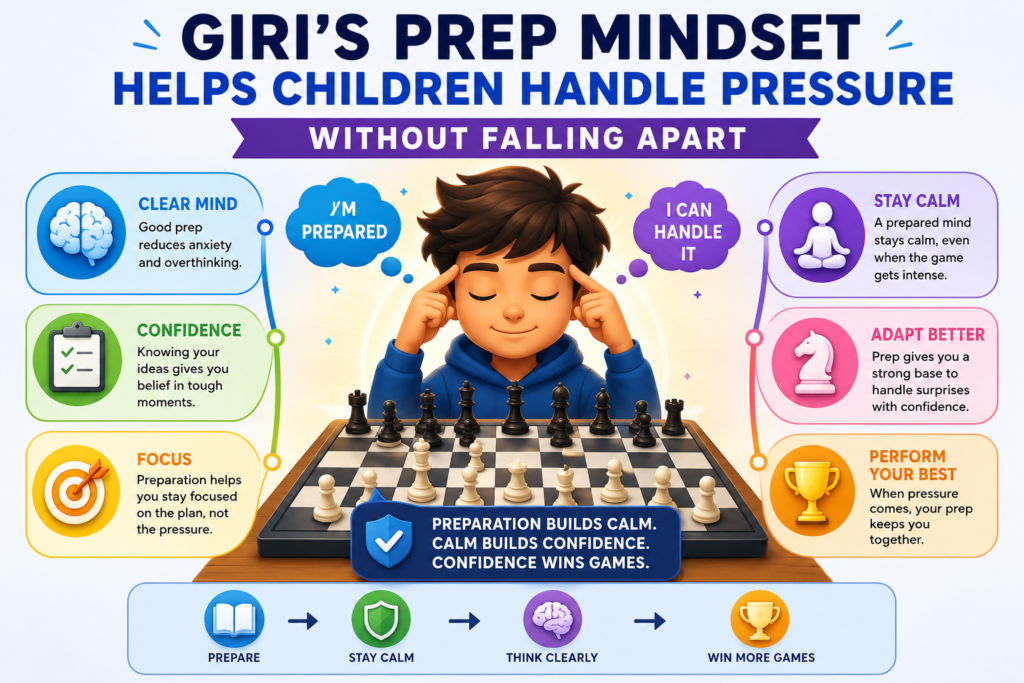
Anish Giri’s way of playing shows another path. A prepared player does not need to run from pressure. He can sit with it. He can look at the position, compare choices, and make a calm move. This does not mean he feels nothing. It means he has trained his mind to stay useful under stress.
That is one of the greatest gifts chess can give a child. Life will bring pressure. School tests bring pressure. Competitions bring pressure. New situations bring pressure. A child who learns to think during chess pressure is building a skill that can help everywhere.
Calm thinking is built before the hard moment arrives
A child cannot simply decide to be calm during a tournament if they have never practiced calm thinking before. Calm must be trained. It is built in lessons, practice games, puzzles, reviews, and small routines.
One routine can be as simple as pausing before every move. Another can be checking the opponent’s threat. Another can be using more time in key moments. Another can be taking one deep breath after a surprise move. These small habits may look tiny, but they change how a child handles the game.
When kids learn these routines, they feel more in control. They may still lose. They may still make mistakes. But they do not feel helpless. They begin to understand that pressure is not a monster. It is a signal to slow down and think.
At Debsie, coaches help students build this kind of calm in a friendly way. We do not shame mistakes. We use them. We help children see what happened and how to do better next time.
The action step is to create a three-second pause before touching a piece
One of the best habits for young players is the three-second pause. Before touching a piece, the child waits for a few seconds and asks, “What did my opponent’s last move do?” This pause can stop many blunders.
It also teaches self-control. The child learns not to act on the first feeling. They learn to check before choosing. They learn that fast is not always strong. In fact, many strong moves come after a quiet pause.
Parents can support this at home without making chess stressful. After a game, instead of asking only, “Did you win?” they can ask, “Did you take your time?” This shifts the focus from result to habit. Over time, better habits create better results.
That is the kind of growth Debsie cares about. We want children to become better players, but also calmer thinkers.
Anish Giri’s secret is that he makes hard work look clean
When people watch a top player like Anish Giri, they may think the moves are easy for him. The game can look smooth. The pieces go to good squares. The opponent gets squeezed. The ending becomes better. The win feels natural.
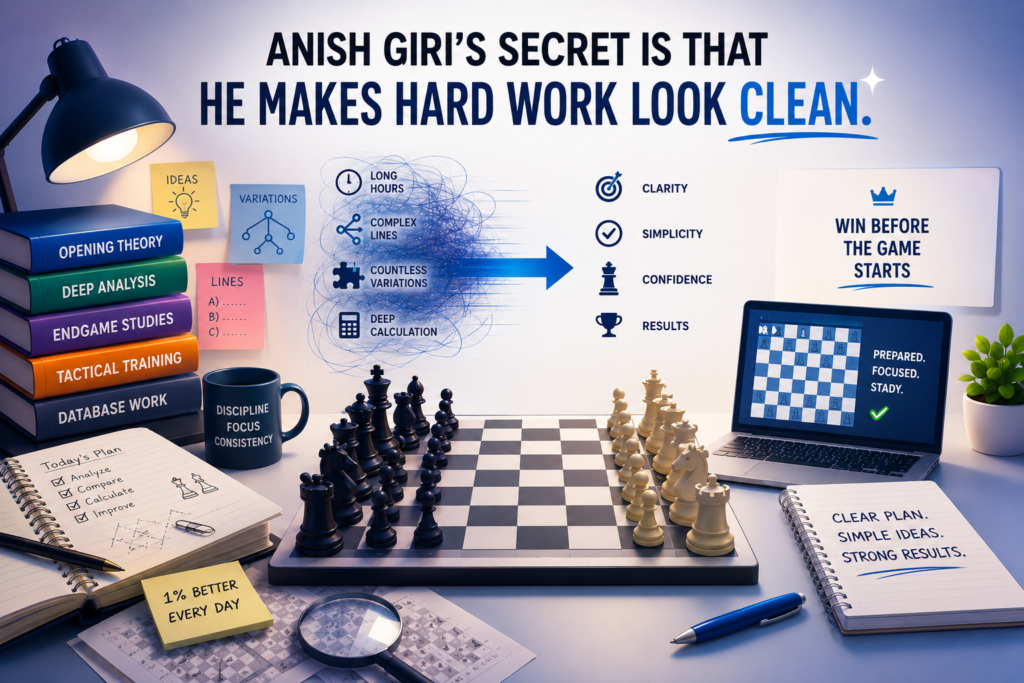
But clean chess is usually built from hard work. The easy-looking move may be the result of hours of study. The calm reply may come from deep opening prep. The simple endgame win may come from years of practice. This is an important lesson for children. Great skill often looks simple from the outside.
The good news is that children do not need grandmaster-level work to grow. They just need the right work for their level. A beginner who stops hanging pieces is making real progress. A student who learns to castle on time is making real progress. A tournament player who reviews losses honestly is making real progress.
The path is clearer when training has structure
Random chess study can feel fun at first, but it often leads to slow progress. A child watches one video on traps, then another on attacks, then another on a hard opening, and soon the ideas do not connect. Structure fixes this.
A strong learning path starts with the basics and grows step by step. First, the child learns safe piece movement, checkmates, and simple tactics. Then they learn opening ideas, planning, and common mistakes. Later, they learn deeper strategy, endgames, tournament habits, and opponent prep.
This is how real confidence grows. The child knows what they are learning now and what comes next. They do not feel lost. They see progress.
Debsie gives students this kind of guided path. With live online classes, private coaching, and regular tournaments, children do not only study chess. They use it. They test ideas. They learn from games. They get feedback from expert coaches. This turns learning into a full circle.
The action step is to make each week have one clear chess goal
A child does not need ten goals at once. One clear goal per week is enough. One week can focus on not losing pieces. Another week can focus on castling early. Another can focus on solving forks. Another can focus on using rooks better. Another can focus on reviewing one full game.
This keeps chess simple and effective. The child can feel progress because the target is clear. Parents can also support the child better because they know what to praise.
A free Debsie trial class can help find that first goal. Maybe your child is already strong in tactics but weak in planning. Maybe they love openings but avoid endgames. Maybe they play fast because they are nervous. Once the main need is clear, the training becomes much more useful.
Anish Giri’s prep monster image may sound advanced, but the heart of it is simple. Prepare well. Know your plan. Stay calm. Review your games. Improve one thing at a time. That is how a child grows in chess, and that is how chess helps a child grow in life.
Conclusion
Anish Giri shows us that great chess is not built on luck alone. It is built on clear plans, steady study, calm choices, and the courage to learn from every game. His “prep monster” style is a powerful lesson for children: get ready before the challenge, think before acting, and keep improving one step at a time.
That is exactly what Debsie helps young players do through friendly coaching, live classes, and real practice. If your child loves chess or wants to think better, a free Debsie trial class can be the first smart move.
Adhip Ray is the founder of Debsie, an online learning platform focused on chess and skill-based learning for children. His work at Debsie brings together chess education, structured thinking, problem-solving, and interactive learning for young students.
Adhip has an academic background in law, statistics, analytics, and technology. He is from Amity Law School and the Indian Statistical Institute, Kolkata, with formal training that connects legal reasoning, data analytics, quantitative thinking, and structured problem-solving. This interdisciplinary background is reflected in Debsie’s focus on building sharper thinking skills in children through chess and related learning programs.
Adhip is also a FIDE-rated chess player from India. He holds FIDE ID 5055954 and has a standard FIDE rating of 1832. His FIDE profile records him as an Indian player with a long rating history in standard chess, including rated games from his competitive playing years. His chess background gives Debsie a founder-led connection to the game, not only as an educational activity but also as a competitive discipline that develops concentration, calculation, planning, and decision-making.
In addition to chess, Adhip has a strong interest in coding, data, and technical problem-solving.
Adhip’s profile combines chess, law, data analytics, and programming. At Debsie, this background supports the creation of learning experiences that are logical, structured, and skill-oriented. The platform’s chess-focused programs are connected to broader cognitive skills such as pattern recognition, patience, strategic planning, focus, and problem-solving.
As founder of Debsie, Adhip brings together experience from multiple fields: formal legal education from Amity Law School, analytical training from the Indian Statistical Institute, Kolkata, competitive chess experience through his FIDE-rated profile, and coding practice through LeetCode. This combination gives Debsie a distinct foundation in strategy, reasoning, analytics, and child-focused learning.
Through Debsie, Adhip is associated with building chess and learning content for children that goes beyond basic instruction. The platform connects chess with thinking skills, helping students approach challenges with more structure, clarity, and confidence. His own background in chess and analytical problem-solving gives the platform a direct link to the skills it aims to develop in young learners.
Adhip is also a member of Forbes Business Council.