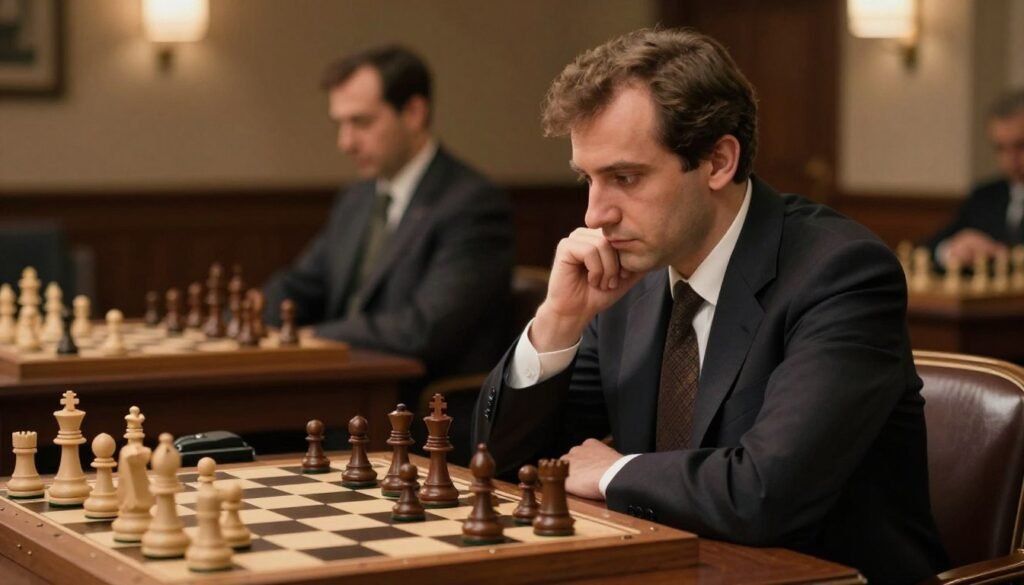
Some chess players win because they are calm. Some win because they are careful. Mikhail Tal won because he made the board feel like it was on fire. Tal, known as “The Magician from Riga,” became the 8th World Chess Champion in 1960 after beating Mikhail Botvinnik, one of the most serious and solid players in chess history. He was only 23. FIDE’s chess museum says Tal rose from master to world champion in just three years, which shows how fast and scary his climb really was.
Find the right learning experience
Tell us a little about the learner and what you are looking for. Our team will review your answers and help you identify the most suitable next step.
- Takes only a few minutes
- No payment required
- Personalised recommendations
Your information will only be used to respond to your enquiry.
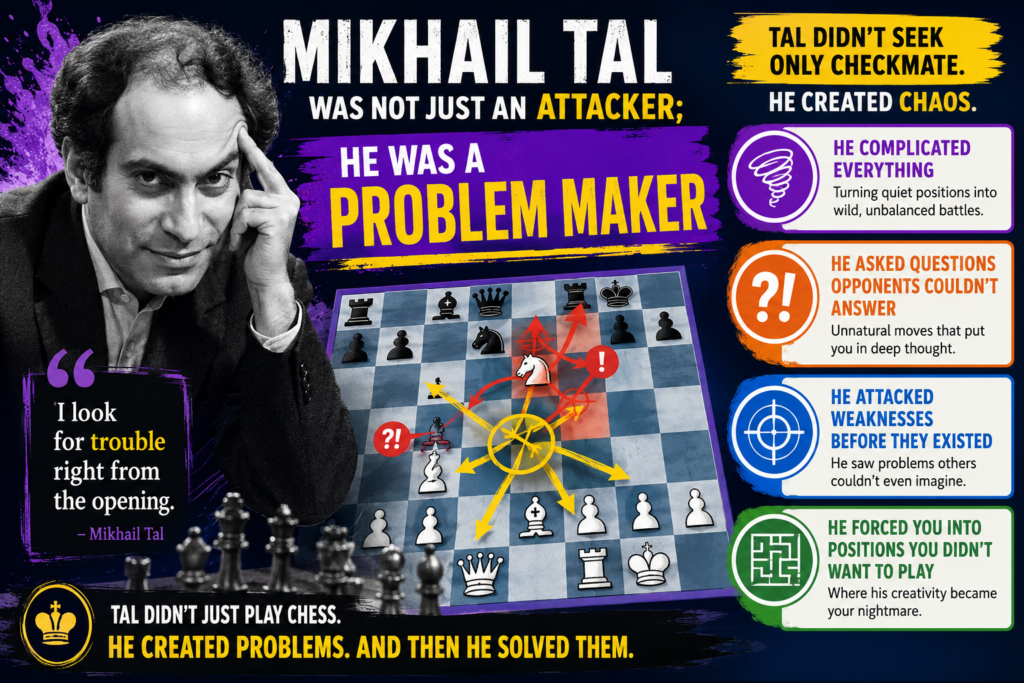
Mikhail Tal was not just an attacker; he was a problem maker
Mikhail Tal did not play chess like most people. Many players look for the safest move. Tal looked for the move that made his opponent feel lost.
That is why his games still feel fresh today. You may know the result. You may even know the move. But when you see the sacrifice, your mind still says, “Wait, how can that work?”
Tal’s attacks were not only about giving up pieces. That is the mistake many young players make when they first study him. They see a knight jump into danger, a rook disappear, or a bishop get traded for two pawns, and they think, “Tal just played wild chess.” But that is not the full truth.
Tal was wild, yes. But he was not random.
He gave up material to get something more useful. He wanted open lines. He wanted quick moves. He wanted the enemy king to feel unsafe. He wanted his opponent to face hard choices again and again. In simple words, Tal was not just making moves. He was making problems.
Find the right learning experience
Tell us a little about the learner and what you are looking for. Our team will review your answers and help you identify the most suitable next step.
- Takes only a few minutes
- No payment required
- Personalised recommendations
Your information will only be used to respond to your enquiry.
Tal’s attacks looked scary because the defender had to be perfect
In normal chess, one small mistake may only cost a pawn. Against Tal, one small mistake could end the game. That is what made him so hard to face. His sacrifices often pushed the game into positions where the defender had no calm path.
Imagine being a child in a tournament. You are already a little nervous. Then your opponent gives up a piece near your king. You count and see you are ahead. That feels good for one second. Then you notice your king has no safe square.
Your pieces are not helping. Your clock is ticking. Suddenly, being ahead in material does not feel so nice.
That was Tal’s world.
He knew that chess is not played only on the board. It is also played in the mind. A move can be strong because it is hard to answer. A sacrifice can be strong because it gives the other player too many choices, and every choice looks risky.
This is one reason Tal became known as the “Wizard from Riga,” a nickname tied to his sharp, creative style and love for sacrifices.
The first Debsie lesson from Tal is to make your opponent uncomfortable
For young players, this does not mean they should throw pieces away. It means they should learn to ask better questions during a game.
What does my opponent want? What move would stop that plan? Where is the king weak? Which piece is not helping? Can I make a threat that also improves my position? These are simple questions, but they build strong thinking.
This is the kind of thinking Debsie helps students grow. A child does not become brave at chess by guessing. A child becomes brave when a coach shows them what to look for. Then the child starts to see patterns.
They notice weak squares. They see open files. They feel when a king is in danger. That is when chess becomes exciting.
Tal teaches us that attack is not noise. Attack is pressure with a purpose.
When students learn this, they also learn something bigger than chess. They learn not to panic when things look messy. They learn to stay focused when there is no easy answer. They learn that courage works best when it is joined with clear thinking.
That is why Tal’s games are perfect for kids who want to grow. His chess is fun, but it also trains the mind to be alert, bold, and patient.
Tal’s fast rise shows why bold chess still needs strong roots
Tal’s story is not only about brilliant sacrifices. It is also about growth. He was born in Riga, Latvia, in 1936, and later became one of the most famous players in chess history. Britannica notes that he learned chess at age six, and by 1960 he had beaten Mikhail Botvinnik to become world champion at just 23 years old.

That sounds like magic. But magic in chess usually has years of work behind it.
Tal’s rise was fast, but it was not empty. He studied. He played serious games. He learned from strong players. He tested his ideas in hard events. The FIDE museum says he went from master to world champion in only three years, after winning the 1959 Candidates Tournament and then defeating Botvinnik in Moscow by 12½ to 8½.
This is important for parents to understand. Great chess does not come from talent alone. Talent may open the door. Good training helps a child walk through it.
His 1960 match with Botvinnik was a battle between control and fire
Botvinnik was not an easy target. He was serious, deep, and very well prepared. He liked order. He liked clear plans. He liked positions where logic could slowly squeeze the other player. Tal was different. He wanted movement. He wanted danger. He wanted the board to become alive.
That is why their 1960 match is still so famous. It was not just one strong player beating another. It was a clash of two ways to think.
Botvinnik trusted structure. Tal trusted activity. Botvinnik wanted to prove that every move had to be correct. Tal wanted to prove that some positions are so hard to defend that “correct” is not easy to find at the board.
The match showed that attack can beat control when the attacker keeps asking strong questions. Tal won the match clearly. He scored six wins, thirteen draws, and two losses, taking the title by four points.
But here is the key lesson. Tal did not win because he attacked every move. He won because he chose moments when activity mattered more than material. He understood that in some positions, a fast attack is worth more than a quiet pawn. He knew when to change the speed of the game.
The Debsie takeaway is that children need both courage and control
A young player should not copy Tal by making random sacrifices. That is like trying to drive fast before learning how to steer. The real lesson is deeper.
Children should first learn the basics well. They need to understand piece safety, king safety, center control, simple tactics, and endgames. Once those roots are strong, they can start to play with more freedom.
This is where guided learning matters. In a Debsie class, a coach can show a student why one sacrifice works and another one fails. That small difference matters a lot. A child may see two moves that look the same. One is brilliant. The other loses. A good coach helps the student see the hidden details.
That is how brave chess becomes smart chess.
Tal’s life also shows kids that fast growth is possible when love for the game meets steady training. A child who enjoys chess will practice more. A child who gets support will stay with the game longer. A child who learns from mistakes will not fear hard positions.
That is the real gift of chess. It teaches kids how to think when the answer is not obvious.
A Tal sacrifice was not a gift; it was a trade for time, space, and fear
When people hear the word “sacrifice,” they often think it means giving something away. In Tal’s games, that is not quite right. Tal was not giving gifts. He was making trades.
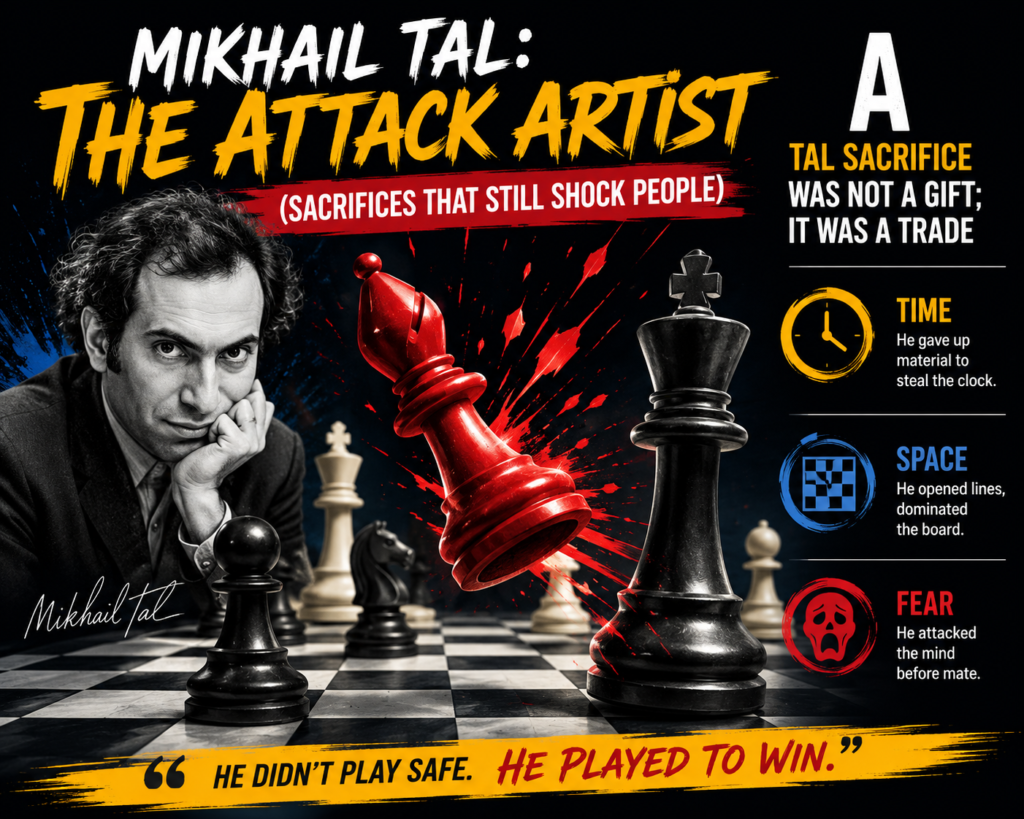
Sometimes he traded a piece for open lines. Sometimes he traded a rook for a trapped king. Sometimes he traded material for quick development. Sometimes he traded a calm position for a storm where he felt at home.
This is why his games still shock people. The first move looks impossible. But after a few more moves, you see the point. His pieces rush forward. The enemy king gets stuck. The defender starts using all their moves just to survive. Then Tal’s “lost” material does not matter as much.
Chess is full of hidden value. A rook is worth more than a bishop in many positions. But a rook sitting in the corner may be useless during an attack. A knight close to the king may become stronger than a rook far away. Tal understood this better than almost anyone.
His famous Game 6 against Botvinnik shows how pressure can beat comfort
One of Tal’s most famous games came in the 1960 World Championship match against Botvinnik. In Game 6, Tal played a bold knight sacrifice that became one of the best-known moments of his career.
Reports about the game often mention that the crowd became so loud and excited that the game had to be moved to a back room.
Think about that for a moment. Chess is usually quiet. But Tal’s play made people react like they were watching a live drama.
The sacrifice was not clean in the way a simple puzzle is clean. That is part of its power. Tal created a position where Botvinnik, one of the best defenders in history, had to solve too many hard problems. Tal did not need the attack to be easy. He needed it to be hard enough that even a great player could go wrong.
This is a very important lesson for students. In real games, you do not always need a forced checkmate. Sometimes you need to create pressure. You need to make threats. You need to improve your worst piece. You need to make your opponent spend time and energy.
Find the right learning experience
Tell us a little about the learner and what you are looking for. Our team will review your answers and help you identify the most suitable next step.
- Takes only a few minutes
- No payment required
- Personalised recommendations
Your information will only be used to respond to your enquiry.
A practical way for kids to study Tal is to pause before the sacrifice
When a student studies Tal, they should not rush through the moves. The best way is to stop right before the sacrifice and ask what Tal may have seen.
Where is the king? Which defender is pinned? Which piece can join the attack next? What happens if the opponent takes the piece? What happens if they refuse it? Is there a check, capture, or threat after the sacrifice?
These questions turn a famous game into a real lesson.
Parents can also use Tal’s games to help children build patience. That may sound strange because Tal played fast, sharp chess. But to understand his attacks, a child must slow down. They must look carefully. They must compare moves. They must learn not to grab material without checking danger first.
That skill helps far beyond chess.
A child who learns to pause before taking a piece also learns to pause before making a rushed choice in life. A child who learns to check danger on the board also learns to think before acting. A child who studies attacks also learns that smart courage is better than blind courage.
This is why Debsie uses chess as more than a game. Chess becomes a safe place for kids to practice focus, patience, and brave thinking. Tal’s games make that practice exciting because they are full of surprise.
Tal’s best attacks started before the sacrifice appeared on the board
Many players only notice Tal when the sacrifice happens. That is the loud moment. That is the move people share, study, and remember. But the real work often starts earlier.
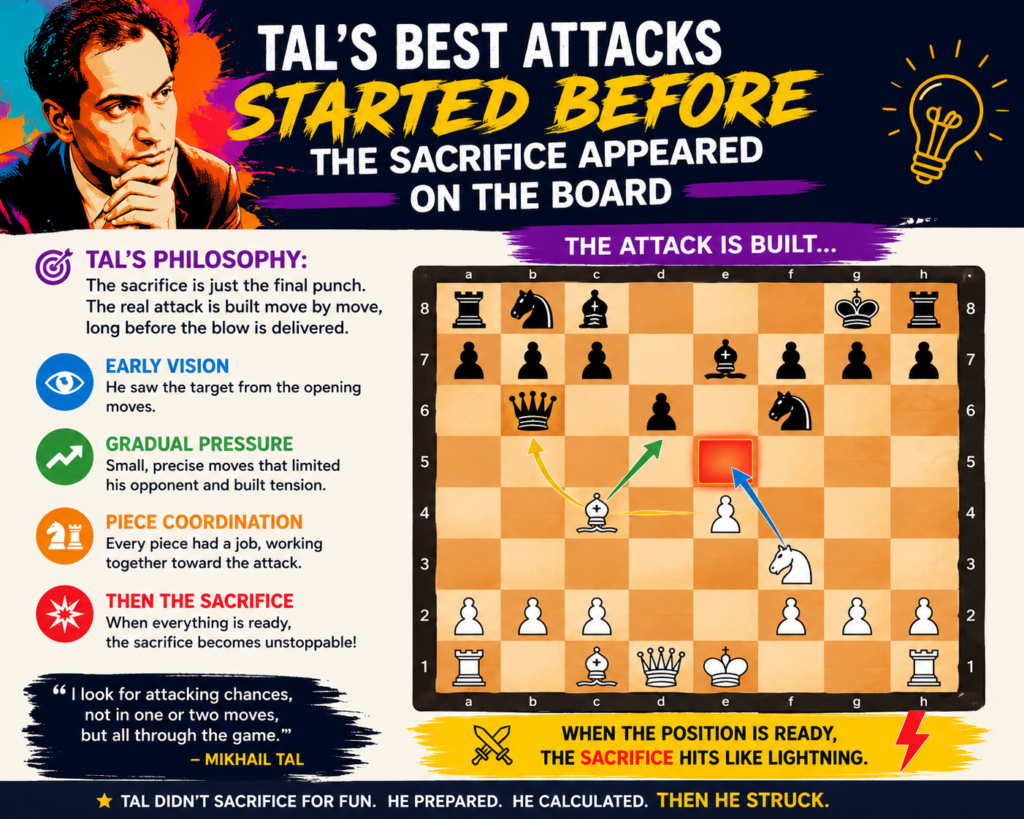
Before Tal gave up material, he usually had pieces ready to attack. His queen was close. His rooks had open lines. His bishops looked at soft squares. His knights were near the king. The opponent’s pieces were often slow, tied down, or placed badly.
That is the hidden part of attacking chess.
A sacrifice is rarely the start of an attack. Most of the time, it is the result of good build-up.
Young players should learn to prepare the storm before starting it
This is where many children go wrong. They see a sacrifice in a master game and want to copy it right away. But if their pieces are not ready, the sacrifice fails. The king escapes. The attack ends. The child feels sad and thinks attacking chess is too hard.
The fix is simple, but it takes practice.
Before attacking, bring more pieces into the game. Do not attack with only the queen. Do not move the same piece again and again without a reason. Do not open the center if your king is the one in danger. Do not sacrifice just because it looks cool.
Tal’s attacks looked like fire, but the pieces behind the fire were working together.
This is the kind of idea a child can learn in a step-by-step class. At Debsie, a coach can show the student how to build an attack before trying to finish it. That makes the student stronger and more confident.
The best Tal-style question is simple: who has more pieces near the king?
This one question can save many games.
Before a child sacrifices, they should count attackers and defenders. If three pieces are attacking and only one piece is defending, the attack may be strong. If only the queen is attacking and the opponent has three defenders, the attack may be fake.
Tal could break this rule because he saw very deep. But most students should first learn the rule before trying to bend it.
That is not boring. That is how real skill grows.
When students understand why attacks work, they enjoy chess more. They stop guessing. They start planning. They feel proud when they find a tactic because they know what caused it.
Tal’s sacrifices still shock people because they look like magic. But when you study them slowly, you see the craft behind the magic. You see brave choices. You see active pieces. You see pressure. You see a player who trusted his ideas because he had trained his mind to see what others missed.
That is the heart of attacking chess.
Tal understood that the player with the attack often controls the story
When Tal attacked, he was not only chasing checkmate. He was changing the whole story of the game.
Before the sacrifice, the position might look normal. After the sacrifice, the defender had to answer Tal’s questions. That is a huge shift. The defender could no longer think, “What plan do I want?” Instead, they had to think, “How do I survive?”
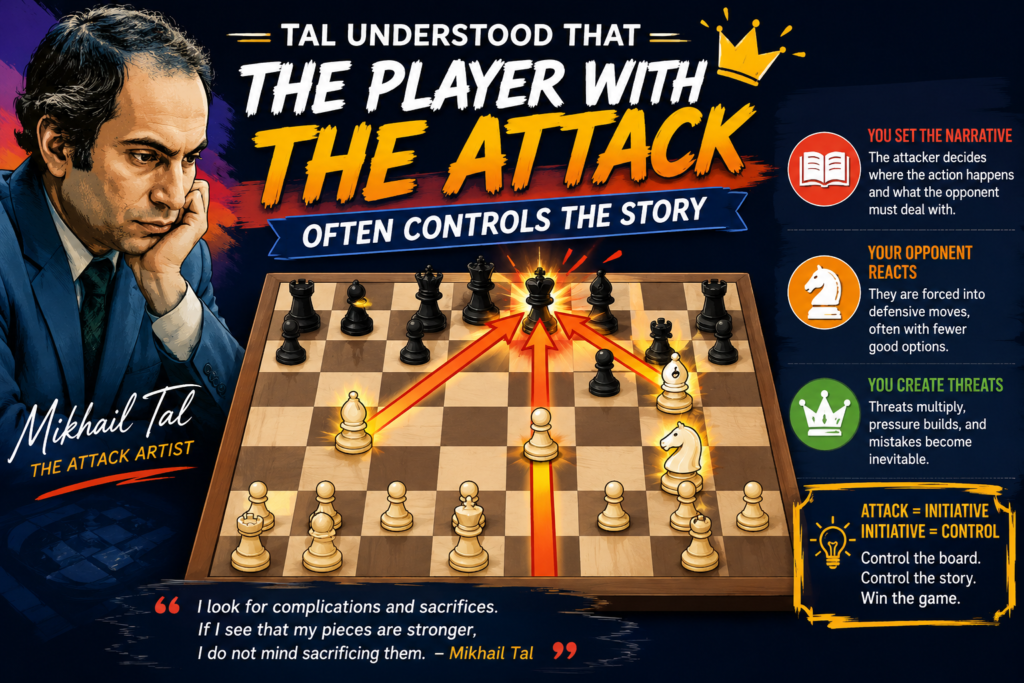
That is the power of the initiative.
The initiative means you are making threats that your opponent must answer. It does not always mean you are winning. It does not always mean you have more pieces. It means your moves have force. Your opponent is reacting. You are leading.
Tal loved this kind of chess. FIDE’s museum describes him as a player known for sacrifices and the fight for the initiative, which is a perfect way to understand his style. He did not attack just because he liked danger. He attacked because danger gave him control.
The initiative can be worth more than a pawn, a piece, or even a rook
Many young players count material and stop there. They say, “I am up a knight, so I am winning,” or “I am down a rook, so I am losing.” But Tal’s games show that material is only one part of chess.
A player can be ahead in material and still be in deep trouble. Their king may be open. Their pieces may be far away. Their queen may be stuck defending. Their moves may all be forced. In that kind of position, the extra piece may not help at all.
This is why Tal’s sacrifices looked so strange to many people. He would give up something real, like a knight or bishop, for something that could not be held in the hand. He wanted time. He wanted open lines. He wanted a king that could not rest. He wanted the next move to come with pressure.
That is hard to teach by only saying, “A knight is worth three points.” Points are helpful for beginners. But chess is alive. A sleeping rook is not the same as an active rook. A knight near the enemy king is not the same as a knight trapped on the edge. Tal knew this with his whole heart.
A simple way to teach initiative is to ask who is making the threats
A child can understand initiative with one simple question: who is asking the questions right now?
If your move attacks the queen, threatens checkmate, opens a file, or brings another piece into attack, your opponent may have to answer you. If your opponent is always answering, you may have the initiative.
But there is a warning. The initiative is not a toy. If a child attacks without support, the attack may vanish. Then the lost material will matter. That is why Tal is not a model for random chess. He is a model for brave chess backed by sharp eyes.
At Debsie, this is a beautiful lesson for students. Coaches can show children how to spot active pieces, weak kings, and forced moves. Then the child learns that attack is not about being loud. It is about being clear.
Parents often want their children to become more focused and more confident. Chess does that in a very natural way. When a child learns to take the initiative, they also learn to take action in life. They learn not to wait forever. They learn to look at the facts, trust their training, and make a strong move.
That is why Tal is such a strong hero for young players. He teaches courage, but he also teaches responsibility. A brave move must still have a reason.
Tal’s sacrifices worked because he made the board hard to understand
Tal did not always look for simple positions. In fact, he often wanted the opposite. He wanted positions where normal rules became blurry. He wanted places where the defender could not solve the puzzle in a calm way.
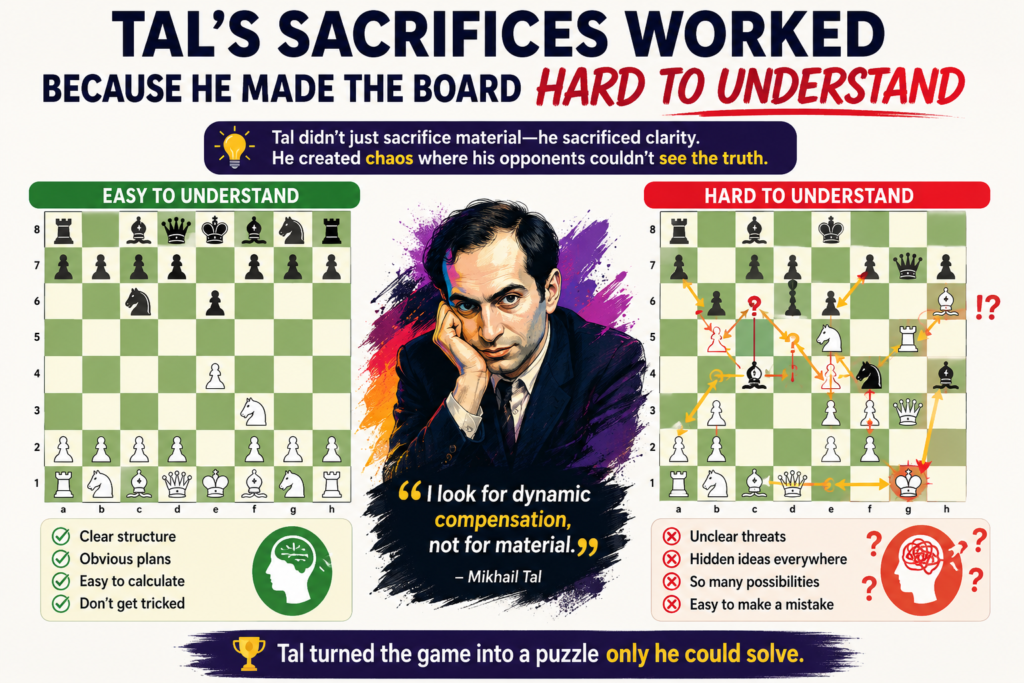
This is one of the reasons his games are so fun to study. Some champions teach us how to build a quiet edge. Tal teaches us how to create confusion with purpose. He could turn a balanced game into a wild fight where both players had chances, but only one player felt truly at home.
A famous line often linked to Tal says that you should take your opponent into a dark forest where normal math no longer works and only one person can find the way out. Wikiquote notes that this quote is widely attributed to Tal, though no original source is known. Even with that caution, the idea fits his chess very well.
Confusion is dangerous only when you understand it better than your opponent
Many children confuse Tal’s style with guessing. That is a big mistake. Tal did not just make the game messy and hope. He created mess that favored his pieces.
That is the key.
If your opponent’s king is weak, a messy position may help you. If your pieces are active and your opponent’s pieces are asleep, a messy position may help you. If you know the attacking pattern and your opponent does not, a messy position may help you.
But if your own king is weak, your pieces are not ready, and you have no follow-up, then mess will hurt you. A sacrifice without a second move is usually not a sacrifice. It is just a lost piece.
Tal understood the second move, the third move, and the feeling of the position. He knew that defenders often fail when every move looks scary. He also knew that human beings are not computers. A move can be powerful because it gives the opponent too much to solve.
This is why Tal’s chess still matters in a world full of engines. Computers may find the best defense later. But real players must defend at the board, under time pressure, with nerves, fear, and doubt.
The student lesson is to create hard choices, not cheap tricks
A cheap trick hopes the opponent does not see something simple. A real attack creates problems even when the opponent sees the idea.
That difference matters a lot.
When a young player sets a one-move trap, they may win today, but they do not grow much. When they learn to build pressure, place pieces well, and force tough choices, they become stronger for life.
Tal’s games help students see this difference. His best attacks were not little tricks. They were deep tests. The defender had to find accurate moves again and again. One wrong step could open the door to a winning attack.
This is also a wonderful lesson for parents who want more than chess trophies. A child who learns to create plans learns to think ahead. A child who learns to handle unclear positions becomes calmer under stress. A child who learns that not every answer is easy becomes more patient.
That is why Debsie’s guided lessons can be so powerful. A coach can take a famous Tal position and slow it down. The child gets to ask, “What is the threat? What is the defense? What happens if I take? What happens if I run?” That turns a wild masterpiece into a clear thinking lesson.
Tal made the board hard to understand. But he did it with purpose. That is the part every student should learn.
Tal’s attacking rules were simple to feel, even when the moves were hard to find
A Tal game can look like a thunderstorm. Pieces fly across the board. Pawns break open lines. Kings get dragged into danger. At first, it can feel too hard for a young student.
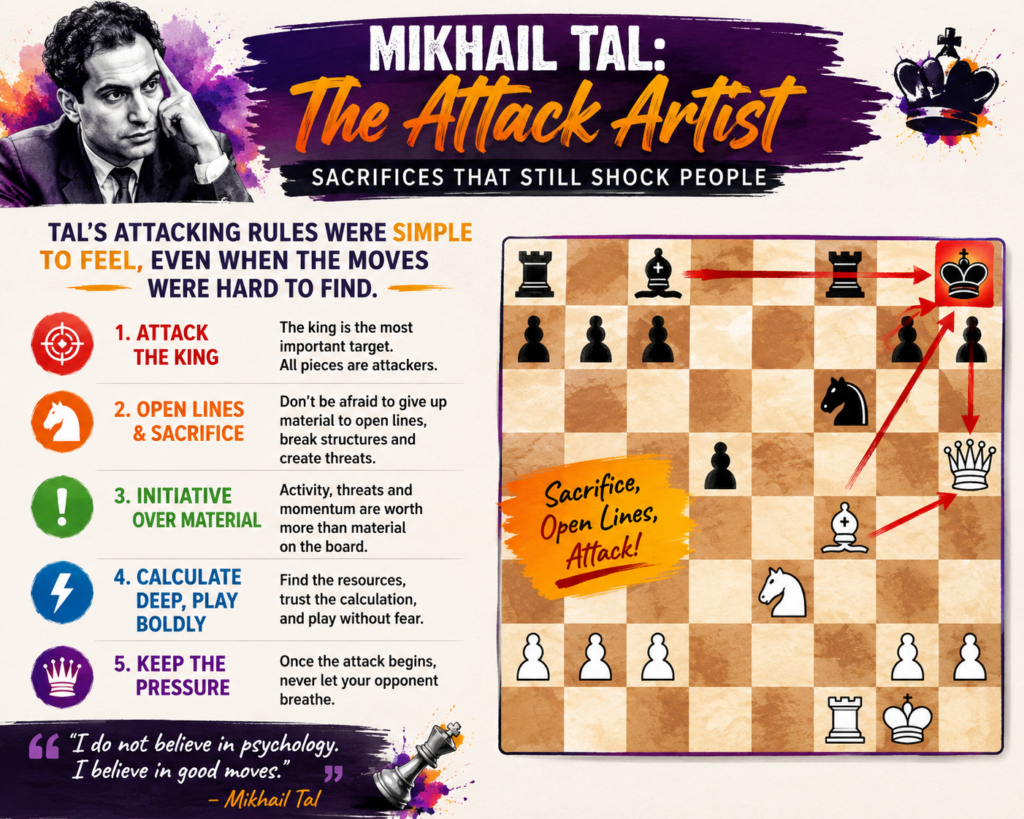
But under the storm, there are simple ideas.
Tal often attacked when the enemy king was stuck, when the defenders were too slow, when his pieces had open paths, and when every move came with a threat. Those ideas are not too hard for children. They just need to be taught in a clear and patient way.
Britannica describes Tal as a grandmaster known for complex and bold moves, and that is true. But bold does not mean impossible to understand. It means the move asks us to look deeper than the surface.
The first real attacking skill is learning when not to attack
This may sound strange in an article about Tal, but it is true. A strong attacker must know when the attack is ready.
If a child attacks too early, the opponent may defend and win the extra piece. If a child waits too long, the chance may disappear. The skill is timing.
Before starting a Tal-style attack, the student should look at the king first. Is it castled? Are the pawns around it weak? Are there open lines nearby? Can a knight jump close to it? Can the queen join safely?
Then the student should look at their own pieces. Are they ready to help? Is the rook still sleeping in the corner? Is the bishop blocked by pawns? Is the queen too far away? A real attack needs helpers.
Finally, the student should look at the defender’s pieces. Are they far from the king? Are they pinned? Are they overloaded? Are they protecting too many things at once?
This is how Tal-style chess becomes teachable. You do not tell a child, “Just sacrifice.” You teach them to read the board.
A strong sacrifice should answer the quiet question: what do I get back?
Every sacrifice needs an answer to this question.
What do I get back?
The answer may be checkmate. That is easy to see. But often the answer is not mate right away. The answer may be two open files. It may be a trapped king. It may be a strong passed pawn. It may be a lead in development. It may be a position where the opponent has only one safe move, and that move is hard to find.
Tal was famous because he understood these hidden returns. He gave up material, but he got pressure. He gave up safety, but he got activity. He gave up a piece, but he got the attack.
This is a great way for Debsie students to study chess. After a sacrifice, they can ask what changed. Did a file open? Did a defender disappear? Did the king lose a safe square? Did a new threat appear?
That kind of study builds real skill. It helps a child stop playing hope chess. Hope chess says, “Maybe my opponent will miss it.” Strong chess says, “Even if my opponent sees it, they still have a hard job.”
Tal’s sacrifices were shocking because they felt risky. But behind the risk, there was a clear attacking idea. That is what made him great. Not the courage alone, but the courage plus the idea.
Tal’s games are perfect training for children because they make thinking exciting
Some chess lessons feel slow. Tal’s games do not. They pull students in. A child sees a knight jump into danger and wants to know what happens next. A queen moves close to the king and the child leans forward. A rook is offered, and suddenly the board feels like a story.
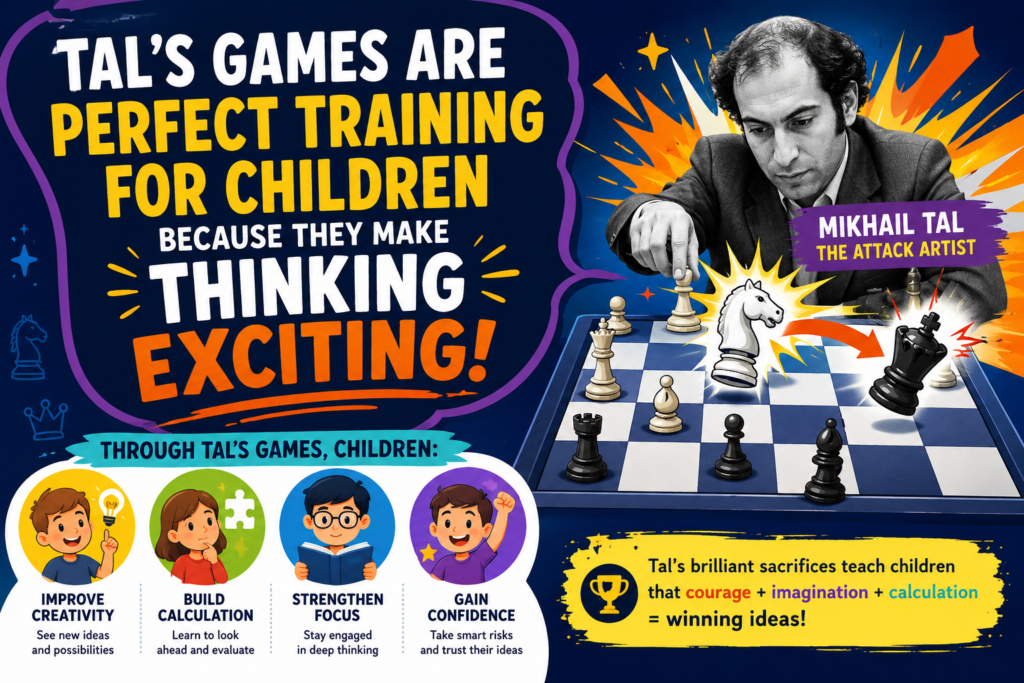
That excitement matters.
Children learn better when they care. They remember ideas when the lesson feels alive. Tal’s games are full of moments that make students curious. And curiosity is one of the best doors into deep learning.
Tal became world champion in 1960 after defeating Botvinnik in Moscow by 12½ to 8½, after winning the 1959 Candidates Tournament. That fast rise is one reason his story still captures young minds.
A good coach can turn Tal’s wild games into calm lessons
A parent may look at a Tal game and think, “This is too advanced for my child.” That can be true if the child studies alone. But with the right coach, even a wild game can become simple.
The coach does not need to show every variation. The coach can focus on one idea at a time. One lesson may be about open lines. Another may be about weak kings. Another may be about counting attackers and defenders. Another may be about not grabbing material too fast.
This is how big chess ideas become child-friendly.
At Debsie, the goal is not to make every child play exactly like Tal. The goal is to help each child become a sharper thinker. Some students will love attacking chess. Some will prefer calm positions. Some will enjoy tactics. Some will enjoy planning. Good coaching helps each child find their own chess voice.
But every child can learn something from Tal.
They can learn courage. They can learn focus. They can learn to look past the first move. They can learn that mistakes are part of growth. They can learn that hard positions are not something to fear.
Tal shows kids that bold thinking can be trained, not just born
Many people talk about Tal like he was pure magic. That makes a nice story, but it can also make children feel like great chess is only for special people.
That is not the message we want.
The better message is this: bold thinking can be trained.
A child can learn attacking patterns. A child can learn to spot weak squares. A child can learn to pause before taking a piece. A child can learn how to use every piece in an attack. A child can learn how to stay calm when the board looks messy.
That is why a free trial class at Debsie can be such a helpful first step. A student gets to feel what guided chess learning is like. Parents get to see how chess can build focus, patience, confidence, and smart decision-making. The child does not just memorize moves. They learn how to think.
Tal’s games still shock people because they show what chess can be at its most exciting. But they also show something deeper. When a player trusts their ideas, keeps asking strong questions, and uses every piece with purpose, the board can change very fast.
Tal shows us that a sacrifice starts with a question, not with a guess
Many people see Tal’s games and think the main lesson is simple: be brave. But that is only half true.
Tal was brave, yes. But his brave moves were tied to questions. Before he gave up a piece, he seemed to ask, “Can my opponent really take this?” Then he asked, “If they take it, where will their king go?” Then he asked, “Which of my pieces can join the fight next?”

This is why his sacrifices still shock people. The first move looks like madness. Then, move by move, the danger becomes clear. The defender may have extra material, but they also have a king with no peace, pieces that cannot move freely, and threats coming from every side.
Tal’s famous 1960 match against Botvinnik is a perfect example of this. He won the world title in Moscow by a score of 12½ to 8½, and his attacking style made that match one of the most talked-about clashes in chess history.
FIDE’s museum says Tal earned the name “The Wizard from Riga” because of his sacrifices and his fight for the initiative.
A good sacrifice should make the other player’s next move painful
The best sacrifices are not just pretty. They are hard to answer. Tal understood this deeply. He did not always need a clear checkmate right away. What he often wanted was a position where every defensive move had a problem.
If the opponent takes the piece, the king may open. If the opponent refuses the piece, Tal may get another attacking move. If the opponent tries to trade queens, the trade may not be possible. If the opponent runs with the king, the escape squares may already be covered.
That is what makes a sacrifice strong. It does not ask only one question. It asks many questions at once.
This is a very helpful lesson for young chess players. Before making a sacrifice, a student should not only ask, “Can I win?” That question is too big. A better question is, “What hard problem am I giving my opponent?” This makes the child think clearly instead of playing by hope.
At Debsie, children can learn to test brave ideas before playing them
Tal’s style is exciting, but it needs guidance. A child may look at one of his games and want to sacrifice right away in their next tournament. That is natural. The games are thrilling. But a good coach helps the child slow down and test the idea first.
In a Debsie class, a student can learn to check the simple signs. Is the enemy king weak? Are more pieces ready to attack? Is there a forcing move after the sacrifice? Can the opponent calmly give the piece back and stop the attack? These questions turn wild ideas into smart ideas.
This is also where chess starts helping a child in daily life. The child learns that courage is not the same as rushing. They learn to pause, think, and then act with purpose. That small habit can help in school, in choices, and in hard moments.
Tal teaches a beautiful truth: bold moves become powerful when they are backed by clear thought.
Tal’s attacks were built on pieces that worked like a team
A Tal attack did not happen because one piece was doing all the work. It happened because many pieces joined the same mission. His queen, rooks, bishops, knights, and pawns often seemed to move toward one target together. That target was usually the king.
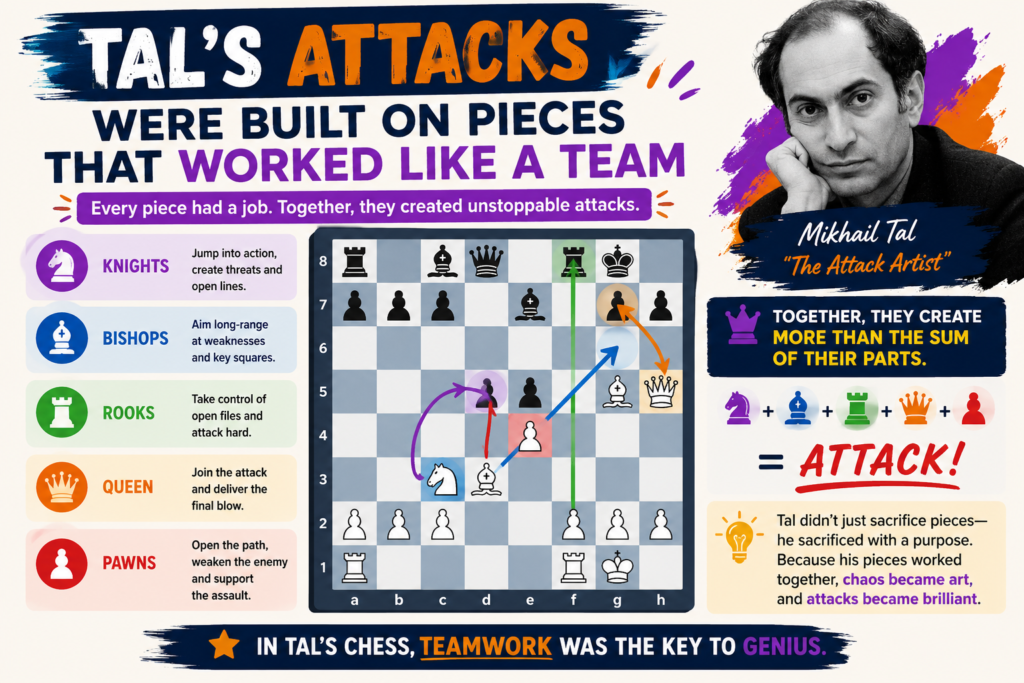
This is one of the biggest lessons in attacking chess. A queen alone may scare the opponent for a moment, but it cannot usually win by itself. A rook alone may look active, but it needs help. A knight near the king can be dangerous, but it becomes much stronger when the queen and bishop are also nearby.
Tal knew how to make his pieces talk to each other. That is why his attacks felt so fast. It was not because each move was random. It was because each move added another voice to the same song.
Britannica describes Tal as a player known for complex and bold moves. That is true, but those bold moves often worked because his pieces were active and ready before the attack broke open.
The quiet move before the sacrifice is often the move that matters most
When people study attacking games, they often jump to the sacrifice. They want the fireworks. But the move before the fireworks may be even more important.
Maybe Tal moved a rook to an open file. Maybe he placed a knight closer to the king. Maybe he pushed a pawn to remove a defender. Maybe he stopped the opponent from castling. Maybe he made a small move that gave his queen a path into the attack.
These moves may not look famous. They may not get shared in chess videos. But without them, the sacrifice may not work.
This is a key point for students. If they want to attack better, they must not only hunt for tactics. They must improve their pieces. A piece that is doing nothing should be invited into the game. A rook stuck in the corner should find an open file. A bishop blocked by pawns should look for a better path.
Strong attacks are built before they are seen.
A child can ask one simple team question before starting an attack
Before launching an attack, a child can ask, “Which of my pieces is not helping yet?”
This question is simple, but it is very strong. It stops a student from attacking too early. It reminds them that chess is a team game. It also teaches patience. Sometimes the best attacking move is not a check. It is a quiet move that brings one more piece closer.
This is the kind of thinking that Debsie coaches can help children build step by step. Instead of telling a student to memorize one famous game, a coach can help the student see the pattern behind the game. That is how the child starts to grow on their own.
Parents love chess because it teaches focus. Tal’s games do that in a fun way. A child must pay attention to every piece. They must notice small changes. They must understand that one move can help the next move.
That is also a life skill. Big results often come from small, smart steps done in the right order.
Tal knew that king safety is not a small detail; it is the heart of the game
In many Tal games, the whole fight came down to one thing: whose king was safer? If the enemy king was stuck in the center, Tal tried to open the board. If the king had weak pawns around it, Tal aimed his pieces there. If the king had no easy escape, he searched for a way to bring more force.
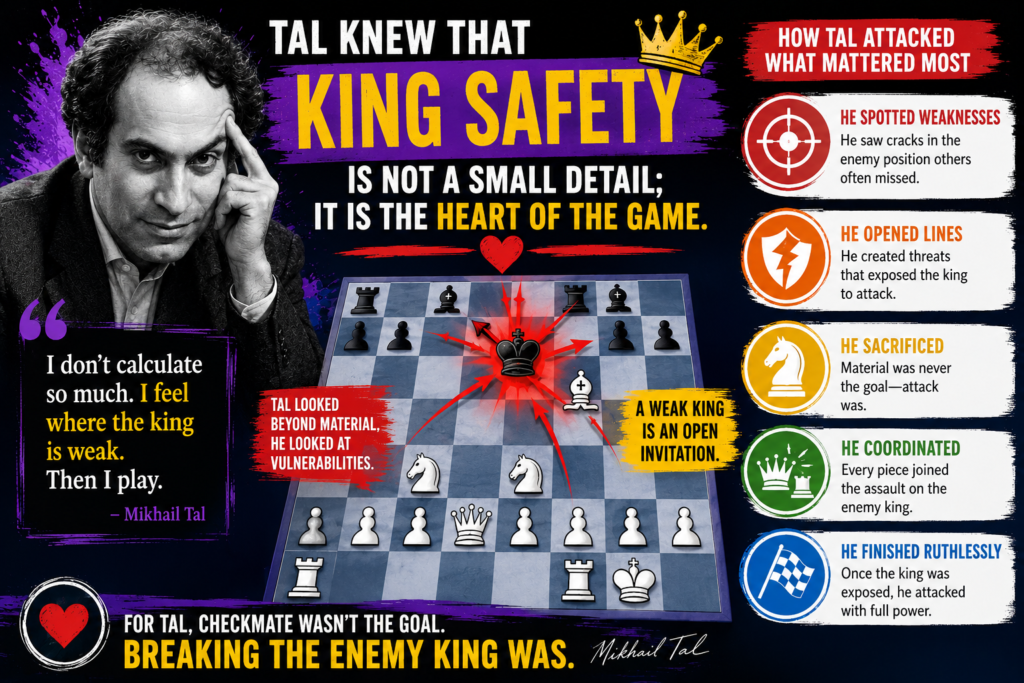
This is why Tal’s sacrifices were so dangerous. He was not only attacking pieces. He was attacking the king’s comfort. Once a king feels unsafe, the rest of the army can become weak too. Pieces that wanted to attack must come back to defend.
Rooks that wanted open files must guard squares. The queen may get tied down. The whole position can become heavy.
In Game 6 of the 1960 World Championship match, Tal’s famous knight sacrifice helped create a storm of problems for Botvinnik. The Guardian later described that game as the artistic high point of Tal’s career and noted that the excited audience was said to be so noisy that the game had to be moved to a back room.
A weak king can make normal piece values less important
Beginners often learn that a queen is worth nine points, a rook is worth five, and a knight or bishop is worth three. That is useful. But Tal’s games show why those numbers are not the whole story.
A rook may be worth five points, but if it cannot help the king, it may feel useless. A knight may be worth three points, but if it lands near the enemy king with checkmate threats, it may feel like a monster. A pawn may be worth one point, but if it opens a file toward the king, it may become the key to the whole attack.
This does not mean children should ignore material. Material matters. But king safety can change everything. When a king is weak, time becomes more important. Open lines become more important. Checks become more important. The next move may matter more than the extra piece.
That is why Tal’s games are so rich. They help students see that chess is not just counting. Chess is also judging danger.
A safe king gives a child the courage to play active chess
One of the best ways for children to attack better is to first keep their own king safe. This may sound basic, but it is powerful. A child who castles on time, connects the rooks, and does not open lines near their own king too early will often have more freedom to attack later.
Tal could create wild positions because he understood the danger. He knew when the opponent’s king was weaker than his own. He knew when the attack was worth the risk.
At Debsie, students can learn this balance in a clear way. They can learn that attacking chess is not only about going forward. It is also about making sure your own home is not falling apart.
This helps children become more steady players. They stop making attacks that fail in one move. They stop grabbing pawns while their king is open. They learn to look at both sides of the board.
Tal’s games make king safety feel exciting, not boring. The king is not just a piece to protect. It is the heart of the battle.
Tal’s style teaches children how to handle fear at the chessboard
Playing attacking chess can feel scary. A child may see a sacrifice, but then fear arrives. What if it does not work? What if I lose? What if my opponent finds the best move? What if my coach or parent thinks it was a bad idea?
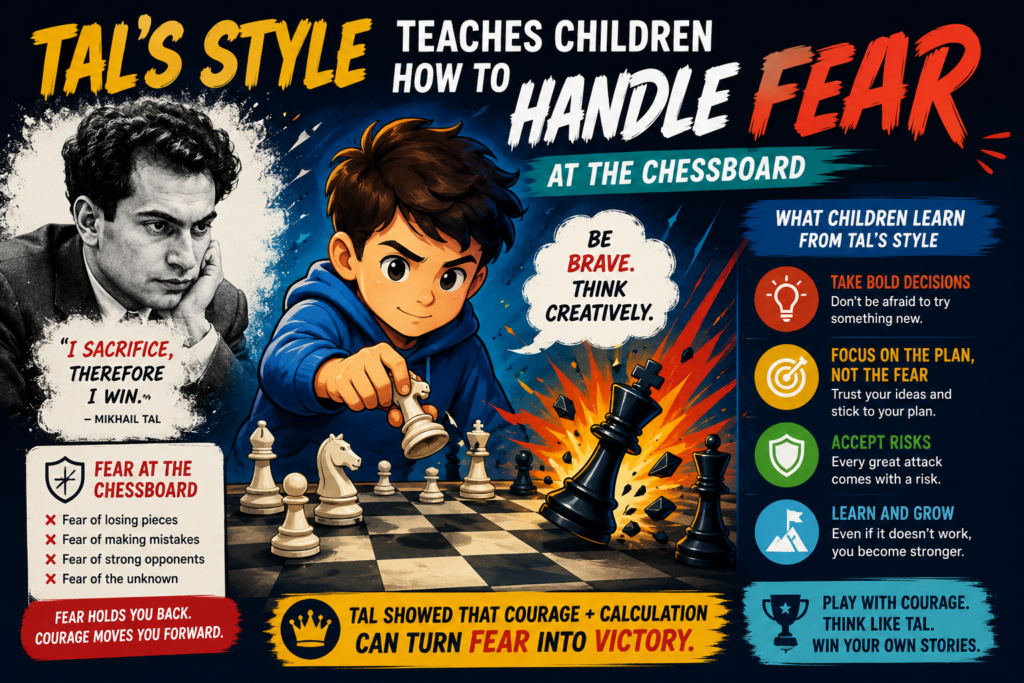
Tal’s games are useful because they show that fear is part of chess. Even great players face unclear moments. The difference is not that strong players feel no fear. The difference is that they have trained their minds to think while fear is present.
Tal did not live a perfect chess life. After winning the world title in 1960, he lost the return match to Botvinnik in 1961. His time as world champion was short, but his impact stayed huge because his games changed how people thought about attacking chess.
A child should not be taught to fear mistakes more than they love learning
This is one reason Tal is such a helpful figure for young players. His games remind children that chess is not only about playing safe. It is about learning to think, test ideas, and grow from the result.
Of course, mistakes matter. A child should review them. A child should learn from them. But if a student becomes too scared to make a move, growth slows down. They may only copy safe moves. They may avoid sharp positions. They may stop trusting their own mind.
Good coaching changes that. A coach can create a safe space where a child can try ideas, see what worked, and understand what failed. Over time, the child becomes braver because the fear of being wrong becomes smaller.
This is very important in chess and in life. Children need chances to think for themselves. They need support when they make mistakes. They need adults who help them learn instead of making them feel small.
Tal’s real gift is not that he makes children reckless; it is that he makes them curious
Curiosity is one of the best things a child can bring to chess. When a student asks, “What happens if I try this?” they begin to think like a problem solver. When they ask, “Why did Tal give up that piece?” they begin to look deeper. When they ask, “Could I use this idea in my own game?” they begin to build their own style.
That is why Tal’s games belong in a child’s chess journey. They are not just old games from the past. They are living lessons. They show how focus, courage, and imagination can work together.
For parents, this is a powerful reason to choose guided chess learning. A child does not need to become the next Tal to gain something great from chess. They can become more patient. They can become more confident. They can learn to think before acting. They can learn to stay calm when the board looks messy.
Debsie helps children build these skills with expert-led online chess lessons, live classes, private coaching, and regular tournaments. A free trial class can be the first step toward helping a child enjoy chess while also growing as a thinker.
Tal teaches students to attack the defenders, not only the king
A young chess player often sees only the big target. They look at the king and say, “I want checkmate.” That is a good start, but it is not enough. Tal looked deeper. He asked a better question. He asked which piece was keeping the king safe.
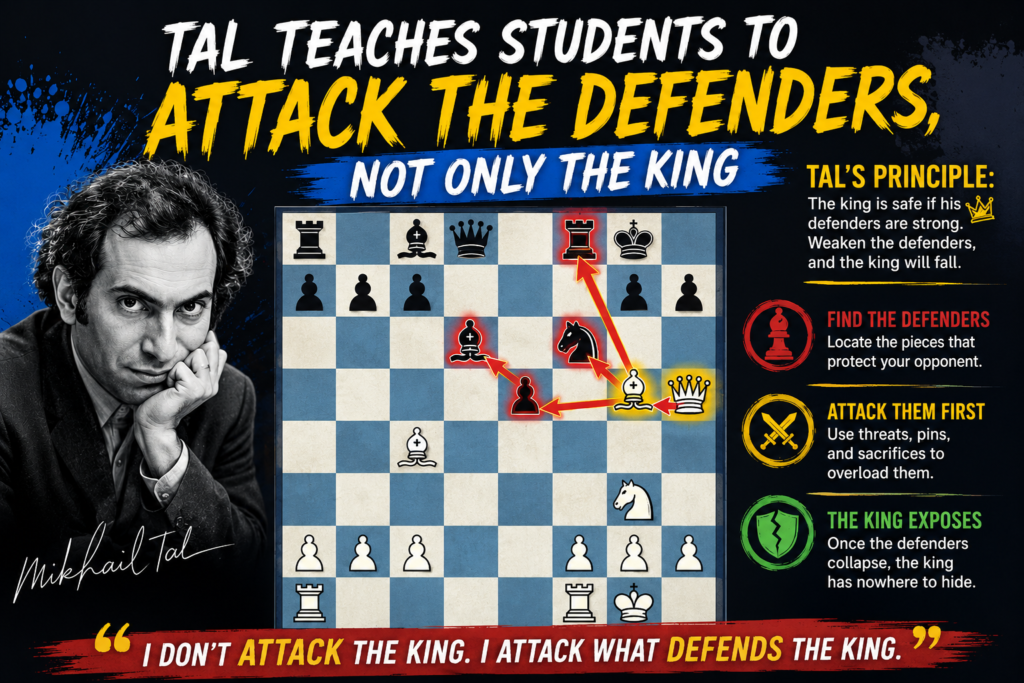
That is one of the secrets behind many strong attacks. The king may look safe because a knight guards a key square. A bishop may protect a weak pawn. A rook may defend the back rank. A queen may cover the only escape square.
When one defender is doing too much work, the attacker can often break the whole position by removing that defender.
Tal’s games are full of this kind of pressure. FIDE describes his style as full of sacrifices and a fight for the initiative, and that matters because initiative often starts when defenders cannot keep up with the threats.
A pinned piece may look strong, but it may not be able to help
One of the first attacking lessons children should learn is that a defender is only useful if it can move or protect something safely. A knight may seem to defend the king, but if it is pinned, it may not really defend.
A bishop may guard a square, but if taking it opens a file, it may be a weak point. A queen may protect everything, but if it is overloaded, one sharp move can make it fail.
This is where Tal was so dangerous. He did not just attack the king. He attacked the pieces around the king. He made them tired. He made them choose. He made one defender handle two jobs, then punished it when it could not do both.
A student can learn this in a very simple way. Before attacking, do not only ask, “Can I give check?” Ask, “What is stopping my checkmate?” That small change makes a big difference. It turns a child from a move hunter into a problem solver.
The Debsie way is to help children see the hidden guards
In a guided class, a coach can freeze a Tal position and ask the student to name the defenders. This is a powerful exercise because children start seeing the board with more care. They learn that every piece has a job. They learn that a sacrifice may work only because one defender is pinned, trapped, or pulled away.
This skill helps students in their own games too. Instead of rushing to attack, they begin to ask better questions. Which piece guards the king? Can I trade it? Can I distract it? Can I make it move away? Can I add one more attacker?
That is how attacking chess becomes clear. It is not about shouting at the board. It is about finding the one piece that holds the house together.
For parents, this is a big reason to let children study great players like Tal with a coach. The game becomes more than entertainment. It becomes training for focus, patience, and smart thinking. A child learns to look beyond what is obvious. That habit can help in school, problem solving, and daily choices.
Tal’s sacrifices were shocking because his timing was so sharp
A sacrifice played too early is often just a mistake. A sacrifice played too late may miss the chance. Tal’s gift was timing. He knew when the position had reached the right point. He felt when the king was weak enough, when the pieces were ready enough, and when the defender was under enough pressure.
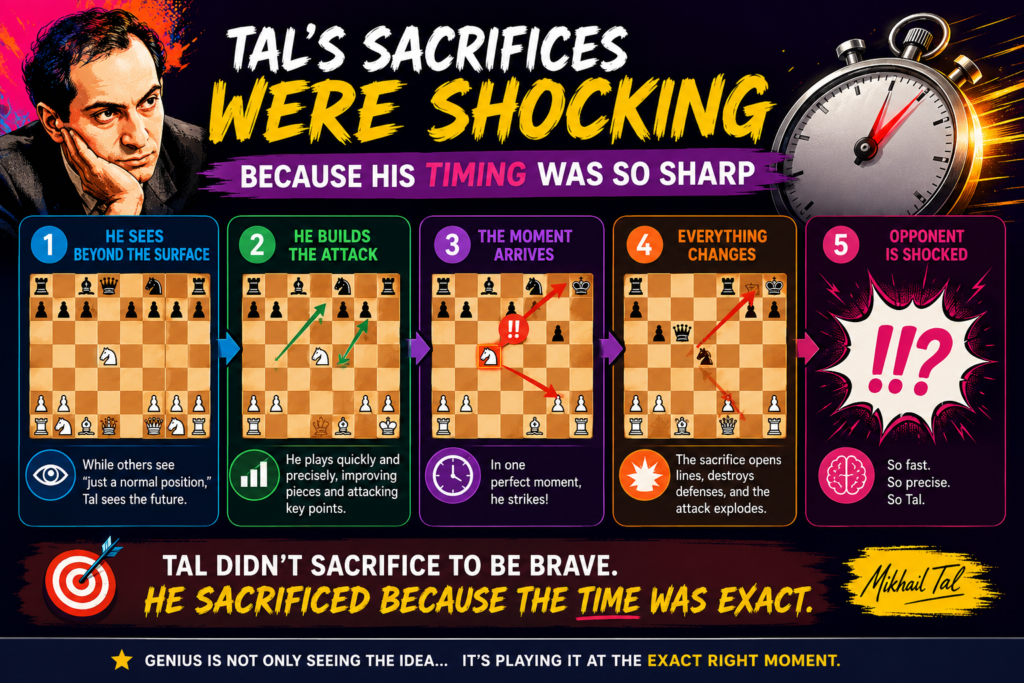
This is why his attacks looked sudden. But the truth is, many of them were not sudden at all. The danger had been growing. Tal simply knew when to open the door.
In the famous sixth game of the 1960 World Championship match, Tal’s knight sacrifice against Botvinnik became one of the most talked-about attacking moments in chess history.
The Guardian described that game as a key artistic moment in Tal’s career, and the excited crowd was said to have become so loud that the game was moved to another room.
The right moment often comes when the defender has no time to breathe
Tal did not wait for the perfect-looking position. If he waited for everything to be safe, the attack might never happen. Instead, he looked for moments when the opponent had no easy move.
This is a useful lesson for students. In chess, there are moments when the board asks you to act. A file opens. A king gets stuck. A defender moves away. A queen becomes loose. A knight lands near the king. These moments may last for one move only.
Children often miss these moments because they are still thinking about material. They see a pawn they can win. They see a piece they can trade. But Tal teaches them to ask, “Is there something more urgent here?” Sometimes the best move is not the safe-looking move.
Sometimes the best move is the move that uses the moment before it disappears.
That is not easy. But it can be trained.
A simple timing test is to ask what happens if you wait
Before playing a sacrifice, a student can ask, “What happens if I do not do it now?” If the opponent can castle, trade queens, bring a defender back, or close the position, then the attacking chance may be urgent. If nothing special changes, the student may have time to improve one more piece.
This is a calm way to teach brave chess. It helps children avoid wild guessing. It also helps them stop playing too slowly when action is needed.
At Debsie, this kind of thinking can be built through live positions and coach-led questions. A coach can show a child the difference between a sacrifice that must be played now and a sacrifice that should wait one more move. That small timing lesson can change many games.
Tal’s timing also teaches a life lesson. Not every chance waits forever. Children learn to prepare well, stay alert, and act when the moment is right. That is a skill they can carry far beyond chess.
Tal’s later career proves that attack was not his only strength
Many people remember Tal only as a young world champion who threw pieces at the king. That picture is exciting, but it is too small. Tal stayed strong for many years because he was more than a fearless attacker.
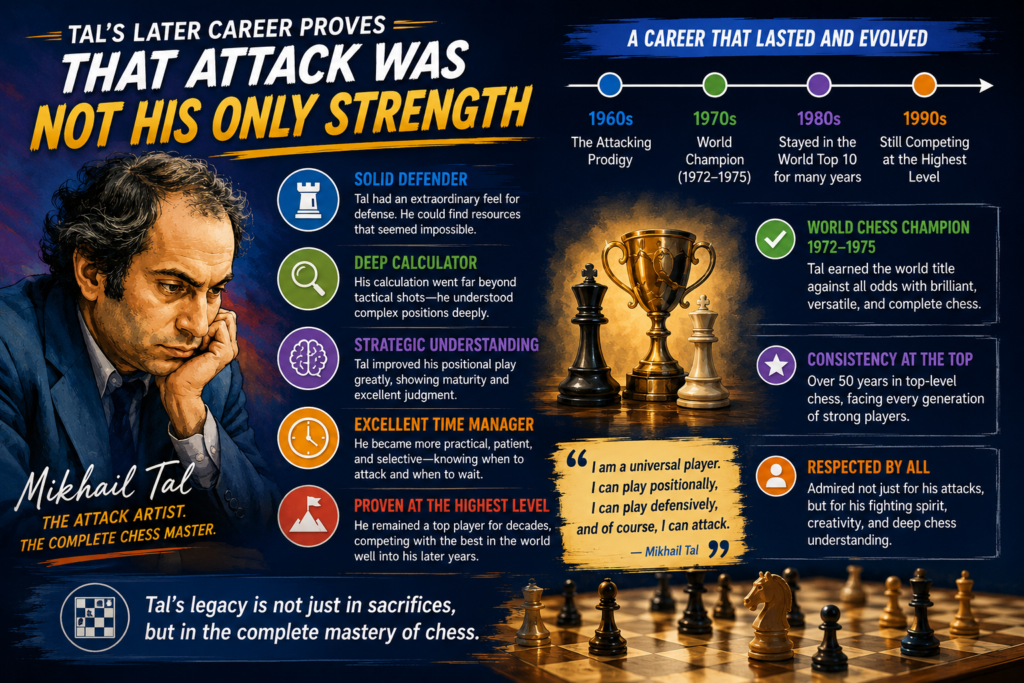
He could defend. He could calculate. He could play endgames. He could handle different kinds of positions.
This matters because children should not think a chess style is a cage. A player may love attacking, but they still need other skills. If a child only knows how to attack, they may feel lost when the position is quiet. If they only know how to defend, they may miss chances to win.
Tal’s best lesson is not to play only one way. His lesson is to play with life, energy, and awareness.
FIDE notes that Tal was a six-time USSR chess champion and that he once held a 95-game unbeaten streak in competitive chess from October 1973 to October 1974. That kind of long unbeaten run does not happen by tricks alone. It shows deep strength, discipline, and control.
A great attacker must also know how to stay solid
This is a very important point for young players. Tal’s sacrifices became famous, but his chess understanding gave those sacrifices meaning. He knew where pieces belonged. He knew how to create threats. He knew when to attack and when to keep the position alive.
A child who studies Tal should not only copy the wild moves. They should also notice how his pieces work together before the attack. They should notice how he keeps pressure even when there is no checkmate. They should notice how he creates practical problems, move after move.
That is the deeper training.
Many games are not won by one brilliant move. They are won because a player keeps making useful moves. One piece improves. One defender gets tied down. One file opens. One weak square becomes a home for a knight. Then, when the moment comes, the tactic appears.
Strong chess growth comes when children learn both fire and balance
Debsie’s coaching can help children enjoy attacking chess without becoming careless. A student can study Tal for courage, but also learn safe king habits, good development, endgame basics, and calm calculation. This balance is what helps a child grow into a complete player.
Parents often want their children to build confidence. But real confidence does not come from always winning. It comes from knowing what to do in many kinds of positions. When a child can attack, defend, plan, and recover after mistakes, they become stronger inside.
Tal’s career is a beautiful reminder of this. His style was full of fire, but his lasting greatness came from skill. The magic was real, but it was built on work.
That is a message every young player should hear. You do not need to be born fearless. You can train your mind. You can learn patterns. You can build habits. You can become braver one good lesson at a time.
Parents can use Tal’s games to make chess study feel alive at home
Tal’s games are not only for advanced players. They can be wonderful for children when studied in the right way. The goal is not to explain every deep line. The goal is to make the child curious.
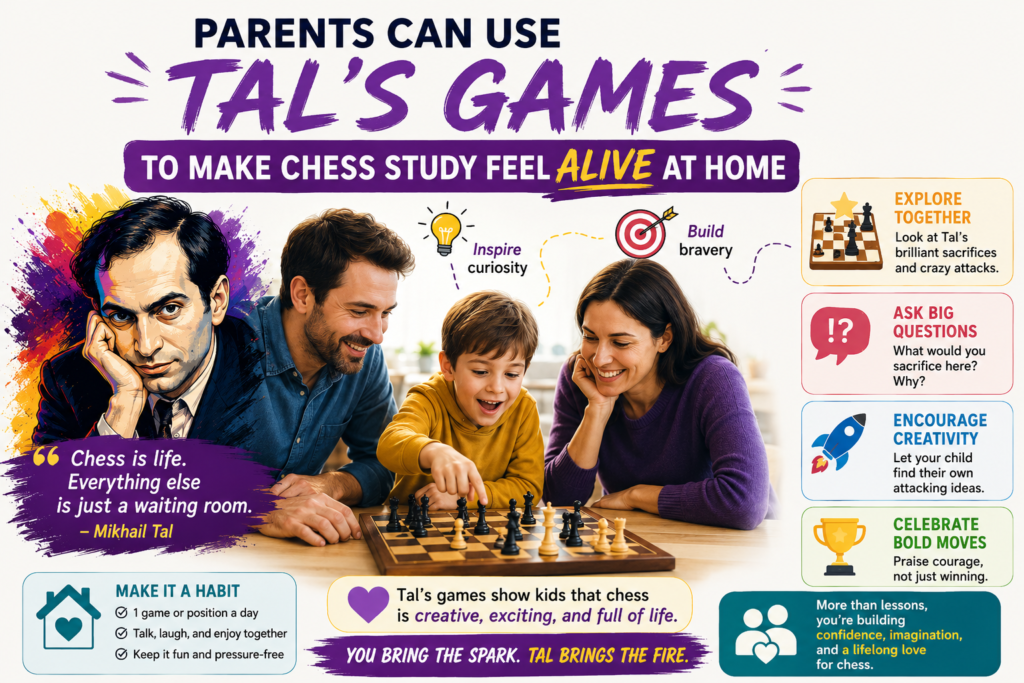
A parent can sit with a child and look at one attacking moment. They can ask what the threat is. They can ask why the king is unsafe. They can ask which piece is defending. They can ask what the sacrifice opens. This turns chess study into a conversation, not a lecture.
Tal learned chess young, and Britannica notes that he learned the game at age six before becoming world champion at age 23. His story can inspire children because it shows how early love for chess can grow into something amazing with time and training.
The best home study is short, warm, and full of questions
Children do not need long lectures to enjoy chess. In fact, long lectures can make the game feel heavy. A better way is to study one sharp position for a few minutes and let the child think.
Ask the child what they would play. Let them explain. Do not rush to correct them. Then show Tal’s move and ask why it might work. The moment the child says, “Oh, I see it,” the lesson becomes theirs.
This is the magic of great chess games. They invite children to think. They also teach children that one idea can change everything. A quiet move can prepare a storm. A sacrifice can open a file. A defender can be pulled away. A king that looked safe can suddenly be in danger.
This kind of study builds focus without forcing it. The child pays attention because they want to know what happens next.
A Debsie free trial class can turn that spark into steady growth
A child may enjoy Tal’s games at home, but guided learning helps that interest grow faster and safer. In a Debsie free trial class, a student can see what it feels like to learn chess with a coach who makes ideas simple. They can ask questions.
They can solve positions. They can learn why a move works, not just what the move is.
That matters because children grow best when they feel supported. A coach can help a shy child speak up. A coach can help a fast child slow down. A coach can help a careful child become braver. Chess then becomes a place where the child learns focus, patience, and smart thinking step by step.
Tal’s sacrifices still shock people because they show chess at its most alive. But for young students, his games offer something even more useful. They teach that brave thinking can be trained. They teach that hard problems can be solved. They teach that a child can learn to stay calm even when the board feels wild.
That is why Tal belongs in every young player’s chess journey. Not because every child must play like him, but because every child can learn from his courage, energy, and joy.
Tal’s speed chess success shows that pattern skill can become instinct
Tal was not only dangerous in slow games. He was also a monster in fast chess. FIDE’s museum notes that in 1988, at age 51, Tal won the official World Blitz Championship in Saint John ahead of Garry Kasparov, who was the world champion at that time.
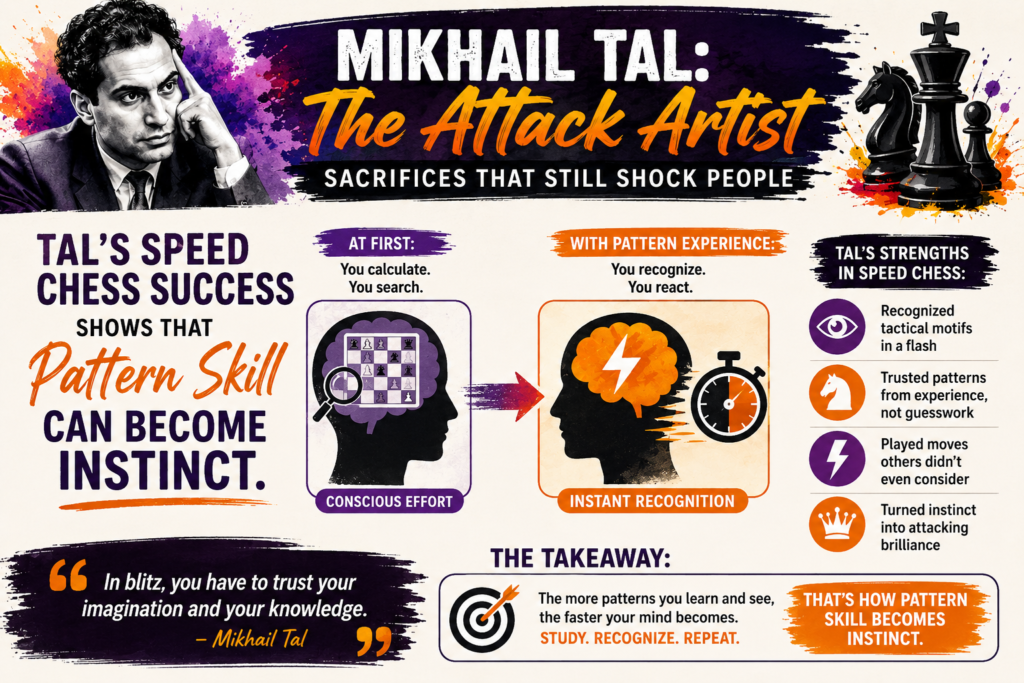
That is not a small detail. It shows that Tal’s attacking eye stayed sharp for decades, even when the clock was racing.
This is important for young players because fast chess can reveal what a player truly understands. When there is very little time, you cannot calculate everything. You must trust patterns. You must know common attacking shapes. You must feel when a king is weak. You must spot loose pieces quickly.
Tal’s blitz strength was not just about moving fast. It was about seeing fast.
Children should not rush, but they should build patterns until good moves feel natural
There is a big difference between rushing and playing with confidence. Rushing means moving before thinking. Confidence means you have seen the idea before, so your mind can find it faster.
This is why pattern training matters so much. A child who solves many checkmate puzzles starts to see mate threats sooner. A child who studies pins and forks begins to notice them in real games. A child who studies Tal’s sacrifices learns what an unsafe king often looks like.
At first, every idea feels slow. The child has to stop and think. Over time, the mind becomes quicker. The move still needs to be checked, but the first idea appears faster.
That is how chess growth works.
The Debsie lesson is to train the eye before trusting the hand
A child should never be told to move quickly just because Tal played brilliant blitz. That would teach the wrong lesson. The better lesson is to train the eye until the child sees danger clearly.
In a Debsie class, a coach can help students build this skill with short, sharp positions. The student may be asked to find the forcing move, spot the defender, or explain why the king is unsafe. Over time, the child does not just memorize answers. They begin to see the board in a new way.
This helps in tournaments too. A student who has trained patterns will not panic as easily when time is low. They will still need to think, but they will not feel lost. They will have mental tools ready.
That is one of the best gifts chess can give a child. It teaches them to prepare well before pressure arrives. Then, when pressure comes, they can breathe, focus, and act.
Tal’s speed chess success reminds us that instinct is not magic. It is practice that has become part of the mind.
Tal’s games teach that mistakes are not the end of the story
Tal’s chess was full of risk. Some of his sacrifices were perfect. Some were not. Later analysis has shown that a few of his famous attacks could have been defended with very accurate play. But that is exactly why his games are so useful for students.
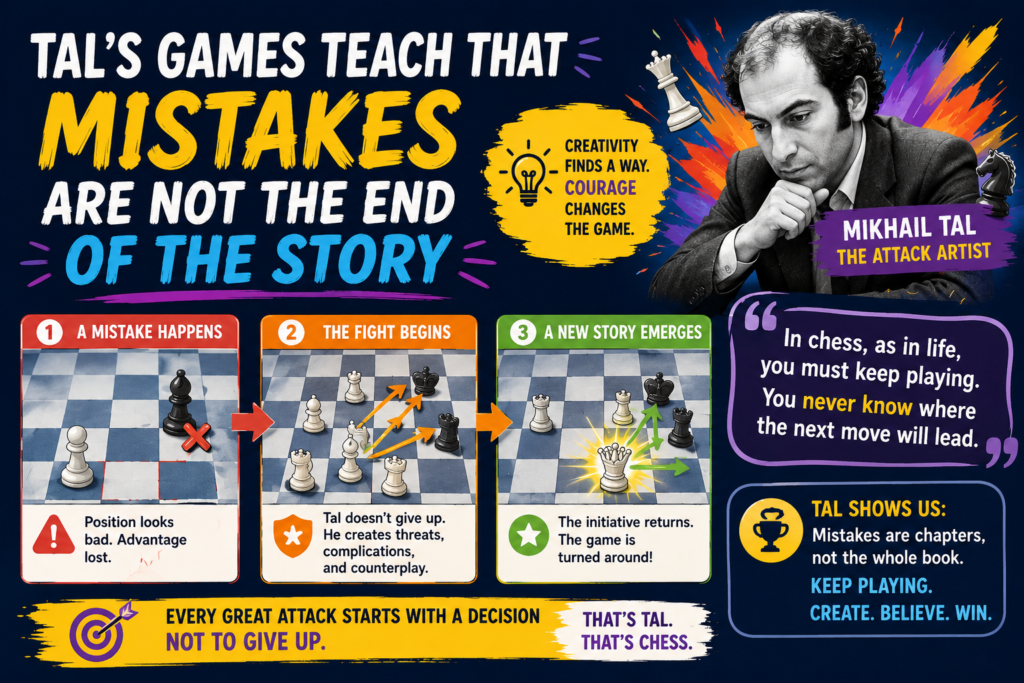
Chess is not played in a silent lab. It is played by people. People get nervous. People miss moves. People feel pressure. Tal understood that better than almost anyone. He often created positions where the defender had to find only moves while the clock was running and the crowd was watching.
The Guardian’s discussion of Tal’s famous sixth game against Botvinnik points out how his knight sacrifice created startling complications and made Botvinnik face a very hard defensive task. That is the heart of practical chess.
A move can be powerful because it gives the opponent a problem they may not solve at the board.
Young players should review mistakes without losing their love for the game
Many children feel upset after losing. They may think one mistake means they are bad at chess. That is not true. A mistake is not a label. It is a lesson waiting to be understood.
Tal’s games show that chess is a living fight. Even world champions had to deal with unclear choices, missed chances, and hard pressure. This should comfort young players. The goal is not to become perfect. The goal is to become better at thinking.
A good post-game review should not feel like punishment. It should feel like a treasure hunt. Where did the attack start? Which move gave the opponent a chance? What was the first warning sign? What should I remember next time?
When children learn this, they stop fearing mistakes so much. They become more open, more honest, and more ready to grow.
A Debsie coach can turn a painful loss into a clear next step
This is where guided learning matters. A child may not know how to review a game alone. They may only see that they lost. A coach can gently show them the turning point.
Maybe the child attacked before developing all pieces. Maybe they took a pawn while their king was weak. Maybe they missed a simple defensive move. Maybe they had a strong attack but did not bring one final piece into the fight.
Once the reason is clear, the child feels less helpless. They can say, “Now I know what to practice.” That is a powerful feeling.
Tal’s games are perfect for this kind of learning because they are full of choices. They teach children that chess is not about one correct mood. Sometimes you must be calm. Sometimes you must be brave. Sometimes you must defend. Sometimes you must strike.
This is also a life lesson. Children learn that mistakes do not end their story. What they do after the mistake matters more.
Tal’s games should be studied slowly, even though they feel fast
Tal’s attacks often feel like lightning. But students should not study them at lightning speed. If a child only clicks through the moves, the game becomes entertainment. That is fun, but it does not build deep skill.

To truly learn from Tal, students need to pause. They need to ask why the sacrifice happened. They need to find the threat. They need to name the defenders. They need to guess the next move before seeing it.
This slow study is where the real value lives.
FIDE’s museum says Tal’s style was full of sacrifices and a fight for the initiative. That means his games are not just good for learning tactics. They are also good for learning how to keep pressure and make the opponent respond.
One Tal game can teach more than ten rushed puzzle sessions
A puzzle is useful because it trains the eye. But a full game teaches the story behind the tactic. You see how the pieces reached the attacking squares. You see why the king became weak. You see which pawn move opened the line. You see how one quiet move prepared a loud sacrifice.
That is why one well-studied Tal game can be so powerful for a child. It teaches the build-up, not just the finish.
The student should not try to understand every grandmaster-level line. That may feel too heavy. Instead, they can focus on one clear theme. In one game, they may study open lines. In another game, they may study a pinned defender. In another, they may study how Tal kept the initiative.
Small lessons, learned well, stay longer.
The best study question is: what changed after this move?
This question is simple and strong. After every important Tal move, the student can ask what changed. Did a file open? Did a defender disappear? Did the king lose a square? Did a knight get closer? Did the queen join the attack? Did the opponent’s best move become harder to find?
This teaches children to think in cause and effect. They stop seeing chess as random moves. They begin to see how one move creates the next move.
At Debsie, coaches can use this method to make master games easier for kids. A famous game does not need to feel far away. It can become a clear lesson that the child can use in their next match.
That is the real goal. We do not study Tal just to admire him. We study Tal so young players can think better, attack better, defend better, and enjoy chess more.
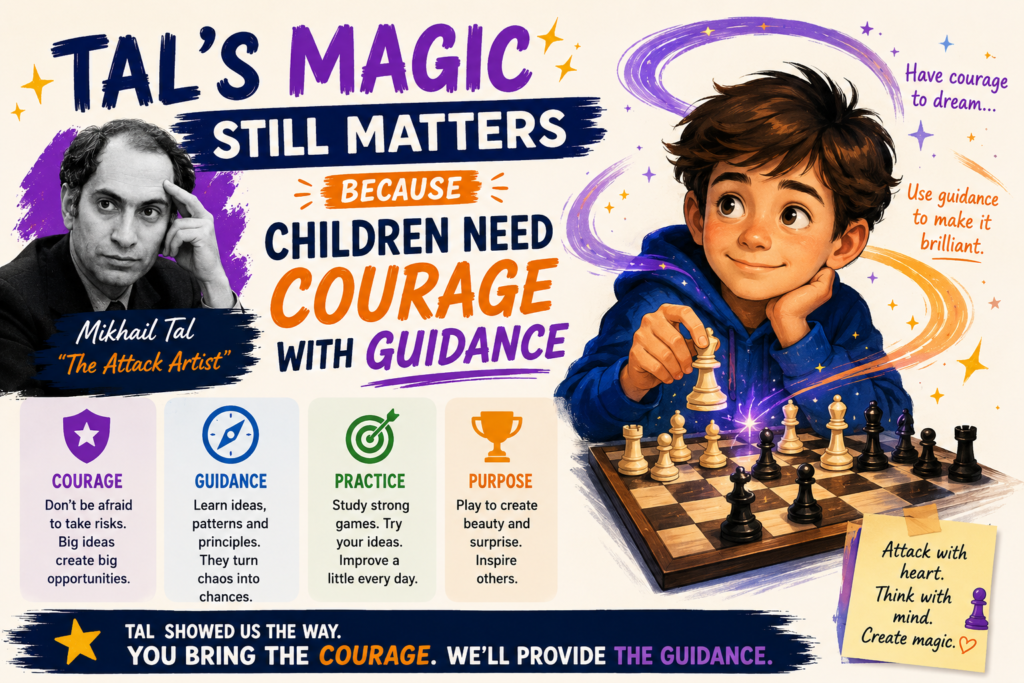
Tal’s magic still matters because children need courage with guidance
The world has changed a lot since Tal became world champion in 1960, but his chess still feels alive. Engines are stronger now. Databases are huge. Students can watch lessons online. But Tal’s games still make people stop and stare.
Why?
Because his chess touches something human. He reminds us that beauty matters. Courage matters. Imagination matters. A game is not only about avoiding mistakes. It is also about creating chances, asking hard questions, and trusting your mind.
Britannica says Tal learned chess at age six and later became world champion at 23 after defeating Botvinnik by 12½ to 8½. That story still inspires young players because it shows how far a child’s love for chess can grow when it is fed with practice and strong learning.
Parents should see Tal as a doorway into deeper chess, not as a reason for reckless play
Tal’s games are exciting, but children need the right message. The message is not “sacrifice everything.” The message is “look deeper.” See the weak king. Notice the trapped defender. Count the attackers. Bring your pieces together. Act when the time is right.
That is the kind of chess thinking that helps children grow.
A child who studies Tal with guidance can become braver without becoming careless. They can learn to take chances without guessing. They can learn to trust ideas without ignoring danger. They can learn that strong moves often come from clear questions.
This is why Debsie is such a strong fit for young chess learners. Live online classes, private coaching, structured lessons, and regular tournaments give children a safe place to practice bold thinking. They are not left alone to figure everything out. They get support, feedback, and encouragement.
The next move for a curious child can be a free Debsie trial class
Tal’s sacrifices still shock people because they are full of life. But the best thing about them is not the shock. The best thing is what they teach.
They teach focus. They teach patience. They teach courage. They teach children to think before acting. They teach students to stay calm when the board looks messy. They teach that a brave idea can become powerful when it is backed by skill.
That is exactly the kind of growth parents want from chess.
A free Debsie trial class is a simple way to help a child take the next step. The child can meet a coach, try a guided lesson, and feel how fun chess learning can be when ideas are explained in a clear and caring way. Tal made chess feel like magic, but good coaching helps children understand how the magic works.
Conclusion
Mikhail Tal’s chess still feels alive because it shows courage with purpose. His sacrifices were not wild guesses; they were bold questions that forced strong players to think under pressure. For children, his games are more than thrilling stories. They teach focus, patience, timing, creativity, and the habit of looking deeper before making a choice.
That is why studying Tal with the right coach can be so powerful. At Debsie, young learners can turn that spark into skill, growing as chess players and as thoughtful, confident people. Book a free trial class and let your child make the next move.

Adhip Ray is the founder of Debsie, an online learning platform focused on chess and skill-based learning for children. His work at Debsie brings together chess education, structured thinking, problem-solving, and interactive learning for young students.
Adhip has an academic background in law, statistics, analytics, and technology. He is from Amity Law School and the Indian Statistical Institute, Kolkata, with formal training that connects legal reasoning, data analytics, quantitative thinking, and structured problem-solving. This interdisciplinary background is reflected in Debsie’s focus on building sharper thinking skills in children through chess and related learning programs.
Adhip is also a FIDE-rated chess player from India. He holds FIDE ID 5055954 and has a standard FIDE rating of 1832. His FIDE profile records him as an Indian player with a long rating history in standard chess, including rated games from his competitive playing years. His chess background gives Debsie a founder-led connection to the game, not only as an educational activity but also as a competitive discipline that develops concentration, calculation, planning, and decision-making.
In addition to chess, Adhip has a strong interest in coding, data, and technical problem-solving.
Adhip’s profile combines chess, law, data analytics, and programming. At Debsie, this background supports the creation of learning experiences that are logical, structured, and skill-oriented. The platform’s chess-focused programs are connected to broader cognitive skills such as pattern recognition, patience, strategic planning, focus, and problem-solving.
As founder of Debsie, Adhip brings together experience from multiple fields: formal legal education from Amity Law School, analytical training from the Indian Statistical Institute, Kolkata, competitive chess experience through his FIDE-rated profile, and coding practice through LeetCode. This combination gives Debsie a distinct foundation in strategy, reasoning, analytics, and child-focused learning.
Through Debsie, Adhip is associated with building chess and learning content for children that goes beyond basic instruction. The platform connects chess with thinking skills, helping students approach challenges with more structure, clarity, and confidence. His own background in chess and analytical problem-solving gives the platform a direct link to the skills it aims to develop in young learners.
Adhip is also a member of Forbes Business Council.