Chess streams can be fun. You see fast moves, big wins, wild blunders, and funny chat moments. But here is the real question: are they helping you get better? Many kids and parents watch chess videos because they want to learn. But not every streamer teaches in a way that builds real skill. Some are great for fun. Some are great for news. Some help you think better, spot plans faster, and stay calm when the game gets hard.
Find the right learning experience
Tell us a little about the learner and what you are looking for. Our team will review your answers and help you identify the most suitable next step.
- Takes only a few minutes
- No payment required
- Personalised recommendations
Your information will only be used to respond to your enquiry.
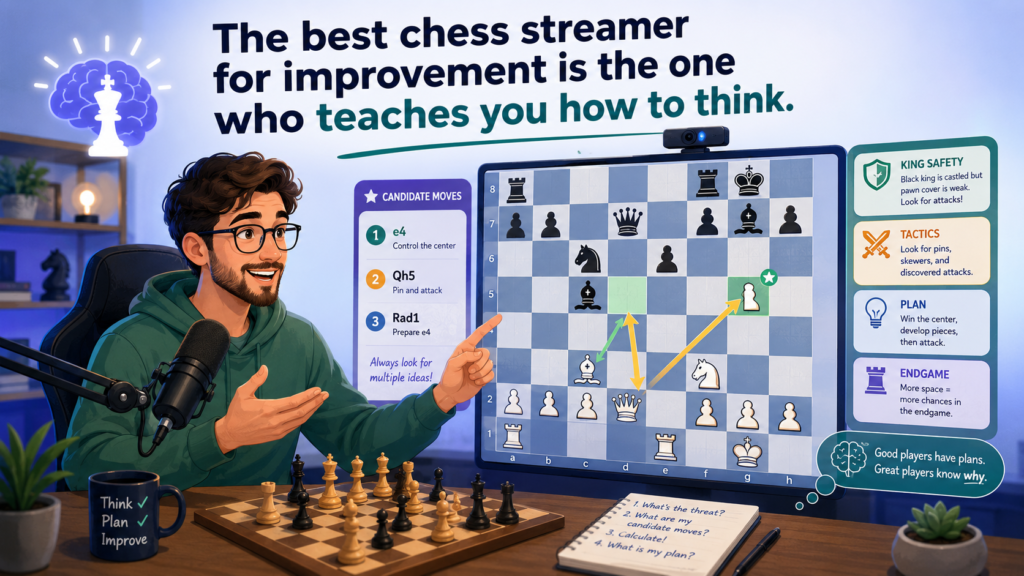
The best chess streamer for improvement is the one who teaches you how to think
A good chess streamer does more than play fast moves. A good chess streamer lets you see the thinking behind the moves. That is the part that helps a student grow. The real lesson is not “play this move.” The real lesson is “this is why this move works.”
When a child watches chess, it is easy to get lost in the fun. There is shouting, chat, jokes, speed chess, big attacks, and funny blunders. That can be exciting, and there is nothing wrong with that. But improvement comes when the child starts asking better questions during the game.
A helpful streamer makes those questions clear. What is my opponent trying to do? Which piece is not safe? Can I take something for free? Is my king in danger? Do I need to attack, defend, trade, or improve a weak piece? These small questions build strong chess habits.
A useful chess stream should make the viewer pause and guess the move
The best way to watch a chess streamer is not to sit back like it is a cartoon. The best way is to treat the video like a small lesson. Before the streamer moves, the student should pause and ask, “What would I play here?”
This one habit changes everything.
Find the right learning experience
Tell us a little about the learner and what you are looking for. Our team will review your answers and help you identify the most suitable next step.
- Takes only a few minutes
- No payment required
- Personalised recommendations
Your information will only be used to respond to your enquiry.
When a student guesses first, the brain has to work. Then, when the streamer explains the move, the student can compare ideas. Maybe the student missed a hanging piece. Maybe the student wanted to attack too soon.
Maybe the student forgot king safety. That small gap between “my move” and “the best move” is where real learning happens.
The best streamers help students build habits they can use in their own games
For kids, this matters a lot. Many young players love tactics, traps, and fast wins. But they often lose games because they move too quickly. They see one idea and play it before checking if it is safe. A good streamer teaches them to slow down inside their mind, even when the clock is moving.
That is also why live coaching is so powerful. A video can show a good idea, but a coach can catch the child’s exact mistake and fix it in real time. At Debsie, students learn with expert coaches who help them think step by step, not just copy moves.
If your child already enjoys watching chess online, a free Debsie trial class can turn that interest into a clear learning path.
Daniel Naroditsky’s archived lessons are still some of the strongest content for real chess growth
Daniel Naroditsky, also known as Danya, became one of the most loved chess teachers online because he had a rare gift.
He could play very strong chess and still explain it in simple words. His YouTube channel describes him as a Grandmaster, Stanford graduate, coach, and streamer, and his teaching style made hard chess ideas feel much easier to understand.
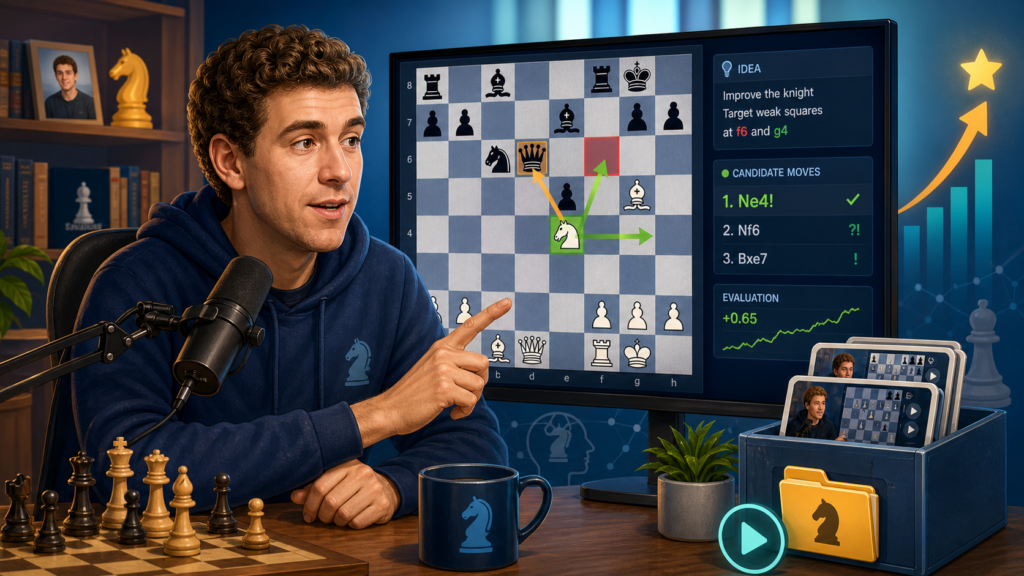
Naroditsky passed away in 2025, so students are now learning from his recorded work rather than live streams. Reports after his death described him as a major online chess figure and a gifted teacher whose content helped make chess easier to enjoy and understand.
His videos are still worth watching because they show the full thinking process. He often explains not just the move he wants to play, but the move he rejects. That is very important. Many beginners think strong players always see the right move right away.
Naroditsky showed that strong chess is often about comparing choices.
His speedrun style works because it teaches decision-making, not just tricks
Naroditsky’s speedrun videos are helpful because he plays against players at different levels and explains what matters at that level. Against beginners, he may talk about free pieces, simple checks, and safe development.
Against stronger players, he may talk more about pawn breaks, weak squares, and long-term plans.
That makes the lessons feel practical. A child rated around beginner level does not need a deep opening line that goes twenty moves. The child needs to stop losing pieces. A stronger student may need to learn how to turn a small edge into a win.
Naroditsky’s content often meets the learner where they are.
Students should watch Naroditsky with a board open and replay the key moments slowly
The best way to use his videos is to pause after the mistake. Do not just watch him win. Ask why the other side started to get worse. Was it one blunder, or did small weak moves build up over time? This helps a student see that many losses do not come from one terrible move.
They often come from five small careless moves.
Parents can also watch a short part with their child and ask simple questions. “What was the threat?” “Which piece was loose?” “Why did he trade queens?” These questions help the child speak about chess. When a child can explain a move, the child is much more likely to remember it.
GothamChess is great for beginners who need energy, stories, and clear warnings
Levy Rozman, known online as GothamChess, is one of the most popular chess creators in the world. His YouTube channel is known for lessons, game recaps, rating climb content, and lively explanations that make chess feel less scary for newer players.
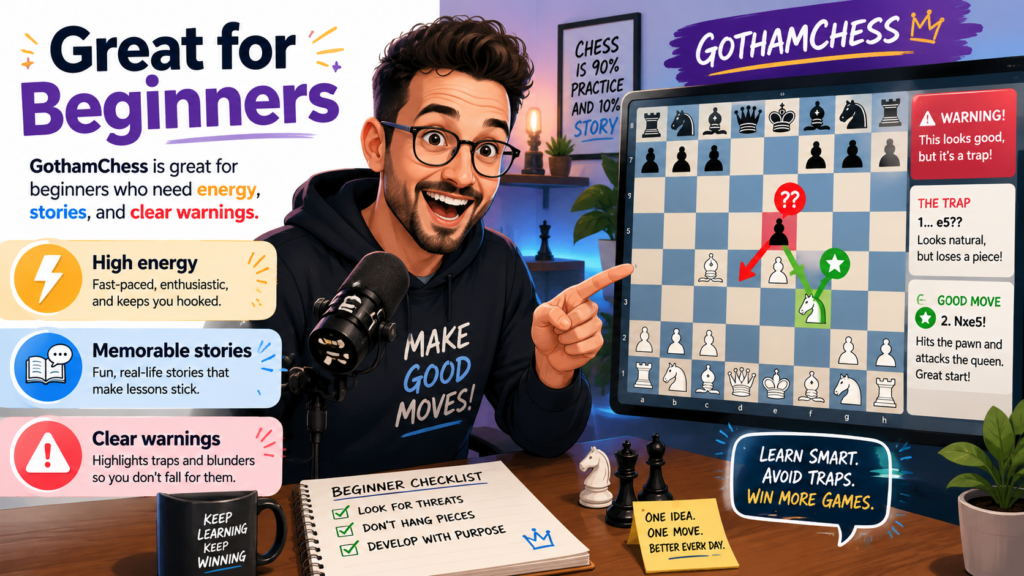
His channel regularly focuses on helping viewers grow and understand why common mistakes happen.
GothamChess is useful because he understands how beginners think. He knows that many players do not need a quiet lecture at first. They need energy. They need emotion. They need someone to say, “Do not do this,” in a way they will remember next time.
That style works very well for kids and casual players. A funny warning can stick in the mind longer than a dry rule. When a streamer makes a mistake feel clear, the student is more likely to avoid it later.
GothamChess is strongest when he explains common beginner mistakes
A lot of students lose games in the same ways. They bring the queen out too early. They forget to castle. They move the same piece again and again. They chase one pawn and lose a knight. They attack before finishing development.
GothamChess often turns these moments into clear lessons.
For a beginner, that is gold.
The goal at this stage is not to play like a grandmaster. The goal is to stop giving the game away. If a student can reduce simple blunders, the rating can rise fast. More important, the child starts to feel proud because games stop feeling random. They begin to see cause and effect.
Parents should use his videos as a spark, then add structure through coaching
GothamChess can make a child excited about chess. That is a big win. But excitement alone is not the same as a full learning plan. A child may watch ten videos and still not know what to study next. That is where structured learning matters.
A strong chess program takes that spark and gives it direction. At Debsie, students get live classes, private coaching options, and guided lessons that match their level. So instead of jumping from video to video, the child learns in a clear order.
First they build safe habits. Then they learn plans. Then they play, review, and improve.
Hikaru Nakamura is best for seeing elite speed, but students need to watch him the right way
Hikaru Nakamura is one of the most famous chess streamers in the world. His Twitch page describes him as Grandmaster Hikaru Nakamura and a five-time United States Chess Champion, and his streams are known for high-level games, speed chess, and sharp commentary.
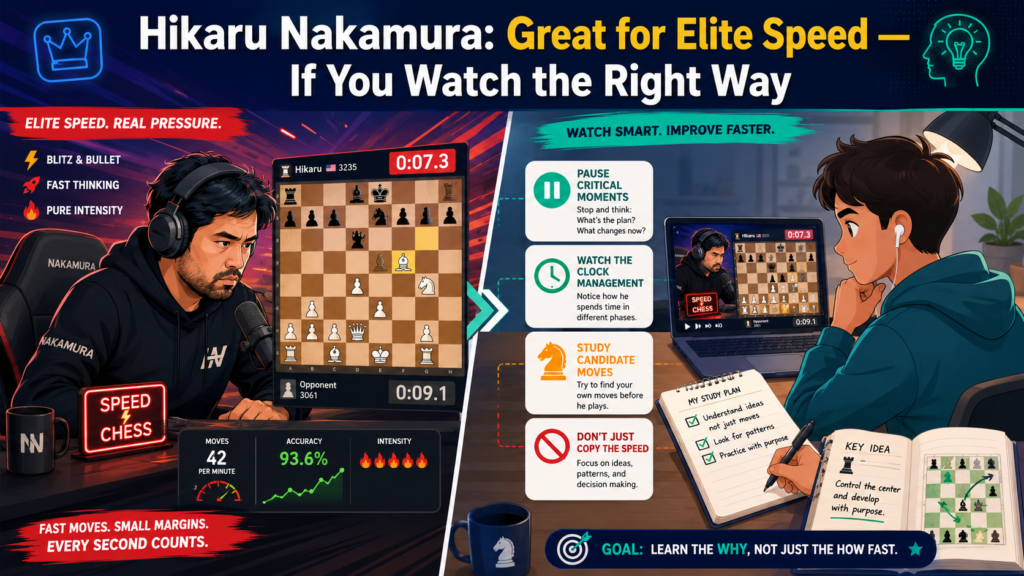
Hikaru is amazing to watch because he sees ideas very fast. He can play strong moves with little time, explain while playing, and handle pressure in ways that most players cannot. For students, this can be both inspiring and dangerous.
It is inspiring because it shows what chess can look like at the highest level. It is dangerous because beginners may try to copy the speed instead of the thinking. A child might watch Hikaru play bullet chess and then start moving instantly in their own games. That is not the lesson we want.
Hikaru helps most when students focus on patterns instead of speed
When watching Hikaru, students should not ask, “How can I move that fast?” They should ask, “What patterns does he see quickly?” That is a much better question.
Strong players do not just guess fast. They have seen thousands of common shapes. They know when a king is weak. They know when a knight belongs on a strong square. They know when a rook should use an open file.
They know when a trade helps or hurts. Hikaru’s games can help students notice these patterns, but only if they slow the content down in their own minds.
Hikaru is better for motivated players who already know the basics
A total beginner may find Hikaru exciting but hard to follow. A student who already knows opening rules, basic tactics, and checkmate patterns will get more value. They can watch how a world-class player handles pressure, time trouble, and messy positions.
For kids, the best rule is simple. Enjoy the fun, but do not copy the rush. Chess growth comes from careful thinking first. Speed comes later. At Debsie, coaches help students build that order the right way, so they learn calm thinking before fast play.
Chessbrah is strong for students who want fun, openings, and practical habits
Chessbrah is led by Grandmasters Eric Hansen and Aman Hambleton. Their YouTube channel describes the content as both chess entertainment and education, and their videos include opening lessons, games, challenges, and live-style teaching.
Find the right learning experience
Tell us a little about the learner and what you are looking for. Our team will review your answers and help you identify the most suitable next step.
- Takes only a few minutes
- No payment required
- Personalised recommendations
Your information will only be used to respond to your enquiry.
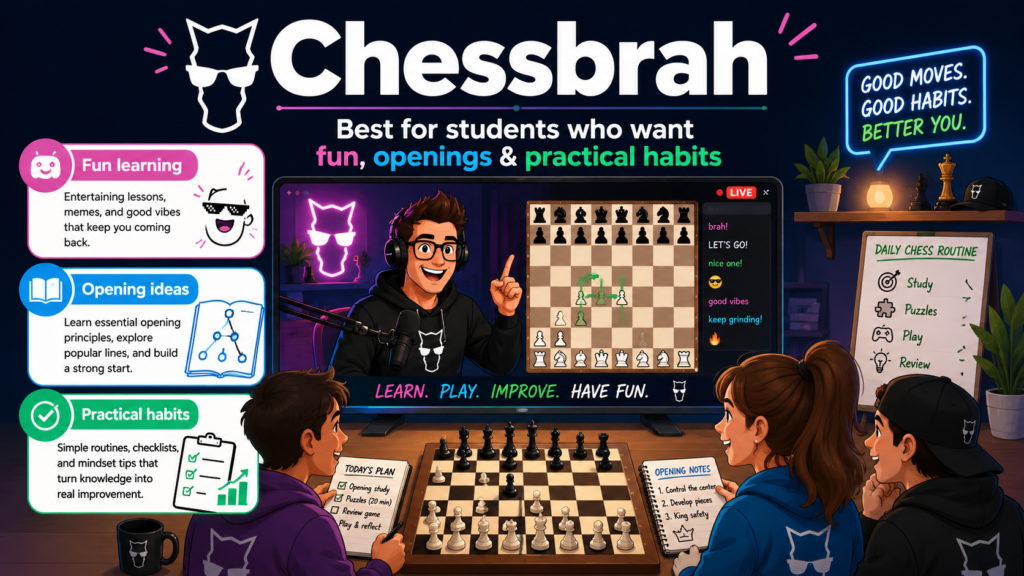
This mix makes Chessbrah useful for students who want learning to feel light. Some chess channels feel like school. Chessbrah often feels more like sitting with strong players who are having fun while still showing good ideas. That can be helpful for kids who lose focus during long, serious lessons.
One of the best parts of Chessbrah content is that it often shows practical chess. Not perfect textbook chess. Real chess. The kind where both sides make mistakes, time gets low, plans change, and the player has to stay alert.
Aman Hambleton’s teaching style is especially useful for beginner and club players
Aman is very good at explaining simple plans in a calm way. His rating climb and beginner-focused videos often show how to win without doing anything fancy. That matters because many young players think they need traps to win. In truth, many games are won by developing pieces, keeping the king safe, taking free material, and not panicking.
That kind of lesson is perfect for growing players. It builds trust in simple chess. It shows that you do not need magic. You need good habits repeated many times.
Chessbrah is best watched with one clear goal per video
A student should not try to learn everything from one Chessbrah video. That can become too much. Instead, choose one goal. Maybe today the goal is to learn how to play the London System. Maybe tomorrow the goal is to understand why early queen moves can be risky.
Maybe the goal is to see how a grandmaster wins against lower-rated players without rushing.
One clear goal keeps the lesson sharp. It also makes it easier for a parent to ask later, “What did you learn?” If the child can answer in one or two clear sentences, the video did its job.
John Bartholomew is one of the best choices for calm, serious beginner improvement
John Bartholomew is not always the loudest name in chess streaming, but his teaching is deeply useful. His YouTube channel describes him as a chess master, entrepreneur, and former Chessable co-founder, and his well-known “Chess Fundamentals” playlist covers key ideas like undefended pieces, coordination, common mistakes, pawn play, and trades.
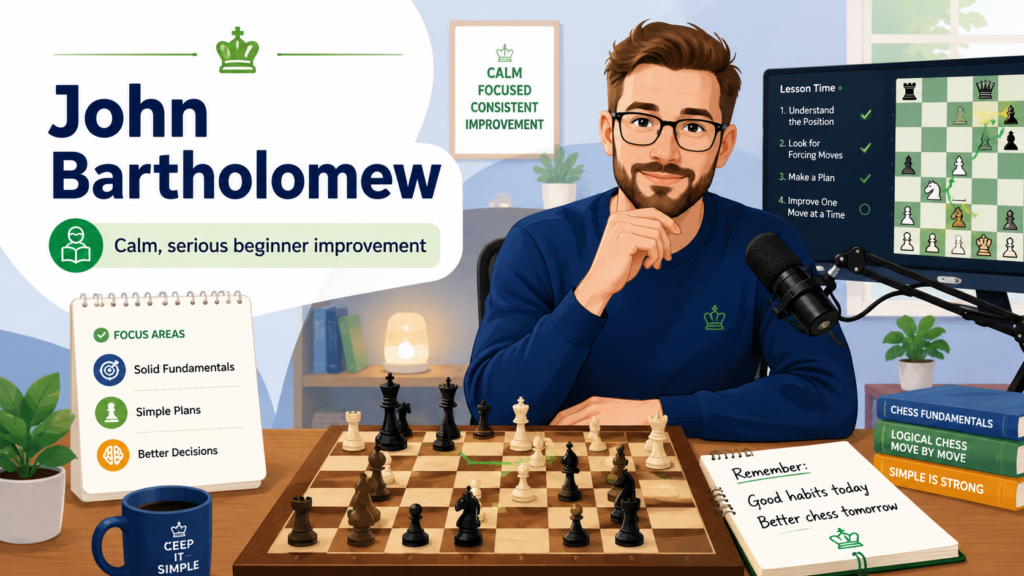
For students who want to improve, this kind of content is extremely valuable. It focuses on the things that decide most beginner and intermediate games. Not fancy openings. Not rare traps. Not wild attacks that only work when the other player forgets everything. Real chess habits.
John’s style is calm and clear. He gives space for the viewer to think. That can be very good for kids who feel nervous, rushed, or overwhelmed during games.
His lessons are great for students who keep losing pieces
Many beginner games are decided by loose pieces. A knight is not protected. A bishop is attacked twice. A queen gets trapped. A rook sits in the corner and never joins the game. John Bartholomew’s teaching helps students notice these simple problems before they turn into losses.
This is one of the fastest ways to improve. Before a child learns a new opening, the child should learn to stop leaving pieces undefended. Before memorizing tricks, the child should learn to ask, “Is my piece safe?” That question alone can save many games.
John Bartholomew is a strong fit for families who want quiet, focused chess learning
Some students love big energy. Others learn better with a calm voice and clean teaching. John Bartholomew is a strong option for the second group. His content is not about making chess look wild every second. It is about helping the viewer build a steady chess mind.
That steady mind is also what good coaching should build. At Debsie, the goal is not just to help children win more games. It is to help them think better, stay patient, and make smarter choices under pressure. Chess becomes a training ground for life, not just a game on a screen.
Eric Rosen is best for calm learning, clever ideas, and clean practical chess
Eric Rosen is a great streamer for students who want chess to feel friendly, not scary. His own channel describes him as an International Master who streams on Twitch and shares many of the best moments on YouTube.
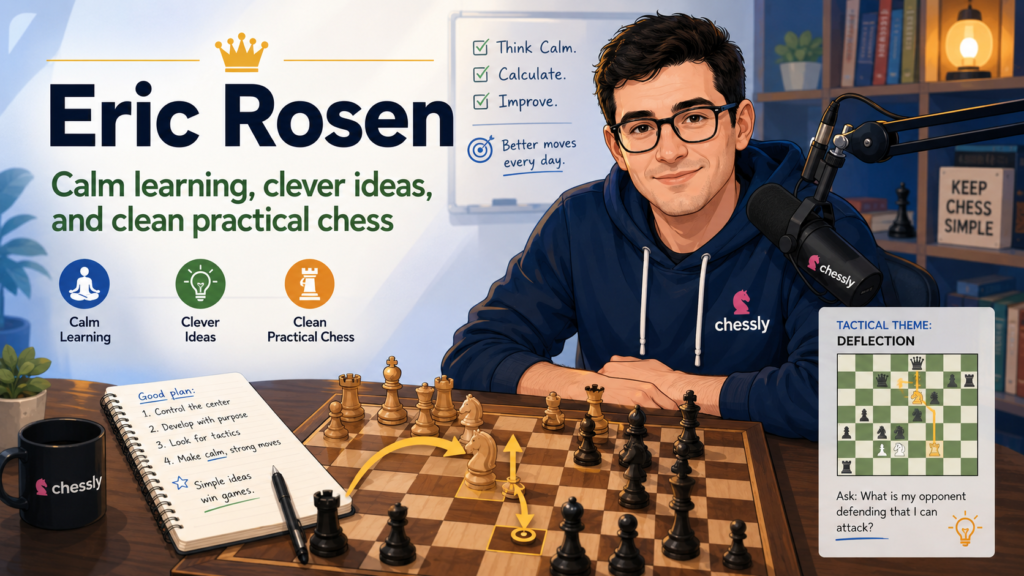
His content is also described as family friendly and made for players of all levels, which makes him a safe and useful pick for many young learners.
What makes Eric helpful is his calm style. He does not make chess feel like a race. He often explains ideas in a soft, clear way, even when the game is wild. That helps kids who get nervous when they are losing or when the position becomes messy.
He is also known for fun openings and traps, like the Stafford Gambit and the London System. But the best lesson from Eric is not just the trap. The real lesson is how he stays alert. He keeps looking for chances, checks, threats, and hidden tactics.
Eric Rosen teaches students that chess can be creative without being careless
Some players think creative chess means throwing pieces at the king and hoping something works. Eric’s games show a better way. Creative chess still needs careful thinking. A sacrifice should have a reason. A trap should have a backup plan. A tricky move should not leave your own king helpless.
That lesson is very important for kids. Young players often love traps because traps feel fast and exciting. But if they only learn traps, they may get stuck. When the trap does not work, they do not know what to do next. Eric’s content can help students see that tricky chess must still be built on good basics.
Students should watch Eric Rosen when they want to learn patience during attack
Eric is especially helpful for students who rush attacks. Many kids see one check and play it at once. Then the attack ends, and their pieces are worse. A better habit is to ask, “Can I bring one more piece into the attack?” or “What will my opponent do after my check?”
That is where Debsie coaching can make online watching much stronger. A child may enjoy Eric’s fun games, then bring those ideas into class. A Debsie coach can help the child understand which ideas are safe, which ideas are risky, and which ideas fit their level. That turns fun watching into real progress.
Anna Cramling is best for students who need confidence, joy, and a friendly chess voice
Anna Cramling brings a warm and happy feeling to chess content. Her Twitch page says she streams chess and tries to spread as much happiness as possible. That simple line explains a lot about why so many people enjoy watching her.
For many kids, chess can feel serious. They may worry about losing. They may feel bad after blunders. They may think chess is only for “smart kids.” Anna’s content can help soften that fear. She shows that chess can be fun, social, and full of learning moments.
This matters because confidence is a huge part of improvement. A child who feels safe making mistakes will learn faster than a child who feels ashamed. When students see a streamer laugh, think, try again, and keep going, they learn that mistakes are part of the game.
Anna Cramling is useful for beginners because she makes chess feel human
Some chess content is so deep that a new player feels lost in the first five minutes. Anna’s style is easier to enter. She often brings personality, reactions, and simple learning moments into the game. That can help students stay connected, even when they do not understand every move.
For young players, this is not a small thing. The first goal is not always deep study. The first goal is often to keep the child curious. A curious child will come back. A child who comes back will slowly build skill.
Anna’s content works best when students focus on courage, not just moves
When watching Anna, students should not only ask, “What move did she play?” They should also notice how she reacts when things go wrong. Does she keep playing? Does she try to find chances? Does she stay in the game even after a mistake?
That is a life skill. Chess teaches kids to handle hard moments. They learn that one bad move does not mean the whole game is over. That same lesson helps with school, sports, and daily life. Debsie builds on this idea by helping students grow in focus, patience, and smart thinking, not just chess rating.
ChessNetwork is best for quiet students who want deep ideas explained in a clean way
ChessNetwork, run by Jerry, is one of the older and more respected learning channels in online chess. The channel description says he is a self-taught National Master from Pennsylvania and that the purpose of the channel is to share chess knowledge to help others improve their game.
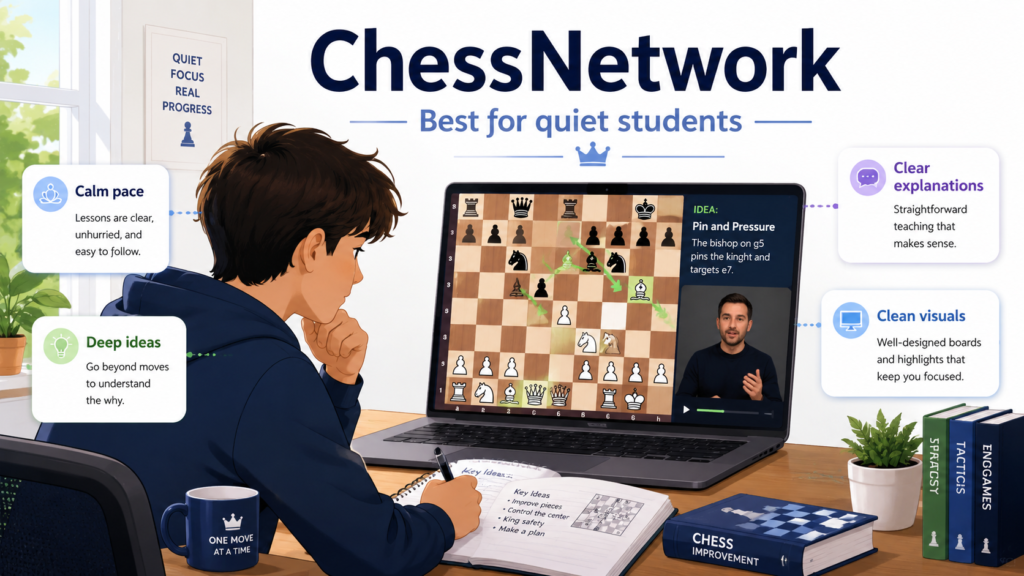
His style is very different from loud streaming. It is calm, steady, and focused. He often explains games, ideas, and patterns in a way that gives the viewer time to think. For students who do not like noisy content, this can be a strong fit.
ChessNetwork is also useful because it often shows complete games with clear ideas. Instead of only showing funny moments or wild tactics, the content can help students understand how a game changes from opening to middle game to endgame. That full-game view is important.
ChessNetwork helps students understand why one small choice can change the whole game
Many beginners think a chess game is lost only because of one huge blunder. Sometimes that is true. But many games are lost slowly. A pawn move weakens a square. A bishop gets blocked. A rook stays asleep. The king remains in the center. Then, ten moves later, the position falls apart.
ChessNetwork’s style helps students notice these slow changes. This is powerful for kids who are past the beginner stage. Once a student stops giving away pieces, the next step is to understand plans. They need to know where pieces belong and why some trades help one side more than the other.
Students should use ChessNetwork when they are ready to study full games
A full game teaches patience. It shows that chess is not only about quick attacks. It is also about building pressure, improving pieces, and waiting for the right moment.
At Debsie, students learn this step by step. A coach may first help a child stop blunders. Then the coach may teach planning. Then the child learns how to review full games and find better choices. ChessNetwork can be a helpful extra tool for this kind of steady learning.
BotezLive is best for entertainment, confidence, and showing that chess can be social
BotezLive is hosted by sisters Alexandra and Andrea Botez. Their Twitch page describes it as a chess show hosted by two sisters who grew up playing competitively and represented Team Canada in international events. The page also notes that they stream chess, chatting, and sometimes other games.
BotezLive is not always the first place I would send a student for deep chess study. But it can still be useful. It shows that chess is not lonely. It can be social, fun, and full of personality.
That matters for kids who think chess is only about sitting quietly in a room. BotezLive can make chess feel alive. It can help students see that chess players can joke, talk, compete, travel, and enjoy the game with friends.
The best learning from BotezLive comes from watching practical decision-making under pressure
The Botez sisters often play games where emotions are high. There may be time pressure, surprises, mistakes, and quick changes. This can help students understand that chess is not played in a perfect world. Real games are messy.
A student can learn from that mess. They can see how players react after mistakes. They can notice when someone rushes. They can also see why time control matters. A good move found too late does not help if the clock runs out.
BotezLive should be treated as chess fuel, not a full chess course
BotezLive can make a child excited to play. That is valuable. But it should not be the only learning source. Entertainment can start the fire, but coaching builds the skill.
This is where parents can guide the child. After watching a fun stream, ask one simple question: “What did you learn that you can use in your next game?” If the child cannot answer, the stream was mostly entertainment.
That is fine sometimes. But if the goal is improvement, the child also needs review, practice, and live feedback from a coach.
The right streamer depends on your child’s level, not just the streamer’s fame
A common mistake is choosing chess content only by popularity. Big numbers do not always mean better learning for your child. A world-class player may be amazing, but their thinking can be too fast for a beginner.
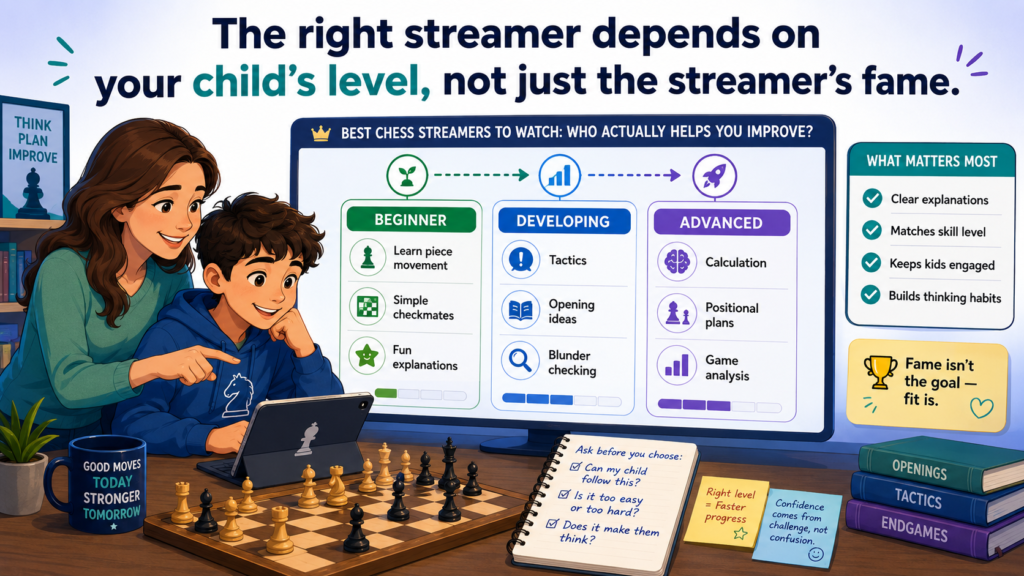
A funny streamer may keep attention, but may not give enough structure. A calm teacher may be perfect for one child and too slow for another.
The best choice depends on what the student needs right now. A beginner needs safe piece habits, basic checkmates, and clear opening rules. A growing club player needs planning, tactics, and endgame skill. A more advanced student needs deeper calculation, better openings, and serious game review.
This is why parents should not ask, “Who is the best chess streamer?” The stronger question is, “Who is the best chess streamer for my child this month?”
Beginners should watch streamers who explain simple mistakes again and again
For beginners, repetition is not boring. Repetition is how the brain learns. A child may need to hear “castle early” many times before it becomes automatic. They may need to see ten examples of hanging pieces before they start checking their own pieces.
At this stage, the best streamers are the ones who slow down and explain basic ideas. GothamChess, John Bartholomew, Eric Rosen, Anna Cramling, and some beginner-friendly Chessbrah videos can work well. The exact name matters less than the teaching style.
A child’s watch plan should match the mistake they keep making
If your child keeps losing the queen, do not start with advanced openings. If your child forgets checkmate patterns, do not start with bullet chess. If your child attacks too early, watch content about development and king safety. If your child freezes in the endgame, watch simple king and pawn lessons.
This is also how Debsie coaches work with students. They do not throw random lessons at a child. They look at the child’s games, spot the real problem, and teach the next useful step. That saves time and helps the child feel real progress.
The smartest way to watch chess streamers is to turn every video into a mini lesson
Watching chess is easy. Learning from chess takes a little more care. The good news is that students do not need to watch for many hours. Even ten focused minutes can help if they watch the right way.
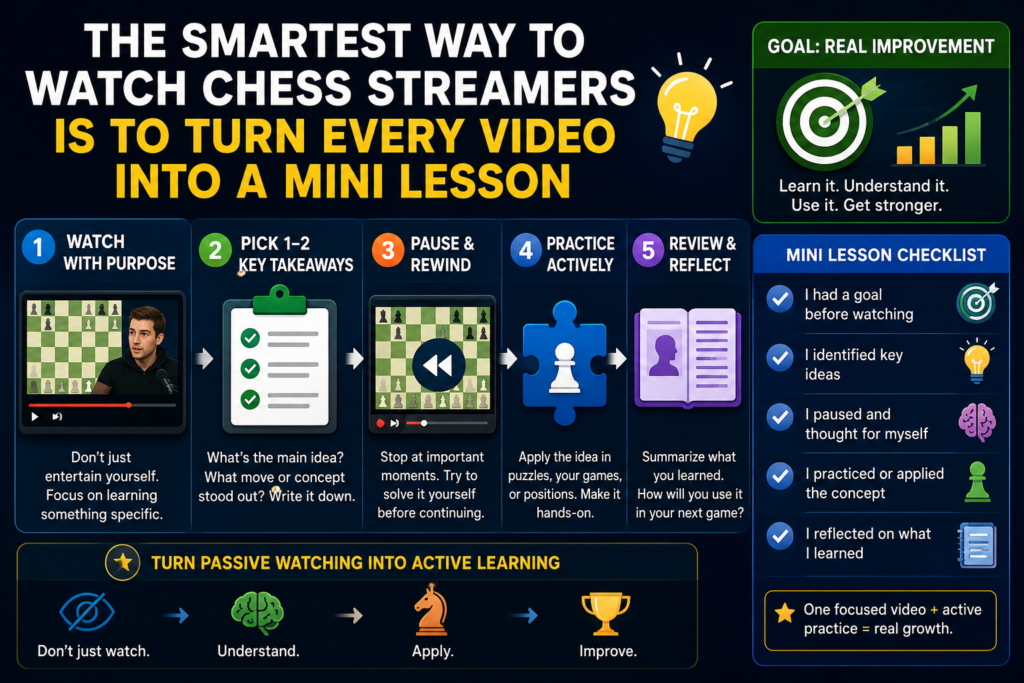
The key is active watching. That means the student should not only follow the moves. They should think before the move is played. They should guess the plan. They should notice threats. They should ask why a trade happened.
They should pause after a blunder and find the mistake.
This makes the brain work. And when the brain works, learning sticks.
One short video watched well is better than five long videos watched lazily
Many kids jump from one chess video to another. They feel like they are studying, but they are mostly just consuming. That can be fun, but it does not always lead to better games.
A better method is to choose one video and watch it slowly. Pause at key moments. Guess moves. Replay one important position. Write down one lesson in simple words. Then use that lesson in the next game.
For example, the lesson might be, “Before I attack, I should finish development.” Or it might be, “I must check if my pieces are protected before I move.” Simple lessons like these can change results fast.
Parents can help by asking for one clear takeaway after each video
The child does not need to write a long report. One clear takeaway is enough. Ask, “What is one thing you will try in your next game?” If the child says, “I will castle before attacking,” that is a win. If the child says, “I will look for loose pieces,” that is also a win.
This small habit turns screen time into skill time. It also helps parents see whether the content is helping or just filling time.
And if your child already watches chess streamers with interest, that is a great sign. It means the spark is there. Debsie can help turn that spark into steady growth through live coaching, clear lessons, and friendly support. A free Debsie chess trial class is a simple way to see how your child learns with expert guidance.
Agadmator is best for players who want to enjoy famous games without feeling lost
Agadmator is not always a “live coach” type of streamer, but his chess videos are very useful for students who want to enjoy great games in a simple way. His channel says he uploads games he personally finds interesting, and that is a big part of his style.
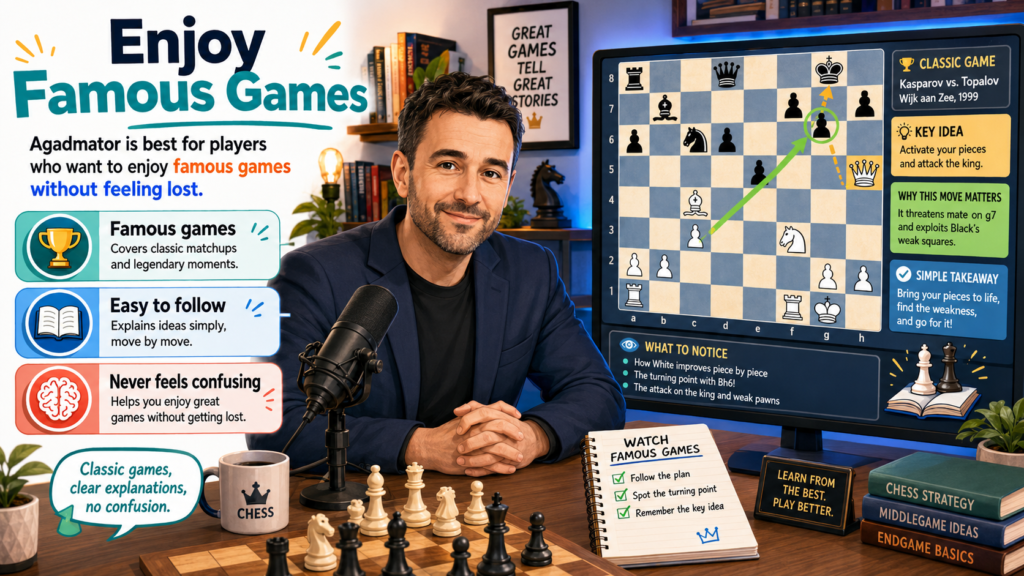
He picks games with a story, explains the key moments, and helps viewers enjoy chess history, modern events, and brilliant ideas without needing to be experts first.
This is helpful because many students only study their own games. That is important, but it is not enough. Watching strong players teaches pattern memory. A child may not fully understand every deep idea, but the brain starts to notice common shapes.
A rook on an open file. A knight jumping near the king. A bishop cutting across the board. A queen joining the attack at the right time.
Agadmator is strongest when the student watches for the turning point
Every good chess game has a moment where the story changes. Maybe one side misses a defense. Maybe a small pawn move creates a weak square. Maybe a quiet move prepares a huge attack. Agadmator’s videos are useful because they often make that story easy to follow.
The best way to watch his content is to look for that turning point. Do not just enjoy the final checkmate. Ask what made the checkmate possible. Was the king weak ten moves earlier? Was one defender removed? Did one side win control of an important square?
Students should pause before the big move and try to find it first
This small habit makes Agadmator’s videos much more useful. When the game reaches a key moment, pause and ask, “What would I play?” Then compare your idea with the move in the video. This turns a simple watch session into a real chess workout.
For children, this can feel like a game inside the game. They are not just watching. They are joining the thinking. And when that interest is matched with live coaching at Debsie, the child gets both sides: the joy of famous games and the clear support needed to use those ideas in real play.
Hanging Pawns is best for students who want openings explained with plans, not just moves
Hanging Pawns is a strong choice for players who want to learn openings in a serious but clear way. The channel describes itself as being for players who are trying to improve, made by a player who is also trying to improve. That honest style makes the lessons feel less cold and more human.
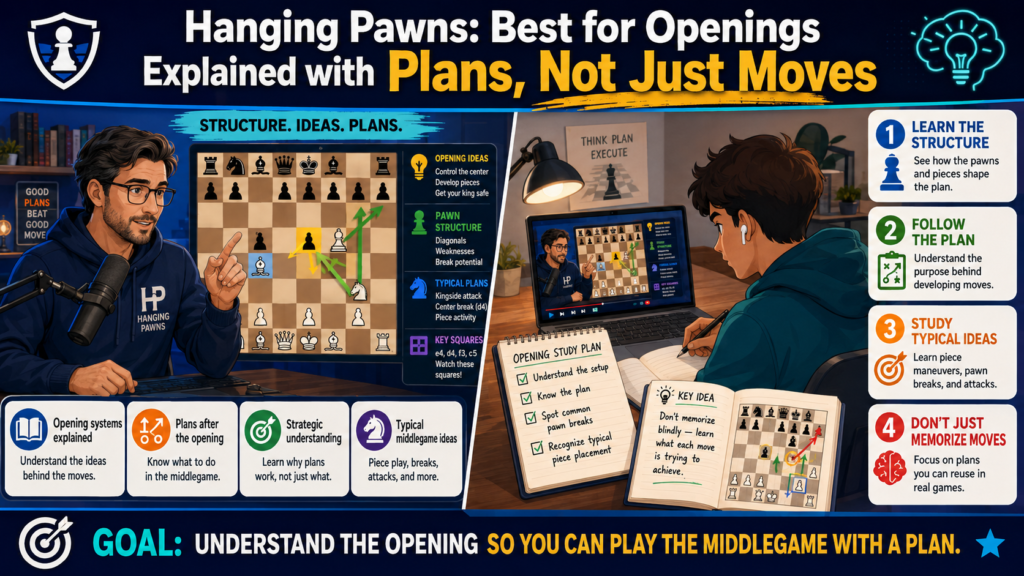
Openings can be a trap for young players. Many kids want to memorize ten moves because it feels like a shortcut. But memorizing without understanding is weak. The child may know the first moves, then freeze when the opponent plays something different. That is why opening study must focus on plans.
A good opening lesson should answer simple questions. Where do my pieces go? Which pawn break matters? What is my king safety plan? What should I do if my opponent does not follow the main line?
Hanging Pawns helps students see the structure behind the opening
The best part of this kind of opening content is that it often explains the pawn structure. That may sound like a big term, but the idea is simple. Pawns shape the board. They decide where pieces can move. They show which side may attack. They also create weak squares.
When a child learns an opening through pawn structure, the child becomes less dependent on memory. They can think for themselves when the game changes. That is a major step from beginner chess to real chess.
Students should not study five openings at once
A child does not need a huge opening library. In fact, too many openings can slow growth. It is better to learn one opening for White and simple replies for Black, then understand the main plans well.
Parents can help by asking, “What is the plan in this opening?” If the child only says the move order, they have not learned enough yet. If the child says, “I want to develop fast, castle, control the center, and push this pawn later,” that is much better.
At Debsie, coaches help students pick openings that match their age, level, and style. That saves the child from random study and builds a clean path forward.
ChessDojo is best for students who want training culture, not just fun clips
ChessDojo is aimed at serious improvement. Its Twitch page describes it as a hub for chess players, improvers, and coaches, with educational chess content and a community for ambitious players. Its YouTube channel also points to instructional videos and live classes.
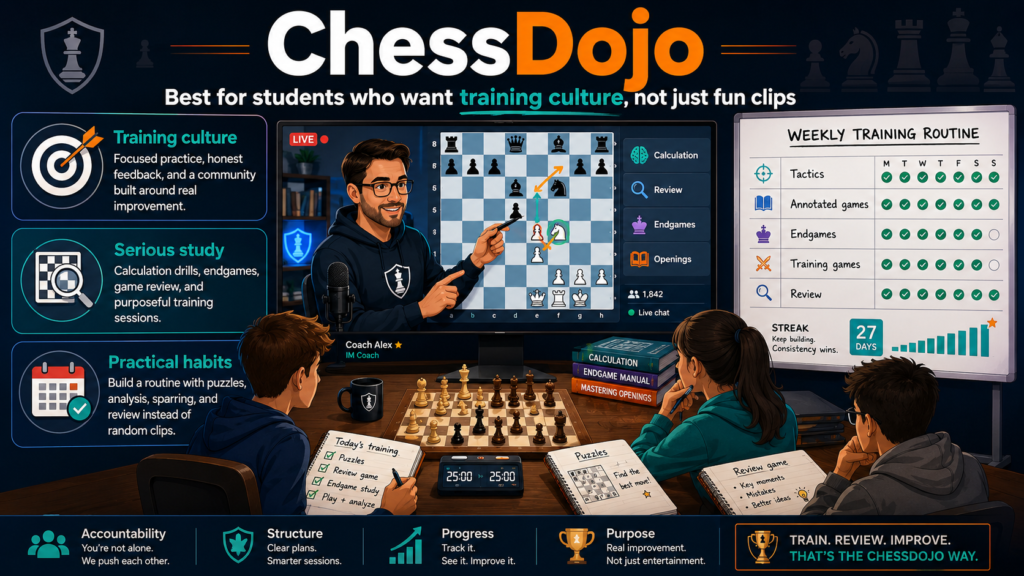
This is useful because many students do not only need more chess knowledge. They need better training habits. They need to review games. They need to solve puzzles the right way. They need to play slower games. They need to stop jumping from one shiny idea to another.
A strong training culture teaches patience. It reminds students that chess improvement is built over time. You do not become strong from one trick. You become strong from many small, smart choices repeated week after week.
ChessDojo content is helpful for families who want a more serious improvement mindset
Some chess channels are built for quick fun. ChessDojo feels more like a gym. That can be great for students who already enjoy chess and want to push higher. It can also help parents understand that improvement is not random. There are clear habits that make a real difference.
One of the biggest habits is game review. Many kids play game after game and never look back. That means they repeat the same mistakes. A better student reviews one game and asks what went wrong. That one review may teach more than five rushed games.
Students should copy the training mindset, not try to do everything at once
A young player does not need a heavy study schedule. What they need is a simple rhythm. Play. Review. Learn one lesson. Try again. That cycle is easy to understand, and it works.
This is also how Debsie builds confidence. Coaches do not just give information. They guide the child through the learning process. The student learns how to think, how to fix mistakes, and how to stay motivated even when progress feels slow.
Ben Finegold is best for students who can handle humor and want strong chess lessons
Grandmaster Ben Finegold has a very clear and funny teaching style. His YouTube channel includes videos from his Twitch streams and live lectures on openings, tactics, and chess ideas. His Twitch profile describes him as an International Grandmaster, and his content often mixes jokes with serious lessons.
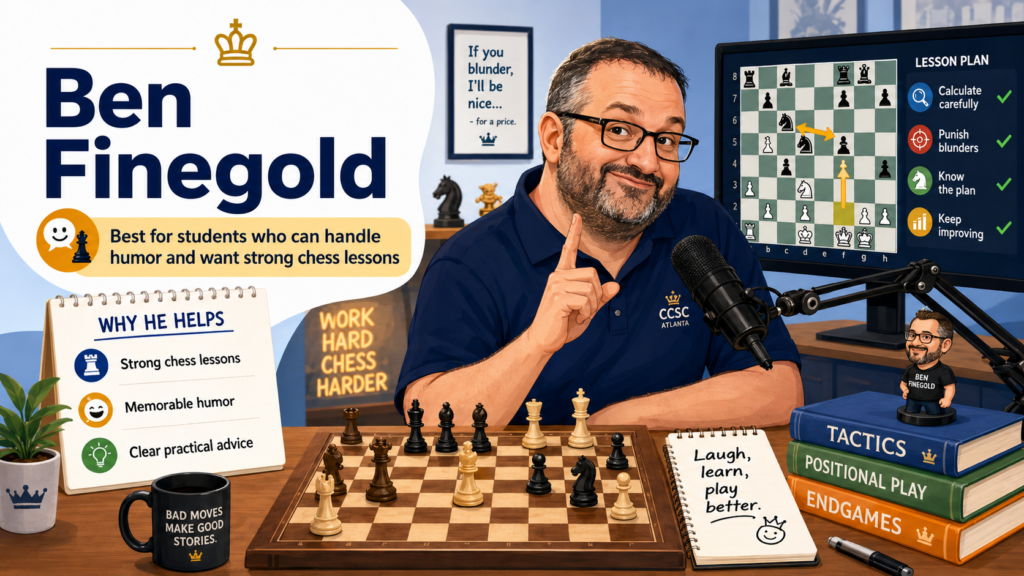
Ben’s style is not for every child. Some students love the humor. Some may find it too sharp. Parents should watch a little first and decide if it fits their child. But for the right student, his lessons can be very memorable.
He is especially good at repeating important ideas until they stick. In chess, that matters. A child may hear a rule once and forget it. But when a teacher says it in a funny way many times, the child may remember it during a real game.
Ben Finegold is useful for learning practical rules that save games
Many of Ben’s lessons come back to basic but powerful chess truths. Do not hang pieces. Develop your pieces. Keep your king safe. Do not make weak moves for no reason. Look for tactics. Use your rooks. These are not fancy ideas, but they win games.
Young players often want advanced knowledge before they master simple safety. That is like trying to run before learning to walk. A child who stops blundering will improve much faster than a child who memorizes a long opening but still leaves pieces free.
Parents should use his lessons as reminders, then help children apply them calmly
A funny line can help a child remember a rule, but the child still needs practice. After watching a lesson, the student should play a slow game and focus on one habit. Maybe the habit is checking for loose pieces. Maybe it is castling before attacking. Maybe it is asking what the opponent wants.
At Debsie, this kind of practice happens with guidance. A coach can catch the exact moment when the child forgets the rule. That is where growth happens. The child does not just hear the lesson. They learn how to use it.
The best streamer for your child may change as your child grows
Parents often want one perfect answer. They ask, “Which chess streamer should my child watch?” But the best answer changes with time. A child who needs fun today may need structure next month. A child who is learning basic tactics now may need endgame help later.
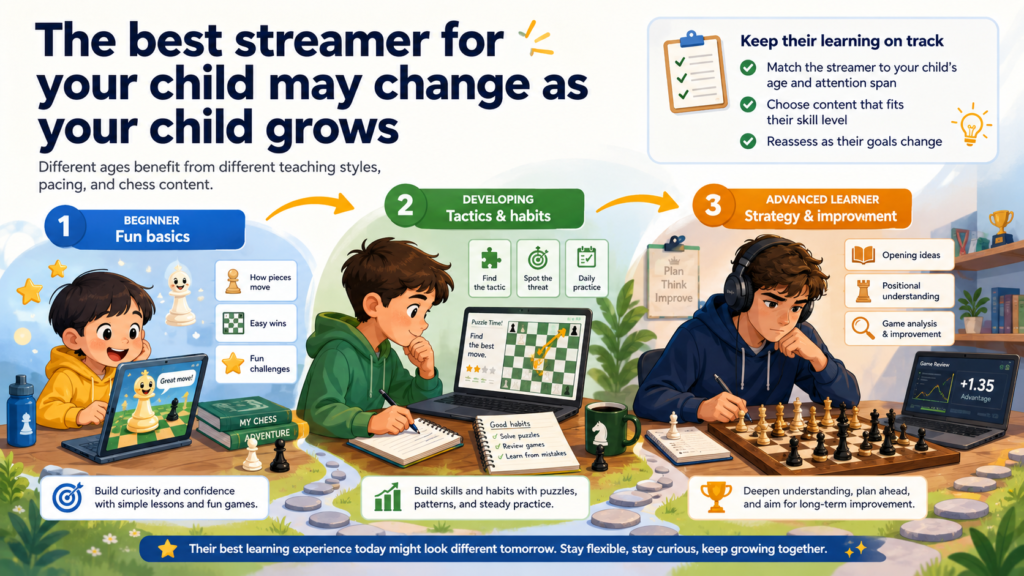
A student who loves fast streams may need calm lessons when they start playing tournaments.
That is why the goal is not to marry one channel forever. The goal is to match the content to the child’s next step. Chess learning is like climbing stairs. Each stair needs a different kind of support.
A beginner may need GothamChess, Eric Rosen, Anna Cramling, or John Bartholomew. A growing player may need Naroditsky archives, ChessNetwork, Chessbrah, Hanging Pawns, or Agadmator. A serious improver may enjoy ChessDojo or deeper grandmaster lectures.
The right question is not who is famous, but what problem the child is solving
A streamer should be chosen like a tool. If your child loses pieces, choose content about blunder checks and board safety. If your child gets scared in attacks, choose content about defense and king safety.
If your child starts well but cannot finish games, choose endgame lessons. If your child gets bored, choose a more lively voice to bring back joy.
This makes learning much more focused. It also stops the child from wasting time on content that is too easy, too hard, or too random.
A simple weekly watch plan can make chess videos far more useful
One smart plan is to choose one theme for the week. The theme could be “safe pieces,” “checkmate patterns,” “opening plans,” or “rook endgames.” Then every video watched that week should connect to that theme.
This helps the child feel progress. Instead of watching many unrelated videos, they build one skill deeply. That is also easier for parents to support. At the end of the week, you can ask, “Show me what you learned.” If the child can show one idea on the board, the week was useful.
Debsie’s live classes make this even stronger because students do not have to guess what to study next. Coaches guide them toward the right theme at the right time.
Chess streams should support real practice, not replace it
Watching chess can help. But watching alone will not make a child strong. A student must play, think, review, and try again. That is where the real change happens.
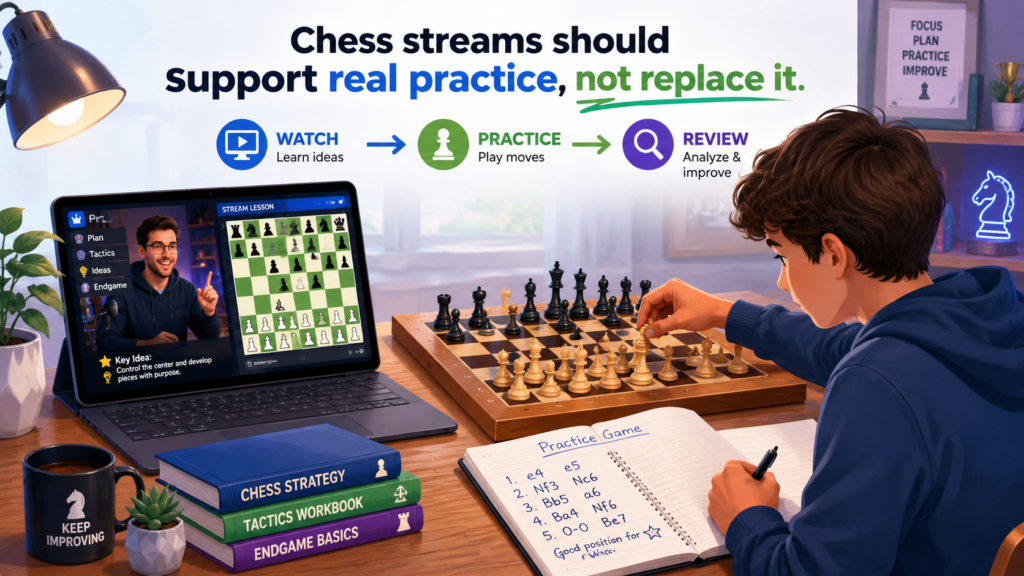
This is the same as learning music or sports. Watching a great piano player can inspire you, but your fingers still need practice. Watching a football star can teach you ideas, but your feet still need training. Chess is no different. The mind has to practice.
The best chess streamers give ideas. The student must turn those ideas into habits.
A child should play slower games if the goal is real improvement
Fast chess is fun, but it can teach bad habits if it becomes the only way a child plays. When the clock is too fast, the child guesses. They move before checking threats. They repeat the same mistakes because there is no time to think.
Slower games give the child space to use what they learned. They can ask, “What is my opponent threatening?” They can check if pieces are safe. They can choose a plan. They can notice when the position changes.
The best growth happens when watching, playing, and coaching work together
Here is the simple formula. Watch one useful idea. Play a game where you try to use it. Review the game to see if you actually used it. Then fix the mistake with help.
That final part is where many students struggle alone. They may know they lost, but not why. They may think the opening was the problem when the real issue was a missed tactic. They may think they need more tricks when they really need patience.
Debsie helps children connect the dots. With expert-led classes, private coaching options, and a warm learning path, students get more than random chess tips. They get support, feedback, and confidence.
If your child already likes chess streamers, a free Debsie trial class can help turn that screen-time interest into real skill, sharper focus, and smarter thinking.
The biggest mistake is watching streamers like a fan instead of a learner
Most students watch chess streams the same way they watch a show. They sit back, enjoy the drama, laugh at mistakes, and move to the next video. That is fine for fun. But it does not build strong chess.
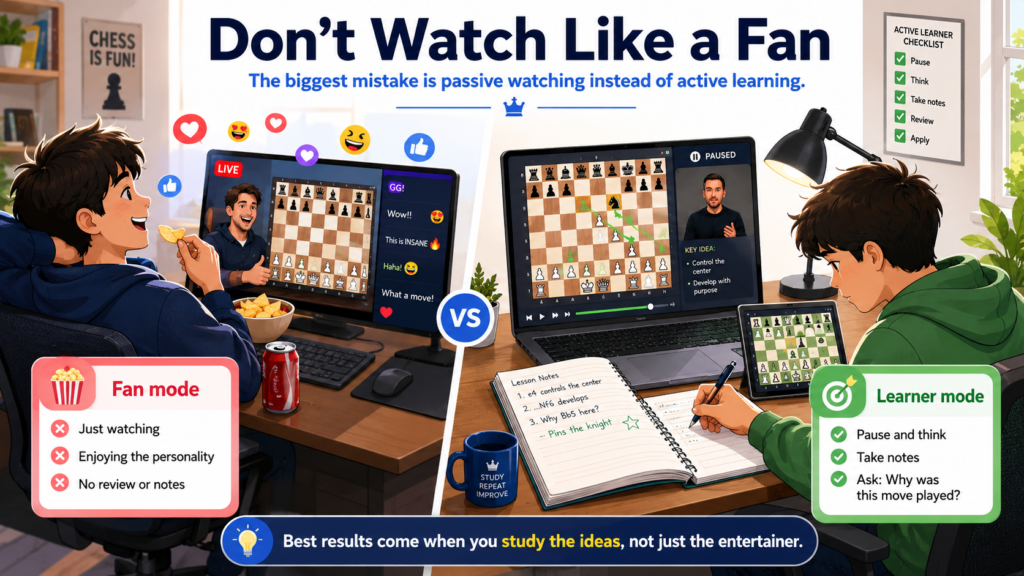
If the goal is improvement, the student needs to watch with a purpose. A streamer can play a great move, but the move only helps the viewer if the viewer understands why it was played. The real value is not in the move itself. The real value is in the thought behind it.
A child who watches passively may remember the streamer’s joke but forget the chess idea. A child who watches actively may remember a simple habit that saves them in their next game.
A good viewer keeps asking what changed in the position
Chess changes move by move. One move may open a file. Another move may weaken a square. One trade may remove a defender. One pawn push may give the king less safety. A useful chess viewer learns to notice these changes.
This is much better than only asking, “Who is winning?” That question comes too late. The better question is, “Why is one side starting to get better?”
When a child learns to spot small changes, chess starts to make more sense. Games stop feeling like random attacks. The student begins to see that strong players build pressure before they win.
The best chess streamers help you notice the hidden reason behind the move
A helpful streamer will often say things like, “This piece has no good square,” or “This pawn is weak,” or “I want to trade this defender.” Those small notes are gold. They teach the student how to see the board like a thinker.
Parents can help by watching one short part with their child and asking, “What changed after that move?” The answer does not need to be perfect. The point is to train the child to look deeper.
This is also what happens in a good chess class. At Debsie, students are not only told which move is right. Coaches help them see what changed, why it matters, and how to use that idea in their own games.
Students should not copy streamer openings without knowing the plan
Chess streamers often play exciting openings. Some play gambits. Some play sharp attacks. Some play fast systems that look easy. A child may see a streamer win a quick game and think, “I want to play that too.”
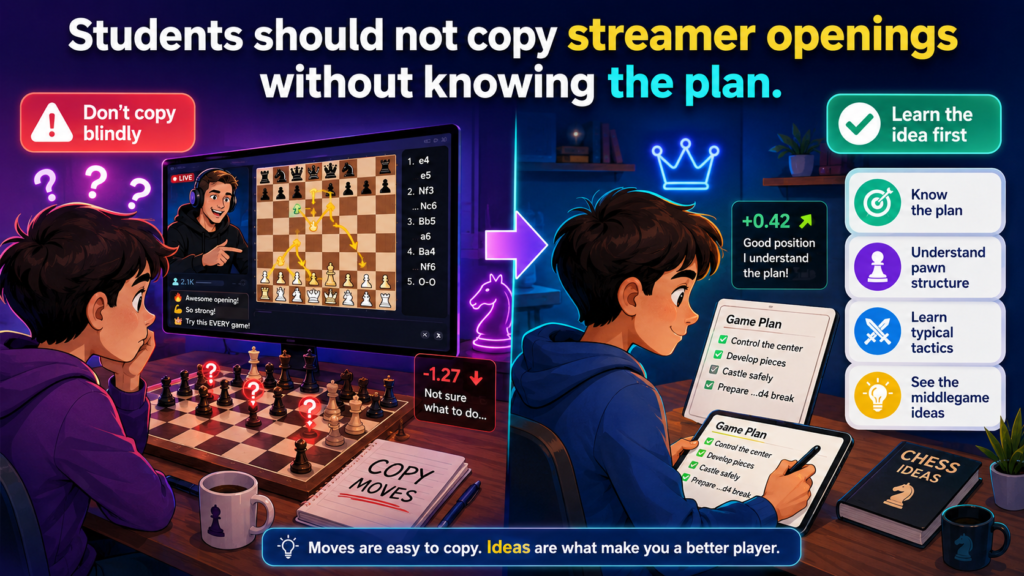
That can be fun, but it can also become a problem.
Many streamer openings work because the streamer already understands the danger, the tactics, and the backup plans. A young player may copy the first few moves but not understand what to do next. Then the opponent plays one strange move, and the child is lost.
Openings are not magic spells. They are starting plans.
A strong opening should help the student develop, stay safe, and understand the middle game
For most kids, the best opening is not the fanciest one. The best opening is the one they can explain. If the child can say where the knights go, where the bishops go, when to castle, and what center plan they want, that opening is useful.
If the child only knows, “The streamer played this, so I play it,” the opening is not ready yet.
A simple opening played with understanding is better than a sharp opening played from memory. This is especially true in online games, where opponents often do not follow the main line. The child must be able to think after the opening changes.
Before copying any streamer opening, the student should ask what the idea is
This is a simple but powerful rule. Before your child adds any new opening from a streamer, ask them to explain it in their own words.
What is White trying to do? What is Black trying to stop? Which piece is most important? Is the king safe? What happens if the opponent does not play the expected move?
If your child can answer in simple words, the opening may be worth trying. If not, they need more guidance first.
At Debsie, coaches help students choose openings that fit their level. This is very important because the wrong opening can waste months. The right opening can build confidence, planning skill, and better results.
Conclusion
Chess streamers can spark love for the game, but the best growth comes when kids watch with purpose, pause to think, and then practice what they learn. The right streamer can teach patterns, confidence, patience, and smart choices, but a child still needs clear feedback to turn ideas into habits.
That is where Debsie helps. With expert coaches, live lessons, private support, and fun tournaments, students learn chess step by step while building focus for life. If your child enjoys chess videos, book a free Debsie trial class and help that interest become real skill, pride, and lasting confidence today.
Adhip Ray is the founder of Debsie, an online learning platform focused on chess and skill-based learning for children. His work at Debsie brings together chess education, structured thinking, problem-solving, and interactive learning for young students.
Adhip has an academic background in law, statistics, analytics, and technology. He is from Amity Law School and the Indian Statistical Institute, Kolkata, with formal training that connects legal reasoning, data analytics, quantitative thinking, and structured problem-solving. This interdisciplinary background is reflected in Debsie’s focus on building sharper thinking skills in children through chess and related learning programs.
Adhip is also a FIDE-rated chess player from India. He holds FIDE ID 5055954 and has a standard FIDE rating of 1832. His FIDE profile records him as an Indian player with a long rating history in standard chess, including rated games from his competitive playing years. His chess background gives Debsie a founder-led connection to the game, not only as an educational activity but also as a competitive discipline that develops concentration, calculation, planning, and decision-making.
In addition to chess, Adhip has a strong interest in coding, data, and technical problem-solving.
Adhip’s profile combines chess, law, data analytics, and programming. At Debsie, this background supports the creation of learning experiences that are logical, structured, and skill-oriented. The platform’s chess-focused programs are connected to broader cognitive skills such as pattern recognition, patience, strategic planning, focus, and problem-solving.
As founder of Debsie, Adhip brings together experience from multiple fields: formal legal education from Amity Law School, analytical training from the Indian Statistical Institute, Kolkata, competitive chess experience through his FIDE-rated profile, and coding practice through LeetCode. This combination gives Debsie a distinct foundation in strategy, reasoning, analytics, and child-focused learning.
Through Debsie, Adhip is associated with building chess and learning content for children that goes beyond basic instruction. The platform connects chess with thinking skills, helping students approach challenges with more structure, clarity, and confidence. His own background in chess and analytical problem-solving gives the platform a direct link to the skills it aims to develop in young learners.
Adhip is also a member of Forbes Business Council.