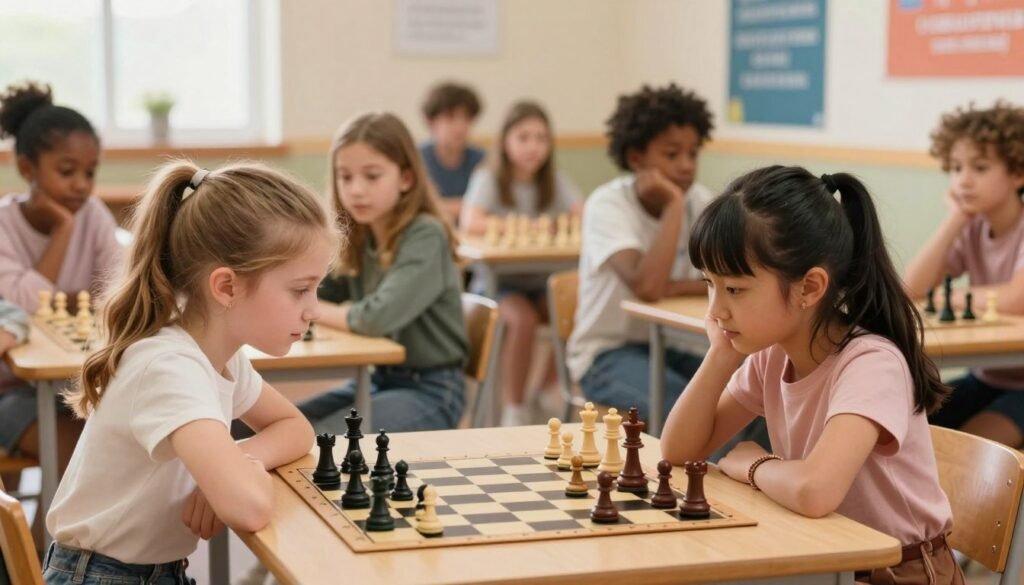
A quiet change is happening in chess. Young girls are no longer just “promising.” They are beating strong players, winning big events, gaining ratings fast, and showing the world that the next chess stars may already be sitting at the board today.
Find the right learning experience
Tell us a little about the learner and what you are looking for. Our team will review your answers and help you identify the most suitable next step.
- Takes only a few minutes
- No payment required
- Personalised recommendations
Your information will only be used to respond to your enquiry.
Why junior girls’ chess is growing so fast right now
The world of girls’ chess is not waiting for the future anymore. The future is already here. Young players are getting stronger at a speed that would have shocked people even ten years ago.

They are playing online, studying with engines, joining strong open events, and facing adults much earlier than many players did in the past. This is why the best junior girls in chess are not just winning age-group medals. Many of them are already fighting titled players and sometimes beating them.
FIDE’s May 2026 rating page shows how serious this group has become. Anna Shukhman is listed as the top standard-rated girl at 2456, Alice Lee is listed as the top rapid-rated girl at 2415, and Eline Roebers is listed as the top blitz-rated girl at 2425.
That matters because it shows that strength is now spread across different time controls, not just slow chess. A future champion must think well, move fast when needed, and stay calm under pressure.
The rating table tells only part of the story
Ratings are useful, but they do not tell the full story. A rating shows results from the past. It does not always show hunger, training habits, courage, or how fast a player is growing. Some young players rise in small steps. Others jump fast after one great run of events.
Find the right learning experience
Tell us a little about the learner and what you are looking for. Our team will review your answers and help you identify the most suitable next step.
- Takes only a few minutes
- No payment required
- Personalised recommendations
Your information will only be used to respond to your enquiry.
That is why smart chess parents and coaches look at both numbers and patterns.
A player who keeps gaining rating while playing stronger events is often more interesting than a player who only protects a high rating. This is one reason players like Bodhana Sivanandan, Lu Miaoyi, Alua Nurman, Alice Lee, Anna Shukhman, Afruza Khamdamova, and Eline Roebers are watched so closely.
They are not all the same type of player, but they share one thing. They are not afraid to test themselves.
What this means for young players at home
For a child who is learning chess, this is a powerful lesson. You do not become strong by only playing easy games. You grow when you face hard positions, make mistakes, review them, and come back with a better plan.
That is the same idea Debsie uses in its chess learning path. Children need kind support, but they also need real challenges that help them think deeper.
Parents should not look at these top junior girls and think, “My child must become like them.” A better thought is, “What habits can my child copy?” The answer is simple. Play often. Review losses. Learn one idea at a time. Stay patient. Ask better questions. These habits help in chess, but they also help in school and in life.
What makes a future chess champion easy to spot
A future champion is not always the child who wins every game at age eight or nine. Early wins are nice, but they can fool people. The real signs are deeper. A future champion stays curious after a loss. She wants to know why a move failed. She does not only ask, “Did I win?” She asks, “Did I understand the position?”
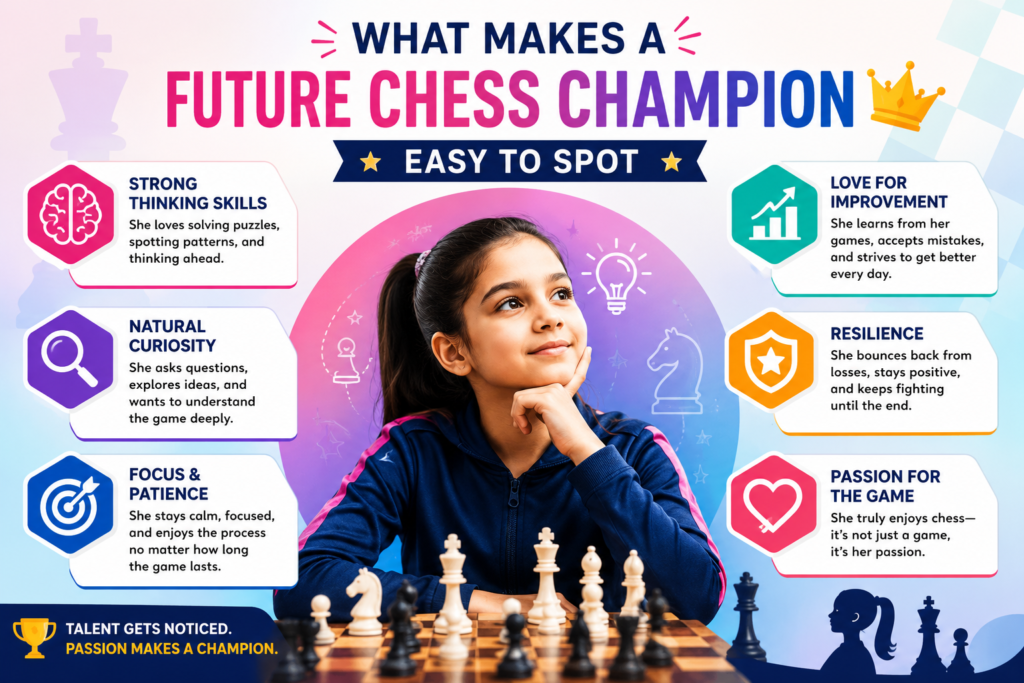
That is the big difference. Strong junior girls usually build a thinking system. They learn how to look for threats, improve pieces, protect the king, and choose plans. They do not just hope for tricks. They learn how to create pressure.
Even when they are young, their games often show patience that many adults still struggle to build.
Strong players are trained, not magically born
Some children have natural talent, but talent alone is not enough. Chess growth needs steady training. It needs games, puzzles, review, openings, endgames, and match practice. But the best training is not random.
A child who solves puzzles for one hour without learning why the answer works may not improve much. A child who studies fewer positions but explains the idea clearly may grow faster.
This is where a good coach can make a huge difference. Many parents buy books, apps, and courses, but the child still feels lost. A coach can turn messy learning into a clear path. At Debsie, this is why live classes and private coaching matter so much.
A child gets to ask questions, speak ideas out loud, and learn in a way that fits how they think.
The simple test parents can use
Here is a simple way to see if your child is learning well. After a game, ask your child what changed the result.
Do not ask only if they won or lost. Ask what move they were proud of, what move they would change, and what plan they missed. If your child can explain even one clear lesson, the game was useful.
This habit turns every game into a training tool. It also builds calm thinking. Children learn that mistakes are not shameful. Mistakes are clues. That mindset is one of the biggest gifts chess can give a child. It teaches them to slow down, think clearly, and try again with a stronger mind.
The top junior girls show different ways to win
One of the best things about watching the best junior girls in chess is that they do not all win in the same way. Some are sharp attackers. Some are calm defenders. Some love fast chess. Some are strongest in long games.
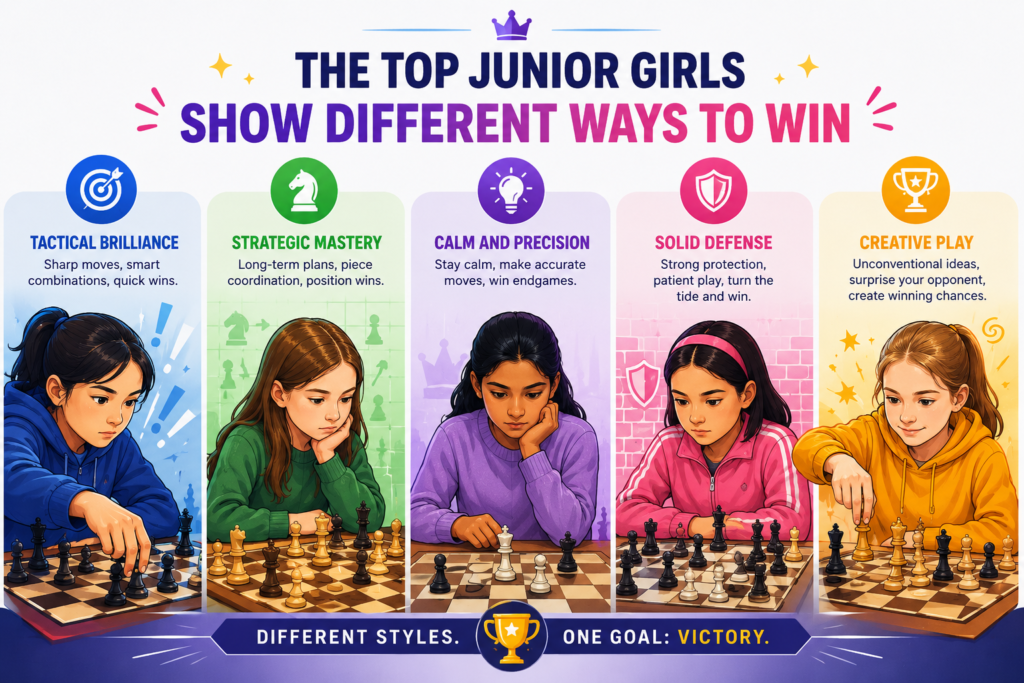
This is good news for young players because it proves there is no single “perfect” chess style. A child can grow in her own way.
Anna Shukhman’s rise to the top of the May 2026 FIDE standard girls list shows the value of strong classical play. Standard chess is slow and deep. It rewards players who can plan, calculate, and stay focused for hours. A young player who becomes strong in this format is building a serious base for the future.
Fast chess is now part of the champion’s path
Rapid and blitz chess are also important now. FIDE lists Alice Lee as the top rapid girl and Eline Roebers as the top blitz girl on its May 2026 ratings page. This tells us something clear. The modern young star must handle both deep thought and quick choices.
Fast chess builds pattern memory. It teaches players to trust their training when the clock is low.
But parents should be careful. Blitz can be fun, but too much blitz without review can build bad habits. A child may start moving too fast, guessing, or playing tricks instead of good chess. The best use of fast chess is as a test, not as the full meal. Slow games build the brain. Fast games test the reflexes.
How your child can copy this in a healthy way
A good weekly chess plan should mix slow thinking and quick practice. A child might play longer games to build deep skill, then use rapid games to test ideas under time pressure. The key is review. Without review, games become noise. With review, every game becomes a lesson.
At Debsie, this balance is built into the learning experience through live classes, private coaching, and online tournaments. Students do not just play and move on. They learn how to understand their choices.
That is how chess becomes more than a board game. It becomes a way to train focus, patience, and smart thinking.
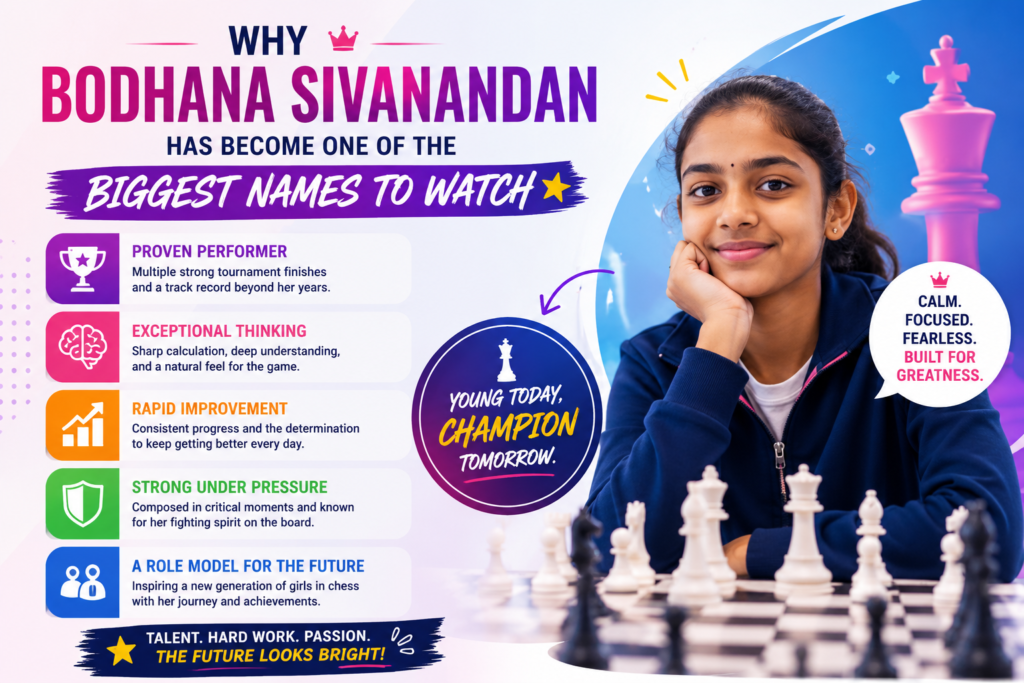
Why Bodhana Sivanandan has become one of the biggest names to watch
Bodhana Sivanandan is one of the most exciting young names in world chess because her rise has been so fast and so rare.
In April 2026, the English Chess Federation said she became England’s top female player at only 11 years old. The same report said she entered the world’s top 100 women and reached a FIDE rating of 2366 after strong results in France, Austria, and Britain’s 4NCL league.
What makes her story even more inspiring is how normal the start sounds. The English Chess Federation reported that she began during lockdown after finding a chess set in a bag her father planned to throw away.
That small moment turned into a major chess journey. For parents, this is a beautiful reminder. A child’s big path can begin with one simple spark.
Her story is about courage, not just rating
Bodhana has also shown that age does not protect older players from good moves. The English Chess Federation reported that she beat former Women’s World Champion Mariya Muzychuk at the European Club Cup and became the youngest female player to beat a grandmaster when she defeated GM Peter Wells at the 2025 British Chess Championships.
These are not small moments. They show courage under pressure.
For a young chess student, this is not a message to rush. It is a message to believe. Children often think strong players are “too good” before the game even starts. Bodhana’s rise shows the opposite. Respect your opponent, but do not fear them. Sit down, think clearly, and play the board.
The parent lesson from Bodhana’s rise
Parents should notice the deeper lesson here. Great progress often begins when a child feels safe enough to try, lose, learn, and try again. Pressure can break love for the game. Support can protect it. The goal is not to force a child into greatness.
The goal is to give the child the right space, the right guide, and the right reason to keep growing.
This is why a free Debsie chess trial class can be such a helpful first step. It gives your child a chance to meet expert coaches, enjoy a live lesson, and see how structured chess learning feels before making a bigger decision.
Alice Lee shows why calm confidence can beat loud pressure
Alice Lee is one of the best junior girls in chess because her game has a rare mix of speed, control, and quiet strength. She does not need to make every game wild. She can press small edges, keep her pieces active, and make the other player solve hard problems for a long time.
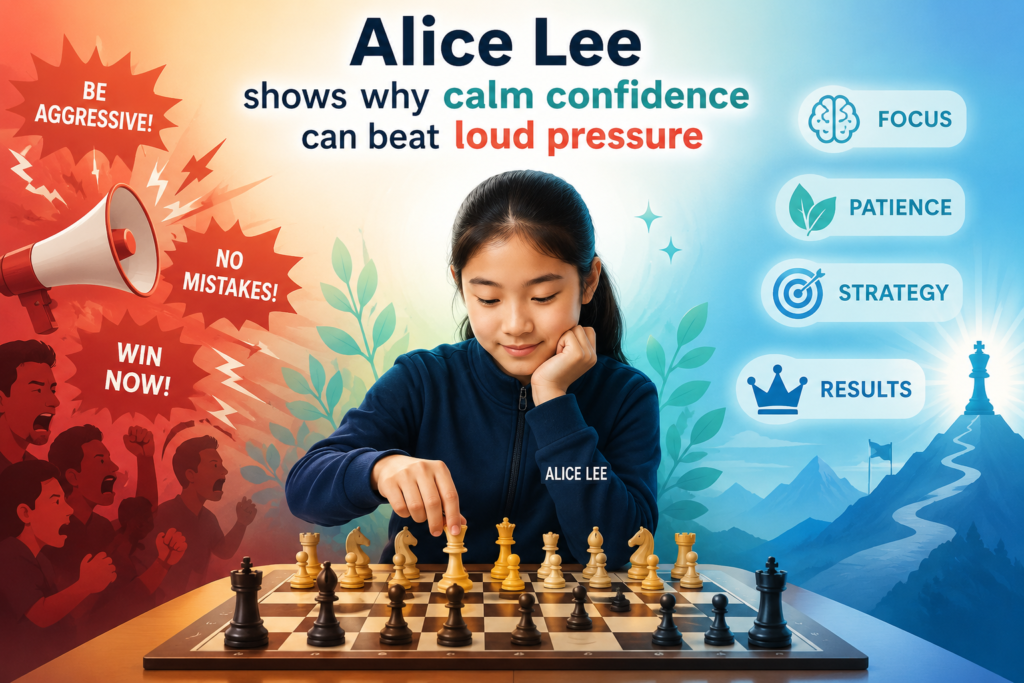
That is a strong skill because many young players only know how to attack. Alice can attack too, but she also knows how to wait.
Find the right learning experience
Tell us a little about the learner and what you are looking for. Our team will review your answers and help you identify the most suitable next step.
- Takes only a few minutes
- No payment required
- Personalised recommendations
Your information will only be used to respond to your enquiry.
FIDE lists Alice Lee as an International Master and Woman Grandmaster, with a May 2026 standard rating of 2415, rapid rating of 2415, and blitz rating of 2389. That balance across all three formats is important. It shows she is not only good when she has lots of time.
She can also make strong choices when the clock is moving fast.
Her rise is a lesson in steady growth
Alice became the youngest American female International Master, according to US Chess. That record matters, but the better lesson is how she got there. She kept playing strong events, facing hard opponents, and building a style that works under pressure.
She has also been part of a new wave of American girls who are showing that young female players can compete at a very high level, not just in girls’ events, but in serious open events too.
For parents, Alice’s path teaches a simple truth. A child does not need to look loud to be strong. Some children show confidence by talking a lot. Others show confidence by staying calm, taking their time, and trusting their choices. Chess gives both kinds of children a place to grow.
What young players can learn from Alice Lee’s style
The best lesson from Alice Lee is that you do not have to win in a hurry. Many kids lose games because they want to finish too fast. They see one check, one capture, or one threat, and they move before asking if the move is safe.
Strong players slow down at the key moment. They look at what the opponent wants. They check if their king is safe. They ask if their pieces are working together.
This is a habit every child can learn. Before making a move, your child can pause and ask, “What is my opponent trying to do?” That one question can save many games. It also teaches a life skill. In school, friendship, and family life, smart choices often begin with the same pause.
At Debsie, coaches help children build this pause into their thinking. The goal is not to make chess feel scary or heavy. The goal is to help kids enjoy the game while learning how to think before they act.
That is one reason a free Debsie trial class can be a great first step for a child who wants to play better and feel more sure at the board.
Lu Miaoyi is a strong reminder that early training can build deep skill
Lu Miaoyi is another junior girl who feels like a future world-class player. She is from China, a country with a proud history in women’s chess. That matters because strong chess culture can shape a young player. When a child grows around good chess ideas, good coaches, and serious events, the path becomes clearer.
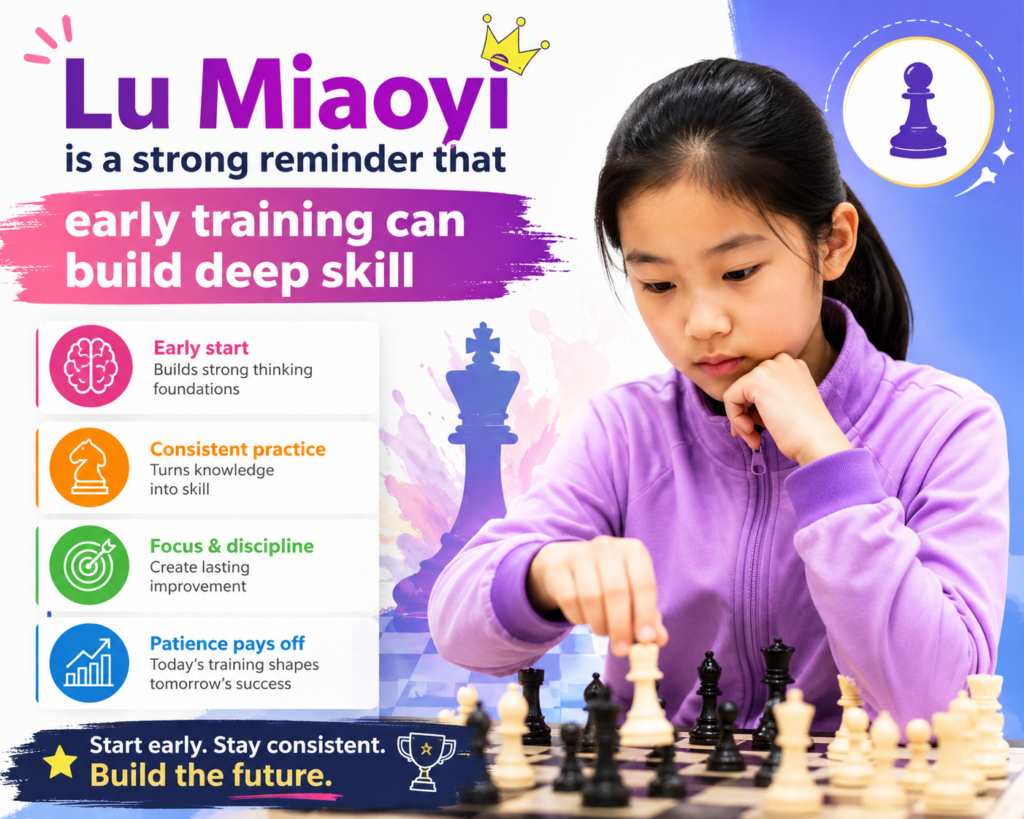
FIDE lists Lu Miaoyi as an International Master and Woman Grandmaster, born in 2010, with a standard rating above 2400 in recent rating data.
Her FIDE profile shows her May 2026 standard rating as 2435, with rapid and blitz ratings also listed. For a player who is still so young, that is a serious level of strength.
Her games show brave attacking ideas
Lu is often praised for her fearless play. The Guardian wrote in 2024 that she and Alice Lee were both among the youngest 2400-plus rated women players, and it also described Lu’s fast progress and attacking wins against strong opposition.
Reports like that are why many chess fans watch her closely. She does not look like a player who is happy to stay safe forever. She looks for chances to take over the game.
This kind of chess is exciting, but it is not reckless when done well. Strong attacking chess needs calculation. It needs timing. It needs a feel for danger. A good attack is not just pushing pawns toward the king and hoping something works.
It is about bringing pieces to the right squares, opening lines at the right time, and knowing when the opponent’s king has no easy shelter.
How a child can build brave but safe chess
Parents often ask if their child should play attacking chess or quiet chess. The best answer is both. A child should learn how to attack, but also learn when not to attack. That is where guided training helps. A young player needs to see the difference between a real attack and a wishful attack.
One simple training habit is to ask after every attacking move, “What happens if my opponent ignores me?” If the answer is unclear, the attack may not be ready. If the move creates a clear threat and improves a piece, then it may be strong. This small test can help children stop guessing and start planning.
Debsie coaches teach these ideas in a friendly way so children do not feel lost. A child learns to be brave, but not careless. They learn to take chances, but not random ones. That is the kind of thinking that helps in chess and in real life. It teaches kids that courage is strongest when it has a plan.
Afruza Khamdamova proves that winning young can come from discipline
Afruza Khamdamova from Uzbekistan is one of the most important junior girls to watch because her record shows both talent and discipline. FIDE lists her as a Woman Grandmaster, born in 2009, with a May 2026 standard rating of 2423.
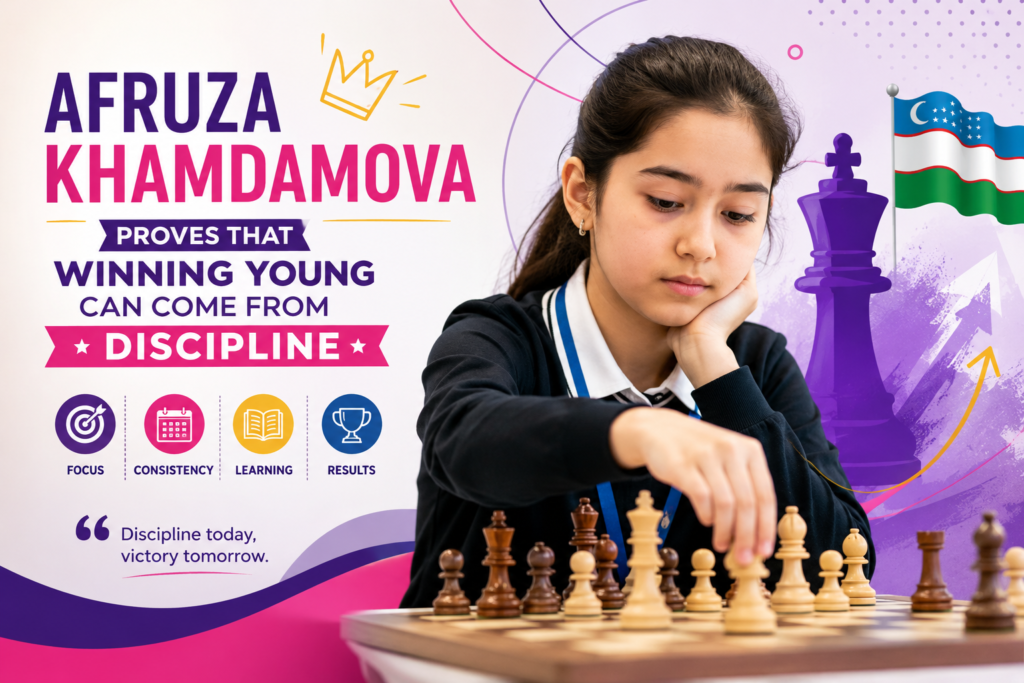
Her FIDE profile also shows International Master approval in 2026 and Woman Grandmaster approval in 2025. That is a strong title path for a young player.
Afruza’s story also matters because she comes from a growing chess nation. Uzbekistan has become a major force in world chess, and young players from the country are now gaining more attention. When one player rises, it can inspire many more children around her. That is how chess cultures grow.
Her youth results show strong focus under pressure
Afruza has been linked with major girls’ youth success, including world youth championship wins. Her profile and public chess records show that she has built her name through serious tournament play, not just online fame.
That is important because over-the-board chess is different. You sit face to face with your opponent. You manage nerves. You handle long games. You cannot hide from the result.
Young players who win big events often share one habit. They recover fast. Every tournament has bad moments. A strong player can lose a game, feel the pain, and still come back ready for the next round.
That emotional skill is just as important as opening study. Many children have the chess talent, but they struggle when one mistake ruins their mood.
Why emotional strength is part of chess training
This is where parents can help a lot. After a child loses, the first words should not be harsh. A child already knows losing hurts. The better move is to help them breathe, rest, and then review the game when they are ready. The question should be, “What can we learn?” not “Why did you do that?”
Chess can teach children how to handle hard days without giving up. That is one of its greatest gifts. In life, children will face tests, sports losses, friendship problems, and school pressure. Chess gives them a safe place to practice staying steady.
At Debsie, students get this kind of support through expert-led lessons and regular practice. They learn that the result matters, but the lesson matters more. That mindset builds stronger chess players and stronger young people.
A free trial class can help your child feel this style of learning before joining the full program.
Alua Nurman shows the power of a late-junior rating surge
Alua Nurman is a great example of why we should not only watch the youngest stars. Some players make their biggest jump in the later junior years. That kind of rise can be very powerful because the player is often more mature, more focused, and better able to handle hard training.
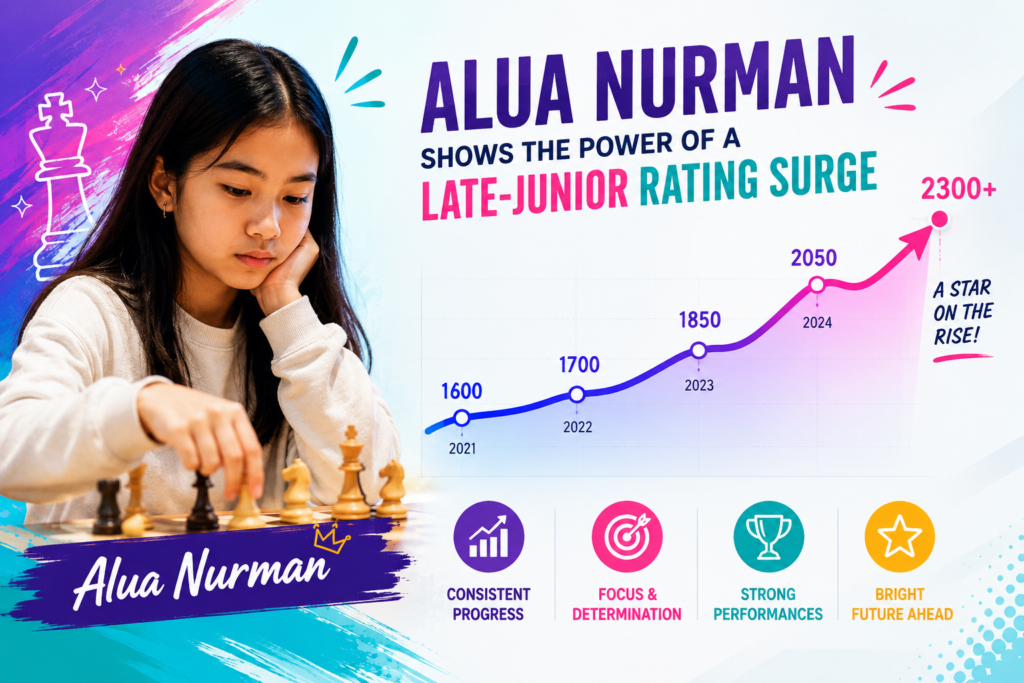
FIDE lists Alua Nurman from Kazakhstan as an International Master and Woman Grandmaster, born in 2007, with a May 2026 standard rating of 2443. Her FIDE profile also shows her International Master title approval in 2026 and Woman Grandmaster title approval in 2024.
That puts her among the strongest junior girls in the world.
Her rise is also a lesson in staying ready
A recent Kazakh report said Alua reached second place in the updated FIDE junior girls’ rankings with 2443 points after climbing 14 spots. Big jumps like that usually do not come from luck alone. They often come when years of work begin to show in tournament results.
This is a helpful lesson for parents whose children are not winning everything right away. Chess growth is not always straight. A child may improve for months before the rating catches up. They may understand more, calculate better, and still lose because they are facing stronger players.
Then one tournament comes, and the results finally show the work.
How parents can support the slow climb
The best thing a parent can do is not panic during plateaus. A plateau is a time when the child’s results look stuck, but the mind may still be growing. During this stage, the child needs clear training, kind support, and enough rest. More pressure is not always the answer. Better learning is the answer.
A smart plan is to focus on one weakness at a time. If your child loses pieces, work on board vision. If your child struggles in the endgame, study simple king and pawn positions. If your child moves too fast, practice slow games. Trying to fix everything at once usually makes the child tired.
This is why structured coaching matters. Debsie helps students follow a path that fits their level, instead of jumping from one random video to another. Kids learn step by step, and parents can see real growth in focus, patience, and confidence.
Eline Roebers shows why speed is not the same as rushing
Eline Roebers is one of the most interesting junior girls in chess because her strength is not limited to one type of game. She has played strong classical chess, but her blitz rating also shows how sharp she can be when the clock is tight.
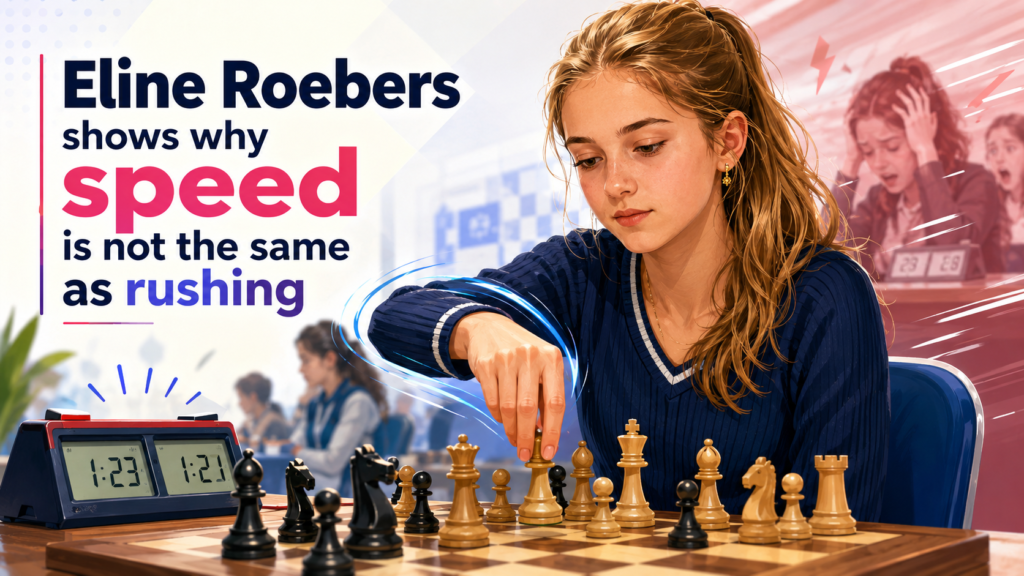
FIDE lists her as an International Master, with a May 2026 standard rating of 2389 and a blitz rating of 2425. That high blitz number matters because fast chess often shows how well a player understands patterns without needing a long think every move.
Still, there is a big lesson here for children. Fast does not mean careless. Strong blitz players do not just throw pieces around. They see common ideas quickly because they have studied them many times before.
They know where pieces belong. They know what danger looks like. They know which checks matter and which checks are empty noise.
Young players should learn to move with purpose, not panic
Many kids love blitz because it feels fun and exciting. That is fine. Chess should be fun. But when a child only plays fast games, they may start to move before they think. They may win some games with tricks, then lose badly when stronger players defend well. This is where parents need to guide the balance.
A strong player like Eline reminds us that quick chess skill is built on deep chess learning. You cannot play fast well if you do not understand slow positions first. It is like reading. A child can read faster only after they know the words. In chess, the “words” are pins, forks, weak squares, open files, king safety, and endgame ideas.
The Debsie way to build smart speed
A healthy training path starts with slow thinking. The child learns to ask, “What is attacked?” and “What does my opponent want?” Then, once these questions become natural, speed improves on its own. The goal is not to rush. The goal is to see clearly.
At Debsie, this is why students are taught step by step. Coaches help kids slow down at the right moments, then trust their skills when the position is clear. This builds more than rating. It builds calm focus. It teaches children not to panic when time is low, in chess or in life.
A free Debsie trial class is a gentle way to see this in action. Your child can learn with expert coaches, ask questions, and feel how smart chess training can be both serious and fun.
Anna Shukhman is a name every chess fan should watch closely
Anna Shukhman has become one of the strongest names in junior girls’ chess. Her FIDE profile lists her as a Woman Grandmaster, with a May 2026 standard rating of 2456. It also shows a clear rise from 2280 in May 2024 to 2456 in May 2026, which is a major climb at this level.
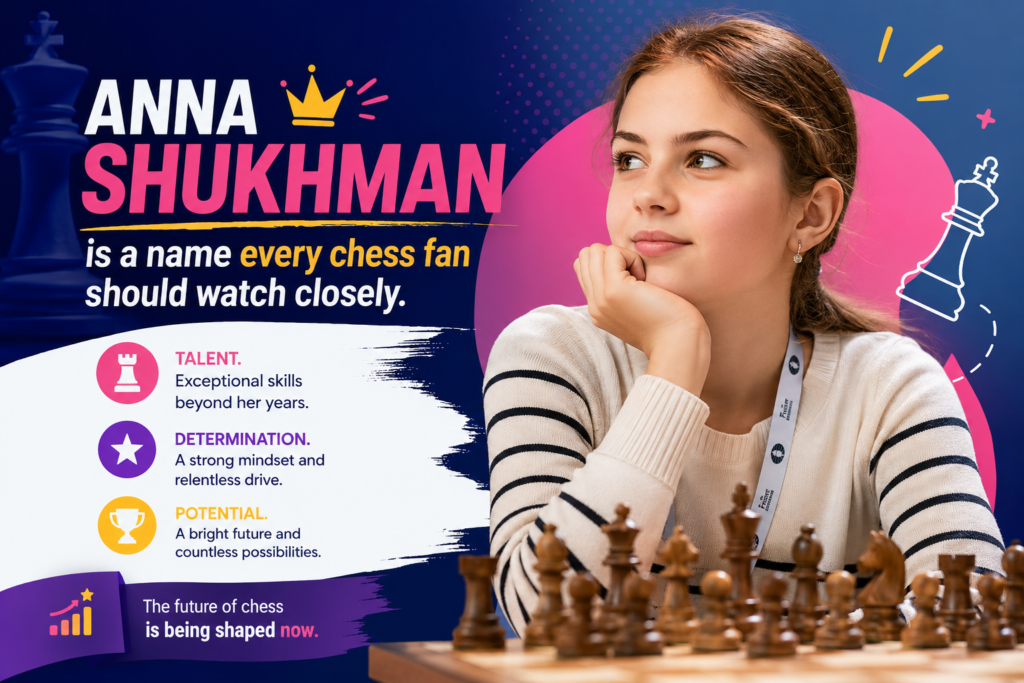
Once a player is already above 2200, every rating point is harder to earn.
This kind of rise tells us something important. Anna is not just having one good month. She has been building strength over time. Her rating growth shows that she can keep improving even when opponents get stronger. That is one of the biggest signs of a future top player.
Her progress shows the value of long-term work
Many parents want quick results. They want their child to play better after one class, one book, or one weekend tournament. Small wins can happen fast, but deep chess strength takes time. Anna’s rise is a reminder that real growth is built layer by layer.
A child may first learn not to hang pieces. Then she learns simple tactics. Then she starts to understand plans. Then she studies pawn breaks. Then she begins to feel endgames better. Each layer matters. Skipping steps may look fast at first, but it often creates gaps later.
What young players can copy from this kind of rise
The key lesson is simple. Track learning, not only trophies. A child should ask, “Am I seeing more than I saw last month?” That question keeps growth healthy. Some tournaments will go badly. Some games will hurt. But if the child is learning, the path is still working.
Parents can help by praising the right things. Praise careful thinking. Praise effort after a loss. Praise the courage to play stronger opponents. Praise the child for reviewing mistakes. These small words shape how a child sees chess.
Debsie’s coaching is built around this same idea. Children do not just memorize moves. They learn how to think. They learn why a move works. They learn how to recover after mistakes. That is how chess becomes a tool for confidence, patience, and smarter choices.
Rose Atwell proves that strong competition can shape a fearless player
Rose Atwell is another junior girl who deserves close attention. FIDE lists her as a FIDE Master from the United States, born in 2009, with a May 2026 standard rating of 2383. Her profile also shows that she had an International Master title decision marked open in 2026, which is a sign that her title path is moving into serious territory.
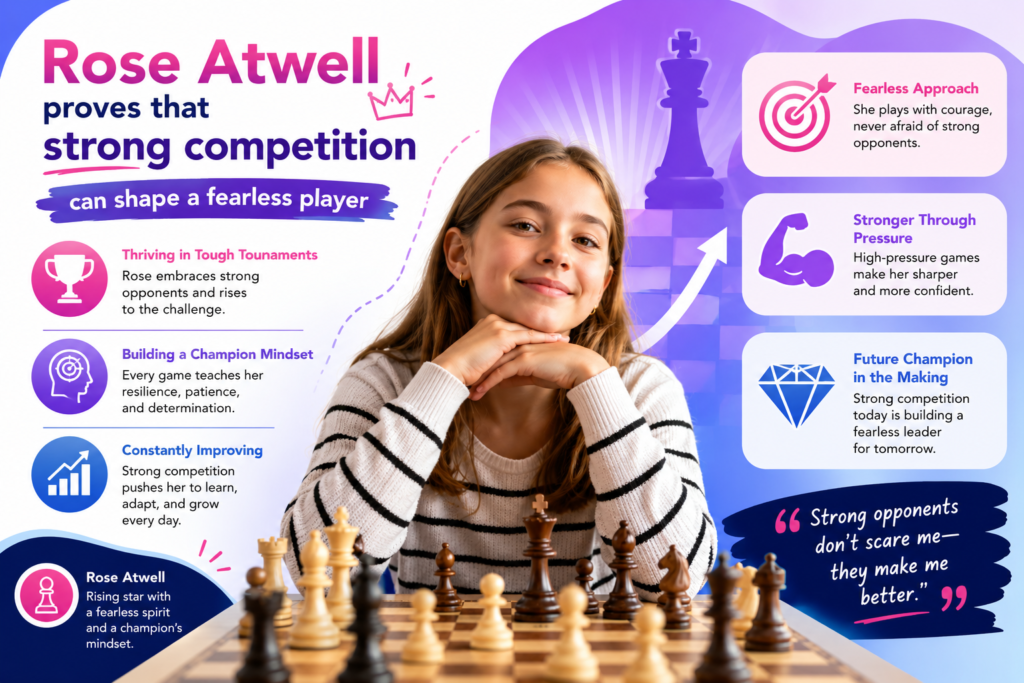
Rose’s progress is important because American chess has become very competitive for young players. A strong junior in the United States often faces deep fields, tough open tournaments, and players who are used to fighting hard.
This can be stressful, but it can also build strength. When a child faces strong opposition often, she learns faster.
Her path shows why hard games are good for growth
It is easy for a young player to enjoy winning easy games. Winning feels nice. But easy games do not always teach enough. Hard games reveal the truth. They show where calculation breaks. They show which openings are weak. They show if the child can stay calm after a surprise.
This is why Rose is a useful player for young students to study. Her rating level shows that she has already passed many hard tests. A player does not reach this level by only beating beginners. She has had to solve real problems over the board.
How parents can help kids face stronger players
Parents should not protect children from every hard game. The better plan is to help them prepare for hard games in a kind way. Before the game, the child can focus on playing good moves, not on the opponent’s rating.
After the game, the child can review one or two key moments instead of feeling crushed by the result.
This keeps chess healthy. The child learns that strong opponents are not monsters. They are teachers. Every game gives feedback. Every mistake points to the next lesson.
At Debsie, students get the support they need to face challenges without losing joy. Coaches explain mistakes in a simple way. They help children see progress even when results are not perfect. This makes kids braver, not just better.
The biggest lesson from these junior girls is that chess growth needs a system
When we look at players like Anna Shukhman, Alua Nurman, Lu Miaoyi, Afruza Khamdamova, Alice Lee, Eline Roebers, Rose Atwell, and Bodhana Sivanandan, one truth becomes clear. Great chess does not come from random practice. It comes from a system.
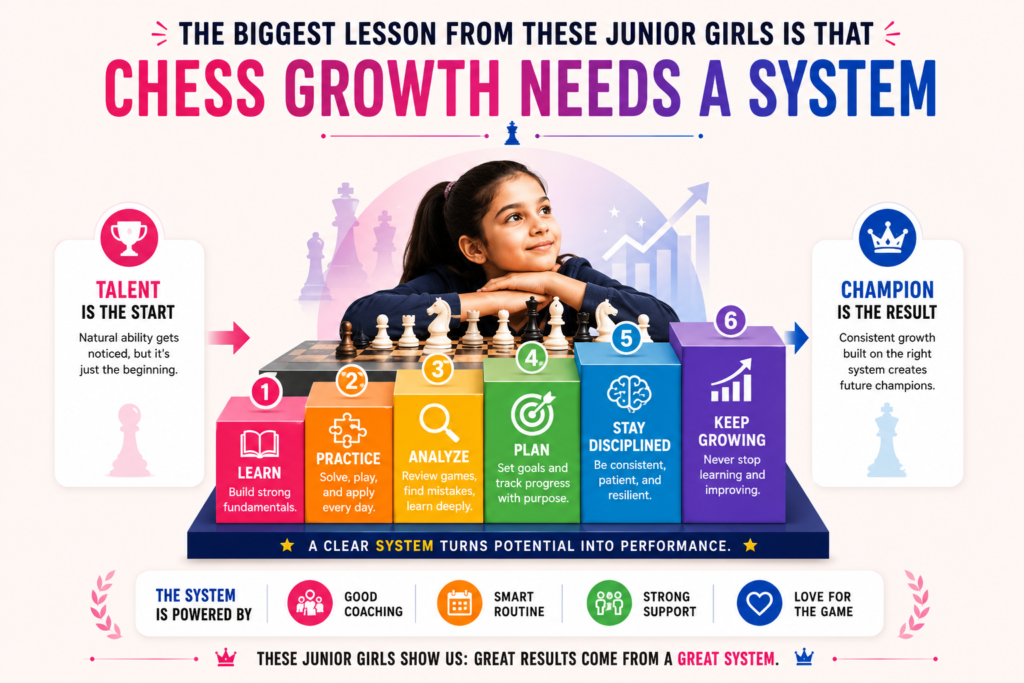
These players may have different styles, countries, coaches, and stories, but they all show signs of serious, steady work.
That system does not need to be scary. It does not need to turn a child’s life into pressure. In fact, the best system should protect the child’s love for chess. It should make learning clear, not confusing. It should help the child know what to study next.
A good chess system has rhythm and purpose
For most young players, the best rhythm is simple. They need lessons, practice games, puzzle training, game review, and tournaments.
But these parts must connect. A child should not learn one opening today, solve random puzzles tomorrow, play blitz all weekend, and never review anything. That feels busy, but busy is not the same as progress.
A better path is more focused. The child learns a theme in class, practices it in games, reviews where it appeared, and then repeats it until the idea feels natural. That is how learning sticks. That is also how confidence grows.
Why Debsie is a smart next step for young chess learners
Debsie gives children a clear and warm place to grow. The platform offers live interactive classes, private coaching, and regular online tournaments, so students can learn ideas, test them, and improve with support.
The coaches are FIDE-certified, which means children are guided by people who understand both chess and player growth.
This matters because parents do not need to guess the whole path alone. Your child gets structure. Your child gets feedback. Your child gets a community. And most of all, your child gets a chance to build life skills through chess.
Chess teaches kids to wait, think, plan, and stay calm. It teaches them that one mistake does not end the story. It teaches them to look deeper before making a choice. That is why watching these junior girls is so inspiring.
They are not only showing what the future of chess may look like. They are showing what steady learning can do for any child who is ready to grow.
What young girls can learn from recent junior stars who have moved into the women’s elite
Some players are not just names to watch anymore. They have already started to move from “future star” to “top women’s chess player.” This matters because young juniors need role models at every step. They need to see what the next level looks like after youth events, school events, and junior titles.

Divya Deshmukh is a strong example. FIDE lists her as a Grandmaster and Woman Grandmaster from India, born in 2005, with a May 2026 standard rating of 2500. She is not in the same junior-girls group as the youngest names anymore, but her path is still very useful for young players because she shows how a strong junior career can turn into real elite chess.
The jump from junior chess to adult chess is a big step
Junior chess can be hard, but adult chess is different. In junior events, many players attack fast, miss tactics, or feel nervous in long games. In strong adult events, players defend better. They know openings deeper. They punish small mistakes.
A young player who wants to grow must learn how to win when the opponent does not fall for easy tricks.
This is where recent junior stars teach a key lesson. They show that a player must become complete. A strong young girl cannot only depend on one weapon. She needs tactics, endgames, openings, calm defense, time control, and emotional strength. Even more, she needs to stay hungry after early success.
The smart lesson for parents is to think beyond medals
Parents often focus on the next trophy. That is natural because trophies are easy to see. But the deeper goal is to build a player who can keep improving year after year. A medal is a moment. A strong thinking system can help a child for life.
So when your child wins, celebrate it. But after the smile, ask what skill got stronger. Did she calculate better? Did she stay calm in a worse position? Did she use her time well? Did she recover after a mistake? These answers matter more than the medal table.
At Debsie, this is the kind of growth we care about. Chess is not taught as a race for quick praise. It is taught as a way to help children think clearly, stay patient, and trust their own mind. That is how young players become ready for harder levels.
Why Bodhana Sivanandan’s story is especially powerful for younger children
Bodhana Sivanandan deserves another look because her story speaks to very young children in a special way. Many chess articles focus on teens, but Bodhana shows that even a child in primary school can learn serious chess ideas when the right support is in place.
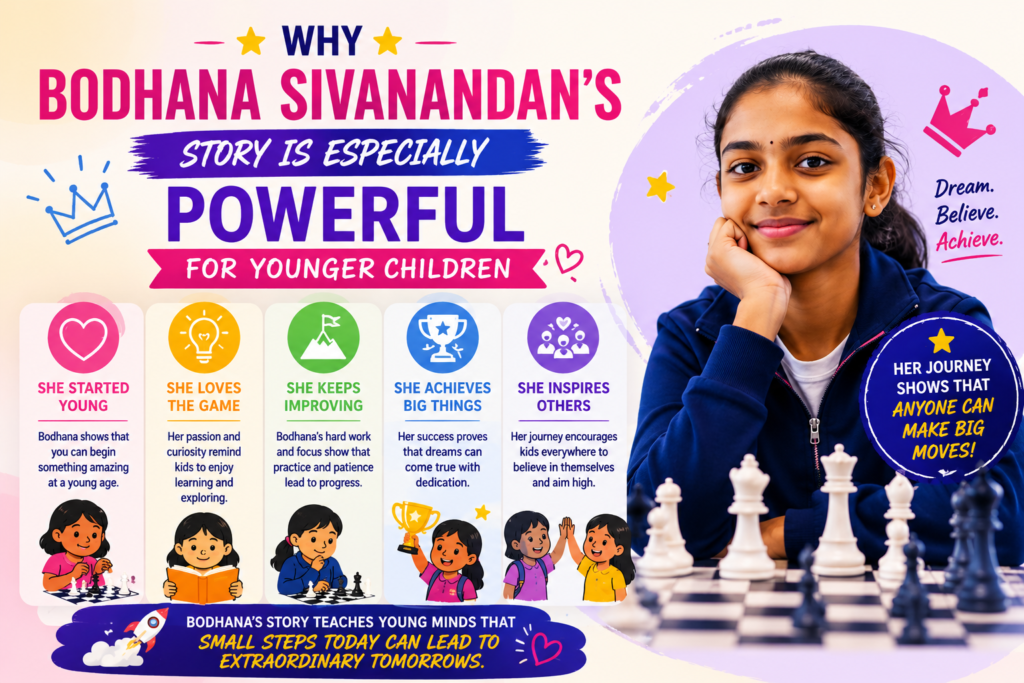
FIDE lists her as a FIDE Master and Woman International Master from England, born in 2015, with a May 2026 standard rating of 2374.
That number is stunning, but the bigger point is not the number. The bigger point is that she started young, kept learning, and faced hard events before most children her age would even feel ready. Reports in 2026 also noted that she became England’s top-rated female chess player at only 11 years old.
Her rise teaches children not to fear strong players
One reason children lose confidence is that they look at a rating, title, or age and decide the game before it begins. They think, “This player is too strong.” Once that thought takes over, the child stops looking for good moves. The body is at the board, but the mind has already given up.
Bodhana’s rise sends a better message. Respect the opponent, but play the board. The pieces do not care about age. A good move is a good move. A strong plan is a strong plan. When a child learns this, chess becomes less scary and much more fun.
Parents should protect joy while building skill
There is also a warning inside every prodigy story. Parents should not turn inspiration into pressure. Most children will not rise like Bodhana, and they do not need to. The goal is not to copy her speed. The goal is to copy the habits behind growth.
A child should enjoy chess, feel safe asking questions, and learn from mistakes without shame. That is how long-term love for the game stays alive. When training becomes only about rating, many children burn out. When training is clear, kind, and exciting, children keep coming back.
Debsie’s free trial class is a simple way for families to feel this balance. Your child can see how expert coaching works, and you can see whether structured live learning helps your child feel more focused and excited.
How to spot the next great junior girl before the ratings show it
The next great junior girl may not be at the top of a rating list yet. She may be a quiet child in a local club. She may be playing online after school. She may be losing to stronger players now, while slowly building the skills that will show later. This is why parents should not judge too early.
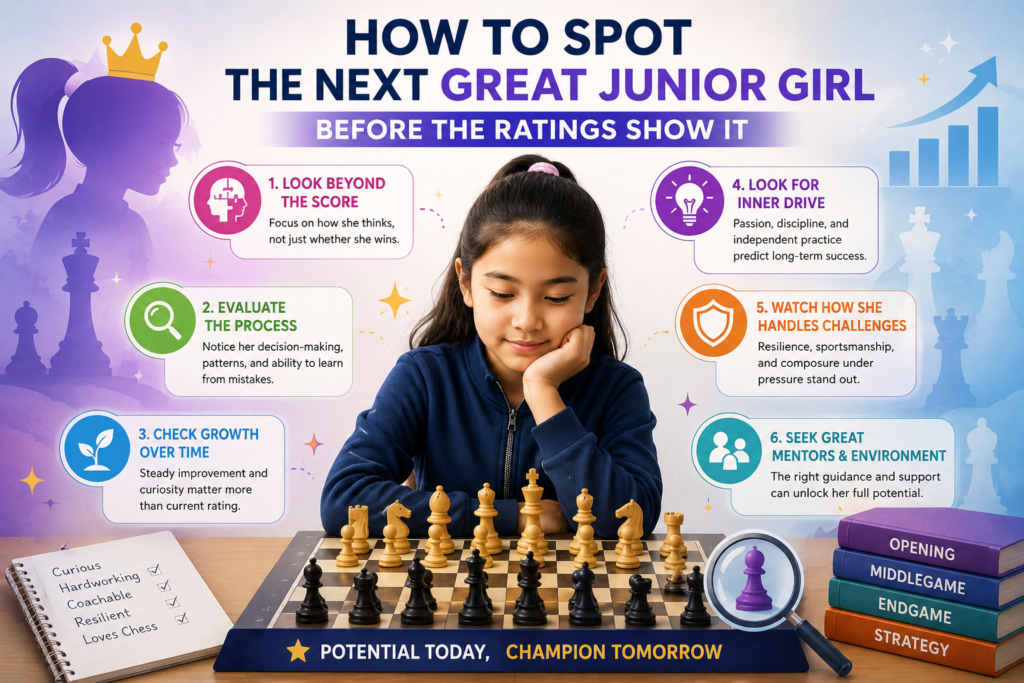
Ratings are helpful, but they are late signals. They tell us what has already happened. A child’s habits tell us what may happen next. A child who loves review, asks good questions, and keeps trying after losses may be much closer to a breakthrough than the rating says.
The real signs are found after the game
The best time to learn about a player is not only during the game. It is after the game. Watch what the child does when the result is known. Does she run away from the board after a loss, or does she want to see what happened? Does she blame luck, or does she look for the key mistake? Does she only enjoy winning, or does she enjoy solving?
These signs matter because chess growth needs honesty. A player who cannot face mistakes will keep repeating them. A player who can look at a mistake with calm eyes can improve quickly.
A simple home habit can change everything
After every serious game, ask your child to find one move she liked and one move she would change. Keep it gentle. Do not turn the review into a court case. The goal is not to prove the child wrong. The goal is to help the child become curious.
This one habit can change how your child sees learning. A loss becomes a lesson. A win becomes a chance to improve. Over time, the child stops fearing feedback. That is a huge life skill.
At Debsie, coaches guide children through this kind of thinking. They help students review without feeling small. That is important because children learn best when they feel safe, seen, and challenged in the right way.
What parents should copy from the training habits of top junior girls
Top junior girls do not grow by accident. Behind every strong young player, there is usually a mix of steady practice, good events, strong coaching, and family support. The exact path is different for each child, but the core idea is the same. Growth needs rhythm.
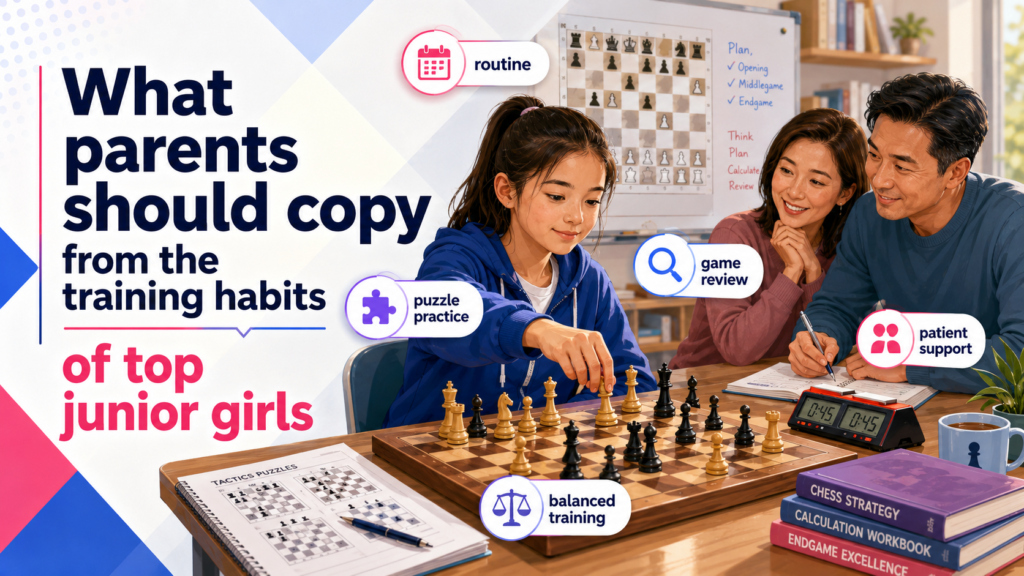
A child does not need six hours of chess a day to improve. In many homes, that would be too much. What matters more is that training is regular and clear. Thirty focused minutes can beat two tired hours. One well-reviewed game can teach more than ten games played too fast.
The best training plan feels simple enough to repeat
A good plan should not feel like a mountain. It should feel like a path. The child learns a new idea, practices it, plays games, reviews mistakes, and tries again. This loop is simple, but it works.
Parents should also avoid changing the plan every week. One week of openings, one week of random traps, one week of blitz, and one week of endgames can leave a child confused. It is better to build one area at a time.
If the child is losing pieces, work on board safety. If the child is missing checkmates, study attacking patterns. If the child is scared in endgames, practice simple king and pawn positions.
Debsie helps families turn chess into a clear path
This is where a structured academy can save parents a lot of guesswork. Debsie offers live interactive classes, private coaching, and bi-weekly online tournaments, so children can learn, test, and grow with support.
The child is not just watching videos alone. The child is speaking, thinking, playing, and getting feedback.
That kind of learning builds more than chess strength. It builds patience because the child learns to wait for the right move. It builds focus because the child must watch the whole board. It builds confidence because the child sees progress through effort.
The best junior girls in chess are exciting to watch because they show what is possible. But the deeper message is for every parent and every child. You do not need to be famous to grow through chess. You only need the right start, the right support, and the courage to keep learning.
How young players can study the best junior girls without feeling overwhelmed
Studying the best junior girls in chess can inspire a child, but it can also feel too hard if the study is not done in the right way. Many parents open a top player’s game, see long engine lines, and think their child is not ready. That is not true. A child does not need to understand every move to learn something useful.
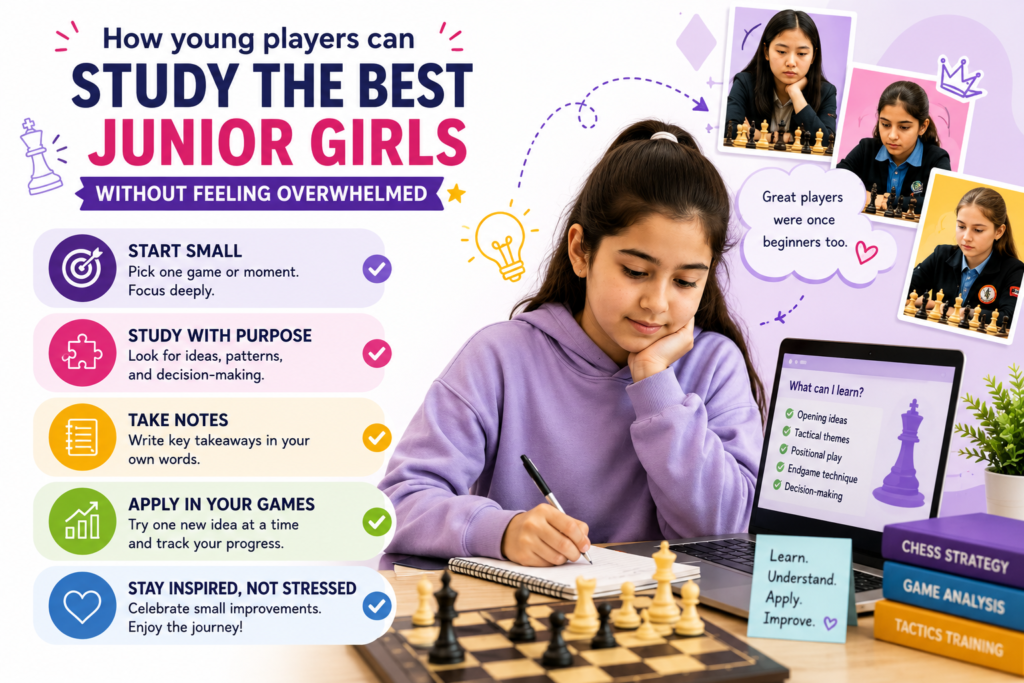
The better way is to look for one clear idea. Maybe the player moved all her pieces before attacking. Maybe she kept her king safe. Maybe she did not grab a pawn because it would waste time. Maybe she traded pieces when she was ahead.
These small lessons are easy to understand, and they help children build real chess sense.
One game can teach more than ten rushed games
A common mistake is trying to study too much at once. Parents may show a child five famous games in one sitting. The child may enjoy it, but very little stays in the mind. It is better to study one game slowly and ask simple questions.
A good question is, “Why did she move this piece?” Another good question is, “What was the threat?” These questions train the child to think like a player, not just watch like a fan. The child starts to see chess as a set of choices. That is where real learning begins.
The Debsie way to make game study simple
At Debsie, game study is not about showing off hard lines. It is about helping children understand why good moves are good. A coach can take one game from a rising junior girl and turn it into a clear lesson for the child’s level.
This matters because children learn best when they feel the idea is within reach. A beginner can learn from a top player if the lesson is simple enough. An intermediate player can go deeper and study plans, weak squares, and endgames. The key is not to copy every move. The key is to copy the thinking habit.
If your child wants to play better, start with one game, one idea, and one question. That small habit can grow into a powerful learning system.
What openings young players can learn from future champions
Openings are important, but they are not magic. Many young players think that if they learn a long opening line, they will start winning every game. That is not how chess works. The best junior girls in chess do not win only because they know moves by heart. They win because they understand the ideas behind the moves.
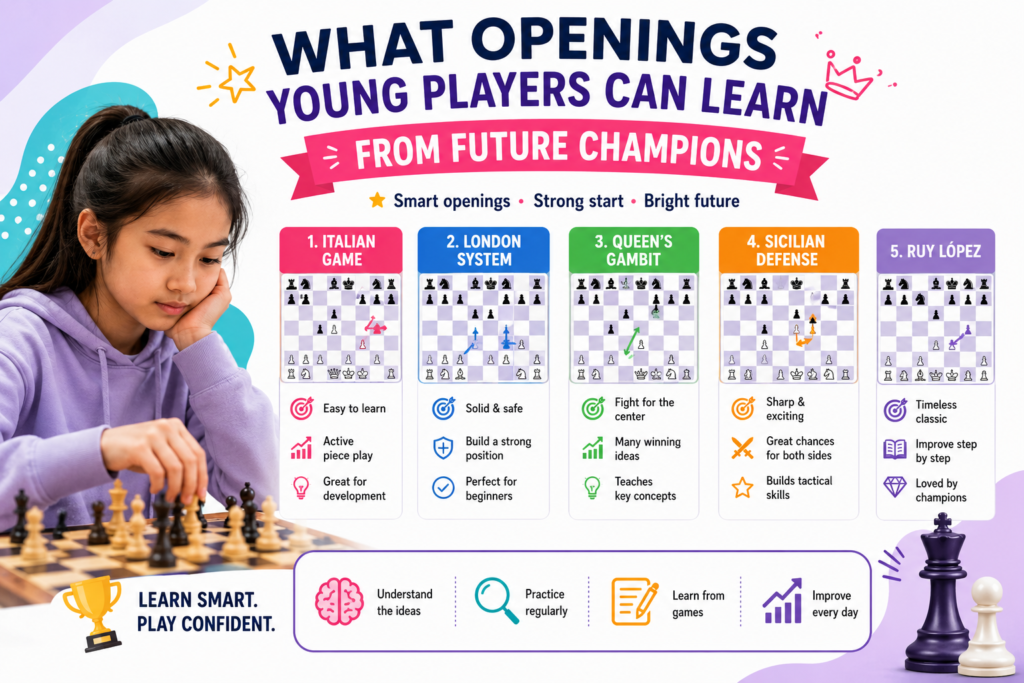
A good opening should help a child develop pieces, keep the king safe, fight for the center, and reach a position they understand. That is enough in the early years. Fancy traps may win a few quick games, but they do not build a strong chess mind.
The goal is to understand plans, not memorize moves
When children memorize without understanding, they become scared as soon as the opponent plays something different. They look at the board and think, “This is not what I learned.” Then they freeze or guess.
A better opening lesson sounds simple. Why does the knight go there? Why should the bishop come out before the queen? Why do we castle? Why should we not move the same piece again and again without a reason? These questions help a child stay calm when the game leaves the book.
Future champions are flexible. They know openings, but they also know how to think when the position changes. That is the skill parents should want for their children.
How Debsie helps children build opening confidence
Debsie coaches teach openings in a way that fits the child’s level. A young learner does not need to memorize twenty moves. They need to know where the pieces belong and what plans make sense. As the child grows stronger, the opening work can become deeper.
This protects the child from a common problem. Many kids spend too much time on openings and not enough time on tactics, endgames, and game review. A balanced student becomes much stronger because chess is not only the first ten moves. The whole game matters.
A free Debsie trial class can help parents see this style of learning. Your child can learn a real idea, ask questions, and feel how simple chess can become when a strong coach explains it clearly.
Why tournaments are so important for young chess girls
Classes are important. Practice is important. But tournaments teach things that lessons alone cannot teach. In a tournament, a child must sit down, manage nerves, use time well, and make choices without help. That is where chess growth becomes real.
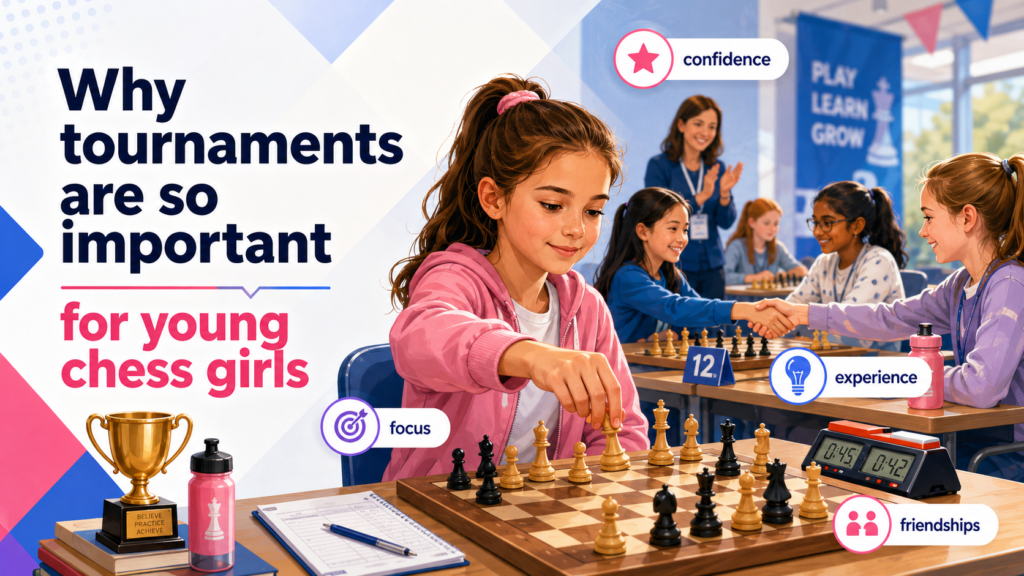
The best junior girls in chess became strong by playing serious games. They had to face pressure. They had to recover after losses. They had to keep going when the position was hard. This is why tournaments are not just for trophies. They are training grounds for the mind.
The real win is not always the medal
Parents sometimes feel sad when a child does not win a prize. The child may feel even worse. But a tournament can be useful even without a medal. If your child learned to slow down, that is progress. If your child saved a worse position, that is progress. If your child reviewed a painful loss, that is progress.
This mindset is very important because chess is a long journey. A child who only feels happy when she wins will struggle. A child who can find lessons in every event will keep growing.
Tournaments also teach children how to handle different styles. Some players attack. Some defend. Some move fast. Some play quiet chess. Facing many types of players helps a child become flexible and strong.
How Debsie makes tournament practice less scary
Debsie includes bi-weekly online tournaments, which gives students a safe and regular way to test their skills. This is helpful because children need practice in real game settings, but they also need support around that practice.
After a tournament, the best step is review. A coach can help the child find the key moment in a game. Maybe the child missed a tactic. Maybe she traded the wrong piece. Maybe she rushed in the endgame. Once the lesson is clear, the loss becomes useful.
This is how confidence grows. Not from always winning, but from knowing what to do next. That is a lesson every child can carry far beyond chess.
How parents can support a chess-loving daughter without adding pressure
A parent’s support can shape a child’s chess journey in a big way. The right support makes the child feel brave, curious, and proud. The wrong kind of pressure can make chess feel heavy. This matters even more for young girls because many of them already face doubts from the world around them.
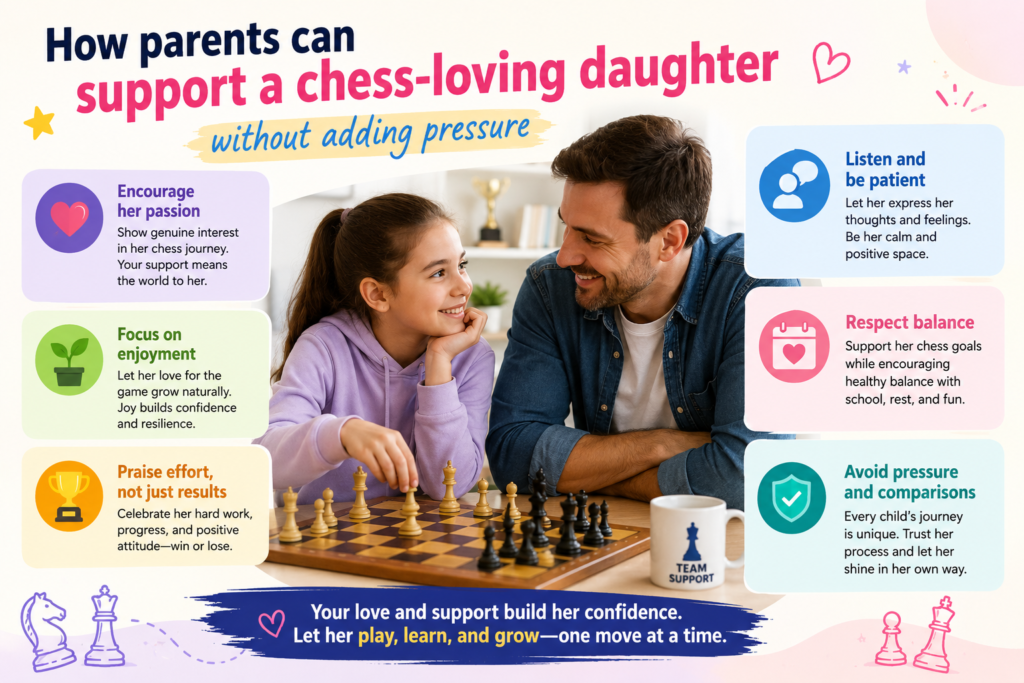
A chess-loving daughter needs to hear that her ideas matter. She needs space to try. She needs adults who believe in her without making every game feel like a test of her worth. When a child feels safe, she thinks better. When she thinks better, she plays better.
The words after a game matter more than parents think
After a game, children remember what parents say. A harsh comment can stay in the mind for a long time. A kind and wise comment can do the opposite. It can help the child feel steady, even after a loss.
Instead of asking, “Why did you lose?” a parent can ask, “What did you learn?” Instead of saying, “You should have won,” a parent can say, “I liked how you kept trying.” These words do not make the child weak. They make the child strong enough to keep learning.
The best junior girls are not strong because they never feel pressure. They are strong because they learn how to handle it. Parents can help build that strength at home.
The Debsie promise for families who want the right start
Debsie gives children a place where chess feels exciting, structured, and caring. Students learn from FIDE-certified coaches, join live interactive classes, get private coaching support, and play regular online tournaments. This helps children grow step by step, without feeling lost.
For parents, that means less guessing. For children, it means more confidence. Your child gets to learn in a global chess community with students from many countries, while building focus, patience, and smart thinking.
The future champions we are watching today started with one move, one lesson, and one person who believed in them. Your child can start the same way. A free Debsie chess trial class is a simple first step toward better chess and stronger life skills.
Conclusion
The best junior girls in chess are not just future champions. They are proof that young minds can do big things with the right support, brave practice, and a love for learning. Their stories teach children to think before moving, stay calm after mistakes, and keep growing even when the game feels hard.
For parents, the message is clear: chess can build focus, patience, confidence, and smart thinking for life. If your child is ready to learn in a kind, expert-led space, Debsie is a beautiful place to begin with a free chess trial class.

Adhip Ray is the founder of Debsie, an online learning platform focused on chess and skill-based learning for children. His work at Debsie brings together chess education, structured thinking, problem-solving, and interactive learning for young students.
Adhip has an academic background in law, statistics, analytics, and technology. He is from Amity Law School and the Indian Statistical Institute, Kolkata, with formal training that connects legal reasoning, data analytics, quantitative thinking, and structured problem-solving. This interdisciplinary background is reflected in Debsie’s focus on building sharper thinking skills in children through chess and related learning programs.
Adhip is also a FIDE-rated chess player from India. He holds FIDE ID 5055954 and has a standard FIDE rating of 1832. His FIDE profile records him as an Indian player with a long rating history in standard chess, including rated games from his competitive playing years. His chess background gives Debsie a founder-led connection to the game, not only as an educational activity but also as a competitive discipline that develops concentration, calculation, planning, and decision-making.
In addition to chess, Adhip has a strong interest in coding, data, and technical problem-solving.
Adhip’s profile combines chess, law, data analytics, and programming. At Debsie, this background supports the creation of learning experiences that are logical, structured, and skill-oriented. The platform’s chess-focused programs are connected to broader cognitive skills such as pattern recognition, patience, strategic planning, focus, and problem-solving.
As founder of Debsie, Adhip brings together experience from multiple fields: formal legal education from Amity Law School, analytical training from the Indian Statistical Institute, Kolkata, competitive chess experience through his FIDE-rated profile, and coding practice through LeetCode. This combination gives Debsie a distinct foundation in strategy, reasoning, analytics, and child-focused learning.
Through Debsie, Adhip is associated with building chess and learning content for children that goes beyond basic instruction. The platform connects chess with thinking skills, helping students approach challenges with more structure, clarity, and confidence. His own background in chess and analytical problem-solving gives the platform a direct link to the skills it aims to develop in young learners.
Adhip is also a member of Forbes Business Council.