YOUR NEXT DISCOVERY

NCERT Class 6 Science: Curiosity

Investigate living things, materials, motion, water and the sky.
Complete the Course to Earn a Certificate and Join the Hall of Fame
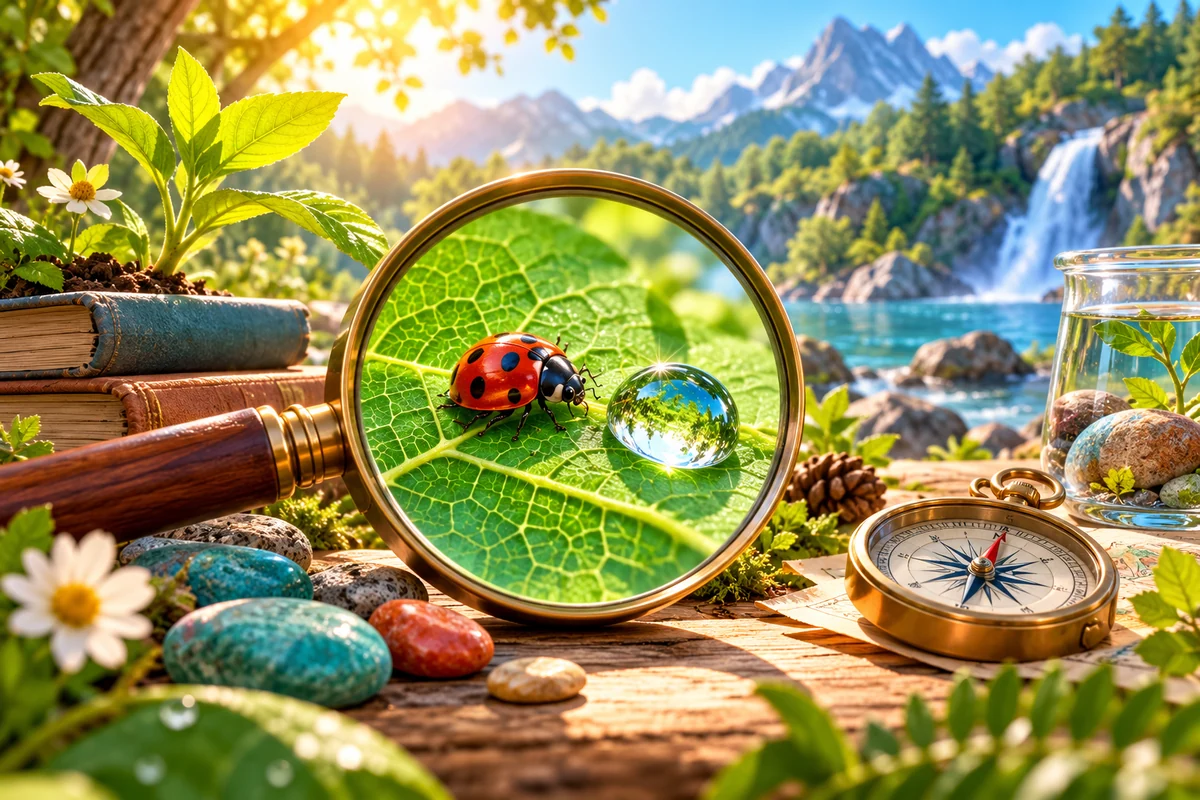
A magnifying glass reveals a ladybird on a leaf beside a bright river and compass.
One garden patch retains plants, flowers and shelter; a second has mostly bare paving. Habitat features differ. The drawing is not a measured count of the organisms living in either patch.

A CLOSER LOOK

Look closely at the living world

Use science to explain everyday observations, test ideas fairly and make thoughtful choices about the world around you.

See it. Try it. Make it yours.

  1. Look closely at the living world

  2. Food that helps us grow

  3. Magnets, measurement and movement

NCERT Class 6 Science, beginner · What to know before you start

Bring with you: Read everyday English, compare whole numbers and simple decimals, and add, subtract, multiply and divide. Recognise everyday plants, animals and objects. No previous secondary-school science is required.

Use science to explain everyday observations, test ideas fairly and make thoughtful choices about the world around you.

A complete English-medium course aligned with all twelve chapters of NCERT Curiosity, 2026–27. Online tasks check specific scientific reasoning; optional practical investigations and notebook work include review guidance and are not automatically certified.

By the end, you can…

  • Observe, compare and group living things using evidence.
  • Explain food choices using nutrients, variety and responsible consumption.
  • Predict magnetic interactions and measure and describe movement accurately.
  • Choose materials by their properties and read temperature measurements.
  • Explain changes of state and choose separation methods for everyday mixtures.
  • Explain life cycles and make evidence-based choices about natural resources.
  • Interpret the night sky and combine scientific ideas in a new investigation.

For another Course

  • The older sixteen-chapter NCERT Science edition and advanced secondary-school derivations.
  • Automatic grading of unseen experiments, unrestricted notebook writing or medical diagnoses.
  • Unsupervised chemical, hot-water or solar-viewing activities.

YOUR LEARNING PATH

One idea leads to the next.

0 of 47 Missions completed or proven
Unit 1

Look closely at the living world

Observe, compare and group living things using evidence.

  1. A question worth investigatingMission 1 of 47Locked. Tell an observation from an explanation. Plan a fair comparison.
  2. Many plants, useful groupsMission 2 of 47Locked. Use stems and branches to group herbs, shrubs and trees.
  3. Read the veins in a leafMission 3 of 47Locked. Recognise leaf veins and compare net-like and parallel patterns.
  4. Look below the groundMission 4 of 47Locked. Explain what roots do and compare taproots with fibrous roots.
  5. What is a seed leaf?Mission 5 of 47Locked. Find seed leaves inside a seed and explain the one- and two-seed-leaf groups.
  6. A body suited to a placeMission 6 of 47Locked. Explain how a feature helps a living thing in its habitat.
  7. Protect the variety around usMission 7 of 47Locked. Compare garden surveys fairly. Choose ways to protect habitats.
Unit 2

Food that helps us grow

Explain food choices using nutrients, variety and responsible consumption.

  1. Different plates, shared needsMission 8 of 47Locked. Tell ingredients from nutrients. Compare meals from different places.
  2. Food for energy, growth and repairMission 9 of 47Locked. Explain the roles of carbohydrates, fats and proteins.
  3. Small nutrients with important jobsMission 10 of 47Locked. Connect vitamins and minerals with their roles and explain a nutrient shortage.
  4. Why fibre and water matterMission 11 of 47Locked. Explain the jobs of fibre and water and choose useful food variety.
  5. Use evidence to test foodMission 12 of 47Locked. Read the results of starch, fat and protein tests.
  6. Build a varied plateMission 13 of 47Locked. Plan a varied meal and reduce food waste.
Unit 3

Magnets, measurement and movement

Predict magnetic interactions and measure and describe movement accurately.

  1. Which objects will a magnet attract?Mission 14 of 47Locked. Test which materials a magnet attracts.
  2. Two ends with different jobsMission 15 of 47Locked. Predict when magnet poles will pull together or push apart.
  3. Find a direction with a magnetMission 16 of 47Locked. Use a compass and spot what can disturb its reading.
  4. Make measurements agreeMission 17 of 47Locked. Choose and convert units of length.
  5. Read the ruler, not its edgeMission 18 of 47Locked. Read a ruler correctly, even when its zero end is damaged.
  6. Measure a winding pathMission 19 of 47Locked. Measure a curved path without stretching or skipping bends.
  7. Moving compared with what?Mission 20 of 47Locked. Describe movement using a reference point and the path followed.
Unit 4

Choose materials and measure temperature

Choose materials by their properties and read temperature measurements.

  1. One object, many possible materialsMission 21 of 47Locked. Tell an object from its materials. Choose materials for a job.
  2. Can you see through it?Mission 22 of 47Locked. Compare transparent, translucent and opaque materials.
  3. Where did the salt go?Mission 23 of 47Locked. Explain dissolving, solutions and the limits of solubility.
  4. Air belongs on the materials listMission 24 of 47Locked. Use mass and space to explain why air is matter.
  5. Can your hand tell the temperature?Mission 25 of 47Locked. Explain why touch alone cannot measure temperature.
  6. Read between the numbered marksMission 26 of 47Locked. Read a thermometer scale and place it correctly.
  7. Choose the right thermometerMission 27 of 47Locked. Choose a thermometer and compare temperature records.
Unit 5

Follow water and separate mixtures

Explain changes of state and choose separation methods for everyday mixtures.

  1. One substance, three statesMission 28 of 47Locked. Explain how water changes between solid, liquid and gas.
  2. Why does one cloth dry sooner?Mission 29 of 47Locked. Explain what makes water evaporate faster or slower.
  3. Where did the puddle go?Mission 30 of 47Locked. Follow water through evaporation, condensation and rain.
  4. Separate grain, husk and stonesMission 31 of 47Locked. Choose handpicking, threshing or winnowing for the correct job.
  5. Use holes or a magnetMission 32 of 47Locked. Choose suitable sieve holes and explain magnetic separation.
  6. Clearer water is not always pureMission 33 of 47Locked. Explain what settling, pouring and filtering can remove.
  7. Recover what you want to keepMission 34 of 47Locked. Plan how to recover sand, salt or water from a mixture.
Unit 6

Life and the resources it depends on

Explain life cycles and make evidence-based choices about natural resources.

  1. Is moving enough to be alive?Mission 35 of 47Locked. Use several signs to decide whether something is living.
  2. What does a seed need?Mission 36 of 47Locked. Use a fair test to find what seeds need to start growing.
  3. A plant changes through its lifeMission 37 of 47Locked. Order a plant's life stages and explain its growth.
  4. Same animal, changing formMission 38 of 47Locked. Compare mosquito and frog life cycles.
  5. Resources we share every dayMission 39 of 47Locked. Choose ways to save water and protect air and water quality.
  6. Life above and below the groundMission 40 of 47Locked. Explain how plants, water and soil depend on one another.
  7. Renewable does not mean unlimitedMission 41 of 47Locked. Compare how quickly a resource is used and replaced.
Unit 7

Beyond Earth and a science field mission

Interpret the night sky and combine scientific ideas in a new investigation.

  1. Find a pattern in the night skyMission 42 of 47Locked. Read a star pattern without assuming the stars are close together.
  2. Who travels around whom?Mission 43 of 47Locked. Explain reflected light, orbits, planets and satellites.
  3. Meet the eight planetsMission 44 of 47Locked. Order the eight planets and distinguish asteroids from comets.
  4. One planet in a much bigger universeMission 45 of 47Locked. Explain where Earth and the Solar System fit in the universe.
  5. Make a useful sky recordMission 46 of 47Locked. Make a safe sky observation that someone else can repeat.
  6. Your school field stationMission 47 of 47Locked. Use measurement, water, seed and resource evidence in a new investigation.Mastery Challenge

A Debsie Course · NCERT Class 6 Science, beginner